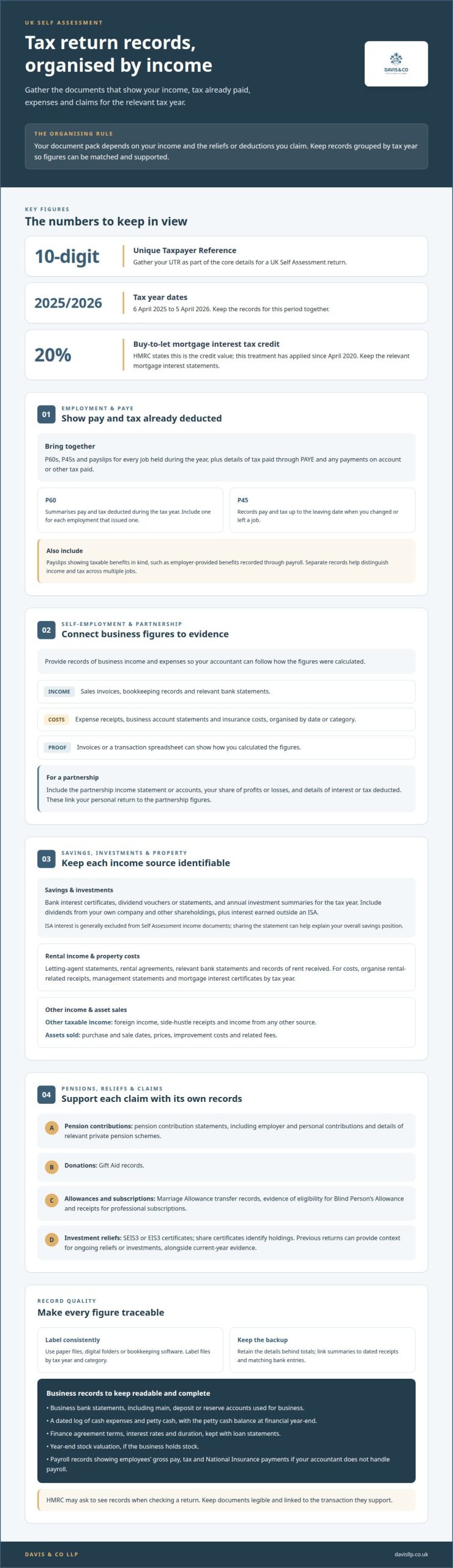
There isn’t one standard document pack: what documents your accountant needs for your tax return depends on your income and the reliefs or deductions you claim. For a UK Self Assessment return, gather your 10-digit Unique Taxpayer Reference, relevant PAYE records such as a P60 or P45, and evidence of income and expenses from sources such as self-employment, savings, investments or property.
It’s understandable to want a clear checklist, especially when records are spread across payslips, bank statements and online accounts. Your accountant needs an accurate picture of the tax year, including income, tax already paid and details that could affect your return.
This guide explains which documents to gather for employment, business, property and investment income, as well as pensions, donations and other claims. It also covers what to do if paperwork is missing, so you can prepare relevant records without collecting documents that do not apply to you.
Key Takeaways
- Match your paperwork to the relevant tax year, from employment records to evidence of tax already paid.
- Gather statements and supporting documents for investment income, rental property, pensions and any reliefs you claim.
- Keep records complete, readable and organised so income and outgoings can be followed and substantiated.
- Bring together sales invoices, purchase invoices and expense receipts to give your accountant a clear view of business activity.
Employment income documents
For employment income, provide your P60 or P45, payslips and details of tax already paid through PAYE. According to HM Revenue & Customs, the 2025/2026 tax year runs from 6th April 2025 to 5th April 2026. Keep documents for the relevant tax year together so income and deductions can be matched accurately.
What tax documents are needed for self-employed people and sole traders in the UK? Provide records of business income and expenses, such as sales invoices, expense receipts, relevant bank statements and bookkeeping records. Invoices or a transaction spreadsheet can show how you calculated the figures.
- Include a P60 for each employment that issued one. It summarises pay and tax deducted during the tax year, including for someone who was also self-employed.
- Include a P45 when you changed or left a job. It records pay and tax up to the leaving date and helps account for employment changes during the year.
- Provide PAYE documents for every job held during the year. Separate P60s, P45s or payslips help distinguish income and tax from multiple employments.
- Gather payslips showing taxable benefits in kind. Examples include employer-provided benefits recorded through payroll, which may affect the income reported on the return.
- Share details of payments on account and other tax paid. These records help distinguish tax already paid from the balance calculated for Self Assessment.
For a partnership, provide the partnership income statement or accounts, your share of profits or losses, and details of interest or tax deducted. These records link your personal return to the partnership figures, rather than treating business income as employment pay.
Keep evidence of business expenses alongside your income records. For example, organise receipts for eligible expenses, business account statements and insurance costs by date or category. If Gift Aid donations or personal pension contributions are relevant, provide supporting records separately so they can be considered alongside your employment and business income.
Investment income and supporting documents
For savings and investments, provide bank interest certificates, dividend vouchers and annual investment summaries for the tax year. Include dividends from your own company and other shareholdings, plus interest earned outside an ISA. ISA interest is generally excluded from Self Assessment income documents, but sharing the statement can help explain your overall savings position.
For pension, savings, dividend and investment income, give your accountant pension contribution statements, bank interest certificates, dividend statements and investment summaries. Include employer and personal pension contributions, along with details of relevant private pension schemes.
- Rental income: provide letting-agent statements, rental agreements, relevant bank statements and records of rent received.
- Property costs: organise receipts for rental-related expenditure, management statements and mortgage interest certificates by tax year.
- Other taxable income: disclose foreign income, side-hustle receipts and income from any other source.
- Asset disposals: provide purchase and sale dates, prices, improvement costs and related fees for assets sold.
For UK buy-to-let landlords, HM Revenue & Customs states that the mortgage interest tax credit is worth 20%, and this treatment has applied since April 2020. Provide mortgage interest statements for the relevant period; loan details and the interest rate can help explain the figures if a statement is unavailable.
To support claims for UK tax reliefs, allowances and charitable donations, provide Gift Aid records, pension contribution statements and evidence for each allowance. For example, include records of Marriage Allowance transfers, evidence of eligibility for Blind Person’s Allowance and receipts for professional subscriptions.
SEIS3 or EIS3 certificates support claims relating to those investments, while share certificates identify holdings. If a previous return included an ongoing relief or investment, provide it as context, alongside current-year evidence. Clear documents help distinguish income, eligible costs and claims rather than combining them in one unexplained total.
Where business and investment figures need to be considered together, management accounts support can help organise financial reporting alongside tax records.
Keeping accurate, complete and readable records
For a UK Self Assessment tax return, your accountant needs records supporting your income, expenses, tax paid and claims. HMRC may ask to see those records when checking a return, so keep each document legible and linked to the transaction it supports.
You can keep tax records in paper files, digital folders or bookkeeping software. Choose a consistent system, label files by tax year and category, and retain the details behind any totals. For example, a monthly expense summary should link back to dated receipts and matching bank entries.
- Keep business bank statements together. Include statements for the main account and any deposit or reserve accounts used for business activity.
- Record cash expenses and petty cash. Maintain a dated log and note the petty cash balance at the financial year-end.
- File new finance agreements. Keep the terms, interest rates and duration with loan statements, so repayments and interest can be understood separately.
- Provide a year-end stock valuation. If your business holds stock, give the accountant its value at the end of the financial year.
Keep a clear record of payroll, too. If your accountant does not handle payroll, provide a monthly pay-run printout or digital equivalent showing employees’ gross pay, tax and National Insurance payments. This helps reconcile payroll figures with business records.
Separate folders for each rental property make income and expenses easier to trace. Keep letting-agent statements, relevant bank statements and evidence of property costs together, rather than mixing them with general business spending.
Before sending your records, group them by period and clearly mark missing items in your own working papers. Businesses can give their accountant access to online bookkeeping records throughout the year, so transactions can be reviewed as they are entered. Accurate, complete and readable records support the figures in your return. HMRC may charge a penalty if records do not meet these standards.
What documents do I need for my tax return?
For a business tax return, gather sales invoices, purchase invoices and expense receipts for the relevant period. These documents show what the business earned and spent, and how you calculated the reported totals. Organise digital invoices and paper receipts by date or category.
Sales records should include every invoice raised, the amounts received and any unpaid balances. For digital invoices, provide access to the bookkeeping or invoicing software; for paper records, supply copies in a consistent sequence. Matching invoices to business bank statements can help explain differences between sales and cash received.
- Purchase invoices: include supplier invoices for goods, materials and services used by the business.
- Expense receipts: retain itemised evidence for costs such as travel, equipment or business supplies, with the transaction date and purpose clear.
- Business card statements: provide statements for business cards and personal cards occasionally used for work expenses.
- Loan records: include business loan statements or details of interest, plus new finance agreements showing their terms.
For rental property, organise letting-agent statements, property-related receipts and relevant bank records together. Mortgage statements can help distinguish mortgage interest from capital repayments. Include rental agreements and documents explaining unusual costs, such as repairs or management charges, so the property’s income and expenses can be reviewed in context.
Construction Industry Scheme workers should provide CIS statements or payslips showing earnings and tax deducted by contractors. Add receipts for eligible work expenses and related bank entries, keeping personal spending separate. This gives your accountant evidence of both income and costs, rather than just a net figure.
Before sending the file, arrange documents by period and label each category, such as sales, purchases, travel or property. Note where a receipt relates to an invoice or bank transaction. If you need help organising records for a property return, discuss your property tax records as part of preparing the supporting paperwork.
Davis & Co LLP
Davis & Co LLP’s Personal Tax Services can help you organise your tax records and understand how they fit together. This support can be useful when your income comes from several sources, such as employment, self-employment, investments or property.
For business owners, Davis & Co’s Business Growth Acceleration and Cash Flow Management offerings support wider financial planning alongside tax considerations. If overseas income or cross-border circumstances affect your tax position, International Tax Planning may also be relevant. The right support depends on your circumstances and the records involved.
To discuss preparing for your tax return, contact Davis & Co LLP and explain your situation and the documents you have gathered.
Make tax preparation part of your routine
Make tax preparation part of your regular financial organisation, rather than leaving it until filing time. Keep tax paperwork in a consistent place and note unusual transactions as they happen. That context can help explain decisions later and make discussions about your return more focused.
Reviewing what documents your accountant needs for your tax return can also help you identify changes in your circumstances, such as a new income source or a shift in business activity. Raise these changes early so the support and planning can reflect your situation. Davis & Co LLP works with individuals and businesses on tax and wider financial matters.
For a considered discussion about your next steps, arrange a conversation with Davis & Co LLP. A clear starting point can make the process more manageable, and you can move forward with greater confidence.
Davis & Co LLP can help with your tax return
Once you have gathered the documents your accountant needs, Davis & Co LLP can support you with Personal Tax Services, Trust Tax Services or International Tax Planning, depending on your circumstances.
If your return involves a business, property or payroll, Davis & Co LLP also provides Bookkeeping Services, Management Accounts, Property Accounting, VAT Compliance and information about payroll outsourcing pricing. Get in touch for support with the records and tax work relevant to your situation.
Frequently Asked Questions
What Information Should I Give my Accountant for Self Assessment?
Start with your 10-digit Unique Taxpayer Reference, National Insurance number and previous return, if available. Knowing what documents your accountant needs for your tax return also means explaining changes during the year, such as a second job, inheritance or overseas move. That context can reveal income or claims that need attention, even while you’re still gathering supporting paperwork.
What Happens If You Don’t Have the Right Documents?
If records are missing, try to obtain replacements, such as bank statements from your bank or duplicate invoices from suppliers. If you cannot recreate every figure, provisional figures can be confirmed later, while estimated figures cannot be confirmed. Explain their use in the return’s “Any other information” box. Incorrect figures may lead to interest or penalties if too little tax was paid.
What records does my accountant need?
Your accountant needs records that trace the figures on your return, including evidence of income, tax paid, expenses and claimed reliefs. A previous Self Assessment return can provide useful context, particularly if you have changed accountants or your circumstances carry over from an earlier year. Keep documents readable and organised by tax year, so each transaction can be traced from its source to the reported total.
What income records and payslips should I provide to my accountant in the UK?
Provide the PAYE documents for each employer you had during the tax year, especially if you changed jobs or held more than one role. A P60 summarises pay and tax for an employment, while a P45 records details when you leave a job. Payslips can help clarify individual pay periods or benefits shown through payroll when annual documents don’t explain a particular amount.
What expenses, receipts and mileage records can I claim on a UK tax return?
For expenses, keep itemised receipts and invoices showing the amount, date and business purpose, and separate them from personal purchases. For business travel, maintain a mileage log with journey dates, destinations, distances and reasons for travel. These details help your accountant assess costs in context. Don’t rely on a bank entry alone if it does not explain what the payment covered.
What documents are needed for rental income and property expenses on a UK tax return?
To understand what documents an accountant needs for a tax return covering rental income, keep a separate file for each property. Include the rental agreement, letting-agent or tenant statements, and bank records showing rent received. Add invoices and receipts for property-related costs, along with mortgage interest statements for the relevant period. Label each document with the property and period to distinguish records across multiple rentals.