What should you do if an accountant’s mistake may have affected your tax return, company accounts or an HMRC deadline? Knowing what to do if your accountant makes a mistake starts with checking what happened, rather than assuming the issue is harmless or that it amounts to negligence.
It’s understandable to be concerned about possible tax, reporting or penalty consequences, especially when a deadline is close. Using an accountant does not necessarily remove your responsibility for checking your tax affairs, so prompt, evidence-based action matters.
This guide explains how to compare the work with your records and instructions, identify urgent deadlines, and find out how to seek a correction. It also covers making a complaint, considering other options, and deciding whether to stay with your accountant or arrange a handover. The right response depends on the facts. First establish what needs correcting, then consider responsibility and the most proportionate way to resolve the issue.
Key Takeaways
- Preserve relevant records, identify the work that may be affected and contact your accountant in writing.
- Distinguish a confirmed factual error from a difference in professional judgement or an explanation that needs clarification.
- Find out what to do if your accountant makes a mistake by checking the affected filing, deadlines and possible consequences before seeking a correction.
- Raise a clear complaint and consider independent escalation options without assuming every error amounts to negligence.
- When deciding whether to stay or move, consider trust, communication and progress on the correction, and plan a careful handover if needed.
What to do first if your accountant makes a mistake
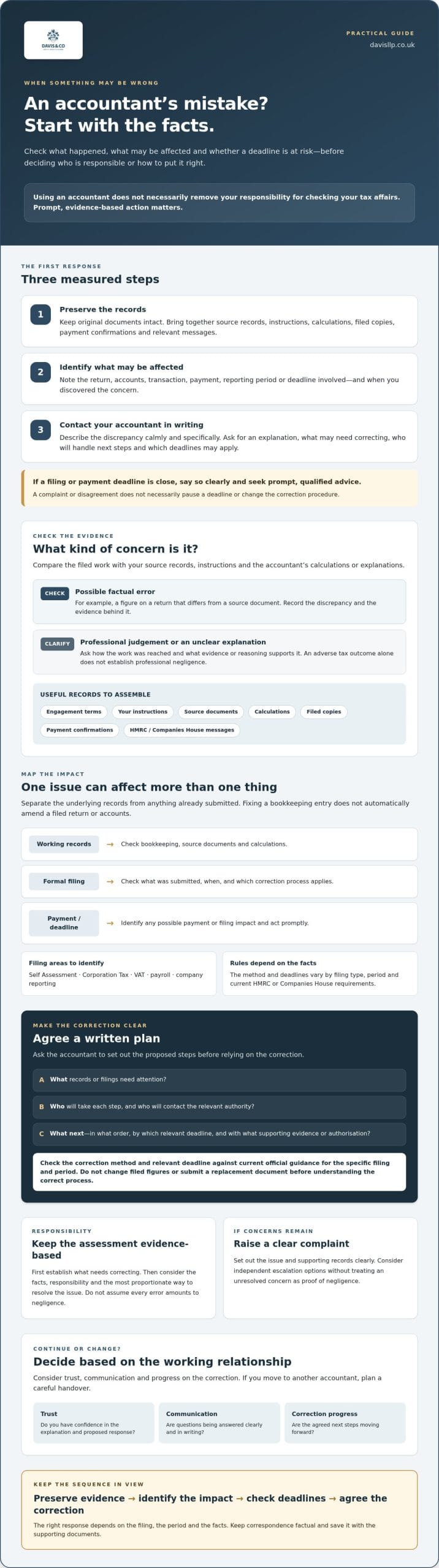
If you suspect an error, take three measured steps: preserve the relevant records, identify the work that may be affected and contact your accountant in writing. Don’t change filed figures or submit a replacement document until you understand the correct process. The next step depends on the type of return or filing, the period involved and the facts behind the concern.
First, establish whether you have found a clear factual error, such as a figure that differs from a source document, or whether the issue is a difference in professional judgement or an explanation that hasn’t addressed your concern. An adverse tax outcome alone doesn’t establish professional negligence. Focus initially on the evidence and any action needed to protect filing or payment deadlines.
How to confirm what may have gone wrong
Compare the submitted return or accounts with your source records, instructions to the accountant and any calculations or explanations they provided. For example, check whether an income figure matches the underlying records and whether relevant correspondence or supporting documents were included. Note when you discovered the concern, which documents are involved and any messages from HMRC or Companies House. Keep original records intact, and clearly label any assumptions or evidence you still need to find.
List what may be affected, such as a particular return, set of accounts, payment, reporting period or deadline. If you’re unsure what to do if your accountant makes a mistake, describe the discrepancy without deciding in advance who is at fault. A clear summary gives your accountant, or another appropriately qualified adviser, a better basis for assessing the issue and possible correction.
What to ask your accountant in writing
Write calmly and specifically. Identify the entry, calculation, filing or advice you’re querying, explain what your records appear to show, and ask for a plain-English explanation. Ask what may need correcting, who will handle the next steps and which filing or payment deadlines could apply. Request copies of relevant submitted documents and records if you don’t already have them.
Keep the correspondence factual and save replies with your supporting documents. If a filing or payment deadline is close, say so clearly and seek prompt, qualified advice about the position. Don’t wait for a complaint or disagreement to be resolved before checking what action may be needed. Raising the issue with your accountant doesn’t necessarily pause a deadline or change the procedure for correcting a submission. Check the applicable steps for the specific filing against current HMRC or Companies House requirements.
How to assess the impact and correct an accountant’s mistake
Once you have identified the work in question, assess what the error affects before deciding how to correct it. It may involve inaccurate bookkeeping or accounts, an incorrect return or other submission, a missed filing or payment deadline, or a financial or reporting impact. One issue can flow into another: an incorrect transaction in the records, for example, may also affect a tax return.
Separate the underlying records from anything already filed. Correcting a bookkeeping entry doesn’t automatically amend a submitted return, company account or other filing. The appropriate process depends on the filing type, tax year, facts and current HMRC or Companies House rules. Deadlines and penalties also vary, so don’t rely on a general timeframe or assume the same correction method applies to every submission.
What records and filings should you review?
Bring together the engagement terms, your instructions, source documents, the accountant’s calculations, filed copies and payment confirmations. Identify whether the concern relates to Self Assessment, Corporation Tax, VAT, payroll or company reporting, and note which period is affected. Where appropriate, check your HMRC or Companies House records to confirm what was submitted and when.
This review can help distinguish an error in the working records from an error in a formal submission. It can also show whether a payment or deadline may be affected. Keep the documents together so there is a clear record of what was filed and the evidence behind it.
How to agree a correction plan
Ask the accountant to set out the proposed correction in writing. The plan should identify which records or filings need attention, who will take each step, the order of those steps and what supporting evidence is needed. Confirm who will contact HMRC or another relevant authority, and whether you need to provide information or authorise an action.
Before relying on the proposal, check the correction method and relevant deadline against current official guidance for that filing and period. If the explanation is unclear, a deadline is close or you’re unsure whether the proposed route fits your circumstances, seek advice from a suitably qualified adviser. A careful review helps establish what to do if your accountant makes a mistake without creating further inconsistencies by changing records or resubmitting figures prematurely.
Once you have gathered the documents and have a clearer view of the issue, tailored accounting and tax advice may help you assess the position and appropriate next steps.
Who is responsible, and what remedy is proportionate?
You can’t determine responsibility simply from the fact that a return or set of accounts is wrong. It depends on the engagement terms, the information each party provided, the instructions given and the work the accountant agreed to perform. For example, a calculation may be wrong, but a review should also establish whether relevant information was supplied and how it was used.
Keep the immediate correction separate from deciding who is at fault. A mistake may need a technical correction without establishing negligence or an entitlement to compensation. A service concern may also warrant a formal response even if no financial loss has been identified. The appropriate route depends on the evidence, urgency and outcome you’re seeking.
Does an accountant’s mistake automatically mean negligence?
No. An error is something to investigate. A service complaint concerns the quality or handling of the work, while a potential negligence issue needs a more careful assessment. Engagement terms, instructions made at the time, source information and the work performed all matter. A disputed claim may also require evidence that the work caused financial loss. A brief account of events isn’t enough to determine liability, so seek qualified independent advice if you’re considering a claim.
If you’re weighing what to do if your accountant makes a mistake, match your response to the issue. Not every disagreement needs to become a legal dispute, and correcting an error may not resolve every concern.
Which resolution route fits the problem?
Consider what you need to achieve before choosing a route:
- Agreed correction: If the issue is clear and the accountant is engaging, focus first on correcting the work and confirming the next steps in writing.
- Fee discussion: If you dispute the charge or scope of work, raise that separately and explain why. Don’t assume a mistake automatically means a fee refund or compensation.
- Formal complaint: If communication stalls or you remain concerned about the service, follow the firm’s complaints procedure and set out the facts, evidence and outcome you’re seeking.
- Independent advice: If the potential loss or question of responsibility is complex, consider advice from an appropriately qualified professional before deciding whether to escalate.
Escalating to a professional body may be an option, but check the accountant’s membership, the body’s current procedures and whether it can consider your type of concern. A professional body’s process may have a different purpose from seeking compensation. For a disputed negligence claim, get appropriate independent advice about the evidence, potential loss and available options. No route guarantees a particular outcome. Preserve relevant records and keep correction work moving if deadlines are still in play.
How to make a formal complaint about an accountant
A formal complaint can address concerns about the standard of service, communication or handling of an error. It’s usually sensible to raise the issue with the accountant or firm first, then follow its complaints procedure if the response doesn’t resolve your concerns. If you’re considering independent escalation, check the relevant body’s current rules and whether it can consider your particular complaint.
Keep the purpose clear. A complaint to a professional body is not the same as correcting a tax return, securing compensation or obtaining legal representation. If a filing or payment issue remains unresolved, deal with it on its own timetable rather than assuming the complaint process will put it right. These separate routes are important when deciding what to do if your accountant makes a mistake.
What to include in a written complaint
Make your account of events clear, specific and supported by documents. Summarise the work you agreed, what you believe is wrong, when you identified the issue and what you have already done to raise it. Include relevant dates and attach copies of supporting records or correspondence, keeping originals for your own files.
Explain any known practical consequences, such as an approaching filing deadline, and state the outcome you’re seeking. You might ask for a clear explanation, a response to a particular concern or proposed next steps for addressing the work. Ask for a specific response or action, but distinguish confirmed facts from suspected loss or liability. A measured complaint is easier to assess than one that presents disputed points as established.
When to consider external advice or escalation
If the firm’s response doesn’t resolve the matter, check which professional body the accountant belongs to and review its current complaint procedures. Eligibility and the issues a body can consider may depend on membership and the nature of the complaint. Don’t assume a professional-body process will amend a filing, award compensation or determine every aspect of a dispute.
If a correction or deadline remains unresolved, independent tax advice may help you understand the filing position and next steps. For disputed legal rights or a potential claim, consider consulting a solicitor. These are distinct forms of support: an accountant can review the accounting or tax position, while legal advice should come from an appropriately qualified legal professional.
Once you have set out the facts, seek tailored accounting and tax advice to help clarify the technical position and any correction steps that may still be needed.
Should you change accountants, and how can you prevent repeat errors?
Changing accountants is a practical decision, not a remedy in itself. A new adviser may be able to review the accounting or tax position, but switching won’t automatically resolve an open filing, correction or complaint. Before deciding, consider whether you still trust the advice, whether communication is clear, whether agreed actions are progressing and whether the accountant has relevant experience for your needs.
Signs a new accountant may be worth considering
A single mistake that is acknowledged, explained and addressed is different from repeated errors or an ongoing breakdown in communication. Consider whether you receive clear answers, know who is responsible for upcoming deadlines and can see agreed actions documented. Also assess technical fit: your needs may involve personal tax, VAT or business reporting, so relevant experience matters.
Prevention starts with clear responsibilities and a reliable flow of information. Keep your own copies of records and submissions, provide complete information, and ask questions when a figure or explanation doesn’t make sense. Agree how key deadlines and outstanding actions will be communicated. These steps won’t eliminate every risk, but they can help you spot gaps earlier.
How to make a careful handover
If you decide to move, request copies of submitted returns, accounts, calculations, underlying records and relevant correspondence. Prepare a list of open matters, including corrections in progress, upcoming filing or payment deadlines, and communications with HMRC or Companies House. Confirm in writing who is handling each outstanding action during the transition. Appointing a new accountant doesn’t automatically transfer or complete every task.
Before choosing a replacement, compare their relevant experience, how they explain their service and how responsibilities will be agreed. A new accountant can review available records and outline the accounting or tax position, but the appropriate next steps depend on the facts. No adviser can guarantee a particular outcome.
Get considered advice on your next steps
If you’re unsure what to do if your accountant makes a mistake, organise the documents first and identify any unresolved deadline. Davis & Co LLP is an independent partnership of Chartered Certified Accountants, founded in 1901, offering services including personal tax, VAT compliance, bookkeeping and specialist tax advice. The firm may be able to provide tailored accounting or tax advice to help you understand your position. That review shouldn’t be treated as a guaranteed correction or resolution. Seek advice suited to your circumstances and the specific issue you need to address.
Take the next step with clarity
If you’re deciding what to do if your accountant makes a mistake, start with the evidence. Identify the work affected, check relevant deadlines and ask for a clear explanation in writing. The right correction depends on the filing and circumstances, so verify the applicable process before changing submitted figures. Keep correction work separate from questions of responsibility, complaint or compensation, since each may need a different response.
If the issue remains unclear, an independent review of your accounting or tax position may help you understand your options. Davis & Co LLP is an independent partnership of Chartered Certified Accountants, founded in 1901. Its services include personal tax, audit and assurance, VAT compliance and bookkeeping.
Discuss your accounting or tax position with Davis & Co LLP for tailored advice on the facts and possible next steps. With a clear record and considered guidance, you can move forward with greater confidence.
Frequently Asked Questions
Is my accountant responsible if they make a mistake?
Responsibility depends on the agreed engagement, the information supplied, the work performed and the nature of the error. A mistake alone doesn’t establish negligence or guarantee compensation. Ask for a written explanation and keep relevant instructions, records and submitted documents. Establish whether a correction is needed, then consider responsibility separately. If the accountant’s role, the cause of the error or any resulting loss is disputed, seek independent professional advice based on the full evidence.
What should I do if my accountant filed my tax return incorrectly?
Get a copy of the submitted return and compare it with your records and instructions. Ask the accountant to explain the discrepancy and set out a proposed correction in writing. The correct route depends on the return, tax year and current HMRC rules, so check official guidance rather than assuming you can simply submit a replacement. Act promptly if a payment, filing or response deadline may be affected, and keep copies of all correspondence.
Can I complain about my accountant to ACCA?
You may be able to complain through ACCA if the accountant is a member and your concern falls within its current procedures. First follow the firm’s complaints process and retain your complaint, the response and supporting documents. Check ACCA’s current guidance on eligibility and how to submit a complaint before proceeding. A professional-body complaint is distinct from correcting a tax return or seeking compensation, and it may not resolve either issue.
What happens if my accountant misses an HMRC deadline?
The consequences depend on the tax involved, what was due, the circumstances and current HMRC rules. Confirm whether the return or payment was submitted, what HMRC has communicated and whether another deadline applies. Ask your accountant for a written action plan, then check the relevant HMRC guidance promptly. Don’t assume a penalty can be removed or that a missed deadline has no consequences. Seek independent tax advice if the next step remains unclear.
Should I change accountants after a mistake?
Not necessarily. Consider whether the accountant has explained the issue, is progressing any correction, communicates clearly and has addressed similar concerns before. A single remediable error may call for a different response from repeated problems or a breakdown in trust. If you decide to move, request your records and clarify who is handling open filings, corrections and deadlines. A new accountant may review the position, but changing advisers doesn’t automatically resolve the outstanding matter.
Can I claim compensation if my accountant made an error?
Compensation isn’t automatic. Whether a claim may be available depends on the agreed service, the work performed, evidence of any breach, whether financial loss occurred and whether the breach caused that loss. Preserve engagement terms, advice, filed documents and correspondence. If the issue is significant or disputed, seek independent advice from an appropriately qualified professional. Ask a qualified legal adviser about any relevant deadlines. An accounting review alone can’t determine legal liability or guarantee an outcome.
Should I tell HMRC if my accountant made a mistake?
Whether you need to contact HMRC depends on what was filed, the tax involved and the correction required. Ask your accountant promptly who will contact HMRC and what action they propose, then check current HMRC guidance yourself, particularly if you’ve received a notice or a deadline is approaching. Keep copies of submissions and communications. If the correction route is unclear or no action is agreed, consider independent tax advice before proceeding.