An official notice of an HMRC compliance check isn’t the result of random chance. If you find yourself asking what triggers a vat inspection, the reality is almost always governed by automated data analytics rather than an outright suspicion of wrongdoing. We understand the acute anxiety this creates; the prospect of extensive document requests and punitive retrospective assessments can quickly disrupt ordinary commercial operations, leaving leadership teams uncertain of where they stand.
This guide provides clear, practical insight into the algorithmic discrepancies and operational anomalies that flag a business for examination, helping you safeguard your position with quiet confidence. You’ll discover the primary digital triggers HMRC prioritises in 2026, a structured pre-audit checklist to verify your records before an officer intervenes, and measured strategies to manage official communications effectively while mitigating statutory penalty exposure.
Key Takeaways
- Distinguish between routine educational assurance visits and data-led compliance audits driven by automated HMRC risk profiling.
- Identify what triggers a vat inspection across standard operations, particularly sudden repayment spikes, erratic return patterns, and submission delays.
- Recognise heightened sector risks, including cash-intensive trading models, complex partial exemption methods, and property tax elections.
- Prepare systematically for an enquiry through rigorous pre-audit reconciliations and structured communication that protects commercial continuity.
- Establish ongoing accounting governance and Making Tax Digital compliance frameworks to minimise exposure to retrospective assessments.
Understanding the HMRC VAT Inspection: Routine Assurance vs. Targeted Audits
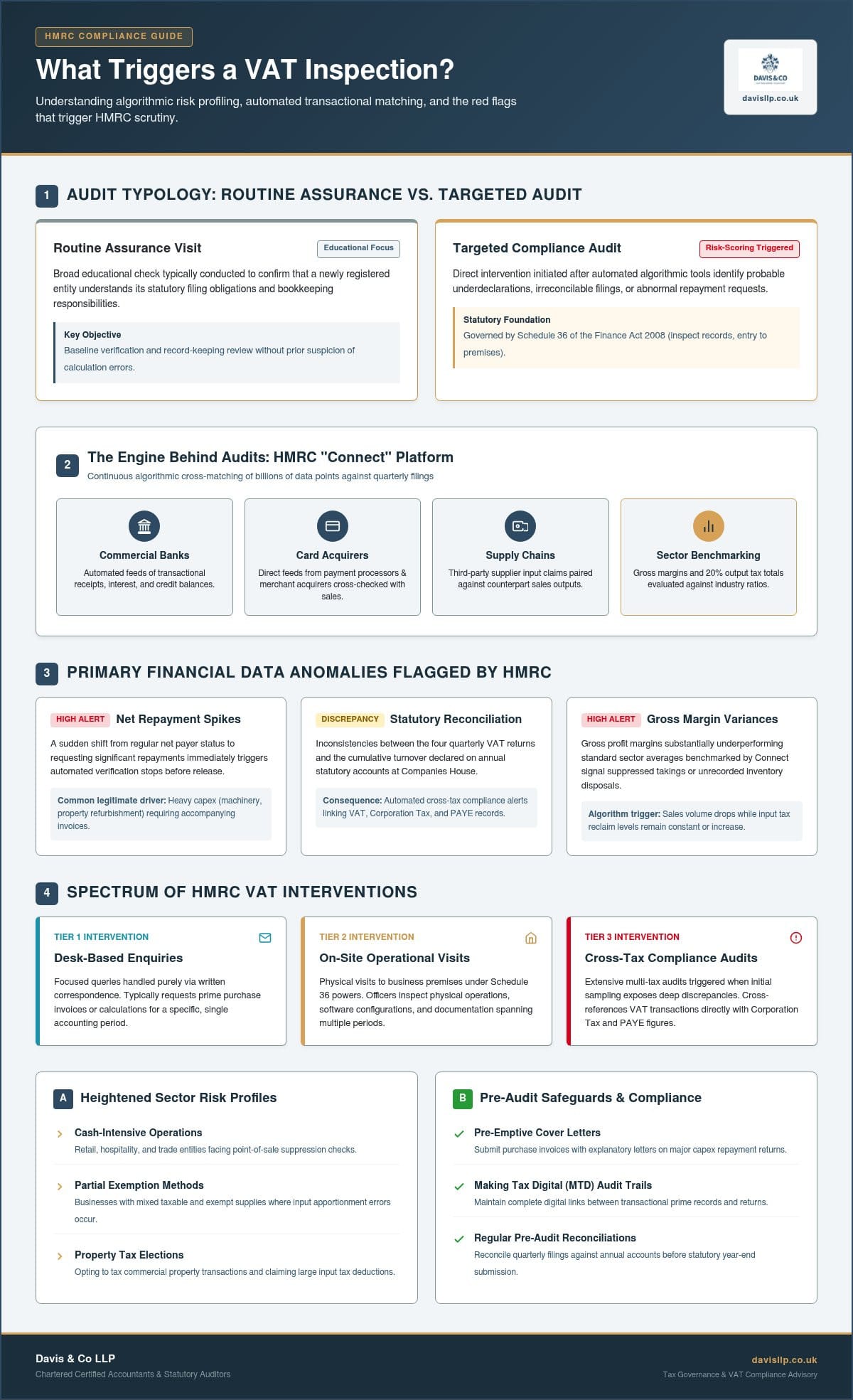
A VAT inspection is a formal examination where HMRC officers review your submitted returns directly against prime accounting records. This assessment evaluates whether input tax claims and output tax liabilities align with statutory legislation. To understand what triggers a vat inspection, you must distinguish between routine educational visits and data-led compliance audits.
Routine visits serve as broad assurance checks, often designed to verify that a newly registered entity understands its filing obligations. In contrast, targeted interventions occur when internal risk-scoring tools detect potential underdeclarations. Officers usually provide statutory written notice detailing the accounting periods under scrutiny, though Schedule 36 of the Finance Act 2008 grants them broad powers to request information and enter business premises at reasonable times.
The Spectrum of HMRC VAT Interventions
Interventions exist along a clear spectrum of intensity:
- Desk-based enquiries: Focused queries handled via correspondence, requesting invoices or reconciliations for a single return.
- On-site operational visits: Physical inspections of digital records, premises, and core trading processes spanning multiple periods.
- Cross-tax compliance audits: Joint reviews that cross-reference transactional VAT returns against corporation tax filings and PAYE records.
An innocent enquiry can swiftly escalate into an intensive multi-period audit if initial sample testing reveals fundamental calculation flaws or inadequate document retention.
How HMRC Connect Powers Data Matching
HMRC audits are no longer random selections drawn from a hat. The engine driving enforcement is HMRC Connect, a sophisticated analytical platform that automatically ingests billions of data points across the UK economy. It continuously scrapes and matches information from commercial banks, card merchant acquiring services, and third-party supply chain returns against your quarterly filings. Within the broader framework of Value-added tax (VAT) in the UK, this technical infrastructure flags deviations instantly.
Connect benchmarks your operational figures against average ratios within your specific industry classification. If your declared gross margins, sales volumes, or standard 20% output tax totals deviate sharply from sector peers, an alert triggers an internal human review. For organisations seeking to establish durable oversight and satisfy these automated parameters, our expert tax advice in the UK guide provides strategic direction on managing institutional compliance risks effectively.
Key Financial Data Anomalies That Trigger a VAT Inspection
Automated risk profiles react primarily to numerical deviations from established baseline filings. When assessing what triggers a vat inspection at the transactional tier, officers look for erratic shifts rather than steady growth. A single unprompted data anomaly can initiate an immediate compliance review before your quarterly repayment even clears.
Significant or Repeated Repayment Claims
HMRC scrutinises net-repayment returns where input tax exceeds output liabilities. If a business transitions abruptly from a net payer to demanding substantial repayments, verification flags activate automatically. Significant capital expenditure, such as heavy commercial machinery or commercial property refurbishments, legitimately creates this scenario. To avoid prolonged repayment freezes, leadership teams should submit supporting purchase invoices alongside an explanatory cover letter upon filing.
Turnover and Profit Margin Deviations
Data systems cross-match declared turnover against merchant acquirer card records and sector profitability norms. The algorithms evaluate:
- Gross profit variances: Reporting gross margins substantially below your industry standard suggests suppressed takings or unrecorded inventory disposals.
- Annual statutory reconciliations: Inconsistencies between four cumulative quarterly VAT returns and the turnover declared in statutory year-end accounts trigger rapid cross-tax reviews.
- Erratic sales trends: Turnover plummeting while input deductions remain constant signals trading irregularities.
Ensuring complete digital audit trails under Making Tax Digital requirements prevents these automated flags from escalating.
Administrative Non-Compliance and Habitual Errors
Administrative discipline directly influences your risk rating. Under the points-based penalty system, quarterly filers who miss deadlines accumulate penalty points; reaching four points incurs an immediate £200 fine, with further fines for each subsequent default. Habitual late submissions, persistent payment arrears subject to late-payment interest, or repeated return corrections indicate failing internal governance. The routine use of estimated figures without swift adjustments also attracts formal scrutiny.
Partnering with a seasoned small business accountant ensures these foundational reconciliation disciplines remain robust. If your enterprise requires seasoned oversight to preserve filing integrity, our specialists at Davis & Co LLP can audit your quarterly submissions to eliminate administrative friction before HMRC intervenes.
Operational and Industry Risk Factors Drawing Heightened Scrutiny
While financial returns provide numerical indicators, external operational environments heavily dictate inspection frequency. Knowing what triggers a vat inspection requires examining your trading model and sector risk classification. HMRC concentrates investigative resources on sectors prone to cash diversion, intricate supply chains, and complex statutory exemptions.
Cash-Intensive and High-Risk Sectors
Hospitality, retail, construction, and the motor trade face persistent institutional surveillance. Cash transactions naturally lack the automatic verification inherent in card payments, making them prime targets for scrutiny. Officers routinely deploy specialist analytical software to identify electronic sales suppression within point-of-sale systems. If till records reveal suspicious transaction deletions or abnormal voids, an audit follows swiftly. A supplier undergoing an audit can also expose your purchasing habits, triggering a secondary review of your input claims.
Partial Exemption and Complex Supply Chains
Organisations operating with mixed supplies encounter substantial technical pitfalls. If your entity delivers both taxable and exempt supplies, recovering input tax demands meticulous apportionment calculations:
- Partial exemption calculations: Miscalculating the standard method or omitting the required annual adjustment invites statutory penalties and retrospective adjustments.
- Commercial property transactions: Exercising an Option to Tax on commercial real estate requires strict adherence to notification rules, formal documentation, and precise timing.
- Cross-border commerce: Cross-border supply chains, reverse-charge obligations, and zero-rated export declarations face rigorous verification to confirm goods have legitimately exited the UK.
Structuring cross-border transactions correctly requires strategic governance. Aligning your trading operations with robust international tax planning frameworks prevents costly compliance failures and shields foreign revenues from unexpected domestic assessments.
Third-Party Referrals and Whistleblower Reports
Informational intelligence frequently prompts sudden compliance interventions. HMRC actively reviews submissions through dedicated fraud reporting channels, processing intelligence provided by disgruntled former personnel, commercial competitors, and disgruntled spouses. Information sharing between statutory bodies, including Companies House, the Insolvency Service, and the National Crime Agency, provides officers with multifaceted views of commercial affairs. When an external report matches minor return inconsistencies, an unannounced or accelerated visit often follows.
What to Expect When HMRC Contacts You: The Investigation Process
Receiving formal correspondence from HMRC marks the transition from algorithmic assessment to active human review. Understanding what triggers a vat inspection allows commercial leaders to anticipate the enquiry’s scope rather than reacting under duress. The investigative process adheres to a formal procedural sequence requiring measured, systematic handling from start to finish.
Initial Notification and Preparation of Records
Proceedings commence with an official notice specifying the accounting periods under examination and setting out the required documentation. HMRC typically provides at least seven days of advance notice before a planned visit. If this timeframe conflicts with critical commercial operations, a reasonable postponement request can be submitted. Use this preparation window to conduct a rigorous internal audit, assembling valid VAT invoices, credit notes, and digital transaction files. Identifying discrepancies privately before the compliance officer arrives allows you to calculate exposures and formulate transparent, unprompted explanations.
Conducting the Meeting Professionally
A professional, contained environment ensures the review remains within its agreed statutory boundaries:
- Single point of liaison: Designate one senior representative or appointed accountant to manage all communications, preventing conflicting statements from operational personnel.
- Digital or premise inspection: Where practical, request a digital desk review or conduct the meeting at your accountant’s offices to avoid disruptions on your commercial trading floor.
- Contemporaneous documentation: Keep verbatim written logs of every question asked, document inspected, and verbal explanation provided during the interview.
Resolving Findings, Assessments, and Penalties
Following the review, HMRC issues a formal decision letter detailing their conclusions. If errors are identified, the officer issues a notice of assessment for unpaid VAT alongside statutory interest, which accrues at the Bank of England base rate plus 4% (currently 7.75% as of January 2026). Penalties vary significantly depending on whether HMRC classifies the behaviour as non-deliberate (careless), deliberate, or deliberate and concealed. An unprompted voluntary disclosure made prior to discovery offers the most effective route to penalty mitigation. For deeper insights into safeguarding business affairs against revenue scrutiny, consult our HMRC tax warning guide.
If you disagree with an assessment, you retain the statutory right to request an independent internal review or lodge an appeal before the First-tier Tribunal (Tax Chamber). If you require experienced representation to navigate an active enquiry, contact Davis & Co LLP to secure your commercial position.
Mitigating Future VAT Scrutiny Through Strategic Accounting Governance
Achieving long-term commercial resilience demands treating indirect tax as a continuous governance priority rather than a recurring quarterly panic. When business leaders examine what triggers a vat inspection, the underlying cause is rarely an isolated incident; it’s almost always an accumulation of unchecked bookkeeping drift and fragmented ledger entries. Establishing rigorous internal oversight ensures your figures remain verifiable and resilient against automated review.
Establishing Rigorous Internal Financial Controls
Sound indirect tax administration begins on the transactional floor. Organisations protect their operations by instituting disciplined bookkeeping controls:
- Dual-authorisation protocols: Require secondary managerial sign-off on high-value supplier invoices to verify genuine VAT registration numbers and appropriate rate assignments.
- Automated monthly reconciliations: Match general ledgers with sales records every month, resolving discrepancies well before quarterly submission deadlines.
- Contemporaneous export verification: Collate shipping documentation, transport proofs, and customs records concurrently alongside zero-rated overseas transactions.
The Value of Proactive Health Checks
Periodic internal assurance reviews provide an indispensable line of defence. Running scheduled mock audits across sample transaction sets exposes calculation drift, particularly within fluctuating partial exemption apportionments or cross-border supply chains. If accidental oversights emerge, submitting an unprompted voluntary disclosure before HMRC flags the anomaly protects director reputation, preserves commercial credit profiles, and materially reduces potential penalty exposure.
Professional Representation and Ongoing Assurance
Managing indirect taxation with absolute composure requires proven technical expertise. Founded in 1901, Davis & Co LLP acts as a trusted strategic partner for UK enterprises nationally. Our chartered certified accountants serve as an authoritative buffer between your business and revenue authorities, overseeing robust VAT compliance, conducting thorough assurance reviews, and safeguarding your operational continuity. By embedding structured governance frameworks into your recurring operations, we eliminate compliance anxiety and secure your long-term fiscal stability.
Transforming VAT Compliance into Commercial Certainty
Understanding what triggers a vat inspection shifts your operational posture from apprehension to strategic control. HMRC’s automated risk algorithms and sector benchmarking mean that scrutiny is rarely arbitrary. By maintaining disciplined digital recordkeeping, resolving transactional discrepancies through regular reconciliations, and addressing complex liabilities proactively, your enterprise can trade with absolute clarity.
Founded in 1901, Davis & Co LLP brings over a century of distinguished practice to commercial accounting and indirect tax governance. Our Chartered Certified Accountants provide authoritative national tax compliance services, serving as a trusted strategic partner to safeguard your operational continuity across routine assurance visits and complex enquiries alike.
You don’t have to navigate revenue scrutiny in isolation. Secure expert representation and protect your business with Davis & Co LLP to ensure your reporting remains resilient, audit-ready, and entirely aligned with statutory standards.
Frequently Asked Questions
Can HMRC inspect my VAT records without giving prior notice?
Yes, HMRC possesses statutory powers under Schedule 36 of the Finance Act 2008 to visit business premises without advance notice. However, unannounced visits remain rare and typically occur only when officers suspect serious non-compliance or document destruction. In standard commercial cases, HMRC provides at least seven days written notification outlining the inspection’s scope, targeted periods, and records required.
How far back can HMRC go during a standard VAT inspection?
HMRC generally reviews records going back four years during a standard compliance check. If an officer establishes that an underdeclaration resulted from careless behaviour, the statutory assessment window extends to six years. Where HMRC proves deliberate tax evasion or intentional concealment, their investigative reach expands up to twenty years alongside substantial retrospective penalty assessments.
What is the difference between a routine VAT check and a formal tax investigation?
A routine VAT check is a factual assurance review designed to verify that submitted figures correspond accurately with prime records. In contrast, a formal tax investigation begins when risk algorithms detect suspected tax suppression or substantial irregularities. While routine assurance stays confined to specific VAT quarters, formal interventions often broaden into cross-tax investigations involving corporation tax, PAYE records, and directors’ personal finances.
Will making a large VAT repayment claim automatically trigger an inspection?
A substantial repayment claim does not guarantee an on-site visit, but it reliably initiates automated verification checks. When analyzing what triggers a vat inspection, repayment requests that diverge sharply from historical filing patterns alert automated filters immediately. HMRC routinely freezes repayment releases until your business provides supporting purchase invoices or formal explanations documenting major capital expenditure.
What penalties can HMRC impose if an error is discovered on a VAT return?
Penalties are calculated as a percentage of potential lost revenue based on taxpayer behaviour. Careless errors incur penalties between 0% and 30%, deliberate misstatements range between 20% and 70%, and deliberate concealed actions reach 100%. In addition, statutory late payment interest accrues daily from the original due date at 7.75% as of January 2026.
What should I do if I discover an error on a submitted VAT return before HMRC notices?
You should calculate and disclose the inaccuracy immediately using an unprompted voluntary disclosure. Net errors under £10,000, or up to 1% of quarterly turnover capped at £50,000, can generally be corrected on your subsequent return. Larger inaccuracies require formal notification via form VAT652. Submitting an unprompted disclosure substantially reduces or entirely eliminates statutory penalty exposure.
Can my appointed accountant represent me during an on-site HMRC inspection?
Yes, you have the statutory right to have your appointed accountant attend and lead discussions during an inspection. Understanding what triggers a vat inspection allows appointed chartered accountants to manage officer interactions with professional composure. At Davis & Co LLP, our specialists regularly manage inspections directly or host them at our offices, shielding leadership teams from operational disruption.