In 2024, more than 10,000 millionaires departed the United Kingdom, a 157% year-on-year increase driven by seismic shifts in our fiscal environment. This exodus reflects a growing concern among high-net-worth individuals regarding the total abolition of the remittance basis. As the UK transitions to a residence-based system, understanding the updated non-dom tax rules uk is no longer optional; it’s a prerequisite for effective wealth preservation. We recognise that these changes, particularly the potential exposure of offshore trusts to inheritance tax, represent a significant departure from the stability you’ve historically relied upon.
While the end of non-dom status marks a historic turning point, it doesn’t have to mean a loss of tax efficiency. This guide provides a strategic roadmap to help you navigate the four-year Foreign Income and Gains (FIG) relief window and the 12% Temporary Repatriation Facility available through 2027. We’ll examine the nuances of the ten-year residence requirement and detail how to restructure your global assets to protect your legacy. You’ll gain the clarity needed to transition from the old regime to a residence-based strategy with confidence and precision.
Key Takeaways
- Understand the fundamental shift from domicile to a residence-based system and how it redefines your UK tax reporting obligations.
- Learn how to utilise the four-year Foreign Income and Gains (FIG) relief window to bring offshore capital into the UK without incurring additional charges.
- Discover how the 12% Temporary Repatriation Facility provides a strategic, time-limited opportunity to manage mixed funds under the new non-dom tax rules uk.
- Identify the risks associated with the “10-year tail” for inheritance tax and why proactive planning is necessary before reaching the decade-long residency threshold.
- Secure the protected status of offshore trusts settled before April 2025 and ensure all annual claims are precisely managed to maintain long-term compliance.
The 2026 Landscape of UK Non-Dom Tax Reform
The 2026/27 tax year represents a landmark period for internationally mobile individuals. It’s the first full fiscal year where the centuries-old concept of domicile has been entirely stripped from the UK tax system for residents. For decades, the non-dom tax rules uk relied on a person’s “permanent home” or their intent to eventually leave the country. We’ve now moved to a strictly residence-based framework. This shift simplifies the entry requirements for new arrivals while simultaneously increasing the tax exposure for long-term residents who previously relied on the remittance basis.
For those who were “deemed domiciled” under the old system, the 2026 landscape is particularly stark. The transition to the arising basis is now complete, meaning worldwide income and gains are subject to UK tax as they occur. This change demands a more sophisticated approach to international tax planning, as the historical protections of offshore structures have been significantly altered.
The Shift from Domicile to Residence
The transition means your tax status is now defined by chronological presence rather than subjective intention. Under the new rules, the 10-year non-residence test is the primary gateway for tax efficiency. If you’ve been a non-UK resident for at least ten consecutive years, you can access a highly favourable initial window. The 2026 UK residence-based tax system replaces the domicile-based remittance basis with a simplified framework where tax liability is determined by the duration of UK residency rather than permanent intent or origin. This clarity removes the ambiguity of domicile disputes, but it requires rigorous tracking of your residency history to ensure you don’t inadvertently trigger a change in status.
Who Qualifies for the 4-Year FIG Regime?
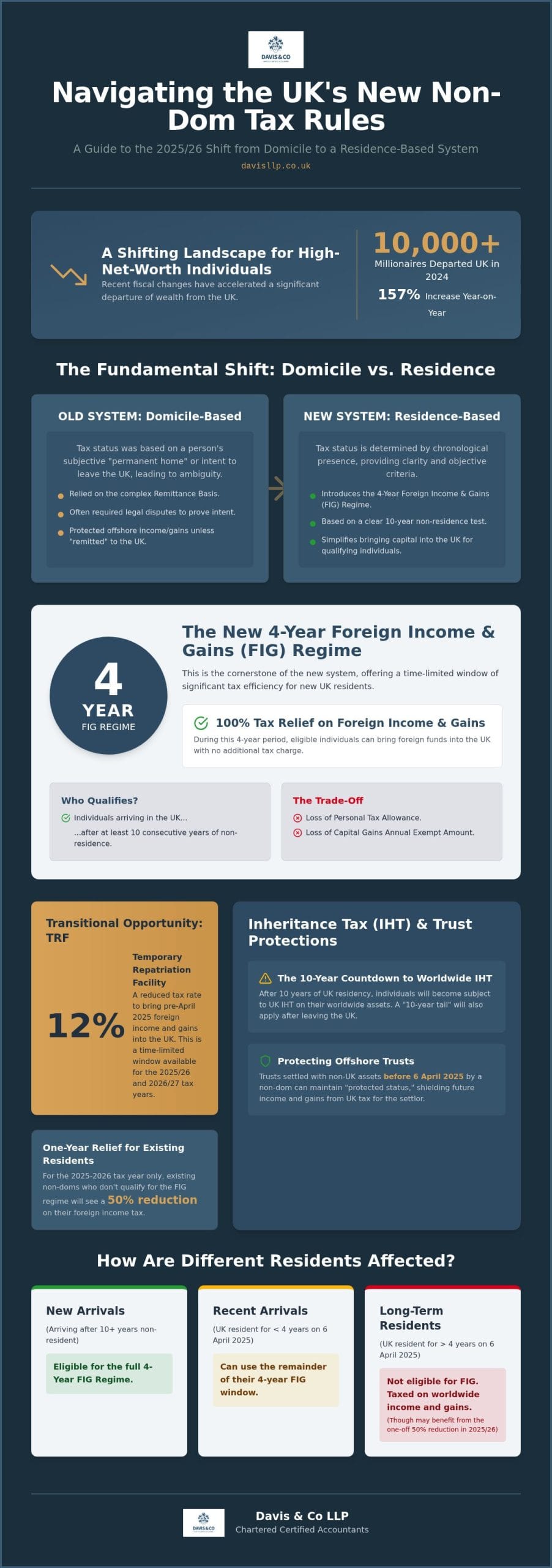
The Foreign Income and Gains (FIG) regime is the cornerstone of the 2026 landscape. To qualify, you must be in your first four years of UK tax residency after a decade of living abroad. During this period, you can claim 100% relief on foreign income and gains, allowing you to bring these funds into the UK without any tax charge. This is a significant improvement over the old remittance basis, which often made bringing capital into the UK a complex and costly exercise.
The transition for existing residents is handled with specific criteria:
- Recent Arrivals: If you had been a UK resident for less than four years on 6 April 2025, you can still access the FIG regime for the remainder of your first four years.
- Intermediate Residents: Those who have lived in the UK for more than four years but aren’t yet deemed domiciled don’t qualify for the FIG regime. They’ll generally pay tax on their worldwide income as it arises.
- Transitional Relief: For the 2025-2026 year, a 50% reduction on foreign income was available, but by the 2026/27 tax year, this specific transitional window has closed, making proactive structural planning essential.
Mechanics of the Foreign Income and Gains (FIG) Regime
The FIG regime serves as the functional engine of the updated non-dom tax rules uk, providing a streamlined alternative to the previous remittance basis. Unlike the old system, which required complex tracking of whether funds were “brought into” the UK, the FIG regime offers 100% relief on foreign income and gains for eligible individuals. However, this relief isn’t automatic. You must make an annual claim through your tax return for each year you wish the relief to apply. It’s also vital to recognise the trade-off: claiming FIG relief results in the loss of your personal allowance and the capital gains tax annual exempt amount for that fiscal year.
Understanding the mechanics of the new FIG regime is essential for anyone receiving significant offshore distributions while residing in Britain. While foreign income is protected, your UK-sourced income remains fully taxable at the standard rates. This distinction requires a clear separation of income streams to avoid administrative errors or inadvertent tax liabilities. The new system prioritises simplicity in remittance but demands absolute precision in the classification of your global revenue.
Qualifying for 100% Relief on Foreign Assets
The scope of FIG relief is broad, covering dividends, interest, and rental yields from non-UK properties. It also extends to capital gains from the disposal of offshore assets, provided the disposal occurs within the qualifying four-year window. This provides a period of relative simplicity for new arrivals. However, this simplicity rests on the foundation of meticulous record-keeping. You’ll need to maintain precise documentation for all multi-jurisdictional assets to satisfy HMRC’s reporting standards. If you manage a complex portfolio, our personal tax services can assist in ensuring your annual claims are robust and compliant.
The End of the Remittance Basis
The most significant operational shift is that “bringing money into the UK” no longer triggers a tax charge for those within the four-year FIG window. Under the previous regime, the concept of remittance created a tax trap that often discouraged the flow of capital into the UK economy. Now, funds earned abroad during the qualifying period can be spent or invested domestically with total freedom. This allows for more fluid cash flow management and lifestyle planning.
For those who don’t qualify for the four-year relief, the consequences are immediate. You’ll be taxed on the arising basis, meaning your worldwide wealth is exposed to UK taxation regardless of where it’s held. This makes the timing of fund repatriation a critical strategic consideration. If you’re approaching the end of your qualifying period, accelerating the remittance of foreign capital may prevent future tax liabilities. The new system rewards foresight over reactive management.
The Temporary Repatriation Facility (TRF) and Rebasing
The transition to the new non-dom tax rules uk includes specific mechanisms designed to settle historic liabilities with minimal friction. Chief among these is the Temporary Repatriation Facility (TRF), which offers a significant incentive for individuals with accumulated foreign income and gains. For the 2026/27 tax year, the TRF remains a critical strategic tool, allowing you to remit pre-April 2025 wealth at a reduced rate of 12%. This provides a definitive window to “cleanse” mixed funds that were previously trapped offshore due to the prohibitive costs of the remittance basis.
We view the TRF not merely as a tax reduction but as a liquidity event. By paying the 12% charge in 2026, you convert complex, offshore-restricted capital into flexible UK funds. This capital can then be deployed for domestic investments or personal expenditure without further income tax or capital gains tax consequences on the principal. It’s a rare opportunity to simplify your global financial structure while significantly reducing the potential tax burden on historic earnings.
Optimising the Temporary Repatriation Facility
The 2026/27 tax year represents the final period to benefit from this 12% rate before the facility expires. Strategic selection is paramount. It’s often more efficient to prioritise the repatriation of accounts with high proportions of income over those consisting largely of capital, as the relative tax saving is greater. We assist clients in auditing their offshore structures to identify which pools of capital are most suited for TRF treatment, ensuring that the necessary claims are filed correctly within the statutory deadlines.
Asset Rebasing and Capital Gains Management
For those who previously utilised the remittance basis and were not yet deemed domiciled by April 2025, the 5 April 2019 rebasing rule offers a powerful shield. This provision allows you to elect to treat the value of personally held foreign assets as of April 2019 as their base cost for UK tax purposes. By electing to rebase personally held foreign assets to their 5 April 2019 values, taxpayers can effectively shield millions in historic capital growth from UK taxation upon eventual disposal.
Calculating this uplift requires professional valuation and precise documentation. It’s essential to act before a disposal occurs to ensure the rebasing election is valid. This mechanism is particularly beneficial for long-held assets like international real estate or private equity holdings that have seen substantial appreciation. Proper application of the updated non-dom tax rules uk ensures that only growth occurring after the rebasing date is subject to the current UK capital gains regime.
Inheritance Tax (IHT) and Offshore Trust Protections
The transition from a domicile-based system to a residence-based framework represents perhaps the most significant risk to long-term estate planning. Under the updated non-dom tax rules uk, the criteria for worldwide inheritance tax exposure have shifted from your “permanent home” to a simple count of years spent in the country. This change creates a new fiscal reality for families who have established roots in the UK while maintaining substantial assets abroad. We find that many clients are unaware of how quickly the decade-long residency threshold can transform their global tax profile.
The 2025 reforms haven’t just changed the rules for current residents; they’ve fundamentally altered the consequences of leaving. This shift demands a move away from reactive accounting toward a more integrated, strategic partnership. We focus on providing a calm, reassuring authority during this period of adjustment, ensuring that your global wealth is managed with the discretion it requires.
The 10-Year Residence Rule for Global IHT
Once you’ve been a UK tax resident for 10 years, your entire global estate falls within the scope of UK inheritance tax. This exposure isn’t easily shed. The “10-year tail” provision ensures that even after you cease to be a UK resident, your worldwide assets may remain subject to the 40% IHT rate for up to a decade. This creates a twenty-year window of potential liability that requires sophisticated management. For individuals approaching their eighth or ninth year of residency, the need for a comprehensive exit or restructuring strategy is urgent. We prioritise highly individualised solutions that account for both your current residency and your long-term mobility goals.
The Future of Excluded Property Trusts
Despite the broad reforms, specific protections remain for offshore structures established under the previous regime. Trusts settled by a non-UK domiciled individual with non-UK assets before 6 April 2025 generally retain their “excluded property” status. This means these assets should remain outside the scope of UK inheritance tax, provided they continue to meet strict compliance requirements. Maintaining this status is a delicate matter of ongoing governance and precise reporting. Our International Tax Planning services focus on preserving these legacy protections within the 2026 landscape.
Effective trust management now involves more than just oversight; it requires a proactive defence of the trust’s original tax-exempt status. As the non-dom tax rules uk continue to evolve, the distinction between organisational compliance and individual tax exposure becomes even more critical. If you’re concerned about the impact of the residence-based system on your family’s future, our trust tax services can provide the discreet, expert guidance necessary to secure your offshore interests.
Navigating the New Tax Reality with Davis & Co LLP
The transition to a residence-based fiscal environment requires more than just technical awareness; it demands a historical perspective and a nuanced understanding of cross-border complexities. Generic advice often fails to account for the highly individualised nature of international wealth, particularly as the non-dom tax rules uk undergo their most significant transformation in centuries. At Davis & Co LLP, we’ve guided high-net-worth families through evolving tax landscapes since 1901. This longevity provides us with a calm, reassuring authority that is essential when managing sensitive commercial and personal matters during times of systemic change.
Our approach is built on the principle of composed partnership. We don’t view tax compliance as an isolated task but as an integrated component of your broader financial strategy. By combining our specialised trust tax services with property accounting and personal tax planning, we ensure that every facet of your global profile is aligned with the new residence-based requirements. This holistic oversight is what distinguishes a strategic partner from a mere service provider.
Bespoke Advisory for International Clients
For those transitioning out of non-dom status, the path forward involves more than just selecting a new tax regime. It requires a meticulous review of how Double Taxation Agreements (DTAs) interact with the UK’s new residence-based system. We provide Expert Tax Advice in the UK that is specifically tailored to your unique jurisdictional footprint. Whether you’re managing offshore investment portfolios or complex corporate structures, we ensure that your transition into the FIG regime or the arising basis is handled with the precision and discretion you expect from a firm with over a century of expertise.
Securing Your Global Wealth
The post-non-dom era rewards those who adopt a multi-year outlook. The 10-year residence threshold for inheritance tax and the four-year window for FIG relief are not merely dates on a calendar; they’re strategic milestones that dictate the long-term security of your estate. We believe that the first step toward stability in this volatile environment is a comprehensive review of your current UK tax position. We’ll work alongside you to audit your global assets, assess your exposure to the “10-year tail,” and implement a structure that protects your legacy. We invite you to experience the quiet excellence of a partnership that values reliability and intellectual rigour above all else. Together, we can secure your wealth within the new non-dom tax rules uk and ensure your financial interests remain robust for the next generation.
Securing Your Fiscal Future in a Residence-Based System
The transition from a domicile-based framework to a residency-based system represents a fundamental shift in how you must manage your global assets. By mastering the updated non-dom tax rules uk, you can effectively leverage the four-year FIG window and the 12% Temporary Repatriation Facility to protect your wealth. These strategic opportunities are time-limited, and the introduction of the 10-year inheritance tax tail makes early intervention vital for long-term security. It’s no longer enough to react to changes; you must anticipate them with a multi-year outlook.
Davis & Co LLP has served as a strategic partner for high-net-worth individuals since 1901. As Chartered Certified Accountants specialising in international tax planning and trust advisory, we provide the discreet, expert guidance needed to navigate these complex reforms. Our focus remains on delivering highly individualised solutions that respect the sensitivity of your personal and commercial affairs. We invite you to arrange a confidential consultation regarding your international tax position to ensure your strategy remains robust. With the right professional oversight, you can face the 2026 landscape with composure and absolute confidence.
Frequently Asked Questions
What has replaced the UK non-dom tax status in 2026?
The remittance basis was abolished on 6 April 2025 and replaced by a residence-based system. This new framework centres on the Foreign Income and Gains (FIG) regime for qualifying new arrivals. It simplifies the tax landscape by removing the concept of domicile and focusing on a person’s chronological residency history. This shift ensures that tax status is determined by time spent in the country rather than subjective intent.
How long does the Foreign Income and Gains (FIG) relief last?
The FIG relief window lasts for exactly four tax years. This period begins when an individual first becomes a UK tax resident after a period of at least ten consecutive tax years of non-residence. During these four years, you can bring foreign income and gains into the UK without incurring a tax charge, provided you make an annual claim on your tax return for each applicable year.
Do I still need to pay the £30,000 or £60,000 remittance basis charge?
No, the remittance basis charge has been abolished along with the remittance basis itself. From the 2025/26 tax year onwards, the annual charges of £30,000 or £60,000 no longer apply. Instead, individuals who don’t qualify for the four-year FIG relief will be taxed on the arising basis. This means their worldwide income is subject to UK tax regardless of whether it’s brought into the country.
What is the Temporary Repatriation Facility (TRF) for 2026?
The TRF is a transitional incentive that allows for the repatriation of pre-April 2025 foreign income and gains at a reduced tax rate. For the 2026/27 tax year, this rate is set at 12%. It’s designed to encourage individuals to bring “mixed funds” into the UK that were previously trapped offshore under the old non-dom tax rules uk. This facility is scheduled to expire after the current tax year.
How does the 10-year residence rule affect my inheritance tax?
Once you’ve been a UK resident for 10 tax years, your worldwide assets fall within the scope of UK inheritance tax. This represents a significant shift from the previous domicile-based system. Additionally, a ten-year “tail” provision means that your global estate may remain subject to UK inheritance tax for up to a decade after you leave the country, requiring a long-term approach to estate planning and wealth preservation.
Can I still use an offshore trust to protect my assets from UK tax?
Offshore trusts settled before 6 April 2025 generally retain their “excluded property” status for inheritance tax purposes. This means non-UK assets held within these legacy structures should remain outside the UK tax net. However, the 2025 reforms have removed many protections for trusts established after this date. Ongoing compliance and precise management are essential to ensure these older structures continue to meet the strict requirements for excluded property status.
What happens to my foreign income after the 4-year FIG period ends?
After the initial four-year relief window expires, you’ll be taxed on your worldwide income and gains as they arise. This means you’ll pay UK tax on all foreign revenue regardless of where it’s held or whether you remit it to the UK. It’s critical to review your investment structures before this transition occurs to ensure you’re utilising all available reliefs and double taxation treaties to manage your increased tax exposure.
How do the new rules affect expats moving to the UK in 2026?
Expats arriving in 2026 benefit from a simplified entry process under the non-dom tax rules uk. If you’ve been non-resident for ten years, you’ll qualify for the four-year FIG regime. This allows you to bring foreign capital into the UK tax-free to support your relocation. However, you must plan for the transition to the arising basis and worldwide inheritance tax exposure well before your residency reaches the ten-year mark.