Receiving a notification regarding an hmrc compliance check often triggers an immediate sense of professional anxiety, particularly as the UK tax landscape undergoes its most significant digital transformation in a generation. With the rollout of Making Tax Digital for Income Tax Self Assessment in April 2026, many sole traders and landlords earning over £50,000 now face a more rigorous reporting environment. It’s understandable that you might feel uncertain when a formal letter or digital nudge arrives, especially when sophisticated scammers are increasingly mimicking official correspondence to exploit this period of transition.
We recognize that your primary concern is maintaining the integrity of your financial affairs while avoiding the steep penalties associated with the new points-based system. This guide provides the clarity you need to verify the legitimacy of any warning, understand the specific 2026 compliance priorities regarding savings and side hustles, and respond with the strategic confidence of a well-advised professional. We’ll outline a clear roadmap for your response, ensuring you can mitigate risk and satisfy HMRC’s requirements without unnecessary disruption to your commercial or personal operations.
Key Takeaways
- Identify the distinct markers of fraudulent activity to protect your identity from sophisticated 2026 tax scams that mimic official HMRC correspondence.
- Understand the primary triggers for an hmrc compliance check, particularly regarding automated data sharing from banks and digital platforms.
- Learn to differentiate between a standard nudge letter and a formal enquiry to ensure your response is proportional and strategically sound.
- Establish a clear roadmap for collating financial records and verifying the authenticity of any warning before committing to a course of action.
- Discover how professional partnership can reduce the administrative burden of tax scrutiny while ensuring full compliance with the latest 2026 regulations.
Distinguishing Fraudulent Scams from Legitimate HMRC Correspondence
The sophistication of financial crime in 2026 has reached a level where even seasoned professionals can feel a moment of hesitation. When you receive a message regarding an hmrc compliance check, your first priority is verification. HM Revenue and Customs (HMRC) maintains strict protocols for communication, yet scammers frequently exploit the public’s desire to remain compliant. Modern fraudulent campaigns often use generative AI to create highly convincing replicas of official documents, making it harder to spot a fake at a glance.
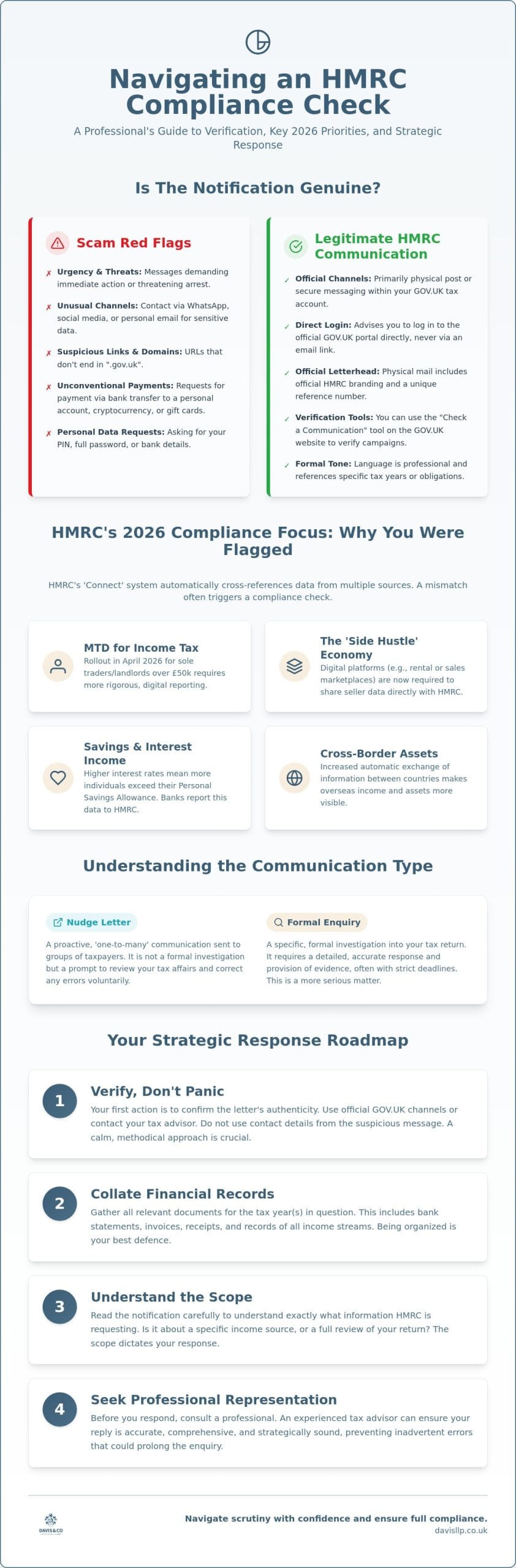
Official communication generally follows a predictable path. HMRC primarily uses physical post or secure messaging within your personal or business tax account. They’ll never use WhatsApp, social media, or personal email accounts to discuss specific tax liabilities or sensitive financial data. The GOV.UK One Login has become the central hub for secure interaction. If you’re unsure about the validity of a message, log in directly through the official portal rather than clicking links provided in an email or text. The “Check a Communication” tool on the government website also serves as a reliable first line of defence, listing current legitimate campaigns and contact methods.
Common Red Flags in Fraudulent Messages
Scammers often rely on psychological pressure to bypass your critical thinking. They frequently demand immediate payment through unconventional methods. If a message asks for bank transfers to an individual’s name, or suggests payment via cryptocurrency or digital gift cards, it’s a fraud. While scammers now use tools to correct their spelling, look for unofficial email domains that mimic the real thing but contain subtle discrepancies. The “refund trap” remains a common tactic. HMRC rarely initiates a refund via an unsolicited SMS containing a link. Legitimate refunds are typically processed through your tax return or a formal P800 calculation sent by post after the tax year ends.
- Urgency and Threats: Messages claiming your National Insurance number has been compromised or threatening immediate arrest.
- Suspicious Links: URLs that don’t end in “.gov.uk” or use link shorteners to hide their true destination.
- Personal Data Requests: Requests for your full PIN, password, or bank details over the phone or via text.
Verifying Nudge Letters and Official Mail
HMRC frequently utilizes “One to Many” letters to prompt specific professional groups to review their affairs. These aren’t always formal enquiries; they often serve as a proactive nudge to ensure you’ve accounted for specific income streams, such as foreign assets or rental income. You should identify the official HMRC letterhead and look for a unique reference number that matches your existing records. Before responding to such a notification, it’s prudent to consult a tax advisor in the UK. This ensures your reply is technically accurate and doesn’t inadvertently trigger a deeper hmrc compliance check through a simple misunderstanding of the request.
Key Compliance Focuses: The 2026 HMRC Savings and Income Warnings
The reach of an hmrc compliance check has expanded significantly in 2026, driven by a sophisticated digital infrastructure that harvests data from a vast array of third-party sources. We’ve observed a marked increase in “nudge” letters and formal enquiries targeting individuals who previously considered their tax affairs straightforward. This shift is primarily due to the convergence of higher interest rates and HMRC’s enhanced visibility into bank accounts, digital platforms, and overseas holdings. When automated data doesn’t align with a self-assessment return, it triggers a red flag within the “Connect” system, often leading to a request for clarification.
The “side hustle” economy is also under intense scrutiny. Digital marketplaces and rental platforms are now required to share seller data directly with the authorities. This transparency means that even modest supplementary income from property or online trade is visible to the Revenue. For those with more complex financial structures, particularly those involving cross-border assets, international tax planning is essential to ensure that all global income is correctly categorised and reported. Failing to reconcile these figures before HMRC initiates contact can lead to higher penalties, as the Revenue often views omissions as “careless” or “deliberate” rather than simple errors.
The Savings Interest Threshold for 2026
The Personal Savings Allowance (PSA) remains a critical factor for taxpayers. Basic rate payers can earn £1,000 in interest tax-free, while higher rate payers are limited to £500. Additional rate payers receive no allowance. As interest rates have remained elevated, many individuals have inadvertently breached these thresholds without adjusting their tax codes or filing returns. Under the current reporting regime, banks and building societies are required to automatically notify HMRC of any individual account that earns more than £100 in interest during the tax year. If you find your savings income has increased, our Personal Tax Services can help you quantify your liability accurately.
Warnings for Crypto and Digital Assets
Digital assets are no longer a blind spot for the authorities. HMRC has secured extensive data-sharing agreements with major cryptocurrency exchanges, providing them with a clear view of transaction histories and wallet links. They’re looking specifically for capital gains that haven’t been declared or income from “staking” and mining activities. According to official government guidance, a voluntary disclosure is always looked upon more favourably than a discovery made during an hmrc compliance check. Taking a proactive approach to reporting digital asset gains allows you to manage your tax position with greater professional poise and significantly reduces the risk of punitive measures.
Decoding the Compliance Check: Why You Have Been Flagged
Understanding the catalyst for an hmrc compliance check is the first step in managing your response with professional poise. Most flags aren’t the result of a random lottery; they’re generated by the Connect AI system, which cross-references billions of data points from banks, the Land Registry, and digital platforms. When your reported income doesn’t align with these external data sources, the system triggers an alert. This automated scrutiny is designed to identify “tax gaps” before they become significant liabilities for the Revenue.
It’s important to distinguish between a “nudge” letter and a formal enquiry. A nudge letter is a proactive prompt for you to review your affairs, often sent when HMRC’s data suggests a potential omission but hasn’t yet warranted a full investigation. In contrast, a formal enquiry is a structured examination of your records under specific legislation. If you receive a notification that seems suspicious or overly aggressive, you should report scam HMRC messages through the official government portal to protect your identity.
Niche Scrutiny for Professional Practices
Dental professionals often face scrutiny over the classification of associate income or complex VAT exemptions. This is where specialised small business accounting becomes a strategic asset, ensuring that your practice’s financial structure remains robust under examination. Property investors are also a primary focus, particularly regarding the distinction between capital improvements and revenue repairs. Rapidly expanding firms often trigger flags through Business Growth Acceleration, as sudden shifts in VAT turnover or payroll figures can suggest underlying accounting errors to the Connect system.
The Severity Levels of HMRC Warnings
- Level 1: Information Requests. These are often “check your return” prompts. They’re manageable but require immediate attention to ensure you don’t inadvertently escalate the situation through silence.
- Level 2: Formal Section 9A Enquiries. This is a serious hmrc compliance check into your Self Assessment return. HMRC will request specific documentation, such as bank statements and invoices, to verify your figures.
- Level 3: Serious Fraud Investigations. These are rare but involve significant penalties. They’re often triggered by suspected deliberate concealment or large-scale discrepancies.
The timeline for a compliance check can vary significantly. A simple request for information might be resolved in a few months, while a complex enquiry into international assets can last over a year. Maintaining a steady, deliberate rhythm in your correspondence helps to build a sense of stability and cooperation with the inspector, which is often a critical factor in a favourable resolution.
Strategic Steps to Take Following an HMRC Compliance Notification
The arrival of a formal notification marks the beginning of a process that requires meticulous attention to detail and a measured, professional approach. While the initial instinct may be one of urgency, your first action should be to verify the authenticity of the communication using the methods established in our opening discussion. Once confirmed as a legitimate hmrc compliance check, you should immediately begin collating all relevant financial records, bank statements, and correspondence for the period in question. Maintaining a central, organised file ensures that your response is based on empirical data rather than memory or estimation.
We advise that you seek professional counsel before making any formal admissions or payments to the Revenue. Engaging an expert allows for a neutral review of your position and ensures that you don’t inadvertently provide information beyond the scope of the specific enquiry. Reviewing your personal tax history for potential errors is equally vital; identifying a discrepancy yourself often places you in a stronger position than waiting for an inspector to uncover it. Finally, you must formulate a structured response that addresses HMRC’s queries point-by-point, ensuring it’s delivered within the stated deadline to demonstrate your commitment to compliance.
Avoiding Common Response Pitfalls
Ignoring HMRC correspondence is perhaps the most significant error a taxpayer can make. Silence is often interpreted as a lack of cooperation or, worse, deliberate concealment, which can escalate a routine enquiry into a more severe investigation with higher penalty multipliers. Providing unorganised or “shoebox” records is similarly counterproductive; it suggests a lack of financial control and may prompt the inspector to broaden the scope of their check. We also strongly recommend avoiding informal admissions during phone calls. Always insist that complex queries are handled in writing so that a precise, permanent record of the exchange exists for both parties.
The Voluntary Disclosure Strategy
If a review of your records reveals an omission, the Digital Disclosure Service (DDS) offers a strategic path to resolution. The timing of this disclosure is critical. An “unprompted” disclosure, made before HMRC begins an hmrc compliance check, carries significantly lower penalty percentages than a “prompted” one. The Revenue assesses fines based on the underlying behaviour that led to the error, ranging from “reasonable care” to “deliberate and concealed.” Professional representation reduces the behavioural penalty rating by demonstrating that you’ve taken active, expert steps to rectify your tax position. If you’re concerned about a potential discrepancy, our Personal Tax Services can provide the discreet, expert guidance needed to manage a voluntary disclosure effectively.
Professional Representation: Navigating Scrutiny with Davis & Co LLP
Facing an hmrc compliance check requires more than just technical accuracy; it demands a level of professional gravitas that only comes from a deep-seated history of success. At Davis & Co LLP, we act as a strategic buffer between you and the Revenue, allowing our understated confidence to guide the narrative of the enquiry. By positioning ourselves as your primary point of contact, we ensure that every piece of correspondence is measured, precise, and aligned with your long-term financial interests. Our firm has been a dependable constant for taxpayers since 1901, providing the intellectual rigour needed to handle complex analytical thought during high-stakes negotiations.
We provide a comprehensive approach to HMRC tax warnings and compliance, ensuring that no detail is overlooked. Whether your situation involves the nuances of International Tax Planning or the specific reporting requirements of Trust Tax Services, our team applies a century of expertise to secure a favourable outcome. We don’t just react to warnings; we anticipate the Revenue’s line of questioning, preparing a robust defence that often resolves issues before they escalate into formal disputes. This proactive management of audit assurance is a signature of our client-centric approach.
A Partnership Built on Reliability and Discretion
Dealing with sensitive commercial and personal matters requires a high degree of discretion. We understand that an hmrc compliance check can feel like an intrusion into your private affairs, which is why we prioritise protecting your reputation throughout the process. By managing the administrative burden of an enquiry, we allow you to focus on your core operations or professional practice without the constant weight of tax anxiety. Our goal is to ensure your tax planning remains both efficient and fully compliant, providing a sense of order that reinforces your credibility as a taxpayer.
- Reputation Protection: We handle all direct communication with HMRC inspectors to maintain a professional distance.
- Administrative Relief: Our team collates, reviews, and submits all required documentation on your behalf.
- Strategic Planning: We align your response with broader tax efficiency goals, such as Business Growth Acceleration.
Securing Your Financial Position
The transition from receiving a warning to establishing a stable, compliant tax plan is a critical phase in your financial journey. We believe that a successful resolution to an enquiry should serve as the foundation for future security. Regular Management Accounts and precise Bookkeeping Services are essential tools in this regard, as they provide the real-time visibility needed to prevent future flags from the Connect system. If you’ve received a notification that has caused concern, we invite you to contact us for a confidential consultation. Together, we’ll review your HMRC correspondence and formulate a customized solution that restores your peace of mind and secures your financial standing.
Securing Your Professional Standing in an Era of Digital Scrutiny
The 2026 tax landscape demands a heightened level of vigilance. As we’ve explored, distinguishing a legitimate hmrc compliance check from a sophisticated scam requires both technical knowledge and a measured, analytical approach. By understanding the specific triggers for modern enquiries, such as the automated reporting of savings interest and digital platform income, you can move from a position of uncertainty to one of strategic control. Verification remains your primary shield, ensuring that your financial data and personal identity remain protected against fraudulent actors.
Navigating these complexities doesn’t have to be a solitary burden. Our firm has acted as a trusted advisor since 1901, bringing over a century of professional gravitas to every negotiation. As Chartered Certified Accountants, we specialise in the intricate requirements of international and professional tax compliance, providing the steady, expert-led representation needed to resolve scrutiny with minimal disruption to your operations. Secure your financial position with professional tax representation from Davis & Co LLP. We’re here to ensure your tax affairs are managed with the precision and discretion they deserve, allowing you to move forward with absolute confidence.
Frequently Asked Questions
Is the HMRC tax warning text I received genuine?
HMRC rarely initiates contact via SMS to discuss specific tax liabilities or to request immediate payment. If you receive a text containing a link or demanding bank details, it is almost certainly a scam. Authentic notifications regarding an hmrc compliance check are typically delivered through the post or via your secure GOV.UK tax account. We recommend verifying any suspicious message by logging into your official portal directly rather than clicking any provided links.
What happens if I ignore an HMRC nudge letter?
Ignoring a nudge letter often prompts HMRC to escalate their interest into a formal enquiry. These letters are “one-to-many” prompts based on data discrepancies the Revenue has already identified through their Connect system. By failing to respond or rectify your position, you signal a lack of cooperation. This can lead to higher penalty multipliers if an underpayment is eventually discovered, as HMRC may categorise the omission as deliberate rather than a simple oversight.
Can HMRC check my bank accounts without my permission in 2026?
HMRC has the authority to receive data directly from UK banks and building societies under automated sharing agreements. While they don’t typically browse individual transactions without cause, the Connect AI system cross-references interest earned and large deposits against your reported income. In 2026, banks must report any account earning over £100 in annual interest, providing the Revenue with significant visibility into your financial affairs without requiring an individual warrant for each check.
Why did I get a tax warning about my savings interest?
You likely received this warning because your earned interest exceeded your Personal Savings Allowance. For the 2026/2027 tax year, basic rate taxpayers have a £1,000 allowance, while higher rate taxpayers are limited to £500. With interest rates remaining elevated, many individuals have inadvertently breached these thresholds. HMRC’s automated systems flag these discrepancies when bank data shows interest income that hasn’t been reconciled through your tax code or Self Assessment return.
How much are the penalties for late tax disclosure?
Penalties are determined by the underlying behaviour and whether the disclosure was prompted or unprompted. For “reasonable care” errors, penalties may be 0%, but “deliberate and concealed” actions can attract fines exceeding 100% of the tax due. In 2026, the points-based system also applies a £200 penalty for late submissions once a specific threshold is reached. Expert representation is essential to argue for a lower behavioural rating and mitigate these potential costs.
Should I pay the tax HMRC says I owe before speaking to an accountant?
We advise against making immediate payments based on a preliminary warning before seeking professional advice. An hmrc compliance check often begins with an estimate or a nudge that may not account for specific reliefs or complex financial structures. Paying immediately can be interpreted as an admission of an error that might not actually exist. A professional review ensures you only settle legitimate liabilities and that your response is strategically sound from the outset.
What is the difference between a tax warning and a tax enquiry?
A tax warning, often delivered as a nudge letter, is an informal request for you to review your own records for potential errors. It doesn’t necessarily mean a formal investigation has started. A tax enquiry is a formal, statutory process under Section 9A of the Taxes Management Act. This allows HMRC to legally demand specific documents and bank records to verify the accuracy of a filed return, representing a significantly higher level of legal scrutiny.
How far back can HMRC go when investigating my tax affairs?
The time limit for an investigation depends on the nature of the discrepancy identified. HMRC can generally look back four years for innocent errors and six years if they suspect careless behaviour. However, if they have reason to believe tax has been deliberately evaded or concealed, they can extend this window to 20 years. This long-reach authority underscores the importance of maintaining precise records and seeking specialist counsel when facing any historical review of your affairs.