In the 2022/23 tax year, the average Inheritance Tax bill for a taxpaying estate reached roughly £212,000, a figure that continues to climb as thresholds remain frozen until 2031. It’s understandable that you might feel a sense of trepidation when evaluating family trust tax rules uk and wider gifting regulations. You want to support your family today, yet the fear of accidental tax evasion or losing your own financial security by giving too much away is a significant burden.
We believe that protecting a lifetime of achievement requires more than just good intentions; it demands professional precision. By mastering the nuances of the seven-year rule and annual exemptions, you can transform a complex legal obligation into a structured strategic advantage. This guide provides a clear roadmap of available tax-free allowances and the meticulous documentation required by HMRC. You’ll gain the confidence to implement a long-term estate strategy that minimises liabilities while ensuring your legacy remains exactly where you intended.
Key Takeaways
- Learn how to maximise the £325,000 nil-rate band and residence allowances to shield your estate from the standard 40% Inheritance Tax rate.
- Navigate the nuances of family trust tax rules uk to determine the most tax-efficient structure for protecting multi-generational wealth.
- Master the timing of Potentially Exempt Transfers (PETs) and understand the impact of the seven-year rule on your lifetime gifting strategy.
- Discover how to utilise the “normal expenditure out of income” exemption to facilitate unlimited tax-free gifts while maintaining your current lifestyle.
- Understand the importance of professional management accounts and international tax planning in ensuring your estate remains compliant with evolving UK regulations.
The Role of Lifetime Gifting in UK Inheritance Tax Planning
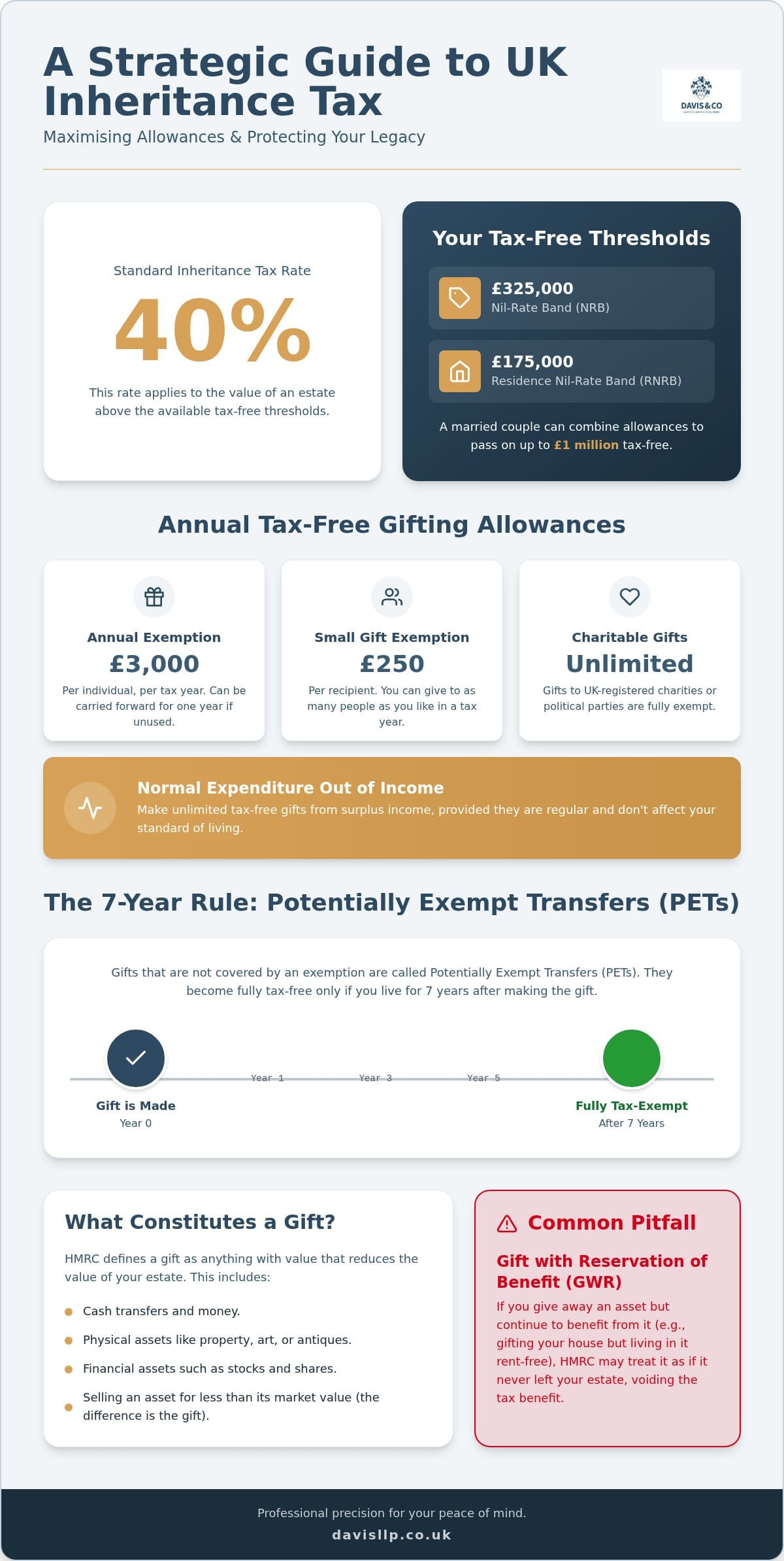
The UK Inheritance Tax System remains a cornerstone of estate planning, particularly as we look toward 2026. Currently, the nil-rate band is frozen at £325,000, while the residence nil-rate band offers an additional £175,000 for those passing a main home to direct descendants. Together, these allow a married couple to protect up to £1 million from the standard 40% tax rate. However, with property values rising and thresholds static until 2031, proactive gifting is no longer optional for many families; it’s a necessity to protect a legacy from fiscal drag.
We often advise clients that gifting serves as a primary lever to reduce an estate’s taxable value. It’s vital to distinguish between exempt transfers, such as gifts to a spouse, and Potentially Exempt Transfers (PETs). PETs only become fully exempt if you survive seven years from the date of the gift. A common pitfall is the Gift with Reservation of Benefit (GWR). If you give away an asset but continue to enjoy its use, such as gifting a home while living in it rent-free, HMRC will likely treat that asset as if it never left your estate. This can lead to an unexpected tax bill for your beneficiaries.
What Constitutes a Gift Under HMRC Rules?
HMRC’s definition of a gift extends far beyond cash transfers. It encompasses anything with a measurable value, including property, unlisted shares, or antiques. Crucially, the “loss in value” rule applies. If you sell an asset to a family member for less than its market rate, the difference is considered a gift. Understanding family trust tax rules uk is essential here, as transferring assets into a trust involves different reporting requirements compared to direct personal gifts. Your intent matters too; a gift must be a clear transfer of wealth without the expectation of receiving something of equal value in return.
The Interplay Between Gifting and Your Will
Lifetime gifting directly influences the composition of your residual estate. By reducing the pool of assets held at death, you lower the eventual tax liability your beneficiaries will face. This strategy must align perfectly with your testamentary wishes to avoid leaving your estate imbalanced or depriving yourself of necessary funds. Seeking professional tax advice in the UK ensures your Will and gifting programme work in harmony. We focus on creating a cohesive plan that respects your need for financial security while efficiently transferring wealth. Meticulous record-keeping is the final piece of this puzzle, as it provides the evidence HMRC requires to validate your exemptions and ensures the family trust tax rules uk are applied correctly to your specific circumstances.
Maximising Your Annual Allowances and Tax-Free Exemptions
Effective estate planning doesn’t always require complex structural changes. Often, the most efficient way to reduce a future tax burden is through the disciplined use of annual allowances. These exemptions are immediate; they don’t require you to survive for seven years to see the tax benefit. According to the Official Inheritance Tax Gift Rules, every individual has an annual gift allowance of £3,000. If you don’t use this allowance in one tax year, you can carry it forward for exactly one year, potentially allowing a £6,000 gift if the previous year’s quota was untouched.
Beyond the primary £3,000 limit, you can make “small gifts” of up to £250 per person to as many individuals as you like. However, you can’t use this in conjunction with the £3,000 allowance for the same recipient. For those with philanthropic interests, gifts to UK-registered charities, political parties, and national institutions are entirely exempt from Inheritance Tax. These transfers are removed from your estate immediately, providing a dual benefit of supporting causes you value while refining your tax position.
Utilising the Annual Exemption Effectively
Timing is everything when managing these allowances. The tax year ends on 5 April, making the weeks leading up to this date a critical window for review. For married couples and civil partners, the impact is doubled. By coordinating your gifting, you can move £6,000 out of your combined estate annually, or £12,000 if carrying forward unused allowances. When considering family trust tax rules uk, it’s vital to track these smaller gifts meticulously. We recommend keeping a clear ledger of all transfers, a process our team supports through professional Personal Tax Services to ensure you have a robust audit trail for HMRC.
Wedding Gifts and Family Allowances
Weddings and civil partnerships offer specific, one-off opportunities to transfer wealth tax-free. Parents can gift up to £5,000 to a child, while grandparents can provide £2,500. For anyone else, the limit is £1,000. These can be combined with your standard £3,000 annual exemption for a more significant impact. To qualify for the exemption, wedding gifts must be made on or shortly before the date of the ceremony and are contingent upon the marriage taking place. This precision ensures the gift is categorised correctly, avoiding the complexities that arise when family trust tax rules uk or PET regulations are applied to larger, undocumented sums.
The Seven-Year Rule and Potentially Exempt Transfers (PETs)
When a gift exceeds the annual exemptions discussed previously, it’s categorised as a Potentially Exempt Transfer (PET). These transfers are called “potential” because their tax-free status depends entirely on the donor surviving for seven years from the date the gift was made. If you survive this period, the value of the gift is fully removed from your estate for Inheritance Tax purposes. However, if death occurs within the seven-year window, the gift is brought back into the estate’s valuation. It’s a common misunderstanding that these gifts are taxed last; in reality, PETs are the first to consume your £325,000 nil-rate band in chronological order. This means a large gift made five years before death could leave very little tax-free allowance for the assets remaining in your Will.
The mechanics of this rule are strictly enforced, and it’s here where the distinction between personal gifting and family trust tax rules uk becomes most apparent. While gifts to individuals are PETs, transfers into most types of trusts are Chargeable Lifetime Transfers (CLTs), which may trigger an immediate 20% tax charge if they exceed the nil-rate band. Understanding these UK government rules on inheritance tax for gifts is vital for anyone looking to move significant capital without unintended consequences. We help our clients navigate these timelines to ensure their gifting strategy doesn’t inadvertently create a liquidity crisis for their executors.
How Taper Relief Actually Works
If the donor dies between three and seven years after making a gift, taper relief may apply. A frequent point of confusion is whether this relief reduces the value of the gift itself; it doesn’t. Instead, taper relief reduces the tax rate payable on the gift, provided the gift’s value exceeds the £325,000 threshold. The relief starts at 20% for deaths between years three and four, rising to 80% if you survive into the sixth year. If the gift is within your nil-rate band, taper relief provides no benefit because there’s no tax on the gift to reduce. It simply uses up the allowance that would otherwise protect your home or other assets.
The Critical Importance of Record Keeping
HMRC places the burden of proof on your executors to demonstrate that gifts were made and when. Without a clear Gift Log, your representatives may struggle to verify dates and values, potentially leading to overpayment or legal disputes. We recommend maintaining a detailed record that includes the date of the transfer, the recipient’s details, and the source of the funds. For business owners, the complexity increases when gifting shares or commercial assets. Engaging professional small business accountants can be a strategic move to ensure these transfers are documented with the precision required by family trust tax rules uk and wider HMRC compliance standards.
Strategic Gifting: Surplus Income and Property Pitfalls
While previous sections detailed the £3,000 annual allowance, the “Normal Expenditure out of Income” rule is often the most significant tool for reducing an estate’s value. It’s unique because it has no upper monetary limit. This exemption allows you to gift unlimited amounts tax-free, provided the transfers are regular and made from your surplus post-tax income. It’s a highly effective strategy for individuals receiving substantial pensions or investment dividends that they simply don’t need for their daily lives.
Success with this rule depends on meeting three strict HMRC tests. First, the gift must be “habitual,” meaning you’ve established a clear, intended pattern of giving over several years. Second, the funds must come from your current income, not from your capital or savings. Finally, you must demonstrate that you can maintain your usual standard of living after the gift is made. If you have to dip into your savings to pay your own bills because you’ve gifted your income, HMRC will likely disqualify the exemption. When assets move beyond simple cash transfers, family trust tax rules uk may offer more control, but they require careful navigation to avoid immediate tax charges.
Mastering the Surplus Income Rule
Proving a surplus requires meticulous financial records. HMRC uses Form IHT403 to scrutinise these gifts after death, asking executors to detail the donor’s annual income against their living expenses. We often suggest that clients maintain detailed management accounts to document this surplus in real-time. Establishing a pattern typically takes three to four years of consistent gifting, though a single gift can qualify if there’s documented evidence that it was the start of a regular commitment. For those managing complex portfolios, our Trust Tax Services can help ensure these regular transfers are structured correctly within your wider estate plan.
Gifting the Family Home: Risks and Realities
Gifting property is fraught with tax traps, most notably the Gift with Reservation of Benefit rule. If you gift your home to your children but continue to live there, the property remains part of your taxable estate unless you pay a full market rent to the new owners. This rent is then taxable income for your children, creating a secondary tax burden. Additionally, gifting any property other than your main residence triggers Capital Gains Tax (CGT) on the increase in value since you acquired it. You’re treated as having sold the property at its current market rate, even if no money changed hands. Before making such a significant transfer, it’s essential to weigh these costs against the benefits of the residence nil-rate band or alternative structures provided under family trust tax rules uk.
Professional Oversight: Managing Your Estate Compliance in 2026
Compliance in the 2026 tax landscape requires more than just a basic understanding of thresholds; it demands a multi-disciplinary perspective. Effective Inheritance Tax mitigation intersects with Personal Tax Services, trust management, and rigorous audit standards. As HMRC’s data-matching capabilities evolve, the margin for error in reporting lifetime gifts has narrowed significantly. We believe that a successful estate strategy must be proactive rather than reactive, ensuring that every gift is documented with the precision required to withstand future scrutiny.
Cross-Border Gifting and International Considerations
For non-domiciled individuals or UK expats, the gifting process is rarely straightforward. Your domicile status is the primary factor determining whether your worldwide estate is subject to UK tax. Without sophisticated international tax planning, you risk falling foul of complex residency rules or missing out on protections offered by double taxation treaties. These treaties are vital for protecting your assets from being taxed in two different jurisdictions simultaneously. We provide strategic advice for residents with significant overseas interests, ensuring that cross-border transfers are handled with discretion and technical accuracy.
The Davis & Co LLP Approach to Personal Tax
Our firm has been a dependable constant in the financial lives of our clients since 1901. We approach estate planning as a composed partnership, offering the understated confidence that comes from over a century of expertise. By integrating family trust tax rules uk into a broader framework of business growth and personal wealth, we ensure your strategy is both robust and flexible. We don’t believe in one-size-fits-all solutions; instead, we focus on highly individualised service delivery that respects the human impact of these complex financial decisions.
The next step in securing your legacy is a comprehensive estate review. This process begins with an accurate valuation of your global assets and an analysis of your current gifting history. Once we’ve identified your potential liabilities, we can refine your strategy to capitalise on the exemptions available. If you’re ready to move forward with bespoke estate planning, we invite you to initiate a consultation with our specialists. We’ll provide the professional oversight needed to ensure your long-term financial security remains uncompromised.
Securing Your Financial Legacy for 2026 and Beyond
Effective estate planning is a continuous process of refinement rather than a one-time event. By prioritising the “normal expenditure out of income” rule and the disciplined use of annual exemptions, you can significantly reduce the taxable value of your estate without compromising your own financial security. We’ve seen how the seven-year rule and the nuances of property transfers require precise timing and exhaustive documentation to satisfy HMRC’s rigorous standards.
Managing these complexities, alongside the specificities of family trust tax rules uk, demands a strategic partner with deep-seated expertise. As Chartered Certified Accountants founded in 1901, Davis & Co LLP brings over a century of professional gravitas to your personal affairs. We specialise in international and trust tax, providing a bespoke, partner-led service that addresses your unique financial landscape with absolute discretion.
Secure your legacy with expert tax planning from Davis & Co LLP. Taking these proactive steps today ensures that your achievements are protected for the next generation, providing the lasting peace of mind that comes from being truly well-advised.
Frequently Asked Questions
Can I give my house to my children tax-free?
You can gift your home, but it’s typically treated as a Potentially Exempt Transfer (PET), meaning you must survive seven years for it to leave your estate. If you continue to live in the property without paying full market rent, HMRC considers this a Gift with Reservation of Benefit, and the house remains taxable. Additionally, gifting a second home or buy-to-let property often triggers an immediate Capital Gains Tax liability for you.
What is the £3,000 annual gift allowance exactly?
The annual exemption allows you to give away £3,000 worth of assets or cash each tax year without it being added to the value of your estate. If you don’t use the full amount, you can carry the remainder forward for exactly one tax year. For a married couple, this combined allowance can reach £12,000 in a single year if neither partner utilised their exemption during the previous twelve months.
How does the 7-year rule work if I die before it expires?
If death occurs within seven years of a gift exceeding your allowances, the value is included in your estate valuation. While taper relief reduces the tax rate on gifts made between three and seven years before death, it only applies if the total gifts exceed the £325,000 nil-rate band. These transfers consume your tax-free threshold before the assets distributed via your Will, potentially leaving more of your estate exposed to tax.
Is there a limit on how much surplus income I can gift?
There’s no monetary cap on gifts made from surplus income, provided you meet HMRC’s strict criteria. The gifts must be part of a regular pattern, funded entirely by your post-tax income rather than savings, and leave you with enough funds to maintain your usual standard of living. Meticulous record-keeping is essential here, as executors must prove these three conditions using detailed financial evidence after your passing to claim the exemption.
Do I need to tell HMRC about every gift I make immediately?
You don’t generally need to report lifetime gifts to individuals at the time they’re made. Instead, your executors provide these details to HMRC during the probate process using records you’ve maintained. However, transfers into certain legal structures, which fall under specific family trust tax rules uk, may require immediate reporting and a 20% lifetime tax charge if the value exceeds your available nil-rate band. Professional oversight ensures these reporting triggers aren’t missed.
What happens if I give a gift but still benefit from it?
If you retain a benefit from a gifted asset, such as keeping the right to live in a house or receiving income from gifted shares, the “Gift with Reservation of Benefit” rules apply. HMRC treats the asset as if it were still part of your estate for Inheritance Tax purposes. To effectively remove an item from your estate, the transfer must be absolute, and you must cease to enjoy any personal advantage from it.
Does the recipient of a gift have to pay tax on it?
Recipients don’t usually pay Income Tax on cash gifts. However, if the donor dies within seven years and the gift exceeds the nil-rate band, the recipient may be liable for the resulting Inheritance Tax. This liability is often a surprise to beneficiaries, which is why we recommend clear communication and professional oversight when implementing family trust tax rules uk or significant personal gifting strategies to ensure everyone understands the potential obligations.
Can I use my annual allowance to pay for my grandchild’s school fees?
You can certainly use your £3,000 annual exemption to contribute toward school fees. If the fees exceed this amount, you might utilise the “normal expenditure out of income” rule to pay them tax-free, provided the payments are regular and made from your surplus income. This is an excellent way to provide immediate support to your family while systematically reducing the eventual tax burden on your estate through disciplined, documented gifting.