For the modern dental professional, tax deductions are not merely a year-end checklist but a strategic tool for practice growth and personal wealth preservation. As we move into the 2026/27 tax year, staying informed about the specific tax deductions for dentists uk professionals can claim is essential for maintaining a healthy balance sheet. You likely feel the weight of the “wholly and exclusively” rule and the pressure of the new Making Tax Digital (MTD) requirements, which now apply to those with qualifying income over £50,000. It’s natural to worry that an overlooked expense or a miscalculated claim might invite unnecessary HMRC scrutiny when your time is already at a premium.
We understand that your focus should remain on patient care rather than deciphering complex legislation. This guide provides the professional clarity required to master dental tax relief, ensuring your practice or associate role is fully optimised for maximum efficiency under current regulations. We will examine a definitive list of allowable expenses, the strategic handling of high-value equipment through the £1 million Annual Investment Allowance, and the practical steps needed to ensure seamless compliance with 2026 digital standards.
Key Takeaways
- Understand the nuances of the “wholly and exclusively” rule to ensure your expense claims remain robust under HMRC examination.
- Identify the specific professional fees and indemnity costs that qualify as tax deductions for dentists uk associates and principals.
- Maximise your cash flow by applying capital allowances to high-value clinical equipment, including dental chairs and diagnostic technology.
- Streamline your administrative overheads by correctly categorising staff costs and patient acquisition investments for tax efficiency.
- Transition smoothly into the 2026 Making Tax Digital (MTD) framework with a clear roadmap for digital record-keeping and compliance.
The Fundamentals of Dental Tax Relief: The “Wholly and Exclusively” Rule
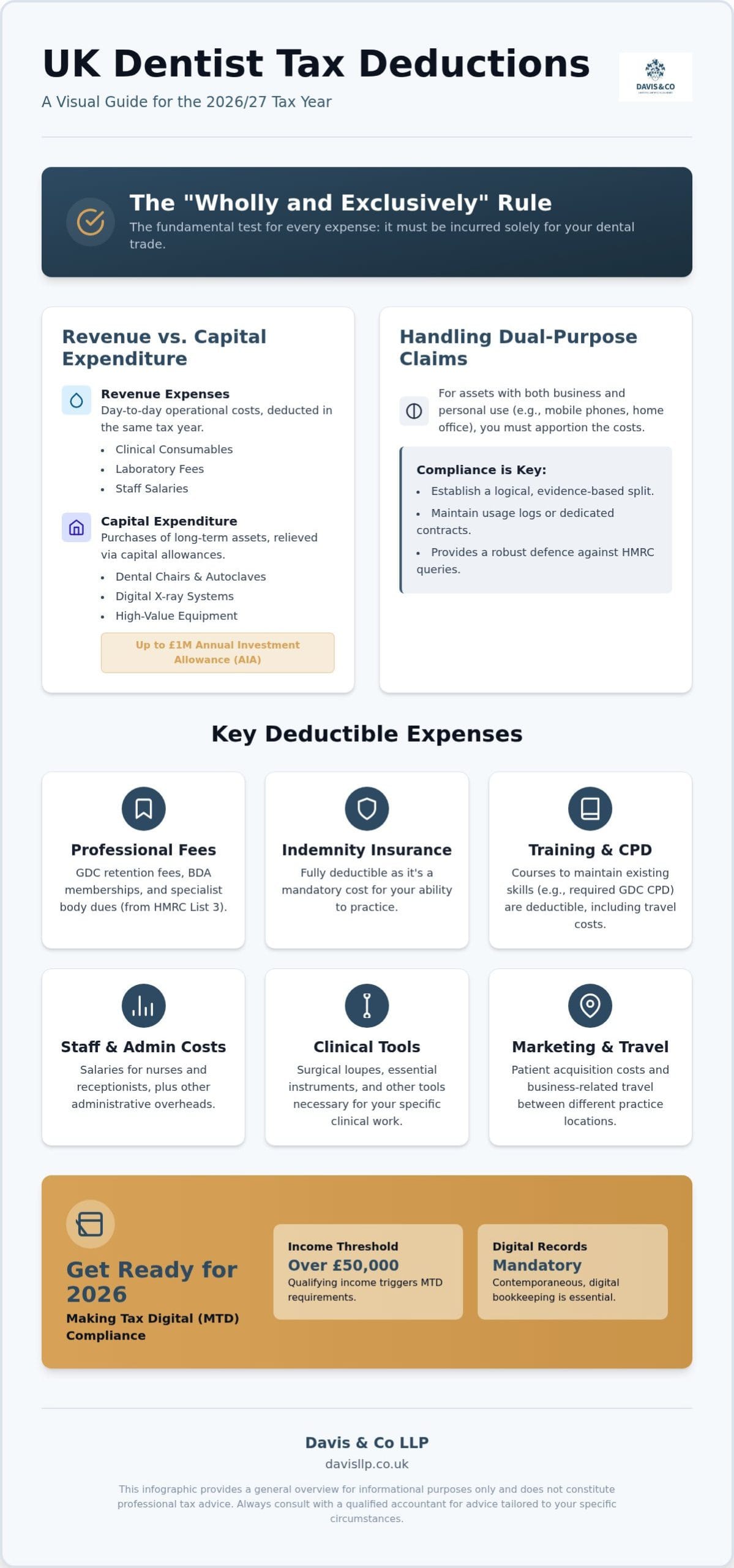
The “wholly and exclusively” rule serves as the fundamental baseline for every expense claim you submit to HMRC. For a cost to qualify as one of the valid tax deductions for dentists uk professionals can utilise, it must be incurred solely for the purposes of your clinical trade or dental practice. If an expense carries a distinct private motive, it risks being disallowed in its entirety. This is why everyday business attire or the standard commute from your home to a permanent surgery typically fails the test; these costs satisfy personal needs that exist regardless of your professional role.
Revenue vs. Capital Expenditure
Understanding the distinction between revenue and capital expenditure is essential for managing your practice’s cash flow and tax timing. Revenue costs are the recurring, day-to-day expenses required to keep your surgery operational. These include clinical consumables, laboratory fees, and staff salaries. These are generally deducted from your professional income in the same tax year they occur. Capital expenditure, conversely, relates to the purchase of long-term assets such as dental chairs, autoclaves, or digital X-ray systems. These items provide enduring value to your practice and are usually relieved through capital allowances rather than direct revenue deductions.
The Nuance of Dual-Purpose Claims
Modern dentistry often involves assets that bridge the gap between professional and personal life. While a surgical loupe is clearly a clinical tool, items like mobile phones or home office utilities require a more granular approach. Apportionment is the method of separating business use from personal use for tax purposes. To remain compliant, you must establish a logical and evidence-based percentage for the business element of these costs. We often suggest that our clients maintain usage logs or dedicated business contracts to provide a robust defence should HMRC ever question the validity of a split claim.
Precision in your financial documentation has never been more critical, particularly with the 2026 implementation of Making Tax Digital (MTD). The era of retrospective, year-end accounting is being replaced by a requirement for contemporaneous record-keeping. Digital bookkeeping ensures that every potential tax deduction for dentists uk associates or principals can claim is captured at the point of purchase. By adopting a disciplined approach to your digital records, you create a transparent audit trail that reinforces the “wholly and exclusively” status of your professional outgoings, providing peace of mind and protecting your practice from unnecessary scrutiny.
Clinical and Professional Deductions for Dental Associates
Self-employed associates operate as independent business entities within a practice framework. This status allows for a range of tax deductions for dentists uk professionals can leverage to protect their net earnings. While the practice owner typically covers general overheads, the associate remains responsible for their own professional compliance and the clinical tools essential to their specific delivery of care.
Professional Subscriptions and Indemnity
HMRC maintains a specific register, known as List 3, which details the professional bodies and learned societies eligible for tax relief. Your annual GDC retention fee, BDA membership, and dues for specialist organisations are all fully deductible. It’s common for associates to overlook these recurring costs during their first few years of practice. If you’ve missed these in previous returns, it’s often possible to make retrospective claims for the past four tax years to recover overpaid tax.
Indemnity insurance is another non-negotiable deduction. As a self-employed clinician, this protection is essential for your professional survival. Because it’s a mandatory requirement for your ability to trade, the full cost of the premium is allowable. You should ensure you follow the official government guidance on allowable expenses to maintain a clear distinction between these professional costs and personal insurance products.
Training and Specialist Courses
The tax treatment of education depends on whether the training maintains or expands your existing knowledge base. CPD required to keep your GDC registration active is generally deductible. This includes the cost of the course itself, alongside associated travel and modest subsistence. However, HMRC often views the acquisition of entirely new specialisms, such as a Master’s degree in a field you don’t currently practice, as capital expenditure. This is because it’s seen as creating a new “enduring asset” in the form of a new qualification or trade rather than simply updating current skills.
Clinical consumables also form a significant part of an associate’s expenditure. If you’re responsible for your own materials, such as specific composite kits or specialised endodontic files, these are revenue expenses. Similarly, any laboratory fees you pay directly are deductible. Balancing these clinical costs with your personal tax position requires a nuanced approach. As a dental tax specialist, we work with associates to ensure every clinical investment is reflected accurately in their digital records, safeguarding their path toward future practice ownership.
Capital Allowances: Optimising High-Value Equipment Purchases
Investing in clinical technology is a significant commitment that requires a deliberate tax strategy. While revenue expenses offset your immediate tax liability, capital allowances provide the framework for recovering the cost of long-term assets. In the 2026/27 tax year, the Annual Investment Allowance (AIA) remains a powerful mechanism for tax deductions for dentists uk, offering 100% relief on qualifying purchases up to £1 million.
The Annual Investment Allowance (AIA) in 2026
Strategic timing of these acquisitions can substantially improve your cash flow. For instance, purchasing a new dental chair or digital scanner toward the end of your accounting period allows you to claim the full deduction against that year’s profits, even if the equipment has only been in use for a few weeks. If you utilise hire purchase agreements, you can typically claim the full AIA on the total value of the asset as soon as it’s brought into use, provided the contract eventually leads to ownership. This is often more tax-efficient than traditional leasing, where relief is usually restricted to the monthly rental payments.
Small Tools and Clinical Equipment
Clinical equipment isn’t limited to large-scale installations. Smaller, high-value items like dental loupes, IT hardware, and practice management software also fall under the capital allowance umbrella. Most clinical equipment used in a dental surgery qualifies as “plant and machinery” for capital allowance purposes. For very small items such as handpieces or curing lights, we often apply the “small tools” treatment, which allows them to be deducted as revenue expenses for simplicity.
Navigating the transition from the old “Super Deduction” era to current 2026 incentives requires precision. Although the 130% relief ended in 2023, the permanent £1 million AIA threshold provides comparable benefits for the vast majority of dental practices. If your annual investment exceeds this limit, you’ll utilise Writing Down Allowances (WDA) to claim relief over several years, typically at 18% for the main pool or 6% for the special rate pool. It’s vital to cross-reference your planned purchases with the official government guidance on allowable expenses to ensure each asset is correctly categorised. By identifying all eligible tax deductions for dentists uk business owners can access, you transform a necessary business cost into a strategic investment in your practice’s future.
Administrative and Practice Management Expenses
While clinical tools are the focus of many, the back-office costs of running a modern surgery are equally vital for financial health. For practice owners, staff costs represent one of the most significant tax deductions for dentists uk firms can claim. This encompasses gross salaries, employer National Insurance contributions, and mandatory pension contributions. These are standard revenue expenses, yet their impact on your annual tax liability is substantial and requires meticulous payroll management to ensure every penny is accounted for correctly.
Marketing and Business Development
Building a personal brand or practice reputation is no longer optional in a competitive clinical environment. Costs for website maintenance, SEO, and local advertising are fully deductible as they’re incurred specifically to generate professional income. This extends to social media management and professional photography for clinical portfolios. It’s vital to distinguish between business entertaining and staff welfare. While providing a team lunch for a training session qualifies as a deductible staff welfare expense, taking a referring colleague to dinner is generally considered non-deductible entertaining by HMRC. We recommend keeping detailed receipts that specify the purpose of any group catering to avoid confusion during an audit.
The Home Office and Administrative Hub
Many dental professionals, particularly associates, perform significant administrative work away from the surgery. You have two primary choices for claiming these costs: the HMRC simplified flat-rate or a detailed calculation of actual household bills. The flat-rate is convenient for those with minimal admin hours. However, the detailed method often yields higher relief if you’ve a dedicated administrative room. This allows you to apportion a percentage of your heating, electricity, and even mortgage interest or rent based on the floor area and time used. Additionally, software subscriptions for digital imaging and patient management are essential tools that should be captured in your digital records.
Managing these administrative complexities requires specialised oversight. The cost of professional accounting services for small business is itself a deductible expense, effectively reducing the net cost of expert advice. Partnering with a dedicated dental tax specialist ensures that your administrative overheads are as lean and tax-efficient as your clinical operations, allowing you to focus on the growth of your practice.
Strategic Tax Planning and 2026 Compliance
Effective tax management requires moving beyond annual compliance toward a forward-looking strategy that anticipates regulatory shifts. For many clinicians, 2026 represents a pivotal year as the digital transformation of the UK tax system reaches a critical milestone. While identifying immediate tax deductions for dentists uk professionals can claim is vital, the long-term sustainability of your practice depends on a robust structure. This often involves a strategic review of your business model, particularly the transition from a sole trader to a limited company. While incorporation offers potential Corporation Tax advantages, the decision must be weighed against current dividend tax rates and the increased administrative responsibilities of a corporate entity.
Making Tax Digital for 2026
From 6 April 2026, the Making Tax Digital (MTD) framework becomes mandatory for those with qualifying income over £50,000. This shift marks the end of the traditional annual tax return, replacing it with a requirement for quarterly digital updates to HMRC. Readiness involves more than just software adoption; it requires a fundamental change in how you manage your professional bookkeeping. At Davis & Co LLP, we facilitate a seamless transition by implementing compliant systems that integrate directly with your clinical management software. This ensures that every clinical expense and patient fee is captured in real-time, providing a transparent audit trail that mitigates the risk of HMRC enquiries.
International and Specialist Planning
Modern dentistry is increasingly global, with many professionals maintaining clinics, assets, or family interests across international borders. Most generic accounting firms overlook the complexities of cross-border financial interests, yet these require sophisticated international tax planning to avoid double taxation and ensure wealth preservation. Whether you are managing overseas property or considering an international practice expansion, your tax strategy must account for both UK and foreign obligations.
The complexity of these issues underscores why choosing a chartered accountant with specific dental expertise is a strategic necessity. A specialist advisor understands the nuances of the NHS pension scheme, the “wholly and exclusively” rule, and the specific tax deductions for dentists uk associates need to remain competitive. By accessing expert tax advice in the UK, you gain a strategic partner dedicated to protecting your professional standing and your personal wealth. We focus on the intricate details of your financial life so you can remain dedicated to the precision of your clinical work.
Securing Your Practice’s Financial Future Through Proactive Management
Effective tax management is a continuous process of refinement rather than a single annual event. By internalising the fundamental principles of allowable expenditure and preparing for the digital transition of 2026, you position your practice for sustained growth. Whether you’re an associate managing professional subscriptions or a principal investing in clinical technology, it’s about ensuring you capitalise on all eligible tax deductions for dentists uk practitioners.
The evolving regulatory landscape demands a strategic partner who understands the unique financial nuances of your profession. Having served as Chartered Certified Accountants since 1901, we provide specialist dental tax and international planning expertise through a bespoke, partner-led service for high-earning professionals. We invite you to consult Davis & Co LLP for specialist dental tax planning and compliance to ensure your financial affairs are handled with the precision they deserve. Taking these steps today provides the assurance that your practice remains compliant, efficient, and well-positioned for the years ahead.
Frequently Asked Questions
Can I claim for the cost of my dental degree or initial training?
You cannot claim tax relief on the cost of your dental degree or initial vocational training. HMRC views these costs as capital expenditure because they enable you to enter a profession rather than maintaining skills within an existing one. While ongoing CPD is deductible, the foundational education required to become a dentist is considered a personal investment. This distinction is vital for junior associates planning their early-career tax strategy.
Are dental loupes considered a deductible expense for tax purposes?
Yes, dental loupes are a deductible expense and are typically claimed through capital allowances. As they’re high-value clinical equipment, they usually qualify for 100% relief in the year of purchase under the Annual Investment Allowance. This ensures that the significant investment required for enhanced magnification is fully recognised as a professional cost. You should ensure that the purchase is recorded contemporaneously within your digital bookkeeping system to maintain accurate records.
Can I deduct the cost of commuting from home to my dental practice?
You generally cannot deduct the cost of commuting between your home and a permanent dental practice. HMRC classifies this as private travel because the choice of where to live is a personal one. However, if you’re required to travel between different surgery locations or to a temporary site for a specific contract, those specific journeys may qualify for relief. Maintaining a detailed mileage log is essential for defending such claims during any professional review.
Is the cost of professional indemnity insurance tax-deductible for dentists?
Professional indemnity insurance is fully tax-deductible for self-employed dentists. Since this cover is a mandatory requirement for your clinical practice, it meets the “wholly and exclusively” criteria for professional expenses. Ensuring this cost is included in your return is a primary way to manage tax deductions for dentists uk professionals must handle. It’s one of the most straightforward claims an associate can make to reduce their taxable income and protect their professional standing.
What is the “wholly and exclusively” rule for dental expenses?
The “wholly and exclusively” rule is the fundamental test HMRC applies to every business expense. It dictates that for a cost to be deductible, its sole purpose must be for your dental trade. If an expense has a dual purpose, such as a mobile phone used for both personal and professional calls, you must establish a logical basis for apportionment. This ensures only the business element reduces your tax liability while maintaining compliance with current legislation.
How does Making Tax Digital affect dentists in 2026?
Making Tax Digital (MTD) for Income Tax requires dentists with qualifying income over £50,000 to maintain digital records from April 2026. You’ll be required to submit quarterly summaries of your income and expenses to HMRC instead of a single annual return. This shift necessitates the use of functional, MTD-compatible software. We assist our clients in transitioning to these digital systems to ensure compliance while maintaining high levels of administrative efficiency and clinical focus.
Can I claim tax relief on my GDC and BDA subscriptions?
You can claim full tax relief on your annual GDC retention fee and BDA subscriptions. These organisations are included on HMRC’s approved list of professional bodies, meaning their fees are recognised as essential professional outgoings. This is a key area where tax deductions for dentists uk associates often find immediate savings. You should also include fees for any specialist societies or faculties that are relevant to your clinical work to maximise your relief.
Should I operate as a limited company or a sole trader as a dentist?
The choice between operating as a limited company or a sole trader depends on your profit levels and long-term financial goals. A limited company can offer greater tax efficiency through a combination of salary and dividends, but it comes with increased administrative complexity and Corporation Tax obligations. Conversely, being a sole trader is simpler but may result in higher personal tax rates as your earnings grow. A bespoke review is necessary to determine the most efficient structure.