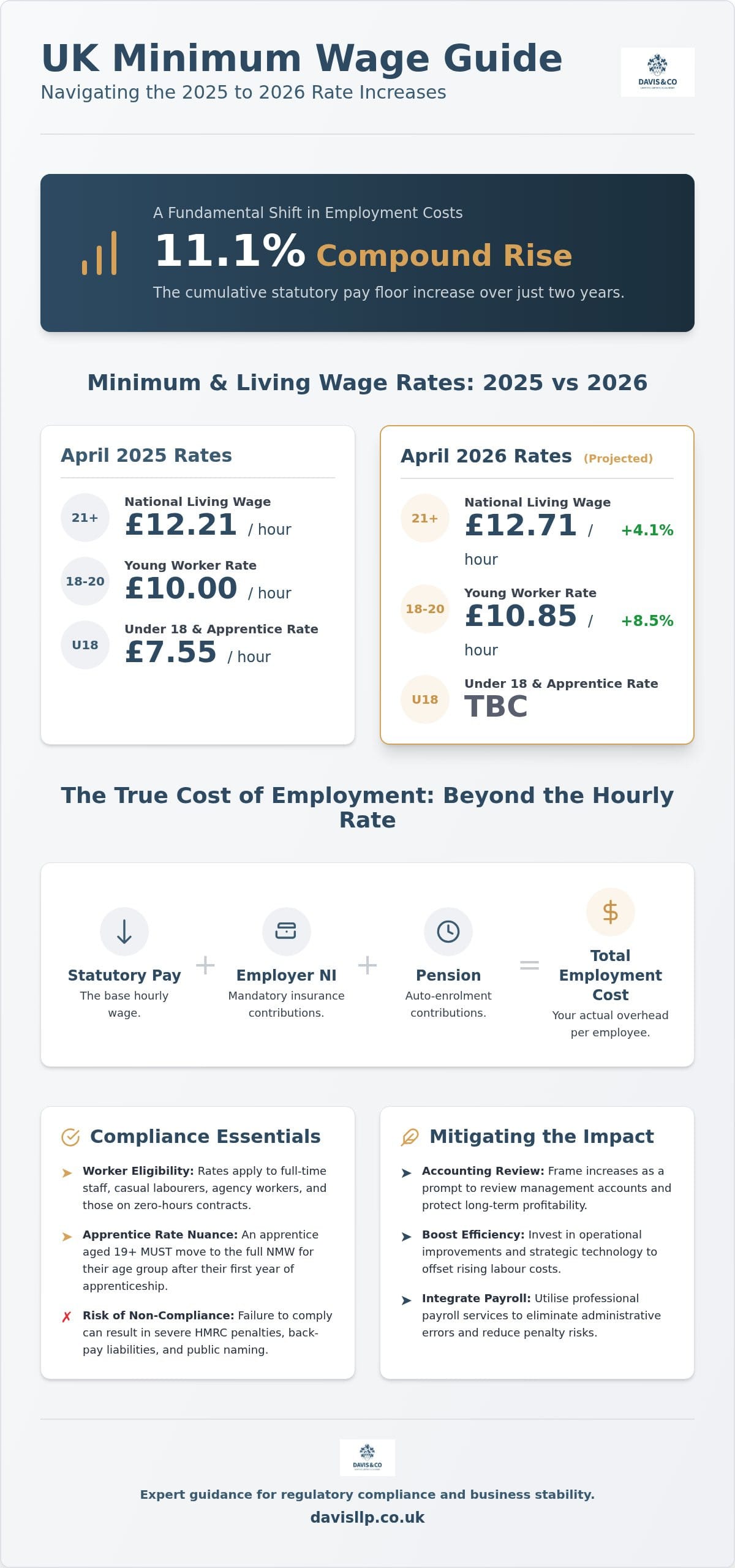
An 11.1% compound rise in the statutory pay floor over just two years represents more than a simple payroll adjustment; it’s a fundamental shift in the cost of UK employment. For many directors, the transition from the minimum wage 2025 rates to the 2026 uplifts feels like a constant exercise in balancing the books against rising overheads. We understand that the pressure of maintaining compliance while managing complex age-tier transitions can be a source of significant anxiety, especially when the risk of HMRC penalties looms over any administrative oversight.
You shouldn’t have to view these legislative changes as a threat to your stability. This guide provides the expert insight needed to navigate the shift between the 2025 and 2026 increases with precision. We’ll explore the specific rate changes, such as the National Living Wage reaching £12.71 in April 2026, and offer strategies for optimizing your cash flow and payroll. By the end of this analysis, you’ll have a clear understanding of your total employment costs and a strategic plan to maintain your commercial momentum.
Key Takeaways
- Understand the specific rate transitions from the minimum wage 2025 levels to the 2026 uplifts to maintain total regulatory compliance.
- Identify the true cost of employment by calculating the multiplier effect on Employer National Insurance and mandatory pension contributions.
- Frame these statutory increases as a prompt for a management accounting review to protect and optimise your long-term profitability.
- Learn how operational efficiency and strategic technology investments can help offset rising labour costs while maintaining your market position.
- Recognise the value of integrated payroll services in eliminating administrative errors and reducing the risk of HMRC penalties.
Navigating the Transition: Minimum Wage Rates for 2025 and 2026
The transition between fiscal years often brings administrative challenges, but the shifts observed in the minimum wage 2025 cycle were particularly noteworthy for their scale. This period marked a substantial adjustment from the 2024 baseline, reflecting a broader economic effort to align statutory pay with the rising cost of living. For many UK employers, these figures aren’t merely historical data; they’re the foundation for current financial planning and essential for retrospective payroll audits. If an HMRC enquiry arises today, your records for the 2025 period must be impeccable to avoid severe penalties and public naming.
The 2025 Rate Breakdown by Age and Status
Understanding the specific tiers is the first step toward total regulatory compliance. From April 2025, the rates were structured to provide a clear ladder of progression, ensuring that workers across all sectors received a fair baseline. For a broader context on how these tiers have evolved since their inception, you can refer to this National Living Wage overview. The 2025 figures include:
- National Living Wage (21 and over): £12.21 per hour.
- 18 to 20 Year Old rate: £10.00 per hour.
- Under 18 and Apprentice rates: £7.55 per hour.
This uplift reflected a deliberate policy shift to increase the earnings of the lowest-paid workers. It’s vital to remember that these rates remain relevant for any back-pay calculations or when reviewing the previous year’s financial performance against industry benchmarks.
Projecting Forward: The 2026 Minimum Wage Landscape
As we move into the current 2026 cycle, the trajectory of wage growth remains steep. The National Living Wage for those aged 21 and over has risen to £12.71, a 4.1% increase from the previous year. However, the most striking change is the 8.5% jump for 18 to 20 year olds, who now earn a minimum of £10.85 per hour. This strategy aims to eventually eliminate age-based pay disparities entirely, a trend that requires careful workforce planning.
Adapting to these cumulative changes requires more than just a reactive payroll update. It demands a sophisticated national minimum wage 2026 strategy that accounts for the 11.1% compound rise seen over the last 24 months. Our experience suggests that businesses failing to project these costs often face sudden cash flow constraints. By mapping out these transitions early, you can ensure your operational budgets remain resilient against the backdrop of rising statutory obligations.
Eligibility and Legal Obligations: Who Qualifies for 2025 Rates?
Identifying who is legally entitled to the minimum wage 2025 rates is the cornerstone of effective risk management. While it might seem straightforward, the legal definition of a worker extends beyond traditional full-time staff. It encompasses casual labourers, agency workers, and individuals on zero-hours contracts. Some businesses mistakenly believe that interns or volunteers fall outside these requirements. However, if an individual performs duties that contribute to the business and has a contract, even an unwritten one, to perform work personally, they are likely entitled to the statutory minimum. Family members living in the employer’s home and working for the family business are one of the few exceptions, but this exemption is narrow and strictly interpreted by HMRC.
The Apprentice Rate Nuance
The rules governing apprentice pay are a frequent source of compliance errors. Apprentices are entitled to the apprentice rate if they are either under 19, or 19 and over but in the first year of their apprenticeship. Once an apprentice turns 19 and has completed their first year, they must immediately move to the full National Minimum Wage for their age group. For a 19-year-old in the 2025 cycle, this meant a significant jump from £7.55 to £10.00 per hour. We recommend ensuring your professional payroll support is calibrated to flag these milestones automatically, as missing a single pay period can trigger a back-pay liability.
The National Living Wage vs. The National Minimum Wage
Terminology often causes confusion during financial planning. The National Living Wage (NLW) is essentially the highest tier of the National Minimum Wage. A pivotal change occurred in April 2024 when the age threshold for the NLW was lowered from 23 to 21. This means that for the minimum wage 2025 cycle, any worker aged 21 or over was entitled to the top rate of £12.21. You can verify the current minimum wage rates on the official government portal to ensure your 2026 projections are accurate.
Understanding these nuanced definitions is a vital component of securing expert tax advice in the UK, as wage levels directly influence your overall tax liabilities and National Insurance contributions. Strategic alignment of your workforce tiers can prevent unexpected spikes in your total cost of employment. By proactively auditing your staff list against these legal criteria, you protect your business from the reputational and financial damage associated with non-compliance.
The True Cost of Employment: Financial Implications for 2026
Focusing solely on the headline hourly rate often leads to a significant underestimation of a business’s total financial commitment. When we look at the minimum wage 2025 rates as a baseline, the transition to 2026 levels reveals a multiplier effect that extends far beyond the employee’s gross pay. Every pound added to the hourly rate triggers a corresponding increase in secondary Class 1 National Insurance contributions, currently set at 13.8% for earnings above the secondary threshold. For a full-time worker, these incremental costs accumulate rapidly, placing additional strain on annual budgets that may already be stretched by inflationary pressures.
Mandatory pension contributions represent another layer of this fiscal challenge. As wages rise to meet the new statutory minimums, more part-time or seasonal staff may be pushed over the auto-enrolment earnings trigger. This shift requires employers to contribute a minimum of 3% on qualifying earnings, a cost that scales directly with wage growth. According to Minimum wage statistics provided by the House of Commons Library, the number of workers affected by these increases has grown steadily, meaning the aggregate impact on a company’s pension liability is more pronounced than in previous decades.
Calculating the Total Cost Per Employee
A precise financial model must account for “hidden” statutory costs that aren’t immediately visible on a basic pay scale. This includes the impact on overtime rates, shift premiums, and holiday pay, all of which are calculated as a percentage of the base hourly rate. The total cost of employment is the sum of the gross wage plus 13.8% for Employer National Insurance and 3% for mandatory pension contributions on relevant earnings. We’ve found that neglecting these variables can lead to a 15% to 20% discrepancy between projected and actual labour costs, potentially jeopardising your year-end profitability.
The Real Living Wage vs. Statutory Minimums
While the statutory rates are mandatory, some organisations choose to adopt the voluntary Real Living Wage to enhance their recruitment and retention efforts. This decision involves a complex trade-off between higher immediate cash flow requirements and the long-term benefits of reduced staff turnover. Adopting a rate higher than the minimum wage 2025 or 2026 baseline can position you as an employer of choice, but it requires a robust strategy to maintain margins. Engaging a small business accountant can provide the clarity needed to balance these social responsibilities with the hard realities of commercial sustainability.
Strategic Management: Mitigating the Impact on Profitability
Absorbing the compound impact of the minimum wage 2025 rates alongside the 2026 increases requires a shift from reactive payroll management to proactive financial strategy. We view these statutory uplifts as a catalyst for a comprehensive management accounting review. Maintaining profitability isn’t just about cutting costs; it involves a meticulous evaluation of pricing structures to ensure margins remain healthy without eroding your market share. For many of our clients, this period serves as an ideal time to invest in operational efficiency. By leveraging automation and modern technology, you can often offset rising labour costs through improved productivity and reduced administrative waste.
Another critical consideration is the ‘pay ripple effect.’ When the floor for the lowest-paid staff rises, the pay differentials for supervisors and middle management naturally narrow. This compression can lead to decreased motivation if not handled with care. To maintain morale and retention, you must strategically adjust your entire pay scale, ensuring that experience and responsibility are still clearly reflected in your remuneration packages. This requires a balanced approach that rewards tenure while staying within the confines of your revised operational budget.
Cash Flow Management and Forecasting
Predictability is the foundation of financial stability in a volatile regulatory environment. We recommend utilizing 12-month rolling forecasts to anticipate the significant rate jumps that occur every April. This allows you to build liquid reserves and adjust your commercial strategy well in advance of the deadline. Precise bookkeeping is essential here; it provides the real-time data needed to make informed decisions about recruitment and expansion. Our team at Davis & Co LLP specialises in business growth and management accounting, helping you transform raw numbers into a clear roadmap for the future.
HMRC Compliance and Record Keeping
The legal requirement for record-keeping is three years, but we strongly advise maintaining your payroll records for six. HMRC’s National Minimum Wage inspectors look for comprehensive evidence of hours worked and payments made, particularly for salaried staff whose hours may fluctuate or for those receiving the accommodation offset. A proactive payroll review can identify potential errors, such as unpaid travel time between sites or deductions for uniforms, before they escalate into an audit. Failing to meet these standards can lead to inclusion on the government’s ‘naming and shaming’ list, which carries significant reputational risk. To secure your business against these risks, consider the benefits of our bespoke growth and compliance advisory, which is designed to ensure your operations remain resilient and fully compliant.
Davis & Co LLP: Your Partner in Regulatory Compliance
Managing the transition from the minimum wage 2025 standards to the current 2026 obligations requires a level of precision that often exceeds the capacity of internal administrative teams. At Davis & Co LLP, we provide the steady hand necessary to navigate these shifts without sacrificing your commercial focus. Our integrated approach treats payroll not as a standalone function, but as a critical component of your broader financial health. By entrusting your compliance to us, you eliminate the anxiety associated with shifting age thresholds and complex back-pay audits, allowing your leadership team to concentrate on strategic objectives.
We recognize that every organization faces unique pressures, which is why our advisory services are highly individualized. Whether you are navigating the specific complexities of the healthcare sector or managing a large-scale retail operation, our deep-seated expertise ensures that your payroll strategy is both robust and flexible. We act as a dependable constant in a volatile regulatory environment, providing the reassurance that your business is well-advised and your obligations are met with professional gravitas. This partnership allows you to maintain the necessary distance of a professional expert while knowing your sensitive commercial matters are in capable hands.
Comprehensive Payroll and VAT Support
Outsourcing the burden of Real Time Information (RTI) and workplace pension auto-enrolment ensures that every legislative milestone is met with absolute accuracy. We manage the automatic triggers for age-related pay jumps, preventing the oversight that leads to HMRC investigations and the reputational damage of the naming list. This level of detail is paired with our expertise in VAT compliance; we ensure that your evolving cost base is accurately reflected in your returns to optimize your cash flow. For those seeking comprehensive tax advice uk, we offer a cohesive service that bridges the gap between daily bookkeeping and long-term fiscal planning.
Strategic Growth Acceleration
We believe that regulatory compliance should serve as a framework for better business management rather than a hurdle to overcome. Our specialist advisors, including our dedicated dental tax specialists, provide nuanced guidance tailored to the unique economic challenges of your specific sector. When you seek to find a chartered accountant, you aren’t just looking for a service provider; you’re looking for a strategic partner who understands the practical realities of your industry. Since 1901, we’ve helped businesses transform legislative headwinds into opportunities for growth and structural refinement. Secure your business’s financial future and maintain your competitive edge by partnering with Davis & Co LLP today.
Securing Your Commercial Future Amidst Legislative Change
The transition from the minimum wage 2025 rates to the 2026 uplifts is a significant milestone for any UK employer. As we’ve explored, achieving total compliance requires a deep understanding of age-tier thresholds and the cumulative impact on your total employment costs, including National Insurance and pension contributions. By integrating these statutory changes into a broader management accounting framework, you can protect your margins while maintaining a competitive edge in recruitment. Precise record-keeping and proactive payroll reviews are your best defense against HMRC penalties and the risk of reputational damage.
Navigating these complexities doesn’t have to be a solitary burden. As Chartered Certified Accountants since 1901, we provide the deep-seated expertise and dedicated payroll support necessary to manage your evolving obligations. From VAT compliance to strategic growth acceleration, our focus remains on your organizational stability. Partner with Davis & Co LLP for expert payroll and strategic business advice to ensure your financial planning is as robust as your ambition. We look forward to helping you turn these regulatory challenges into a foundation for sustained success.
Frequently Asked Questions
What were the National Minimum Wage rates from 1 April 2025?
From 1 April 2025, the National Living Wage for those aged 21 and over was £12.21 per hour. For workers aged 18 to 20, the rate was £10.00, while those under 18 and apprentices received £7.55. These minimum wage 2025 levels served as the regulatory floor until the 2026 increases took effect, providing a necessary baseline for historical payroll audits and compliance checks.
Does the 2025 minimum wage apply to all workers regardless of contract?
Yes, the statutory minimum applies to almost all workers, including agency staff, casual labourers, and those on zero-hours contracts. It’s not limited to full-time employees with formal written contracts. If an individual meets the legal definition of a ‘worker’ who provides personal service, they’re entitled to the rate applicable to their age group. This remains true even if the individual has signed a document agreeing to a lower rate.
How do the 2025 rates differ for apprentices?
Apprentices are entitled to a specific rate of £7.55 if they’re either under 19 or in the first year of their apprenticeship. Once an apprentice turns 19 and completes their first year, they must be paid the full minimum wage for their age bracket. This transition is a common area for payroll errors, and we recommend that employers review their apprentice contracts annually to ensure full regulatory compliance.
What are the penalties for failing to pay the 2025 National Living Wage?
Non-compliance can result in HMRC issuing a notice of underpayment, requiring you to pay all arrears plus a penalty of up to 200%. This fine is capped at £20,000 per worker. Additionally, businesses are often publicly ‘named and shamed’ by the government, which can cause lasting damage to your brand reputation and recruitment efforts. In extreme cases, persistent failure to pay can lead to criminal prosecution.
Can an employer deduct the cost of uniforms from the minimum wage?
Employers cannot make deductions for uniforms or equipment if doing so reduces the worker’s pay below the relevant minimum rate. This rule applies even if the worker has previously agreed to the deduction in their employment contract. You must ensure that any charges for business-related expenses or mandatory clothing don’t breach the statutory pay floor, as these are viewed as business costs by HMRC inspectors.
What happens to the minimum wage when a worker turns 21 in 2026?
When a worker turns 21 in 2026, they must be moved to the National Living Wage rate of £12.71 per hour. This change must legally take effect from the start of the next pay reference period following their birthday. It’s essential that your payroll systems are calibrated to flag these age milestones automatically, as missing the update can lead to unintended arrears and significant compliance risks for your business.
Are there any exemptions to the National Minimum Wage for small businesses?
No exemptions exist for small businesses or startups regarding the National Minimum Wage. Every employer in the UK, regardless of the number of staff they employ or their annual turnover, is legally bound to pay the statutory rates. Failure to do so is a criminal offense, and the size of the business is not considered a valid defense during an HMRC investigation or an employment tribunal hearing.
How often does the UK government review the minimum wage rates?
The UK government reviews minimum wage rates annually following recommendations from the independent Low Pay Commission. These adjustments typically take effect on 1 April each year to align with the start of the new tax year. Staying informed about these yearly cycles is vital for maintaining an accurate 12-month rolling financial forecast and ensuring that your minimum wage 2025 records are correctly archived for any future audits.