The centuries-old concept of domicile has effectively been decoupled from the UK tax system, marking the most significant shift in private client taxation for a generation. For those managing complex global portfolios, the transition from the remittance basis to the residence-based Foreign Income and Gains (FIG) regime represents more than just a change in terminology. It’s a fundamental restructuring of how uk tax for non domiciled residents is calculated, moving from a system of source to a strict four-year window of opportunity.
We understand that the abolition of the remittance basis creates a period of profound uncertainty, particularly regarding the risk of double taxation and the new ten-year tail for inheritance tax. You’ve likely spent years structuring your affairs around permanent non-dom status, only to find the legislative goalposts have moved. This article provides the strategic clarity you need to address these changes. We’ll examine the specific mechanics of the 4-year FIG rules, the time-limited 12% Temporary Repatriation Facility available until April 2027, and the essential steps required to maintain inheritance tax compliance under the new residence-based framework.
Key Takeaways
- Learn how the abolition of the remittance basis fundamentally alters the landscape of uk tax for non domiciled residents, shifting the focus from domicile to a four-year residence-based framework.
- Identify the strategic windows offered by the Temporary Repatriation Facility, which permits the repatriation of historic foreign income at a reduced 12% tax rate through April 2027.
- Understand the new ten-year residence threshold that triggers UK inheritance tax on global estates, marking a departure from the previous domicile-based system.
- Explore the benefits of rebasing capital assets to April 2019 values to effectively mitigate future capital gains tax liabilities on international disposals.
- Discover how bespoke international tax planning facilitates a seamless transition from protected settlement regimes to the new arising basis of taxation.
The 2026 Transition: Abolition of the Remittance Basis
The UK tax landscape is undergoing its most radical transformation in decades. The move from a domicile-based system to a residence-based framework represents a departure from centuries of legal precedent. This transition aims to simplify the UK taxation system overview while aligning it with modern international standards of transparency. For many, the shift represents a loss of the flexible “non-dom” status that allowed for the shielding of offshore wealth. The 2026 FIG regime is a residence-based system designed for new UK arrivals.
For those who’ve been UK resident for more than 15 years, the changes are particularly acute. Historically, the “deemed domicile” status applied once an individual had been resident for 15 of the previous 20 tax years. Under the new rules, the concept of domicile is largely removed from the assessment of income and capital gains. Long-term residents will find they’re now taxed on an “arising basis” for all global income, regardless of whether those funds are brought into the UK. This marks a significant increase in the complexity of uk tax for non domiciled residents who have built their lives in Britain.
Defining the New 4-Year FIG Regime
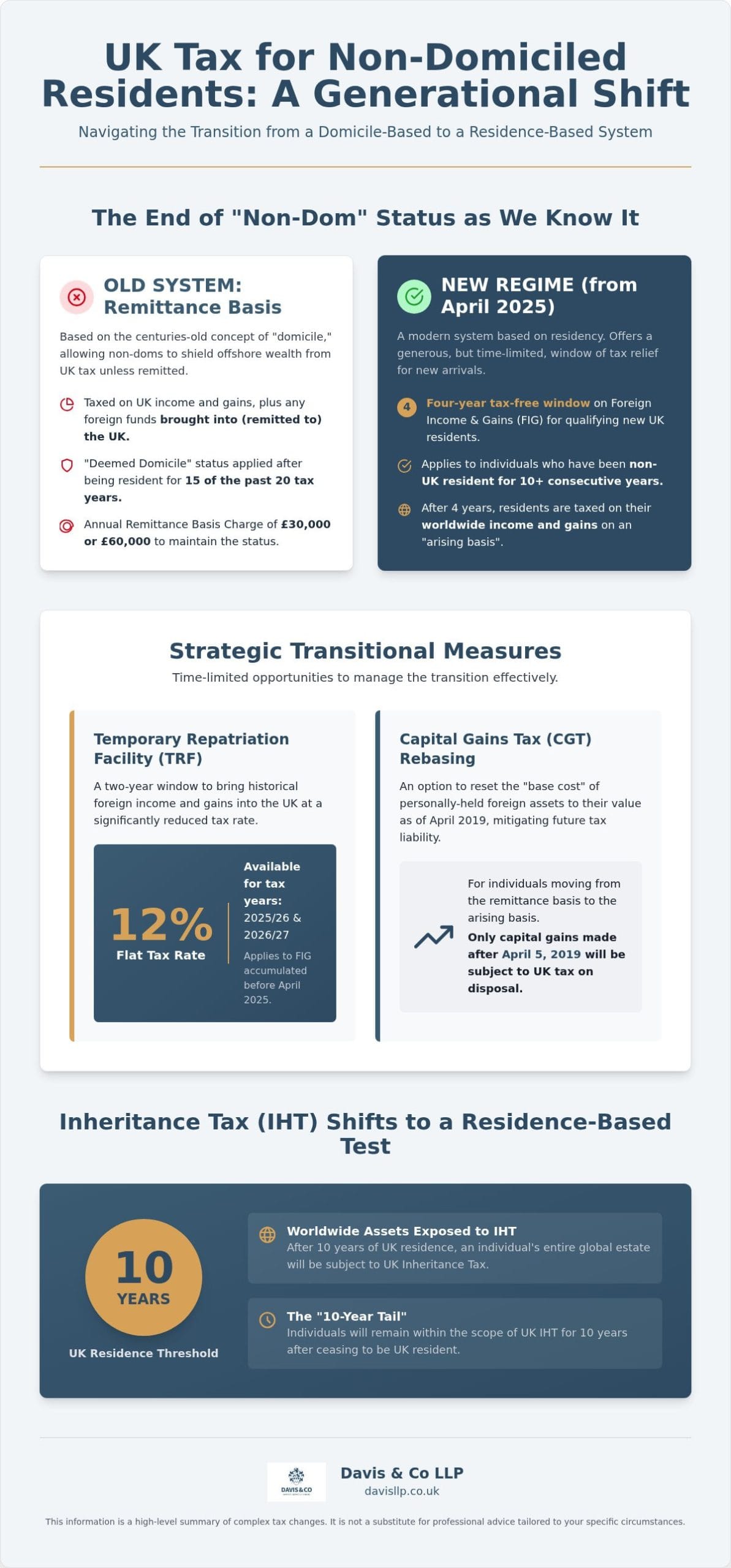
The FIG (Foreign Income and Gains) regime serves as the primary replacement for the old remittance basis. Eligibility is strictly defined; an individual must have been non-UK resident for at least 10 consecutive tax years immediately before their arrival. For those who qualify, the regime provides 100% tax relief on foreign income and gains for their first four years of UK residence. Unlike the previous system, there’s no requirement to keep this money offshore. You can bring foreign wealth into the UK to invest in property or business ventures without additional tax charges. It’s a generous, albeit time-limited, window for strategic capital deployment.
The End of the Remittance Basis of Taxation
The abolition of the remittance basis means the annual £30,000 or £60,000 “remittance basis charge” will cease to exist. However, the treatment of unremitted foreign income and gains generated before April 2025 remains a complex area. These historic funds remain subject to the old rules if brought into the UK later, unless they’re managed through specific transitional facilities. We recommend a thorough audit of existing offshore structures immediately. Reviewing trust deeds and segregating accounts is essential to ensure a clear distinction between historic FIG and new capital. This preparation is vital to avoid accidental tax triggers as we approach the 2026 implementation dates.
The Temporary Repatriation Facility and Capital Gains Rebasing
The Temporary Repatriation Facility (TRF) is a time-limited opportunity to remit pre-2025 foreign income and gains at a reduced tax rate. For many individuals transitioning away from the remittance basis, the TRF provides a strategic window to bring offshore wealth into the UK with significantly lower exposure than standard income tax rates. This facility is particularly relevant as the landscape of uk tax for non domiciled residents shifts towards an arising basis of taxation, requiring a proactive approach to historical wealth management.
Managing this transition involves more than just understanding the new rates; it requires a deep dive into the composition of your offshore accounts. The shift from the remittance basis isn’t merely a change in how you report income, it’s a fundamental change in how your global liquidity is treated by HMRC. Utilising these transitional windows effectively can result in substantial long-term savings.
Steps to Utilise the Temporary Repatriation Facility
Securing the benefits of the TRF requires a methodical approach to identifying historic foreign income and gains (FIG). The facility allows for a flat tax rate of 12% for the 2025/26 and 2026/27 tax years, rising to 15% in 2027/28. To utilise this effectively, you should:
- Identify qualifying foreign income and gains accumulated prior to 6 April 2025 that have not yet been remitted.
- Conduct a comparative analysis of potential tax savings, noting that standard income tax rates can reach up to 45%.
- Ensure the election and payment are made within the strict HMRC deadlines to lock in the 12% rate before it increases.
The official government technical note provides the granular detail necessary for these elections, emphasizing the need for precise record-keeping and account segregation.
Capital Gains Rebasing for Non-Doms
Rebasing offers a vital relief for those who have held foreign assets for many years. Under the new regime, individuals who were previously taxed on the remittance basis may be eligible to rebase personally held foreign assets to their market value as of 5 April 2019. This ensures that only the growth in value after this date is subject to UK Capital Gains Tax upon a future disposal.
This provision is essential for mitigating the impact of losing the remittance basis. Without rebasing, your tax liability could extend back to the original acquisition date, potentially decades ago. We often find that obtaining professional, contemporaneous valuations for international property and private equity portfolios is the most critical step in this process. Ensuring these valuations meet HMRC standards protects against future disputes and provides a clear baseline for your global estate. If you require assistance with these complex calculations, our team provides bespoke international tax planning to secure your transition.
Inheritance Tax Reform: Shifting to a Residence-Based System
The most profound impact of the 2026 reforms lies in the realm of Inheritance Tax (IHT). Historically, IHT exposure for your global estate was tied to the complex concept of domicile; however, this is being replaced by an objective, residence-based test. Under the new framework, an individual’s worldwide assets fall within the scope of UK IHT once they’ve been resident in the UK for 10 out of the previous 20 tax years. This change simplifies the criteria but significantly expands the exposure for many uk tax for non domiciled residents. Consulting the official guidance on non-domiciled tax confirms that this residence-based approach will apply to all assets, regardless of their location.
Strategic planning must also account for the “10-year tail.” Once you’ve met the 10-year residence threshold, you remain subject to UK IHT on your worldwide estate for a further 10 years after you cease to be a UK resident. This provision ensures that a departure from the country won’t immediately shield global assets from the standard 40% tax rate. It demands a long-term perspective on estate management that persists long after you’ve moved elsewhere. The complexity of managing uk tax for non domiciled residents under these rules cannot be overstated, particularly when dealing with multi-jurisdictional assets.
Worldwide Assets and the 10-Year Rule
The 10-year rule fundamentally alters the “excluded property” status that many individuals relied upon for wealth preservation. Previously, assets held in offshore trusts by non-domiciled settlors were often excluded from the UK IHT net. Under the new regime, these protections are being dismantled. If you’ve reached the 10-year residency mark, your global estate, including previously protected offshore holdings, becomes liable. Planning for this transition requires a meticulous review of trust tax services to ensure structures remain compliant under the new transparency rules.
Trusts and the New IHT Framework
The cessation of domicile-based protections means that settlor-interested trusts are now subject to an arising basis of taxation. Income and gains within these structures are taxed on the settlor if they don’t qualify for the four-year FIG regime. This shift requires a strategic restructuring of family offices and private wealth vehicles. Effective international tax planning is no longer about maintaining a status that no longer exists; it’s about navigating the 10-year window and the subsequent “tail” with precision. Early intervention is the only way to mitigate the risk of double taxation on global assets.
Strategic Considerations for New and Existing Residents
The transition from the remittance basis to the 4-year FIG regime represents a fundamental shift in how time is valued within the UK tax system. While the previous system allowed for a 15-year window before deemed domicile status applied, the new regime compresses this into a focused four-year period of relief. This shift requires a more urgent approach to capital management. The removal of the “remittance” requirement simplifies the administrative burden, allowing for the free flow of capital into the UK, yet the brevity of the window demands immediate action. Managing these complexities requires a holistic approach to personal tax services, particularly for those with income streams spanning multiple jurisdictions.
The Statutory Residence Test (SRT) remains the primary mechanism for determining an individual’s tax status. It’s no longer just about the number of days spent in the country; it’s about a nuanced evaluation of ties and intentions. For uk tax for non domiciled residents, understanding the interaction between the SRT and the new FIG rules is critical to ensure that the four-year clock doesn’t start prematurely or that the 10-year non-residence requirement isn’t accidentally compromised.
Planning for New Arrivals
For those moving to the UK after April 2025, pre-arrival planning is the most effective way to secure long-term wealth. You must ensure you meet the 10-year non-residence criteria to qualify for the FIG regime. We recommend structuring income-generating assets before arrival to maximise the four-year tax-free window. This involves documenting your global footprint meticulously to prove eligibility to HMRC. Accidental triggers, such as split-year treatment nuances, can inadvertently shorten your relief period if not managed with precision.
Strategy for Long-Term Residents
Individuals who have already exceeded the four-year residency mark face a different set of challenges. The “stay vs leave” financial impact analysis has become a standard requirement for our high-calibre clients. When the arising basis becomes mandatory, traditional UK tax mitigation strategies become more prominent. Utilising Gift Aid and pension contributions can help manage UK-taxable income levels, but these are often secondary to a broader restructuring of offshore holdings. A comprehensive tax advice UK review is necessary to align your personal objectives with the 2026 legislative reality. To discuss how these changes affect your specific portfolio, please contact our team for a bespoke consultation through our International Tax Planning department.
Bespoke International Tax Planning with Davis & Co LLP
Since 1901, Davis & Co LLP has served as a strategic partner for individuals whose lives and assets span multiple borders. We understand that managing uk tax for non domiciled residents requires more than just technical proficiency; it demands a partner-led approach that prioritises discretion and long-term stability. Our firm, composed of Chartered Certified Accountants, brings over a century of professional gravitas to the challenges posed by the 2026 FIG regime. We don’t view tax planning as a series of isolated transactions, but as a cohesive strategy that integrates your corporate interests with your personal wealth preservation goals.
Our commitment to intellectual rigour ensures that we address the human and organisational impact of complex tax changes. By positioning ourselves as a strategic partner rather than a mere service provider, we offer a sense of reliability that is essential when dealing with sensitive commercial matters. We maintain the necessary distance of a professional expert while fostering a composed partnership that makes our clients feel secure and well-advised.
A Tailored Approach to Cross-Border Wealth
We provide bespoke modelling of tax liabilities under the new framework, ensuring that every variable of your global portfolio is accounted for. For dual-resident individuals, navigating treaty claims becomes a critical component of risk mitigation. Finding a chartered accountant with this specific international expertise is essential for securing your legacy in an era of increased transparency. Our process involves a rigorous analysis of your cross-border exposure, allowing us to build structures that are both compliant and resilient. This highly individualised service delivery is the signature of our client-centric approach, supporting the long-term stability of family offices.
Next Steps for International Residents
The complexity of the upcoming changes necessitates a proactive audit of your current standing. We recommend beginning with a full review of unremitted foreign income and gains accumulated prior to April 2025. This allows us to determine the potential benefits of the Temporary Repatriation Facility before the 12% rate expires. We suggest the following immediate actions:
- Conduct a comprehensive audit of all unremitted foreign income and gains to categorise historic capital.
- Review trust deeds and existing settlement structures to identify latent inheritance tax exposure.
- Evaluate the interaction between corporate holdings and personal tax residency to prevent accidental triggers.
- Schedule a confidential consultation with our partners to develop a strategic roadmap for 2026.
Our rhythmic consistency and steady, deliberate approach help build a sense of trust in an often volatile environment. We invite you to engage with us to ensure your global assets are protected under the new residence-based tax framework.
Strategic Preparation for the Post-Domicile Era
The landscape of uk tax for non domiciled residents has fundamentally transitioned from a system of historical status to one of temporal residency. Navigating this shift effectively requires more than a surface-level understanding of the 2026 reforms; it demands a comprehensive restructuring of how global assets are held and remitted. By leveraging the 12% Temporary Repatriation Facility and the 2019 rebasing provisions, you can mitigate the immediate financial impact of the arising basis of taxation. Davis & Co LLP, founded in 1901, offers the deep-seated expertise and professional gravitas required to manage these sensitive transitions with absolute discretion. As Chartered Certified Accountants specialising in international and trust tax planning, we provide a composed partnership that prioritises your long-term security and intellectual rigour. Ensuring your affairs are compliant with the new ten-year inheritance tax threshold is the final, essential step in preserving your family’s legacy. Secure your international tax strategy with a confidential consultation. We’re ready to assist you in building a stable and well-advised future.
Frequently Asked Questions
What is the new 4-year FIG regime for non-doms in 2026?
The FIG regime replaced the remittance basis on 6 April 2025. It provides qualifying individuals with 100% relief on foreign income and gains for their first four years of UK residence. Unlike the previous system, you can bring these funds into the UK without incurring additional tax charges. It’s important to note that electing for this regime results in the loss of your annual personal income tax allowance and capital gains exemption.
How does the Temporary Repatriation Facility work for existing non-doms?
The Temporary Repatriation Facility allows individuals previously taxed on the remittance basis to bring historic foreign income and gains into the UK at a reduced tax rate. For the 2025/26 and 2026/27 tax years, this rate is 12%. In the 2027/28 tax year, the rate increases to 15%. This facility provides a strategic opportunity to simplify offshore structures and access global liquidity with significantly lower tax exposure than standard rates.
Will I still be taxed on the remittance basis in the 2026/27 tax year?
No, the remittance basis was officially abolished on 6 April 2025. From that date, individuals are either taxed under the new 4-year FIG regime if they qualify or on the arising basis, where worldwide income is subject to UK tax as it’s earned. Transitioning away from the remittance basis is a central challenge in managing uk tax for non domiciled residents, requiring a proactive shift toward a residence-based tax framework.
How many years do I need to be non-resident to qualify for the new tax rules?
To qualify for the 4-year FIG regime, you must have been a non-UK resident for at least 10 consecutive tax years immediately preceding your arrival in the UK. If you meet this requirement, you can claim full relief on foreign income and gains for your first four tax years of residence. This strict 10-year non-residence threshold makes precise pre-arrival planning essential for high-calibre individuals and families considering a move to the United Kingdom.
Does the UK still use ‘domicile’ to determine Inheritance Tax?
The UK has fundamentally moved away from using domicile as the primary trigger for worldwide Inheritance Tax (IHT). Under the residence-based framework, your global estate becomes subject to UK IHT once you’ve been a UK resident for 10 out of the last 20 tax years. While the legal concept of domicile remains in other areas of law, it’s no longer the determining factor for IHT liability. This shift provides a more objective test for status.
What is the 10-year tail in the new UK tax system?
The 10-year tail refers to the period during which an individual remains within the scope of UK Inheritance Tax after departing the country. If you were a UK resident for at least 10 years, your worldwide estate remains liable for UK IHT for up to 10 years after you cease to be resident. This provision ensures that moving abroad doesn’t provide an immediate exit from the UK’s residence-based inheritance tax regime for long-term residents.
Can I still use an offshore trust to protect my assets from UK tax?
The protected settlement regime for offshore trusts ended on 6 April 2025. Income and gains within settlor-interested trusts are now generally taxed on the UK resident settlor on an arising basis unless they qualify for the 4-year FIG regime. This shift requires a thorough review of trust deeds. Many family offices are now restructuring their holdings to adapt to these new transparency and taxation standards for uk tax for non domiciled residents.
How can I legally remit foreign income to the UK after 2025?
New residents under the FIG regime can bring foreign income and gains into the UK tax-free during their first four years. For those with historic unremitted income, the Temporary Repatriation Facility offers a 12% tax rate for remittances made during the 2026/27 tax year. Beyond these specific windows, foreign wealth is generally taxed as it arises. It’s vital to distinguish between new capital and historic offshore gains to ensure you remain compliant with HMRC reporting requirements.