An estimated 133,000 additional UK companies now qualify for reduced reporting requirements following the most significant threshold shift since 2016. For many directors, the “two out of three” rule remains a source of persistent anxiety rather than a clear benchmark. We understand that it’s easy to view a statutory audit as a burdensome cost or a complex compliance hurdle that distracts from your core operations. However, clarity regarding your obligations is the first step toward reclaiming your focus on growth.
This guide provides the precision you need to master the small business audit requirements uk for the 2026 financial year. We’ll help you confirm your exemption status with confidence and demonstrate how strategic assurance can actually drive your business forward. We’ll examine the updated £15 million turnover and £7.5 million balance sheet thresholds, outline the essential filing timelines for Companies House, and provide a clear roadmap for those preparing for their first formal audit. By the end of this article, you’ll have a logical framework to ensure your business remains both compliant and competitive in an evolving regulatory environment.
Key Takeaways
- Understand the updated 2026 small business audit requirements uk, including the increased turnover threshold of £15 million and the £7.5 million balance sheet limit.
- Learn how to apply the “two out of three” rule and the two-year qualification period to accurately determine your company’s exemption status.
- Discover why voluntary audits can serve as a catalyst for growth, enhancing stakeholder confidence and preparing your business for future investment or sale.
- Establish a robust preparation timeline that begins at least three months before your filing deadline to ensure a seamless and efficient audit process.
- Explore how a composed partnership with a strategic advisor can transform statutory compliance into a tool for deep analytical insight and organizational stability.
Understanding the Audit Thresholds for UK Small Businesses in 2026
A statutory audit is an independent, objective examination of a company’s financial statements. Under the Companies Act 2006, this process ensures that accounts provide a true and fair view of the entity’s financial health. For stakeholders such as HMRC and Companies House, the audit acts as a vital layer of verification, confirming that tax obligations and public filings are accurate. While many directors view this as a purely regulatory task, we prefer to frame it as part of a broader “assurance” strategy. Assurance encompasses various levels of financial verification, providing the transparency that lenders and investors often require to support your long-term growth.
The Three Key Criteria for Audit Exemption
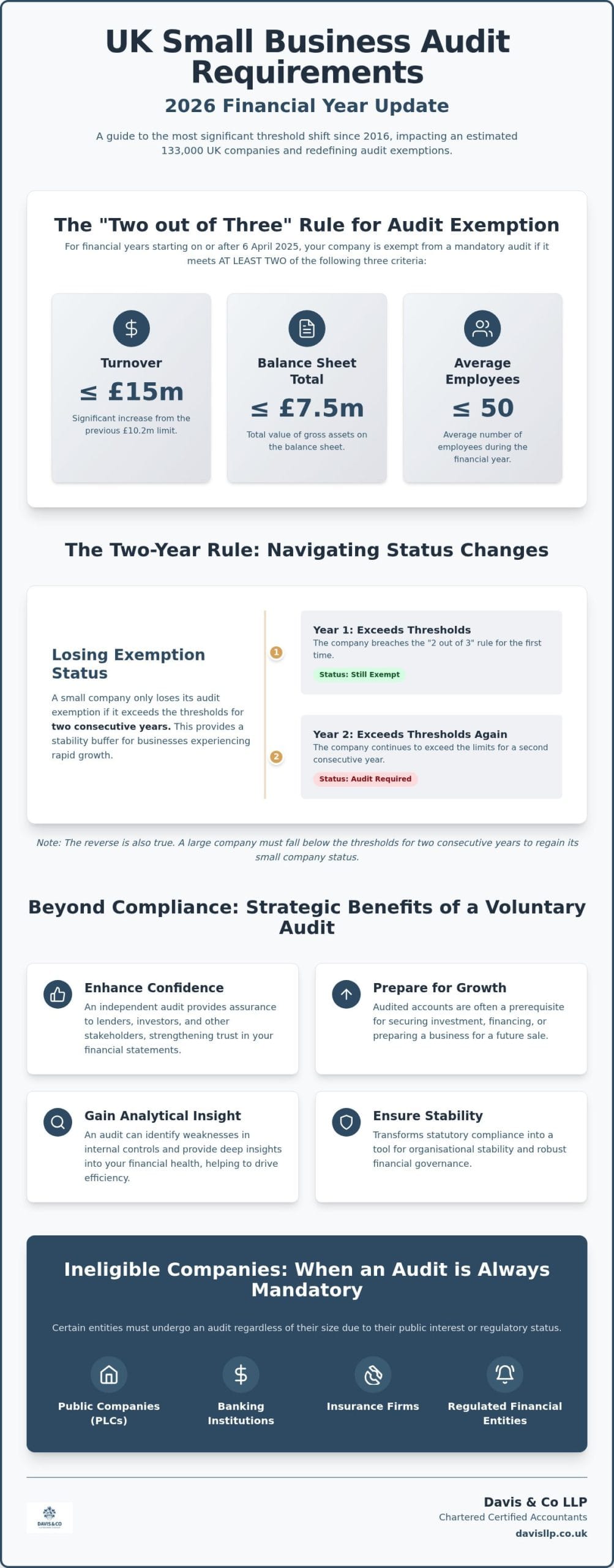
The small business audit requirements uk are governed by a “two out of three” rule. To qualify for an exemption for financial years beginning on or after 6 April 2025, your business must meet at least two of the following thresholds:
- Turnover: Your annual turnover must be no more than £15 million. This represents a significant increase from the previous £10.2 million limit, reflecting a deliberate effort to reduce administrative burdens on growing enterprises.
- Balance Sheet Total: The total value of your gross assets on the balance sheet must not exceed £7.5 million.
- Employee Count: The average number of employees during the financial year must be 50 or fewer.
If your business exceeds two of these markers, a statutory audit becomes mandatory. It’s vital to calculate these figures precisely, as even a minor miscalculation can lead to compliance issues with Companies House. We find that businesses approaching these limits benefit from early planning to ensure their systems are robust enough for the transition to audited accounts.
Ineligible Companies: When Size Doesn’t Matter
Certain entities are precluded from exemption regardless of their financial scale. Public companies, banking institutions, and insurance firms are required to undergo an audit by default due to their heightened public interest and systemic importance. Additionally, if your business is a subsidiary within a larger group that isn’t considered “small,” you may still find yourself subject to these requirements.
An ineligible company is defined under the Companies Act as one that carries out specific regulated activities or belongs to a group containing a public company or a regulated financial entity. We recommend a thorough review of your corporate structure to ensure that group-level complexities don’t inadvertently trigger an audit obligation. This is particularly relevant for businesses with international parents or those operating in niche financial sectors.
The “Two out of Three” Rule: Navigating Audit Exemptions
While the individual thresholds provide a baseline, the application of the small business audit requirements uk depends on how these markers interact. A company is generally exempt if it satisfies at least two of the three criteria: turnover below £15 million, gross assets under £7.5 million, and fewer than 50 employees. However, status isn’t determined by a single year’s performance alone. The “two-year rule” dictates that a company only loses its audit exemption if it exceeds these limits for two consecutive financial years. Conversely, a large company must fall below the thresholds for two years running to regain its small company status.
This buffer provides a period of stability, yet it requires vigilant monitoring. For rapidly growing SMEs, hitting the thresholds in year one is a clear signal that an audit is likely on the horizon. We recommend a proactive review of your management accounts to identify these trends early. If you anticipate crossing the line for a second time, starting the preparation process early prevents a last-minute scramble to meet statutory deadlines. Our team often assists clients with Business Growth Acceleration strategies to ensure compliance doesn’t hinder operational momentum.
Case Study: Crossing the Threshold for the First Time
Consider a scaling technology firm that transitions from micro-entity status to exceeding the small company turnover limit. In the first year it exceeds the threshold, it remains exempt. However, if growth continues into the second year, the firm must appoint a statutory auditor. This appointment should ideally occur well before the financial year-end to allow the auditor to observe year-end procedures, such as physical stocktakes. A significant challenge in a first-year audit is the verification of opening balances. Auditors must gain assurance that the previous year’s closing figures, which form the current year’s starting point, are accurate and reliable.
Group Company Complications
The landscape becomes more complex when a business is part of a larger corporate structure. To determine exemption, you must calculate the aggregate turnover and balance sheet totals for the entire group. If the group as a whole exceeds the small group thresholds, even a dormant subsidiary might require an audit. These calculations often involve adjusting for intercompany transactions to ensure a true representation of the group’s scale. For entities with cross-border interests, international tax planning can significantly influence how group reporting is structured and where audit obligations are triggered. Navigating these group-wide requirements requires a nuanced understanding of both UK and international reporting standards.
Mandatory vs. Voluntary Audits: Strategic Benefits for Growth
The small business audit requirements uk establish the legal minimum, yet adhering solely to the letter of the law can sometimes limit a company’s strategic potential. Many ambitious directors choose to undergo a voluntary audit even when their turnover and assets remain below the statutory thresholds. This decision often stems from a desire to project a level of financial maturity that exceeds the business’s current scale. By opting for an independent examination, you provide an undisputed “clean bill of health” that resonates with external stakeholders, particularly when eye-marking the business for international expansion or a future merger.
Beyond external perception, the audit process serves as a rigorous internal health check. It’s an effective mechanism for detecting internal fraud and identifying systemic vulnerabilities in your financial reporting. While most small business owners trust their internal teams, the objective oversight of an auditor ensures that financial controls are robust and consistently applied. This level of scrutiny transforms the audit from a compliance exercise into a protective asset, safeguarding the business’s capital and reputation as it scales.
Securing Finance and Investor Confidence
Lenders and financial institutions typically operate on a foundation of risk mitigation. While unaudited accounts are acceptable for standard filings, they often invite additional scrutiny during a credit application or a request for increased facilities. Audited financial statements provide a level of assurance that can lead to more favourable borrowing terms or higher credit limits. For those seeking private equity or venture capital, professional assurance is frequently a non-negotiable prerequisite. Investors want to know that the data underpinning their valuation is accurate. Engaging the strategic small business accountant ensures that your financial narrative is supported by the rigour that high-level investors expect.
Improving Operational Efficiency
The true value of an audit often lies in the “Management Letter” provided at the conclusion of the engagement. This document highlights process weaknesses and offers practical recommendations for improvement. For instance, an auditor might identify gaps in your VAT compliance or suggest more efficient ways to handle complex reconciliations. We’ve seen that businesses maintaining regular, high-quality management accounts find the year-end audit process significantly smoother. This disciplined approach to record-keeping doesn’t just satisfy the auditor; it provides the leadership team with more accurate data for daily decision-making, ultimately driving better cash flow and profitability.
Preparing for an Audit: A Checklist for Small Business Owners
Effective preparation for a statutory audit begins long before the auditor arrives on-site. We recommend establishing a clear timeline at least three months prior to your filing deadline. This lead time allows your finance team to resolve discrepancies without the pressure of an impending cut-off. Central to this process is the thorough reconciliation of all major balance sheet accounts. When your bank balances, trade debtors, and creditors are fully reconciled to supporting evidence, the auditor can verify the figures with far greater efficiency.
The shift toward digital record-keeping has fundamentally changed how we approach the small business audit requirements uk. Cloud accounting platforms allow for real-time data access and automated document attachment, which significantly reduces the time spent on manual data entry and retrieval. This digital transparency allows your auditor to focus on high-level analytical review rather than basic transactional verification. Selecting a registered auditor who understands the nuances of the SME landscape is equally critical. You need a partner who recognizes that while your business must meet rigorous standards, the practical realities of a smaller operation require a tailored, pragmatic approach.
The Audit Trail: Documentation and Evidence
An auditor’s primary objective is to obtain sufficient evidence to support the financial statements. You’ll need to prepare a comprehensive suite of documentation, including bank statements, purchase and sales invoices, payroll records, and company minute books. During the substantive testing phase, the auditor will select individual transactions and trace them back to these source documents to ensure accuracy and validity. The audit trail is the sequence of documentation that validates financial entries. Maintaining this trail ensures that every figure on your balance sheet has a verifiable origin, which is the cornerstone of a successful audit.
Internal Controls and Governance
Auditors also evaluate the systems you use to prevent errors and fraud. We suggest reviewing the segregation of duties within your finance function to ensure that no single individual has total control over a financial process. It’s equally important to document your key accounting policies and any significant management judgements, such as the valuation of stock or the treatment of bad debts. Compiling these elements into a robust Year-End File provides the auditor with a logical starting point for their review. If you require assistance in refining these processes, our Audit and Assurance team can provide the strategic guidance necessary to ensure your business is fully prepared.
How Davis & Co LLP Supports Your Statutory Audit and Compliance
Davis & Co LLP approaches the statutory audit not as a seasonal obligation, but as a pivotal component of your long-term commercial strategy. We provide Audit and Assurance services that transcend basic compliance, offering the deep analytical precision required to protect your interests. By positioning the audit within a wider framework of Business Growth Acceleration and Management Accounts, we ensure that the insights gained during the process are used to improve your operational efficiency. It’s a style of composed partnership that prioritises your peace of mind while maintaining the intellectual rigour necessary for high-level financial oversight.
Our firm’s history spans over 120 years, during which we’ve refined our ability to manage the standard small business audit requirements uk alongside highly complex international interests. For UK-based SMEs with cross-border operations, our expertise in International Tax Planning ensures that your group reporting is both compliant and tax-efficient. We understand that transparency is essential for sensitive commercial matters, and we maintain a culture of reliability and discretion in every engagement. We don’t just process figures; we provide a strategic viewpoint that helps you navigate the volatility of the modern market.
Beyond the Numbers: Strategic Assurance
The value of engaging a Chartered Accountant lies in the independent perspective they bring to your organisation. Our audit process identifies specific opportunities for growth acceleration by highlighting areas where capital is underutilised or processes are redundant. We don’t simply verify your past performance; we provide the assurance needed to secure your future. This commitment to clarity ensures that your stakeholders, from shareholders to lenders, have absolute confidence in the integrity of your financial narrative. It’s a level of oversight that adds genuine value to your business valuation.
Next Steps for Your Business
We recommend a proactive review of your current financial status against the 2026 thresholds. If your turnover is approaching £15 million or your gross assets are nearing £7.5 million, early preparation is your most effective tool for maintaining compliance. A preliminary consultation allows us to discuss your audit readiness and identify any gaps in your internal controls before they become regulatory issues. We invite you to contact us for a tailored audit and assurance assessment to discover how our expertise can support your business’s next phase of development.
Securing Your Business Future through Strategic Compliance
Mastering the small business audit requirements uk is about more than avoiding penalties at Companies House. It’s an opportunity to establish a foundation of financial integrity that supports your long-term ambitions. By understanding the updated 2026 thresholds and the “two-year rule,” you can accurately assess your exemption status while preparing for the inevitable transitions that follow successful growth. Whether you’re nearing the £15 million turnover limit or choosing a voluntary audit to attract international investment, professional assurance remains a powerful tool for commercial stability.
As Chartered Certified Accountants with a history dating back to 1901, we provide the deep-seated expertise required to manage complex cross-border interests and accelerate business growth. We invite you to Consult Davis & Co LLP for Expert Audit and Assurance Services to ensure your reporting is both precise and strategically aligned with your objectives. Our team is dedicated to a composed, professional partnership that makes you feel secure and well-advised at every stage of your journey. With the right guidance, compliance becomes a catalyst for your next major milestone.
Frequently Asked Questions
What are the current UK small business audit thresholds for 2026?
For financial years beginning on or after 6 April 2025, a company is generally exempt if it meets at least two of the following criteria: turnover not exceeding £15 million, a balance sheet total under £7.5 million, and an average of 50 or fewer employees. These small business audit requirements uk are significantly higher than previous years. You must meet these criteria for two consecutive years to change your company’s audit status.
Can shareholders request an audit if the company is exempt?
Yes, shareholders holding at least 10% of the nominal value of a company’s shares or 10% of any class of shares can formally request an audit. This request must be made in writing and sent to the company’s registered office at least one month before the end of the financial year. This provision ensures that minority shareholders can obtain independent assurance even if the directors initially opt for an exemption.
How long does a small business audit typically take to complete?
The duration of an audit varies depending on the complexity of the business and the quality of the records provided. Typically, the fieldwork phase takes between one and three weeks. However, the entire process, including planning, testing, and final reporting, often spans several months. We recommend starting the planning process at least three months before your filing deadline to allow for a thorough and unhurried examination of your financial records.
What happens if a company fails to file audited accounts on time?
Filing accounts late with Companies House results in automatic civil penalties. These fines range from £150 for accounts up to one month late to £1,500 for accounts more than six months late; these amounts double if the accounts are late for two consecutive years. Beyond financial penalties, late filing can damage your credit rating and alert HMRC to potential compliance issues, which might trigger an investigation into your tax affairs.
Is a voluntary audit worth the investment for a growing SME?
A voluntary audit often provides a significant return on investment by enhancing stakeholder confidence and preparing the business for future growth. It signals financial maturity to lenders and potential investors, which can lead to better borrowing terms or higher valuations during a sale. Additionally, the process identifies internal control weaknesses. While there’s an upfront cost, the long-term benefits of strategic assurance and process improvement frequently outweigh the initial professional fees.
Do subsidiary companies always need an audit if the parent company does?
Not necessarily, but it depends on the group’s overall size and the subsidiary’s specific circumstances. If the entire group qualifies as “small” based on aggregated thresholds, the subsidiary may be exempt. However, if the group is large or medium-sized, the subsidiary usually requires an audit unless it qualifies for a specific parent company guarantee exemption. We often review group structures to determine the most efficient compliance path for each individual entity within the group structure.
What is the difference between an audit and an independent examination?
An audit is a high-level assurance engagement providing a “true and fair” opinion on financial statements, whereas an independent examination is a less rigorous review primarily used by smaller charities. Audits involve extensive testing of internal controls and transaction sampling to provide a high level of confidence to external stakeholders. Independent examinations focus on ensuring accounts match the underlying records without the deep analytical scrutiny and verification procedures required in a statutory audit.
How can I find out if my business is classified as “ineligible” for audit exemption?
Ineligibility is determined by the nature of your business activities rather than just your financial size. Public companies, banks, insurance firms, and entities authorised by the Financial Conduct Authority are automatically ineligible for exemption. If your business is part of a group that includes an ineligible entity, the entire group may lose its exemption. We recommend a formal review of your articles of association and regulatory status to confirm your classification under the Companies Act.