Since the introduction of 20% VAT on private school fees in 2025, the average cost of a day school education has climbed to approximately £22,000 per year. For families facing additional rate income tax of 45%, using trusts for school fees planning has transitioned from a niche luxury to a core financial necessity. We recognize that the financial burden of private education now requires a more sophisticated approach to preserve your family’s educational legacy without compromising your broader estate planning goals.
This guide demonstrates how tailored trust structures can mitigate these rising costs, potentially reducing the effective expense of fees by 20% to 40% through tax-efficient wealth transfer. We’ll explore how utilizing a child’s £12,570 personal allowance and leveraging grandparental support can transform your approach to education funding. We provide a clear analysis of bare and discretionary trusts, explaining how these vehicles serve as essential tax-mitigation engines in the current regulatory environment.
Key Takeaways
- Understand why funding private education from post-tax income is increasingly inefficient in the 2026 landscape and how to transition toward a more sustainable capital-led model.
- Compare the benefits of Bare Trusts and Discretionary Trusts to determine the optimal balance between immediate tax transparency and long-term control over asset distribution.
- Learn the technical requirements for using trusts for school fees planning to effectively utilize a child’s £12,570 personal allowance and the current dividend thresholds.
- Discover how business owners can integrate trust structures with family-owned company shares to direct corporate distributions toward educational costs with maximum tax efficiency.
- Recognize the necessity of rigorous trust compliance, including the management of annual tax returns and trustee minutes, to maintain the integrity of your family’s financial strategy.
The 2026 Landscape: Why School Fees Planning Requires Trusts
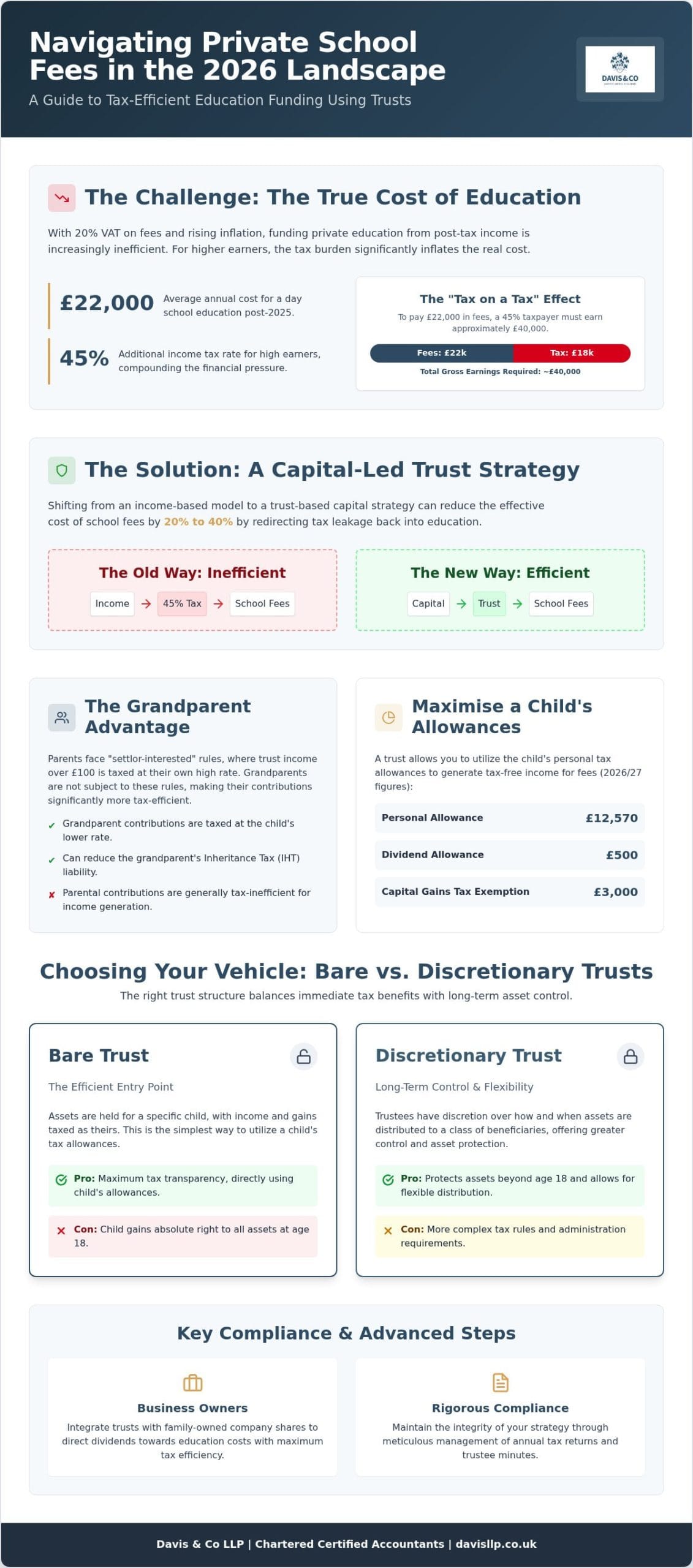
The environment for private education has shifted fundamentally since the introduction of VAT on tuition and boarding fees. In 2026, families are no longer just adjusting to a one-off price hike; they are managing a permanent increase in the cost of living for their children. For high earners, the financial math is daunting. To pay £22,000 in average day school fees from an additional-rate tax bracket of 45%, an individual must earn roughly £40,000 gross. This “tax on a tax” makes funding education from personal income increasingly unsustainable. By using trusts for school fees planning, families can redirect this tax leakage back into the classroom.
Success in this environment requires a move away from short-term cash flow management toward long-term capital efficiency. Before implementing complex structures, understanding the basics of trust law is helpful to appreciate how legal ownership is separated from beneficial enjoyment. This separation allows assets to generate income that is taxed at the child’s lower rates rather than the parents’ higher ones. The “Grandparent Advantage” remains the cornerstone of 2026 planning. While parents are restricted by settlor-interested rules, which tax trust income as the parent’s if it exceeds £100, grandparents face no such hurdle. This allows for a clean, tax-efficient transfer of wealth that serves as a hedge against educational inflation.
The True Cost of Private Education in 2026
The initial VAT shock of 2025 has been compounded by standard fee inflation, which historically outpaces the Consumer Price Index. Traditional savings accounts and ISAs, while useful, often lack the scale required to meet a £250,000 to £700,000 lifetime commitment per child. We’ve seen that relying on post-tax earnings alone creates a significant drag on a family’s liquidity. A strategic trust structure doesn’t just save on the headline cost; it preserves the family’s core capital by utilizing the tax-free personal allowances of the beneficiaries.
Intergenerational Wealth Transfer as a Solution
Intergenerational planning allows families to address two challenges at once: rising school fees and potential Inheritance Tax (IHT) liabilities. When grandparents fund a trust, they can often utilize the “normal expenditure out of income” exemption, which allows for unlimited gifts that are immediately exempt from IHT, provided they don’t diminish the donor’s standard of living. This strategy reduces the grandparent’s taxable estate, which might otherwise be taxed at 40% above the £325,000 nil-rate band. It’s a method of using trusts for school fees planning that benefits three generations simultaneously, ensuring the educational legacy is secured while the family’s overall tax footprint is minimized.
Mechanisms of Control: Bare Trusts vs. Discretionary Trusts
Choosing the appropriate legal vehicle is the most critical decision when using trusts for school fees planning. The choice dictates not only the immediate tax efficiency but also the level of control you retain over the capital. While international peers might consider how trusts compare to 529 plans, UK families must navigate the specific distinction between bare and discretionary structures. Each serves a distinct purpose within a long-term educational strategy.
Bare Trusts: The Efficient Entry Point
A bare trust is the simplest form of trust, where assets are held by trustees for the absolute benefit of a specific child. For tax purposes, the Inland Revenue treats the income and capital gains as belonging directly to the beneficiary. This transparency is highly advantageous. It allows the trust to utilize the child’s full £12,570 personal allowance for the 2026/27 tax year, alongside their £3,000 capital gains tax exemption and £500 dividend allowance. For many, this effectively makes the income used for school fees tax-free.
However, this simplicity comes with a significant caveat. At age 18 in England and Wales, the child gains an absolute right to the trust assets. They can demand the capital be transferred to them, regardless of the trustees’ original intentions. This “age 18 rule” means bare trusts are often best suited for funding immediate primary and secondary education costs rather than holding vast sums intended for later life. If you require more robust oversight, our Trust Tax Services can help you evaluate if this risk aligns with your family’s objectives.
Discretionary Trusts: The Strategic Powerhouse
Discretionary trusts offer a much higher degree of flexibility and protection. Here, the trustees have the power to decide which beneficiaries receive payments, when those payments are made, and in what amounts. This structure is ideal for families with multiple grandchildren or those who wish to maintain control over the capital well beyond the child’s 18th birthday. It prevents a young adult from accessing the entire fund prematurely, ensuring the money remains dedicated to its educational purpose.
The trade-off for this control is a more complex tax regime. Discretionary trusts are subject to the “relevant property” regime, which includes potential entry charges, ten-yearly periodic charges, and exit charges when capital is distributed. Furthermore, income within the trust is initially taxed at the trust rate of 45% for non-dividend income and 39.35% for dividends. While the beneficiary can often reclaim this tax if they are a non-taxpayer, the administrative burden is higher. Choosing between these vehicles depends on the total fund size and the number of generations you intend to support.
Maximising Tax Efficiency Through Personal Allowances
The primary financial driver for using trusts for school fees planning is the ability to shift income from a high-tax environment to one that is virtually tax-free. When a high-earning parent pays fees from their salary, they’re using income that has already been eroded by 45% tax and National Insurance. By contrast, a trust allows income to be taxed in the hands of the child. To achieve this, the identity of the settlor is paramount. If a parent settles funds for a minor child, any income over £100 is taxed as the parent’s income. However, when grandparents act as settlors, this “parental settlement” rule doesn’t apply, allowing the child’s full tax-free threshold to be utilised.
By routing investment income through a trust, a child’s £12,570 personal allowance can be fully exhausted before any tax is due. This is further enhanced by the £500 dividend allowance and the personal savings allowance. In a discretionary trust, the process involves the trust paying tax at 45% on non-dividend income, which is then “passed through” to the child with a tax credit. The child, typically having no other significant income, can then reclaim this tax from HMRC using an R40 form. This mechanism ensures that the capital remains productive while the tax leakage is systematically recovered.
The Mathematics of Tax Savings
The disparity between an additional-rate taxpayer and a child with no other income creates a powerful compounding effect over time. Grossing up describes the process of calculating the pre-tax earnings required to cover a net cost; for an additional-rate taxpayer, this means earning nearly £1.82 for every £1 spent on fees. When we consider a seven-year secondary education with fees of £22,000 per year, the total gross income required from a parent is approximately £280,000. By contrast, a trust-funded model utilising a child’s allowance can reduce the required gross income by over £100,000 across the same period. This calculation doesn’t account for the potential growth of the trust assets, which further widens the gap between traditional funding and trust-based planning.
Inheritance Tax (IHT) Synergies
Beyond immediate income tax savings, these structures offer profound Benefits of Education Trusts regarding asset protection and estate reduction. Gifts into a bare trust are treated as Potentially Exempt Transfers (PETs), meaning they fall entirely outside the grandparent’s estate if they survive for seven years. For those preferring a discretionary trust, the £325,000 Nil Rate Band (NRB) can be utilised every seven years to settle assets without an immediate 20% lifetime IHT charge. This strategy allows a family to remove both the initial capital and all future growth from their taxable estate, ensuring that wealth is preserved for the next generation’s education rather than being claimed by the Treasury.
Advanced Planning: Trusts and Family-Owned Businesses
For entrepreneurs and directors of private limited companies, the synergy between corporate governance and personal wealth management offers a highly effective route for education funding. By integrating trust planning with corporate share structures, business owners can bypass the inefficiency of drawing personal dividends to pay school fees. This approach involves using trusts for school fees planning as a direct recipient of company distributions, ensuring that the capital remains within the family’s control while significantly lowering the tax burden.
A common mechanism involves the creation of “Alphabet Shares.” This strategy allows a company to issue different classes of shares, such as Class A or Class B, to a trust. By doing so, the directors can declare dividends on the trust’s specific share class without being compelled to pay equivalent amounts to all other shareholders. For larger estates, implementing a Family Investment Company (FIC) as a long-term funding vehicle provides even greater flexibility. The FIC acts as a corporate wrapper where the trust holds the growth shares, allowing the family to manage multi-generational educational costs through a single, professionally managed entity.
Step-by-Step Implementation for Business Owners
Strategic implementation requires a methodical approach to ensure both legal and fiscal robustness. We typically follow a structured four-step process for our clients:
- Step 1: Review the existing Articles of Association to ensure the company has the power to issue multiple share classes.
- Step 2: Create a new class of shares specifically designed for the trust, often with restricted voting rights to maintain founder control.
- Step 3: Settle these shares into a Discretionary or Bare Trust, ideally with grandparents acting as settlors to avoid the parental settlement trap.
- Step 4: Manage dividend declarations in alignment with school fee cycles, ensuring the company’s distributable reserves are sufficient.
Navigating HMRC Anti-Avoidance Rules
While these structures are highly efficient, they must be managed with absolute precision to withstand HMRC scrutiny. The “Settlements Legislation” found in ITTOIA 2005 is designed to prevent arrangements where a person seeks to divert income to others to reduce their tax liability. HMRC often looks for “substance over form,” meaning the arrangement must have genuine commercial reality and cannot be a mere “bounty” from parent to child. A professional valuation of shares is critical before settlement to establish a fair market value and avoid unintended capital gains or IHT consequences. To ensure your business structure is fully compliant, our Trust Tax Services provide the necessary technical oversight for these complex arrangements.
The Davis & Co Approach to Educational Trust Management
At Davis & Co LLP, we approach the management of educational funds with a perspective honed over a century of practice. We recognize that using trusts for school fees planning is not a static exercise; it’s a dynamic strategy that requires meticulous oversight to remain effective. We don’t merely provide a structure; we act as a strategic partner to ensure that the initial tax benefits are maintained through changing market conditions and legislative updates. Our role is to provide the technical foundation that allows your family’s educational goals to be met with absolute financial efficiency.
Our methodology prioritizes rigorous ongoing compliance. This includes the preparation of annual trust tax returns and the recording of formal trustee minutes to document distribution decisions. These administrative steps are essential to demonstrate that the trust is operating as a genuine legal entity, particularly when utilizing the child’s £12,570 personal allowance or the corporate share structures discussed in previous sections. We often integrate these vehicles with broader international tax planning for families with global assets or cross-border residency. Navigating the 2026 fiscal environment requires the precision of a Chartered Accountant who understands the complex interplay between trust law, corporate distributions, and multi-generational tax liabilities.
A Partnership for Perpetual Planning
We move beyond transactional advice to focus on annual tax optimization. Our team coordinates closely with legal professionals to ensure trust deeds are drafted with the necessary flexibility to accommodate future grandchildren or changes in educational requirements. This collaborative approach ensures that your plan remains robust against shifts in UK tax policy, providing a stable foundation for your family’s future. We believe that a successful trust should evolve alongside your family, adapting to new challenges while preserving core capital.
Securing Your Family’s Educational Legacy
The ultimate objective of our partnership is the peace of mind that comes from knowing your children’s or grandchildren’s education is financially ring-fenced. By delegating the technical complexities of trust management to our specialists, you can focus on the personal impact of your family’s legacy. We provide the clarity and discretion required to handle sensitive financial matters with the gravitas they deserve. If you’re ready to explore a bespoke strategy for your family, scheduling a confidential consultation is the first step toward securing Expert Tax Advice in the UK.
Securing Your Educational Legacy in a Shifting Fiscal Environment
The fiscal landscape of 2026 demands a transition from reactive payments to proactive, structural wealth management. We’ve explored how the 20% VAT on fees has fundamentally reshaped the cost of private education, making it essential to move away from funding tuition solely through post-tax income. By using trusts for school fees planning, you can effectively harness the personal allowances of the next generation and integrate corporate distributions into a cohesive, multi-generational strategy.
Since 1901, Davis & Co LLP has acted as a strategic partner for high-net-worth families, providing the expert trust tax services and strategic international tax planning required to manage complex compliance. Whether you’re navigating the nuances of alphabet shares or seeking to utilize the “Grandparent Advantage” to reduce your taxable estate, our professional oversight ensures your plan remains robust against future regulatory shifts. We’re here to ensure your family’s capital remains focused on the long-term success of your children.
Your family’s educational legacy is too significant to be left to chance. Consult our trust tax specialists to protect your family’s educational future and secure a stable, tax-efficient path forward.
Frequently Asked Questions
Can I set up a trust for my own children to pay their school fees?
Yes, you can, but it’s rarely the most tax-efficient route. Under the parental settlement rules, if the trust income exceeds £100 per year, HMRC treats that income as your own for tax purposes. This negates the benefit of using the child’s personal allowance. For this reason, most families find that grandparents acting as settlors provide a much more effective foundation for using trusts for school fees planning.
How much does it cost to set up and maintain a school fees trust in 2026?
Professional fees for establishing a trust in 2026 depend on the complexity of the assets and the specific structure chosen. Initial costs typically cover the drafting of the trust deed and registration with the Trust Registration Service. Ongoing maintenance involves preparing annual trust accounts and tax returns to ensure compliance. While we don’t provide fixed estimates here, the long-term tax savings often significantly outweigh the administrative expenditure required for professional oversight.
What happens to the money in a bare trust if the child does not go to university?
In a bare trust, the child gains absolute entitlement to the capital and income at age 18. If they choose not to attend university, the funds remain theirs to use as they see fit, whether for a property deposit or business venture. Trustees no longer have the legal power to withhold the money once the beneficiary reaches adulthood. This underscores why some families prefer the restricted access provided by discretionary structures.
Is there a limit to how much a grandparent can put into an educational trust?
Grandparents can settle any amount, but the structure determines the immediate tax impact. For discretionary trusts, transfers exceeding the £325,000 Nil Rate Band may trigger an immediate 20% lifetime inheritance tax charge. However, bare trusts are treated as Potentially Exempt Transfers with no upper limit. Additionally, regular gifts made from normal expenditure out of income can often be settled without utilizing any of the grandparent’s nil-rate allowance.
Can a trust be used to pay for extra-curricular activities or boarding costs?
Most trust deeds are drafted with broad powers that allow trustees to cover a wide range of educational costs. This includes boarding fees, which now average between £42,500 and £54,000 per year including VAT. Beyond tuition, trust funds can typically be used for music lessons, sports equipment, and educational travel. We recommend ensuring the trust deed specifically defines education widely enough to encompass these essential elements of a private school experience.
How does the 2025 VAT change affect existing trusts established years ago?
The 2025 VAT introduction has significantly increased the burn rate of capital in existing trusts. A fund originally calculated to last through a child’s entire secondary education may now face a shortfall of approximately 14% to 20% due to the added tax burden on fees. Many families are currently reviewing their trust assets to determine if additional capital injections are required to meet these permanent increases in educational costs.
Do I need to inform HMRC every time the trust pays a school fee invoice?
You don’t need to notify HMRC of individual invoice payments made to a school. Instead, the trust’s financial activity is reported collectively through the annual Trust Tax Return (SA900). Trustees must also ensure the trust is recorded on the Trust Registration Service and kept up to date. While the day-to-day payments are private, using trusts for school fees planning requires rigorous record-keeping of trustee meetings and distribution resolutions to maintain the trust’s tax-efficient status.
What are the tax implications if the settlor dies within seven years of gifting?
If a settlor dies within seven years of making a gift into a bare trust, the value of that gift is brought back into their estate for Inheritance Tax purposes. Taper relief may reduce the tax rate if the settlor survives at least three years after the gift. For discretionary trusts, a death within seven years can result in a recalculation of the tax due on the initial settlement, potentially leading to additional liabilities for the estate.