Could the administrative simplicity of your tax reporting be masking a significant financial inefficiency? For many UK directors, assessing vat flat rate scheme eligibility was once a straightforward task, yet the introduction of the Limited Cost Trader category has fundamentally altered the arithmetic of compliance. You likely chose this path to avoid the granular burden of tracking every purchase receipt, seeking instead the predictable rhythm of a single percentage to protect your time.
We recognize that the fear of an HMRC sector misclassification or an unexpected 16.5% rate trap can create unnecessary friction in your strategic planning. This article provides a definitive checklist to help you navigate these complexities with the composure of a well-advised professional. We’ll examine the £150,000 entry threshold, the strict definition of relevant goods, and how Making Tax Digital has narrowed the functional gap between accounting methods. You’ll gain a clear framework to decide whether the flat rate remains a viable component of your cash flow management or if a transition to standard VAT accounting is now the more prudent choice for your business’s growth.
Key Takeaways
- Determine your vat flat rate scheme eligibility by accurately calculating expected turnover against the £150,000 threshold using a forward-looking 12-month perspective.
- Navigate the ‘Limited Cost Trader’ test by identifying if your expenditure on relevant goods falls below 2% of your gross turnover, which triggers a mandatory 16.5% rate.
- Ensure sector-specific compliance by applying the ‘Main Business Activity’ rule to determine your flat rate category when your operations span multiple trades.
- Protect your business from HMRC penalties by monitoring the £230,000 exit threshold and understanding the mandatory requirements for leaving the scheme as you scale.
- Shift your focus from administrative convenience to strategic cash flow management by identifying the precise point where standard VAT accounting offers superior financial benefits.
What is the VAT Flat Rate Scheme and Why Does Eligibility Matter?
The VAT Flat Rate Scheme (FRS) represents a simplified method for small businesses to manage their obligations within the broader UK value-added tax framework. Under standard VAT accounting, a business must calculate the exact difference between the VAT charged to customers and the VAT paid to suppliers. The FRS replaces this granular calculation with a single, sector-specific percentage applied to your gross turnover. While HMRC designed the scheme to reduce the administrative burden of record-keeping, its financial impact varies significantly depending on your business model.
Securing and maintaining vat flat rate scheme eligibility requires a proactive approach. In a volatile economic climate, the thin margin between a tax saving and a tax loss can shift quickly. We view VAT not merely as a compliance hurdle, but as a critical element of Cash Flow Management. A business with minimal reclaimable expenses often finds the flat rate advantageous. Conversely, those with high operational costs might find they are inadvertently subsidizing their tax bill by remaining in a scheme that no longer serves their financial interests. Regular eligibility audits are essential to ensure your tax structure remains efficient as your turnover scales.
The Core Concept: Gross Turnover Percentages
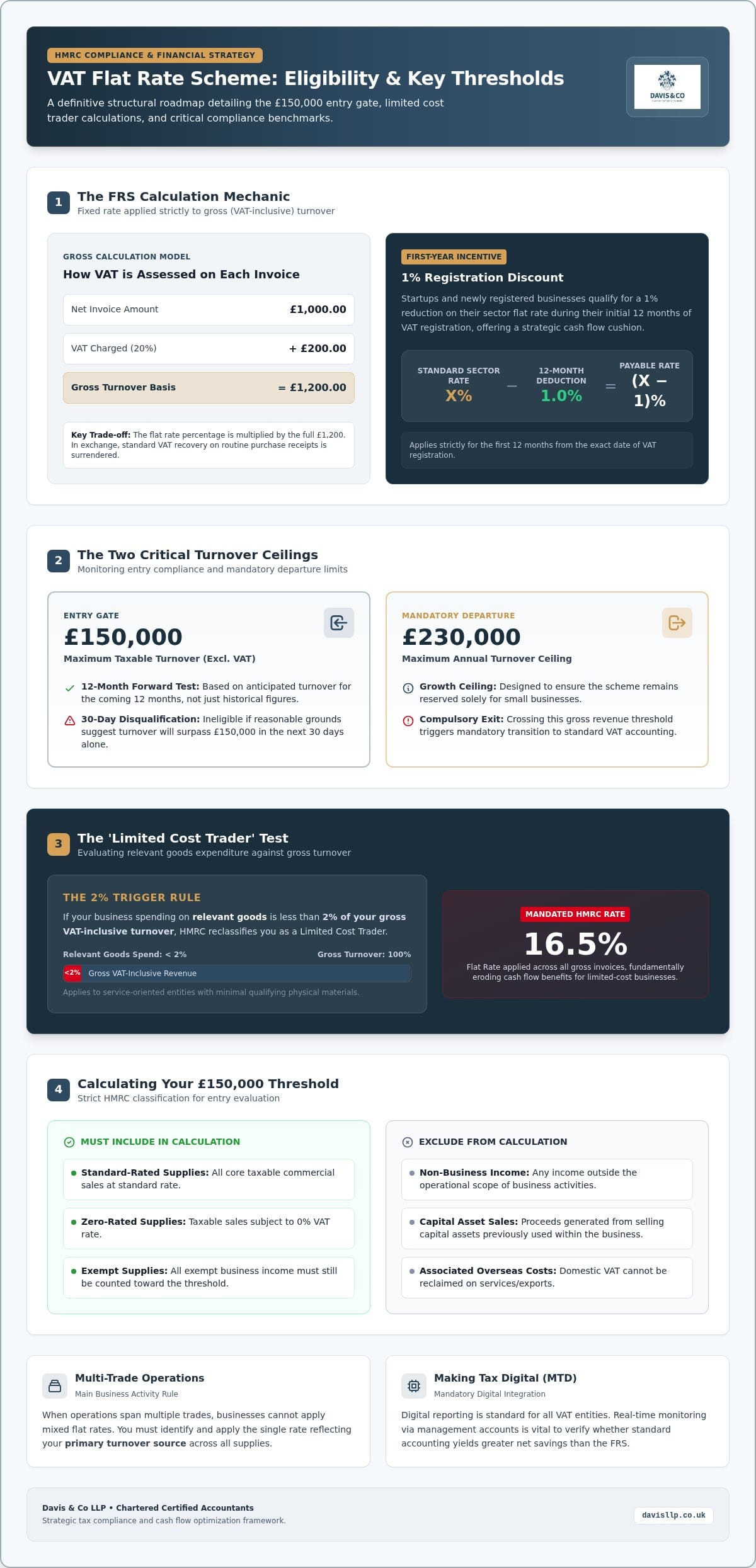
The defining mechanic of the FRS is that the flat rate applies to your VAT-inclusive turnover. If you invoice a client for £1,000 plus £200 VAT, your flat rate is calculated on the full £1,200. This is a fundamental shift from standard accounting. You trade the right to reclaim VAT on most business purchases for the simplicity of this fixed rate. Startups should note that a 1% discount applies to their flat rate during the first 12 months of VAT registration. This introductory period often provides a vital cash flow cushion during the early stages of business growth, provided the sector rate is chosen accurately.
VAT Compliance in the Age of Making Tax Digital (MTD)
By 2026, digital record-keeping is a mandatory reality for all VAT-registered entities. The FRS integrates with MTD requirements, but the perceived simplicity of the scheme can lead to a false sense of security. While modern software can automate basic arithmetic, it cannot provide the strategic oversight necessary to ensure you remain in the most efficient VAT position. We believe that robust management accounts are essential for this purpose. They allow us to monitor your expenditure-to-turnover ratios in real time. This ensures that your chosen VAT method aligns with your broader commercial objectives rather than just satisfying a filing deadline.
The Entry Threshold Checklist: Can Your Business Join?
To establish your vat flat rate scheme eligibility, you must first verify that your taxable turnover, excluding VAT, is expected to be £150,000 or less over the next 12 months. This threshold acts as a strict entry gate for the scheme. However, the calculation isn’t always as simple as reviewing your previous year’s accounts. HMRC applies a forward-looking test: if there are reasonable grounds to believe your turnover will exceed £150,000 in the next 30 days alone, you are prohibited from joining. This proactive assessment ensures the scheme remains reserved for small businesses as originally intended.
Calculating Your Taxable Turnover Correctly
When assessing the £150,000 limit, you must include the value of all standard-rated, zero-rated, and exempt supplies. It’s a common misconception that exempt income should be omitted. In reality, it must be factored into the entry calculation. Conversely, you should exclude any non-business income and the sale of capital assets that you’ve previously used in the business. According to the GOV.UK VAT Flat Rate Scheme guidance, HMRC’s primary test for entry is whether you have reasonable grounds to believe your taxable turnover in the next twelve months will exceed the threshold. For businesses engaged in international tax planning, this calculation requires particular care. If a significant portion of your revenue is derived from exports or services provided to overseas clients, the FRS may simplify your filing but could lead to a higher tax liability because you cannot reclaim VAT on the associated domestic costs.
Specific Exclusions and Anti-Avoidance Rules
The ‘Associated Businesses’ rule serves as a significant hurdle for serial entrepreneurs. If your business is associated with another company, for instance, if they are under common control or have shared economic links, you are barred from joining the scheme. This prevents firms from artificially splitting a large operation into smaller entities to stay under the £150,000 limit. HMRC has increased its scrutiny of such ‘artificial separation’ for VAT purposes, viewing it as a form of tax avoidance. Navigating these structural nuances is where seeking expert tax advice in the UK becomes indispensable. We often assist clients in evaluating their corporate structure to ensure they remain compliant while optimizing their VAT position. If you are unsure how your group registrations or international operations impact your status, our team can provide a tailored strategic tax review to clarify your options and confirm your vat flat rate scheme eligibility.
The ‘Limited Cost Trader’ Test: A Critical Eligibility Hurdle
The ‘Limited Cost Trader’ rule remains the most significant barrier to financial efficiency within the scheme. HMRC introduced this measure to curb the perceived advantage held by high-margin service businesses that had few overheads but collected standard-rate VAT. If your business is classified as a limited cost trader, your vat flat rate scheme eligibility is technically intact, but the fiscal benefit almost evaporates. You’re required to apply a 16.5% rate to your gross turnover. When you consider that this equates to 19.8% of your net sales, the remaining 0.2% margin is rarely enough to cover the input tax you’ve forfeited the right to reclaim. For most, this is the point where standard VAT accounting becomes the more logical choice for cash flow management.
What Counts as ‘Relevant Goods’ in 2026?
To avoid the 16.5% rate, your expenditure on ‘relevant goods’ must exceed 2% of your turnover. However, the definition of these goods is notoriously narrow. They must be tangible items used exclusively for business purposes. Professional services, including legal and accounting fees, are strictly classified as services and cannot be used to meet the 2% threshold. We’ve compiled a brief checklist of common items to help you distinguish between them:
- Included: Stationery, physical stock for resale, and small tools used in trade.
- Excluded: Services such as rent, software subscriptions (SaaS), and virtual office costs.
- Excluded: Capital expenditure items like laptops or machinery, motor fuel (unless you’re in the transport sector), and food or drink for staff.
The Calculation: 2% of Turnover or £250 per Quarter
You must perform the limited cost test every quarter during your VAT return preparation. If your expenditure on relevant goods is less than 2% of your VAT-inclusive turnover, or more than 2% but less than £250 in that quarter, you must use the 16.5% rate. This creates a volatile environment for consultants and dental professionals who may have fluctuating supply costs. For a dental practice, clinical supplies usually count as relevant goods, but if a quiet quarter drops spending below the £250 floor, the tax bill spikes significantly. Falling into this category for even a single quarter can negate any administrative savings the scheme provides. We ensure our clients’ vat flat rate scheme eligibility is monitored through precise bookkeeping by Davis & Co LLP, preventing these sudden, costly transitions and ensuring your tax strategy remains robust.
Sector-Specific Rates and Choosing the Correct Category
Once you’ve confirmed your vat flat rate scheme eligibility based on turnover, the next strategic decision involves selecting the correct sector category. HMRC provides a comprehensive list of rates, ranging from 4% for certain retailers to 14.5% for architects and IT consultants. The choice you make determines the exact percentage of gross turnover you’ll remit to HMRC. Startups should also account for the first-year 1% discount. This incentive applies for the initial 12 months of your VAT registration, providing a modest but welcome boost to your early-stage cash flow. It’s vital to remember that this discount expires exactly one year from your registration date, regardless of when you actually joined the Flat Rate Scheme.
Navigating Hybrid Business Models
Many modern enterprises don’t fit neatly into a single HMRC box. If your business generates income from multiple activities, you must apply the ‘Main Business Activity’ rule. This requires you to identify which trade represents the highest percentage of your total turnover. For example, a company providing both structural engineering and general building services must choose the rate that reflects its primary revenue source. Incorrectly selecting a lower-rated category is a common pitfall that triggers HMRC penalties and back-dated VAT liabilities. As a dental tax specialist, we frequently work with clinicians who offer both exempt healthcare and taxable aesthetic treatments. We ensure their sector mapping is precise, protecting them from the risks of misclassification while optimizing their tax position.
The Impact of 2026 Regulatory Updates
Maintaining vat flat rate scheme eligibility requires an awareness of the shifting regulatory landscape. While the 2025 and 2026 budgets haven’t introduced drastic changes to the flat rate percentages themselves, the broader economic context has evolved. Persistent inflation can erode the administrative benefits of the scheme, especially as the cost of ‘relevant goods’ increases relative to your service fees. If your expenditure patterns shift, you may inadvertently fall into the 16.5% limited cost trader category we examined previously. This is why regular reviews with a chartered accountant are non-negotiable. We provide the intellectual rigour needed to assess whether your current VAT method still aligns with your long-term commercial goals. If you’re unsure if your sector classification remains accurate under the latest guidelines, we invite you to contact our VAT compliance team for a professional assessment.
Strategic VAT Management: When to Join and When to Leave
Confirming your initial vat flat rate scheme eligibility is merely the first step in a continuous cycle of fiscal oversight. While the scheme provides a predictable framework for smaller entities, its utility often diminishes as a business matures. We view the transition between VAT methods as a pivot point in a company’s lifecycle. Joining the scheme is a tactical decision for administrative ease; leaving it is frequently a strategic move to reclaim significant input tax as your operational overheads increase. Monitoring your status ensures you don’t remain in a structure that has become a financial anchor rather than a benefit.
The most definitive trigger for departure is the £230,000 VAT-inclusive turnover threshold. If your total income over the preceding 12 months exceeds this figure, HMRC requires you to leave the scheme. You must also exit if there are reasonable grounds to believe your turnover in the next 30 days alone will surpass this limit. This mandatory removal necessitates a swift return to standard VAT accounting, where every purchase receipt must be digitally recorded to support your input tax reclaims. We facilitate these transitions by aligning your bookkeeping processes with the requirements of standard accounting well before the threshold is breached, ensuring no disruption to your compliance record.
The Exit Checklist: Signs You’ve Outgrown the Scheme
Beyond the mandatory turnover limit, several commercial indicators suggest it’s time for a voluntary withdrawal. You should evaluate your position if any of the following apply:
- Turnover Growth: Your annual VAT-inclusive revenue is approaching the £230,000 ceiling.
- Capital Investment: You are planning significant expenditure on equipment or assets. While the scheme allows for a single reclaim on capital goods costing £2,000 or more (including VAT), a series of smaller high-value purchases is more tax-efficient under standard accounting.
- Operational Shifts: Your business model is moving from a low-overhead service to a model requiring substantial physical stock or raw materials.
Integrating VAT into Your Growth Acceleration Strategy
Effective VAT management is a pillar of business growth acceleration. By identifying the precise moment the flat rate loses its edge, we help you redirect tax savings back into your core operations. This proactive stance is particularly valuable during HMRC investigations, where our ‘composed partnership’ approach provides the reassurance and technical evidence needed to defend your classification choices. Your vat flat rate scheme eligibility isn’t a static status; it’s a variable that requires regular calibration. We recommend a bespoke VAT audit as the first step for any UK SME in 2026 to ensure your tax structure supports, rather than hinders, your long-term ambitions. If you suspect your business has outgrown its current VAT method, our partners are ready to guide you through a seamless transition to a more efficient framework.
Future-Proofing Your VAT Strategy
Maintaining vat flat rate scheme eligibility requires more than a cursory glance at your annual turnover. It demands a vigilant assessment of the Limited Cost Trader rules and a precise understanding of your main business activity. As we’ve discussed, the transition from administrative ease to financial inefficiency can happen quickly as your business scales towards the £230,000 exit threshold. Ensuring your sector classification remains accurate is vital to avoiding back-dated liabilities and protecting your operational cash flow.
Our firm has served as a trusted partner for UK businesses since 1901, offering specialist expertise in dental and international tax scenarios. We provide the composed authority needed to manage HMRC compliance and MTD requirements with total discretion. We invite you to secure your VAT compliance with a strategic consultation from Davis & Co LLP. By addressing these complexities now, you can focus on your growth acceleration with the confidence that your tax affairs are in expert hands. Taking this proactive step ensures your business remains resilient and well-advised throughout 2026 and beyond.
Frequently Asked Questions
Can I reclaim VAT on capital assets while on the Flat Rate Scheme?
Yes, you can reclaim VAT on a single purchase of capital expenditure goods costing £2,000 or more, including VAT. This exception applies only to tangible assets, such as a new dental chair or specialized machinery, rather than services or items for resale. You must ensure the purchase is listed on a single invoice to qualify. Smaller, multiple purchases cannot be aggregated to reach this threshold under current HMRC regulations.
What happens if my turnover unexpectedly exceeds £150,000 mid-year?
Once you’ve joined the scheme, your vat flat rate scheme eligibility is maintained until your total VAT-inclusive turnover exceeds the £230,000 exit threshold. Crossing the £150,000 entry limit mid-year doesn’t trigger an immediate removal, provided you were eligible at the point of joining. However, you must monitor your growth closely. If you expect your income in the next 30 days alone to exceed £230,000, you must notify HMRC and leave the scheme immediately.
Is the VAT Flat Rate Scheme still available for new businesses in 2026?
The scheme remains a valid option for newly registered UK businesses in 2026, provided they meet the initial turnover and association criteria. It’s particularly attractive for startups due to the 1% discount applied during the first 12 months of VAT registration. We often recommend this for micro-businesses with low overheads to simplify their initial compliance burden. However, the introduction of Making Tax Digital has made the administrative benefits less pronounced than in previous years.
How do I calculate the ‘Limited Cost Trader’ threshold if I sell services?
You’re classified as a limited cost trader if your expenditure on relevant goods is less than 2% of your gross turnover or under £250 per quarter. Because professional services, SaaS subscriptions, and rent are strictly excluded from the definition of ‘relevant goods’, most service-based consultants fall into this category. This triggers a mandatory 16.5% flat rate. We assist clients in performing these quarterly audits to determine if the scheme remains financially viable for their specific model.
Can I switch between the Flat Rate Scheme and Standard VAT accounting at any time?
You can choose to leave the scheme at the end of any VAT accounting period by notifying HMRC in writing. While the flexibility to exit exists, you should be aware that once you leave, you’re prohibited from rejoining for at least 12 months. This lockout period makes the decision to switch a strategic one. We recommend a full review of your projected expenditure before transitioning back to standard VAT accounting to avoid the forfeiture of reclaimable input tax.
Does the Flat Rate Scheme apply to international sales or exports?
Yes, the flat rate percentage applies to your total VAT-inclusive turnover, which includes zero-rated exports and sales to international clients. This often makes the scheme less efficient for businesses with significant international trade. Since you can’t reclaim the VAT paid on domestic costs associated with those exports, your effective tax rate may rise. For firms with complex cross-border interests, we typically explore more bespoke VAT compliance strategies to preserve cash flow and maintain global competitiveness.
What are the penalties for choosing the wrong flat rate percentage?
Selecting an incorrect sector category can lead to HMRC issuing assessments for underpaid VAT, often backdated to the point of joining. Penalties are calculated as a percentage of the potential lost revenue, with higher rates applied if the error is deemed careless or deliberate. Proving you took reasonable care is essential. Our team ensures your vat flat rate scheme eligibility and sector classification are documented and defended with the intellectual rigour required to satisfy a formal enquiry.
How does the 1% discount for the first year of VAT registration work?
Businesses receive a 1% reduction in their sector’s flat rate for the first 12 months of their VAT registration. It’s important to note that this period begins on the date you first register for VAT, not the date you join the Flat Rate Scheme. If you wait six months after registering to join the scheme, you’ll only benefit from the discount for the remaining six months. We help startups maximize this window as part of a broader growth strategy.