The nearest accountant may not be the right fit for your work. When searching for dental accountants near me, location is a useful starting point, but it won’t show whether an adviser understands the financial demands of dentistry or can support your particular arrangements.
It’s reasonable to expect clear answers about tax, payroll and practice finances, but firms can describe similar services in different ways. The detail matters: an associate may need different support from a self-employed principal or practice owner, and dental tax expertise may need to sit alongside wider accounting services.
This guide explains how to assess a prospective dental accountant, compare services and ask questions that reveal relevant sector experience. It also covers support that may be useful at different stages of your dental career, and how to agree a clear scope of work. The aim is to help you choose based on fit and expertise, not proximity alone.
Key Takeaways
- Searching for dental accountants near me can help you find accessible advice, but a nearby office isn’t the only measure of suitability.
- Identify which support may fit your circumstances, from personal tax services to practice bookkeeping, payroll, VAT compliance or management accounts.
- Compare prospective advisers using the same criteria, including dental-sector experience, service scope, communication and responsibility for each task.
- Prepare questions and relevant background information before discussing your requirements, without sharing unnecessary sensitive details.
- Davis & Co LLP combines specialist dental tax expertise with wider accounting services for dental professionals and practices across the UK.
Dental accountants near me: what specialist support should cover
A dental accountant is an accountant whose advice and services are shaped around the financial needs of dental professionals and practices. General accountancy covers a range of organisations; dental-sector-focused accountancy applies that expertise to the working arrangements and operational context of dentistry. This distinction matters when you want advice that reflects your professional circumstances rather than a service scope that may not fit them.
Accounting support covers financial matters such as tax and practice finances. It isn’t clinical guidance, legal advice or representation, or advice on financial products. If you need help in one of those areas, confirm which type of professional is appropriate instead of assuming it falls within an accountant’s remit.
Dentistry in the UK includes different settings and professional arrangements. The overview of Dentistry in the United Kingdom provides background on NHS and private practice and the General Dental Council. For choosing an accountant, the practical point is that your work context can affect the financial questions you need to discuss.
What makes an accountant relevant to dental professionals?
An adviser familiar with dental work arrangements and practice operations may better understand the context behind your figures and explain how their services fit your needs. That doesn’t guarantee a particular tax outcome. An associate, a self-employed dentist and a practice owner may each need a different balance of personal tax and wider business accounting support.
Ask prospective firms to describe their dental-sector experience and the work they undertake for clients with circumstances like yours. Then check the proposed scope: what is included, what is outside scope and who will handle each responsibility.
Does a dental accountant need to be close to you?
The search phrase dental accountants near me may express a preference for accessible advice, not a need to visit a nearby office. Consider how the firm communicates, how meetings are arranged and whether you’ll have a clear point of contact. These details can matter more to an ongoing working relationship than distance alone.
Ask how the firm works with clients across the UK and what communication arrangements you can expect. Davis & Co LLP has national UK coverage and specialist dental tax expertise. Discuss your requirements with the firm and confirm the relevant service scope and engagement arrangements directly.
Which dental accounting services might suit your work or practice?
The right scope depends on how you work and what financial responsibilities you hold. An associate may prioritise personal tax support and clear income records, while a practice owner may also need help with the organisation’s finances. These are starting points for discussion, not a checklist every dentist must follow.
Use the examples below to identify questions for a prospective adviser. Ask which services they provide, what each covers and whether any element falls outside the engagement.
| Your circumstances | Possible areas to discuss |
|---|---|
| Associate or self-employed dentist | Income records, tax compliance, personal tax support, and questions about NHS or private income relevant to your situation |
| Practice owner | Bookkeeping, payroll, VAT compliance and management accounts, depending on the practice’s needs |
| Developing practice | Whether business growth or cash flow support could be useful as operations change |
Support for associates and self-employed dentists
If you work as an associate or are self-employed, explain your working arrangement and ask how the accountant would approach your income records and tax compliance. Don’t assume your circumstances match another dentist’s. NHS and private income can raise different questions depending on your situation. The adviser should clarify what information they need and what personal tax support is within the agreed scope.
Professional responsibilities sit alongside financial ones. The General Dental Council (GDC) standards are a reference for the wider professional context, but they aren’t a substitute for accounting advice. Keep clinical or regulatory questions distinct from discussions about tax and finances.
Support for dental practice owners
For a practice, bookkeeping can help organise financial records. Payroll relates to paying staff, while VAT compliance and management accounts may be relevant depending on the practice’s activities and reporting needs. Confirm precisely which tasks the accountant will undertake, how often the work is completed and what information the practice must provide. A service listed on a website isn’t automatically included in a proposal.
As a practice develops, you may also want to discuss cash flow management or business growth support. Ask what the adviser’s work covers and which matters would require a separate professional. Davis & Co LLP offers dental tax expertise alongside payroll, VAT compliance, bookkeeping and management accounts. Discuss your circumstances with the firm to identify potentially relevant services and confirm the engagement scope.
How to compare dental accountants beyond the search results
Search listings and service pages can make firms look similar. Compare the evidence behind each description: relevant dental-sector work, services covered, communication and how responsibilities are divided. A suitable accountant should match both your professional context and the services you need.
Use the same criteria for each firm and record the answers in a simple comparison table. For example, compare:
- Dental experience: the types of dental professionals or practice structures the firm advises.
- Service scope: which tax and accounting services are included and what is excluded.
- Working relationship: who will handle your work, how you’ll communicate and what records you must provide.
- Terms: how the engagement is documented, how additional work is agreed and how billing is calculated.
Check qualifications and professional memberships directly rather than relying on a website description. The Institute of Chartered Accountants in England and Wales (ICAEW) provides information about its own membership. Confirm the relevant individual’s or firm’s credentials with the appropriate professional body, and read the engagement terms so you understand the agreed responsibilities before work begins.
Questions to ask a prospective dental accountant
Ask what types of dental professionals or practice structures the firm regularly advises. You don’t need confidential client names or records to assess whether its experience is relevant. Find out who will handle your work, how routine questions and document requests are managed, and what information you’ll need to provide.
Ask the firm to explain the proposed engagement in plain terms: what work is covered, how work outside scope is identified and how you’ll be told if additional support is needed. Clear answers let you compare the substance of each proposal, not just its headline description.
How to assess fees and service scope
Request a written proposal tailored to your circumstances. It should set out the work included, any additional services available, the billing basis and how extra work would be agreed. Don’t assume two proposals cover the same responsibilities simply because both mention tax or accounting.
Compare each proposal as a whole: scope, communication arrangements and the access or support described, alongside the fee. If you’re considering specialist dental tax support, you can discuss dental tax expertise with Davis & Co LLP and clarify which services and engagement terms fit your requirements.
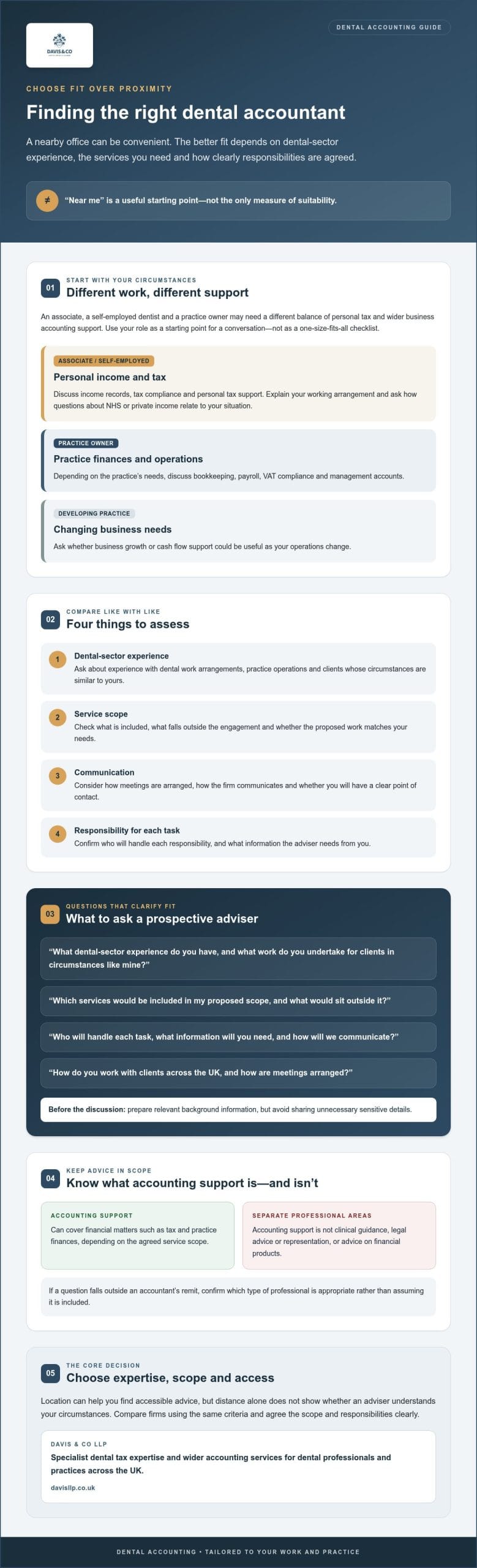
A practical checklist for choosing a dental accountant
A consistent process makes it easier to compare advisers and decide what you need now, without committing to services that may not be relevant. Use these steps to organise your search for dental accountants near me and keep the decision grounded in your circumstances.
- Define your current needs. Note whether you’re an associate, self-employed dentist or practice owner, then identify the accounting or tax questions you need help with now. Separate these from possible future requirements, such as additional practice reporting or support as your operations develop.
- Shortlist firms with relevant experience. Look for evidence that a firm advises dental professionals or practices with circumstances comparable to yours. Confirm its experience and service scope directly.
- Ask each firm the same questions. Discuss who would handle your work, how communication is managed, which records you must provide and how the firm approaches work outside its agreed scope.
- Review written proposals. Compare the services, responsibilities, reporting arrangements, exclusions and billing basis. Check that the proposal reflects your present requirements and explains how additional work would be discussed.
- Agree responsibilities before appointing. Make sure you understand what you and the firm are each expected to do, how information will be exchanged and how changes in your circumstances will be addressed.
Prepare for an initial conversation
Make a brief note of your professional role, practice structure and main accounting or tax questions. Where relevant, record how bookkeeping, payroll, VAT and reporting are currently managed, and identify any gaps you want to discuss. You don’t need to provide unnecessary sensitive information at this stage. Ask how the firm handles onboarding and records, and what it needs to assess your requirements.
Clarify ongoing communication as well. Establish who your usual contact would be and how updates, questions and document requests are managed. Clear arrangements help you judge whether the working relationship will suit your needs.
Review the proposal before appointing an adviser
Look beyond service labels when reading a proposal. It should describe the work included, your responsibilities, reporting arrangements and exclusions. Ask how changes in your practice or requests for additional work will be raised and agreed, so both sides understand what to expect.
Choose based on fit and clarity, rather than proximity or polished marketing language alone. If you’d like to discuss your circumstances and the support that may suit them, discuss your dental accounting requirements with Davis & Co LLP.
How Davis & Co LLP supports dental professionals across the UK
For dentists searching for dental accountants near me, location is only one consideration. Davis & Co LLP provides specialist dental tax expertise and tailored accounting and tax advice for dental professionals and practices across the UK. The firm is an independent partnership of Chartered Certified Accountants, founded in 1901. Its professional status and history provide context, but shouldn’t be confused with a dental-specific accreditation.
The firm’s wider services include payroll, VAT compliance, bookkeeping and management accounts. Which may be relevant depends on your role and practice arrangements. An individual dentist may be looking primarily for dental tax support, while a practice may also want to discuss how its accounting needs fit alongside other business services. Establish the appropriate scope for your circumstances rather than assuming it from a general service list.
When a broader accounting relationship may be useful
Dental tax advice can sit alongside broader business accounting support where circumstances call for it. For example, a practice owner might ask whether bookkeeping or management accounts are relevant to their reporting needs, or whether payroll support fits the way the practice operates. These are discussion points, not services every dental professional requires.
Davis & Co LLP offers specialist dental tax expertise and wider practice support. Before proceeding, describe the work you need and ask the firm to confirm which services it proposes to provide, what each covers and where your responsibilities begin and end.
What to clarify before getting started
In an initial discussion, outline your role, practice arrangements and priorities. Ask about the proposed scope, how communication and records will be handled, and how fees are set before agreeing an engagement. If you’re checking a professional’s accountancy credentials, use the relevant professional body’s resources. A guide such as How to Find a Chartered Accountant may also help you understand what to verify.
Clarity at the outset can help you assess whether an adviser is suited to your circumstances and how the working relationship will operate. To discuss a tailored combination of dental tax and wider accounting support, discuss your dental accounting needs with Davis & Co LLP.
Choose support that fits your dental work
The right adviser is not necessarily the closest one. Focus on whether a firm understands your professional context, can explain its dental-sector experience and offers a clearly defined scope of work. Your needs as an associate may differ from those of a practice owner, so compare proposals against the support you require now and what may become relevant if your circumstances change.
If you’re still searching for dental accountants near me, consider proximity alongside communication, responsibilities and service fit. Davis & Co LLP is an independent partnership of Chartered Certified Accountants, founded in 1901, with specialist dental tax expertise. Its wider support includes payroll, VAT compliance, bookkeeping and management accounts, subject to your requirements and the agreed engagement scope.
To discuss which services may suit your circumstances, discuss your dental accounting requirements with Davis & Co LLP. Set out your priorities and ask the firm to confirm the proposed scope and terms.
Frequently Asked Questions
What does a dental accountant do?
A dental accountant provides accounting and tax advice shaped around the financial needs of dental professionals or practices. Depending on the confirmed services, this may include personal tax support, bookkeeping, payroll, VAT compliance or management accounts. The role is financial, not clinical or legal. Ask what work the accountant undertakes, which tasks are included in an engagement and whether their experience is relevant to your professional arrangements or practice.
Do I need a specialist accountant as a self-employed dentist?
You don’t necessarily need a specialist, but dental-sector experience may help an accountant understand the context of your work and the questions you need to address. As a self-employed dentist, you may wish to discuss income records, tax compliance and your working arrangements. Don’t assume all associates or self-employed dentists have identical circumstances. Check the adviser’s relevant experience and confirm that their services cover your requirements.
How do I find a dental accountant near me in the UK?
Use searches for dental accountants near me to identify possible advisers, then compare their dental-sector experience, service scope and communication arrangements. A nearby office isn’t essential if the firm can work with you in a way that suits your needs. Ask how meetings are arranged, who your point of contact would be and how the firm supports clients across the UK. Verify credentials and engagement terms directly.
What should I ask before choosing a dental accountant?
Ask what types of dental professionals or practices the firm regularly advises, who would handle your work and what records you must provide. Clarify which services are included, how communication works and how additional work is agreed. Request a written proposal that sets out responsibilities, exclusions and billing arrangements. You can assess relevant experience without asking for confidential details about the firm’s other clients.
Can a dental accountant help with both personal tax and practice accounts?
Yes, a firm may provide both, but confirm that its services cover your specific needs. Personal tax support may suit an individual dentist, while a practice may also need bookkeeping, payroll, VAT compliance or management accounts. These services aren’t automatically part of one engagement. Davis & Co LLP offers personal tax services and wider accounting support alongside specialist dental tax expertise. Ask the firm to confirm the proposed scope and responsibilities.
How much do dental accountants charge?
Fees depend on the work you need and the scope agreed with the firm, so there isn’t one figure that applies to every dentist or practice. Request a written proposal showing the services included, how billing is calculated and how additional work would be handled. Compare proposals on scope and communication arrangements as well as the fee, and clarify exclusions before agreeing to an engagement.
Are dental treatments always exempt from VAT?
No. VAT treatment can depend on the nature and purpose of a treatment and the circumstances in which it is provided, so don’t assume every dental service is exempt. Cosmetic treatments may require particular consideration. If you’re a practitioner or practice owner, ask an adviser to assess the specific services and transactions involved, and confirm current VAT treatment before making decisions or submitting returns.