Could a company that meets the new size limits still need an audit? The audit exempt threshold depends on more than the company’s figures: the financial-year start date and the company’s circumstances also matter. For financial years beginning on or after 6 April 2025, the limits are turnover of no more than £15 million, a balance sheet total of no more than £7.5 million, and an average of 50 or fewer employees. A company must meet at least two of these three tests to qualify as small.
Meeting the size test does not automatically establish audit exemption. Earlier financial years use lower monetary limits, and the two-year rule, group structure, company type, company articles or a qualifying shareholder request may affect eligibility. Transitional provisions can also matter when assessing a financial year beginning on or after 6 April 2025.
This guide explains how to identify the relevant threshold period, apply the two-out-of-three tests and review circumstances that may prevent an exemption. It also sets out the records and decisions to consider before preparing accounts, so you can assess your company’s reporting position in a more organised way.
Key Takeaways
- Use the company’s financial-year start date to identify the audit exempt threshold that applies before assessing its figures.
- Meeting two of the three size tests may establish small-company status, but it does not by itself confirm audit exemption.
- Review the company’s articles, group position and any shareholder audit request, as these may affect eligibility.
- Organise the financial and employee records for the relevant period, then consider the company’s circumstances alongside the size tests.
- Davis & Co LLP’s Tax & Business Advisory and Compliance & Record-Keeping services can help companies organise financial information and consider compliance responsibilities.
Audit exempt threshold: what the exemption does, and does not, mean
For a qualifying UK private limited company, audit exemption means it is not required to obtain a statutory audit for the relevant financial year, provided it meets the applicable conditions. The exemption removes the requirement for an independent audit. It does not remove the company’s responsibility to keep accounting records, prepare annual accounts or meet its other reporting obligations.
The Companies Act 2006 sets out audit requirements and exemptions for companies. Eligibility depends on the rules for the particular financial year and the company’s circumstances. A low turnover figure on its own does not establish that an audit can be omitted.
What does audit exemption mean for a private limited company?
An exemption affects whether the company must have its accounts audited. It does not mean the company can skip preparing or filing accounts. Directors remain responsible for ensuring that the company’s financial information is properly maintained and that its accounts are prepared in line with the relevant requirements. Treat the audit decision and accounts preparation as connected, but separate, responsibilities.
Why the audit exempt threshold is not a single turnover figure
The audit exempt threshold uses three size measures, not turnover alone. In general, a company must meet at least two of the three relevant conditions to qualify as small for this purpose. That is one part of the assessment. Company type, group position and shareholder action may also affect whether an exemption is available.
For example, a private company may have turnover below the relevant limit but still need to assess its balance sheet total and average number of employees. It must also consider whether other conditions apply. Base the assessment on the company’s records for the relevant period, rather than an informal estimate or a single headline figure.
Keep the following distinction in view:
- Audit requirement: whether the company must obtain a statutory audit, after applying the relevant size tests and other conditions.
- Accounts and reporting: the company’s separate responsibilities to maintain financial records and prepare and file accounts as required.
Company documents and ownership arrangements matter too. The articles of association may require an audit, and qualifying shareholders may be able to request one under the statutory rules. Group relationships can also affect how the size assessment is approached. These considerations do not replace the threshold test. They help determine whether meeting it is enough in the company’s particular circumstances.
A practical starting point is to identify the financial year under review, assess the applicable size conditions, then examine the company’s type, group connections, articles and shareholder position. This avoids the common mistake of treating low turnover as the only factor that determines whether an audit is required.
UK audit exempt threshold figures for financial years beginning in 2026
For a financial year beginning on or after 6 April 2025, the relevant small-company size limits are turnover of no more than £15 million, a balance sheet total of no more than £7.5 million, and an average of 50 or fewer employees. These are the figures to consider for a financial year beginning in 2026, subject to the rules and other eligibility conditions that apply to the company.
The key date is the start of the financial year being assessed. It is not the date the accounts are filed or the date you check the rules. The GOV.UK guidance on audit exemptions sets out the date split and criteria for private limited companies.
Which threshold figures apply to your financial year?
First, record the start and end dates of the accounting period. If it begins on or after 6 April 2025, use the newer monetary limits. If it begins before that date, the previous limits apply: turnover of no more than £10.2 million and a balance sheet total of no more than £5.1 million. The employee limit remains 50 or fewer. Match the thresholds to the period itself.
A company with a financial year beginning in 2026 uses the new limits even if its accounts are prepared or filed later. By contrast, filing accounts in 2026 does not mean the newer thresholds apply to a period that began earlier. Starting with the period date helps prevent comparing a company’s figures with limits that do not apply to that financial year.
How the two-out-of-three size test works
Assess each measure separately using the company’s records for the relevant period. The general test is met when the company is within the limit for at least two of the three measures:
- Turnover: compare the relevant figure with the limit for that period.
- Balance sheet total: compare the company’s total assets with the applicable limit.
- Average employees: compare the period’s average number of employees with the employee limit.
For example, an illustrative company could exceed the turnover limit but remain within the applicable limits for both its balance sheet total and average employees. It would meet two size conditions, but that result alone would not establish that it can claim audit exemption. The company’s type, group position and other applicable requirements still need to be considered.
Keep a short record of the period start date, the figures used for each test and the accounts or schedules that support them. If the accounting information is complex, Davis & Co LLP’s compliance and record-keeping support can help organise financial information and consider related compliance responsibilities.
When meeting the audit exemption threshold may not be enough
Passing the size test is an important part of assessing audit exemption, but it is not the whole decision. Company documents, shareholder action, group membership and the company’s legal type can each affect the outcome. Review these factors before concluding that the company can prepare accounts without a statutory audit.
The statutory framework includes the Companies Act 2006, Section 477, which sets out an audit exemption for qualifying small companies, subject to conditions. Treat the audit exempt threshold as one part of a wider eligibility review, not as stand-alone permission to omit an audit.
How shareholder requests and company documents affect exemption
Start with the company’s articles of association. These governing documents may require an audit even if the company appears to satisfy the size criteria. Review the current version and any relevant amendments. A statutory exemption does not necessarily override an audit requirement set out in the company’s own articles.
Shareholder rights need a separate check. Under the GOV.UK guidance, shareholders holding at least 10% of the nominal value of the company’s issued share capital may request an audit in writing. The ownership register and written communications from shareholders are therefore relevant when assessing exemption. Meeting the size test does not prevent a qualifying request from affecting the position.
For a practical review, bring together:
- The current articles of association and any amendments.
- The shareholder register, including each holding’s nominal value.
- Written shareholder communications concerning an audit.
- The financial information used to assess the company’s size.
These records help establish whether the size assessment is consistent with the company’s governing documents and shareholder position. If the wording of an article or request is unclear, resolve that point before the accounts are finalised.
Why group status and company type need a separate check
A company assessed on its own may be in a different position from a company connected to a wider group. Group membership can bring additional conditions into the exemption assessment, so the analysis may differ from the stand-alone size test. If the company has parent companies or subsidiaries, do not rely solely on its individual figures.
Record the company’s ownership and control relationships, then assess the applicable group rules using current official guidance. The relevant conditions can depend on the group’s circumstances, so do not assume that the individual-company limits apply unchanged or infer group thresholds from a summary. If the structure changed during the period, note what changed and when, so the assessment reflects the relevant facts.
Company type can also determine whether an exemption is available. Public companies, insurance companies, banking companies and certain financial services firms may be excluded under the rules, regardless of their apparent size. Check the company’s classification against current official guidance rather than relying on the general small-company test. Directors can reach a better-supported view after considering the company’s documents, shareholders, group position and type alongside the size tests.
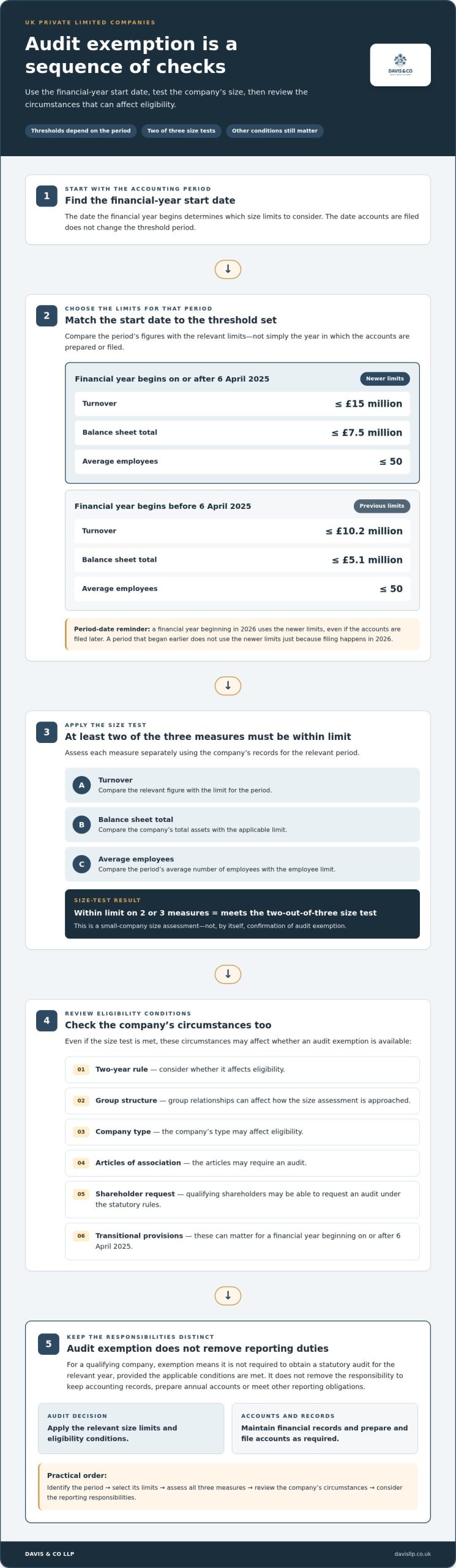
How to check audit exemption eligibility before preparing accounts
Before deciding how to prepare the accounts, create a clear record of the company’s position for the relevant financial year. The audit exempt threshold is only one part of the assessment. Consider the period, supporting figures and any exceptions together. A documented review also gives directors a clear basis for the accounts preparation process.
A practical sequence for reviewing the company’s position
Work through the checks in order. This keeps the assessment tied to the correct period and reduces the risk of relying on figures or documents that do not answer the relevant question.
- Identify the accounting period. Record the financial-year start and end dates, then establish which threshold set applies. Do not use the accounts filing date as a substitute for the period start date.
- Gather the size information. Assemble the turnover figure, balance sheet total and average employee information for the accounting period. Keep the accounts schedules and records supporting each figure, including the calculations behind the employee average.
- Assess whether size status has changed. A company’s status may depend on how it meets or fails the size conditions across consecutive financial years. Check current GOV.UK guidance for the applicable two-year rule and any transitional provisions before relying on a change in status, particularly for a period beginning under the revised thresholds.
- Review other eligibility factors. Consider whether the company belongs to a group, falls into a company type excluded from exemption, has articles of association requiring an audit, or has received a qualifying written shareholder request.
- Record the conclusion. Keep a concise note of the period assessed, evidence considered, relevant company documents and reasoning. This makes the assessment easier to revisit and shows how the conclusion was reached.
Gathering records is a practical preparation step, not a substitute for applying the current rules. If the company’s group structure is complex, its status has recently changed, or its documents point in different directions, use current official guidance before reaching a conclusion. Any advice should be considered alongside the company’s own circumstances and the applicable requirements.
What to include when exemption is claimed
If an eligible company uses the exemption, its balance sheet must include the prescribed audit exemption statement. The statement records that the company is entitled to claim the exemption and addresses the relevant shareholder position and directors’ responsibilities for the accounts and accounting records. Use the current official wording rather than a saved template, so the statement reflects the applicable rules.
Before the accounts are approved, compare the statement with the eligibility assessment and company records. This final consistency check helps ensure the declaration is supported by the work already completed, rather than added as a formality at the end.
For help organising financial information and considering company compliance responsibilities, learn about Davis & Co LLP’s compliance and record-keeping support.
How Davis & Co can support audit-threshold and compliance decisions
Applying an audit exempt threshold involves more than comparing figures with limits. Directors may need to organise financial records, understand how a change in company size affects reporting, and consider whether group arrangements or company documents alter the picture. Davis & Co LLP provides Tax & Business Advisory and Compliance & Record-Keeping services to help companies organise financial information and consider compliance responsibilities.
Davis & Co LLP is a firm of Chartered Certified Accountants established in 1901. Its support can be tailored to a company’s circumstances, helping directors make sense of the information they have and identify questions that need attention. Any exemption decision must still be assessed against current statutory requirements. Advisory and record-keeping support does not guarantee a particular outcome.
When tailored advice can help a director make a clearer decision
Advice may be useful when a company’s figures are close to a size limit, its position has changed over consecutive years, or its group structure makes the assessment less straightforward. Directors may also need to understand how the audit question relates to their wider accounts and record-keeping responsibilities.
Tax & Business Advisory and Compliance & Record-Keeping support can help bring the relevant financial information into a clearer, more organised view. That gives directors a stronger basis for considering the company’s circumstances and reporting questions, while current official guidance remains the reference point for statutory eligibility.
A considered next step for company compliance
Before discussing support, gather the financial information for the period under review, note any changes in company size or group structure, and write down questions about the company’s reporting responsibilities. A focused set of records and questions makes it easier to discuss the issues that matter. You may also find context in our UK business accounting and growth guide, which considers accounting and compliance as part of managing a business.
Our chartered accountant selection guide offers further considerations when reviewing professional support for broader company matters. Support should reflect the company’s records, structure and reporting needs, rather than rely on a general assumption based on turnover alone.
Davis & Co LLP can help organise financial information and consider company compliance responsibilities through its advisory and record-keeping services. Speak with Davis & Co about your company’s circumstances and support needs.
Make audit planning part of your reporting process
Set a point in the annual reporting calendar to revisit the audit exempt threshold, rather than leaving eligibility until the accounts are nearly complete. Changes in ownership, group structure or financial performance can make an earlier assessment less relevant. Keeping the supporting records together and noting what has changed gives directors a clearer basis for planning the next reporting period.
If the company’s circumstances raise questions, a focused discussion can help clarify which financial information and compliance issues need attention. Davis & Co LLP supports companies through its Tax & Business Advisory and Compliance & Record-Keeping services.
Discuss your company’s compliance and financial reporting needs with Davis & Co to take a clear, informed next step for your business.
Frequently Asked Questions
What is the audit exempt threshold for a UK company?
For financial years beginning on or after 6 April 2025, the audit exempt threshold uses three size tests: turnover of no more than £15 million, a balance sheet total of no more than £7.5 million, and an average of 50 or fewer employees. A company generally needs to meet at least two tests. These figures do not settle every eligibility question, so directors should consider the company’s type and circumstances against current official guidance.
Does a company qualify for audit exemption if it meets two of the three thresholds?
Not necessarily. Meeting two size tests may support eligibility, but it does not automatically mean the company can omit an audit. Check whether the company’s articles require one, whether it belongs to a group and whether its type is eligible. Also establish which financial-year start date determines the applicable figures. These checks distinguish a positive size-test result from a complete exemption assessment.
Which financial-year start date determines the audit exemption threshold?
The financial-year start date determines which threshold set applies. GOV.UK distinguishes periods beginning on or after 6 April 2025 from periods that began earlier. For example, a period starting before that date uses the earlier figures, even if the accounts are filed later. Establish the accounting period’s start date from the company’s records, then compare the relevant measures with the correct figures and review current guidance.
Can shareholders require an audit even if a company is usually exempt?
Yes. According to the GOV.UK guidance, shareholders holding at least 10% of the company’s shares may request an audit in writing. The request may be made by a qualifying shareholder or by shareholders acting together. Directors should keep a clear record of the company’s shareholder position and any written request, then follow the current official requirements rather than assume the size tests are decisive.
Does being part of a group affect the audit exemption threshold?
It can. A company within a group may need a separate assessment because the conditions can differ from those for a stand-alone company. Map the company’s parent and subsidiary relationships and note any changes in ownership or control. Do not treat the stand-alone thresholds as a complete group analysis. Use current Companies House or GOV.UK guidance for the rules that apply to the specific structure.
Does audit exemption mean a company does not need to prepare or file accounts?
No. Exemption relates to whether an audit is required. It does not waive the company’s accounts or reporting responsibilities. Directors should continue to maintain the information needed to prepare accounts and meet applicable filing requirements. A company considering audit exemption should still organise its accounting records and supporting schedules for the reporting period. Companies House guidance explains the accounts obligations that apply to the company.
What statement is needed when a company claims audit exemption?
GOV.UK guidance says that when a company uses audit exemption, an audit exemption statement must appear on its balance sheet. It records the company’s entitlement to the exemption, whether members required an audit, and directors’ responsibilities. Because the wording matters, do not rely on a paraphrase or an old template. Use the current official requirements when preparing the balance sheet and ensure the statement reflects the company’s actual position.