A limited company does not automatically leave you better off. For sole trader versus limited company tax in 2026, the broad incorporation tipping point is around £45,000-£50,000 in annual profit, although how much you withdraw can affect the comparison. Below that, staying a sole trader may be simpler, while the company structure can become more attractive as profits rise.
It’s understandable to focus on headline tax rates, but the decision also depends on how you take profits, the extra reporting involved and whether you want to retain money in the business. This guide explains how each structure affects tax, when incorporation may suit your circumstances and what a change involves. It also sets out the key differences so you can weigh the tax implications against the practical demands of running your business.
Key Takeaways
- Compare the full tax picture, including Corporation Tax and tax on dividends, rather than relying on one headline rate.
- Assess whether the company’s reporting and administrative responsibilities make sense for how you run the business.
- Use your expected profits and personal income needs to identify when incorporation could be worth considering.
- Plan a switch carefully; moving at the start of a tax year can help make the transition more straightforward.
Should You Be a Sole Trader or Limited Company in 2026?
The choice affects personal liability, reporting duties and how you manage business finances. The UK Personal Allowance is £12,570 for both sole traders and company owners, according to HM Revenue & Customs.
Sole Trader Liability
A sole trader and their business are one legal entity, so there is no legal separation between business debts and personal finances. If the business cannot meet its obligations, personal assets may be exposed. Sole traders have fewer company reporting requirements, but do not get the liability separation that incorporation provides.
Limited Company Liability
A limited company is legally distinct from its owners and directors. This separation can limit personal financial risk for company debts, while the company remains responsible for its own obligations. It is not a blanket protection from every personal liability. Companies must file annual accounts with Companies House and a Company Tax Return with HMRC; statutory accounts are due within 9 months of the year end.
Setup and Running Costs
A sole trader avoids these company filings, but must register for Self Assessment with HMRC if business income exceeds £1,000 in a tax year. Running costs also depend on record-keeping and reporting requirements.
For 2026/27, sole traders make Self Assessment payments in January and July. A limited company pays Corporation Tax and files company returns; owners may also need personal Self Assessment for dividends.
VAT registration thresholds affect businesses under either structure. VAT-registered unincorporated businesses have reported under Making Tax Digital for VAT from April 2022, so record-keeping requirements matter when comparing structures.
| Option | Legal status | Liability | Reporting |
|---|---|---|---|
| Sole trader | Owner and business are one entity | Personal assets may be exposed | Self Assessment |
| Limited company | Separate legal entity | Company bears its obligations | Company accounts and tax return |
Weigh your personal risk against the additional filings and ongoing administration that come with running a company.
Limited company Corporation Tax and dividend tax
A sole trader vs limited company tax 2026 comparison must account for both company-level and personal taxes. How much profit you retain or withdraw affects the overall calculation.
Corporation Tax on Company Profits
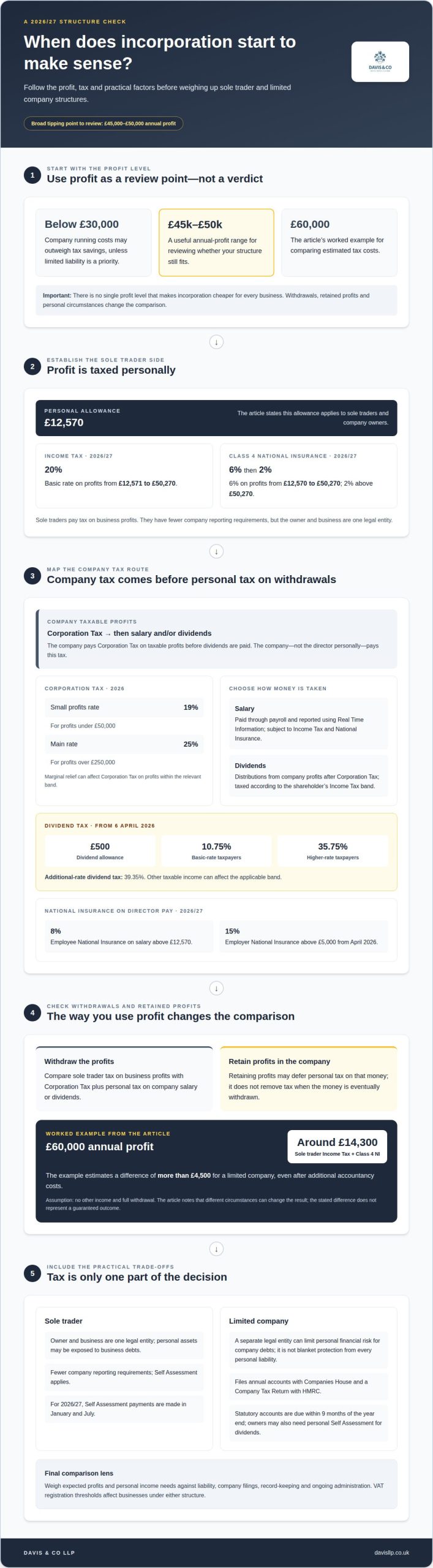
Corporation Tax applies to a company’s taxable profits before dividends are paid. For 2026, HM Revenue & Customs sets the small profits rate at 19% for profits under £50,000 and the main rate at 25% for profits over £250,000. Marginal relief can affect the corporation tax payable on profits within the relevant band. The company pays this tax, not the director personally.
Salary and Dividend Extraction
A director can take money as salary, dividends, or a combination. Salary is paid through payroll and reported to HMRC using Real Time Information. It is subject to Income Tax and National Insurance, while dividends are distributions from company profits after Corporation Tax. A sole trader vs limited company tax 2026 assessment should distinguish these routes: each has different tax treatment, and the suitable balance depends on profits, personal income and National Insurance.
Dividend Tax and Allowance
HM Revenue & Customs sets the dividend allowance at £500 for 2026. Dividends above it are taxed according to the shareholder’s Income Tax band. From 6 April 2026, HM Revenue & Customs sets dividend tax rates at 10.75% for basic-rate taxpayers and 35.75% for higher-rate taxpayers. The additional-rate dividend tax rate is 39.35%, according to HM Revenue & Customs. Other taxable income can affect the applicable band.
For 2026/27, sole traders pay Class 4 National Insurance at 6% on profits from £12,570 to £50,270, then 2% above £50,270. Directors pay employee National Insurance at 8% above £12,570 on salary. Employer National Insurance is 15% above £5,000 from April 2026.
Company Secretarial Services can help organise company records and reporting responsibilities alongside remuneration decisions. Davis & Co LLP’s Company Secretarial Services may be relevant when you need support with company administration.
At what profit level does the math start to favour incorporation?
There is no single profit level that makes incorporation cheaper for every business. The sole trader vs limited company tax 2026 comparison depends on tax rates, withdrawals and whether profits stay in the company.
Profit Levels for Incorporation
Annual profits around £45,000-£50,000 are a useful point to review your structure. Below £30,000, company running costs may outweigh tax savings, unless limited liability is a priority. For the 2026/27 tax year, sole traders pay income tax at the basic rate of 20% on profits from £12,571 to £50,270, according to HM Revenue & Customs. They also pay Class 4 National Insurance at 6% on profits from £12,570 to £50,270, according to HM Revenue & Customs. These charges make rising profits relevant to the assessment.
Tax Costs by Profit and Withdrawals
How much profit you withdraw can change the comparison. Sole traders pay tax on business profits, while a company pays Corporation Tax before its owner pays personal tax on salary or dividends. Retaining profits may defer personal tax on that money, but does not remove tax when it is eventually withdrawn.
At £60,000 profit, the example estimates a sole trader’s Income Tax and Class 4 National Insurance at around £14,300. A limited company may incur Corporation Tax and personal tax when profits are withdrawn as dividends. The estimated difference exceeds £4,500, even after additional accountancy costs. This sole trader vs limited company tax 2026 assessment assumes no other income and full withdrawal, so different circumstances can change the result.
Corporation Tax Rates and Thresholds
For 2026, HM Revenue & Customs sets the Corporation Tax small profits rate at 19% for company profits under £50,000. The main rate is 25% for profits over £250,000, according to HM Revenue & Customs. Between those limits, marginal relief produces an effective rate of 26.5% for 2026/27. These thresholds affect company tax, but not alone the owner’s total tax after taking income. Include them in your sole trader vs limited company tax 2026 comparison alongside personal withdrawals and retained profits.
Compare the combined tax under each structure with your planned withdrawals, and review the figures as your income changes.
Switching from sole trader to limited company
Treat the change as a transfer between two legal structures, not simply a new name for the same business. A limited company is a separate legal entity, so its income, assets and obligations need to be recorded separately from your sole-trader activity.
Many business owners choose the start of a tax year for the changeover. This can make the boundary clearer in bookkeeping and tax records, although the right timing depends on your trading arrangements. Set a practical cut-off date, record transactions up to it as sole-trader activity, and keep subsequent company transactions separate.
Making Tax Digital for Income Tax began on 6 April 2026 for sole traders and landlords with qualifying income above £50,000. Those affected must keep digital records and send quarterly updates to HMRC. A limited company is not covered by this Income Tax regime, but switching does not remove the sole trader’s reporting responsibilities for the period before incorporation.
After incorporation, the company must register for Corporation Tax within three months of starting business. It files a Company Tax Return, known as a CT600, and pays Corporation Tax on company profits. Corporation Tax is due 9 months and 1 day after the end of the accounting period. Statutory accounts must also be filed with Companies House within 9 months of the year end.
Prepare a transition schedule covering invoices, expenses, business records and outstanding tax obligations. Keep your sole-trader Self Assessment information separate from the company accounts, since each relates to a different trading period and legal entity. Consider how the company will pay you too, as salary and dividends have different tax treatments.
Company Secretarial Services can support the company’s filing and administrative responsibilities during the transition. Discuss company secretarial support as you plan the change.
Davis & Co LLP: Company Secretarial Services
Davis & Co LLP provides Company Secretarial Services to support businesses with the administrative responsibilities of incorporation. This can help when you move from sole-trader records to a separate company structure and need to consider company administration alongside tax decisions.
As profits, withdrawals and reporting obligations change, the right structure depends on how your business operates, not just its headline tax position. Company Secretarial Services can support company administration, while International Tax Planning may be relevant if cross-border tax matters affect your decision.
If you are weighing incorporation or planning a transition, contact Davis & Co LLP to discuss the support relevant to your circumstances.
Make your next structure decision with confidence
Choose the structure to support your business’s future direction, not just its current position. Revisit the decision as your plans, cash needs and personal circumstances change. A considered review can help align the structure with how you intend to grow and use business profits.
A useful next step is a tailored discussion about your objectives and the practical demands of each structure. Davis & Co LLP offers International Tax Planning, Business Growth Acceleration and Cash Flow Management to support related business decisions. The right fit depends on your circumstances, including how you plan to manage cash and develop your business.
For guidance on your options and the transition ahead, contact Davis & Co LLP. A clear assessment can help you move forward with a structure that supports your next stage of growth.
Davis & Co LLP can help you assess your business structure
Davis & Co LLP offers Business Growth Acceleration, Cash Flow Management and Personal Tax Services to help you consider whether working as a sole trader or through a limited company suits your circumstances.
Turn to Davis & Co LLP when you are weighing the tax implications or need support with the practical responsibilities of running a company. Its services include company secretarial support, payroll services, VAT compliance, management accounts and bookkeeping.
Frequently Asked Questions
Can I start as a sole trader and switch later?
Yes, you can start as a sole trader and incorporate later. Set a clear date for the change, then separate business transactions and records before and after it. The sole-trader period remains relevant to your Self Assessment, while the company has its own accounting and tax obligations. Planning the transition can also clarify which business holds assets, contracts and outstanding invoices.
At what profit level is a limited company worth it?
Annual profits around £45,000-£50,000 are a useful point to assess incorporation, rather than a universal cut-off. Below £30,000, running costs may outweigh potential tax savings unless limited liability is a priority. Consider how much profit you need to withdraw, how much you can retain, and the additional administration. Those factors can change the result even when two businesses report similar profits.
How does the new digital tax regime change the “simplicity” of being a sole trader?
Making Tax Digital for Income Tax adds digital record-keeping and quarterly updates for sole traders with qualifying income above £50,000 from 6 April 2026. The threshold falls to £30,000 in 2027 and £20,000 in 2028. Affected taxpayers may have additional reporting obligations during the year, rather than relying solely on an annual return.
What are the UK income tax rates and personal allowance for 2026/27?
The Personal Allowance is £12,570, according to HM Revenue & Customs. For 2026/27, the basic rate is 20% on profits from £12,571 to £50,270. The higher rate is 40% on profits from £50,271 to £125,140, and the additional rate is 45% above £125,140. These bands help estimate Income Tax, but National Insurance is a separate part of a sole trader’s calculation.
What is the UK Corporation Tax rate for small and large companies in 2026?
For 2026, HM Revenue & Customs sets the small profits rate at 19% for company profits under £50,000 and the main rate at 25% for profits over £250,000. Companies with profits between those limits may receive marginal relief, producing an effective rate of 26.5% in 2026/27. The applicable amount depends on taxable company profits and the relevant thresholds.
How do take-home profits compare for a sole trader and limited company at different profit levels in 2026/27?
At £60,000, the sole-trader estimate is £14,300, while the limited-company example gives roughly £9,700 in Corporation Tax and dividend tax when profits are withdrawn.