Tax-efficient employee benefits can reduce tax and National Insurance in some circumstances, but they do not make tax disappear. The outcome depends on the benefit and how the employer provides it. Well-designed tax efficient employee benefits packages can include approved arrangements, such as pension salary sacrifice, provided each benefit meets the relevant rules.
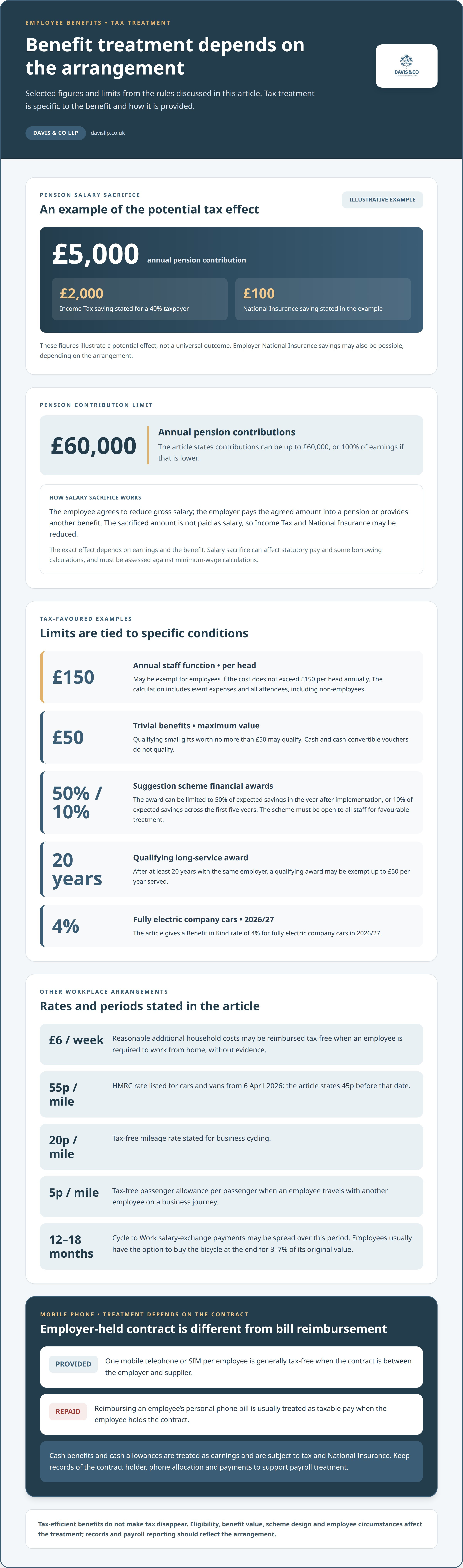
It’s understandable to look for ways to make a benefits budget go further for both the business and its employees. The distinction matters: some benefits may be tax-free, while others create a taxable benefit or are treated as earnings. For example, according to HM Revenue & Customs, an annual staff function can be exempt for employees if its cost doesn’t exceed £150 per head.
This article explains how pension salary sacrifice works, when benefits may receive favourable tax treatment, and why an employer-provided mobile phone can be treated differently from reimbursement of an employee’s bill. It also looks at how to shape a package around employee needs, business costs and the tax treatment of each benefit.
Key Takeaways
- Understand how pension salary sacrifice can change the tax and National Insurance treatment of pay, and what other effects to consider.
- Distinguish benefits that may qualify for tax relief from cash or perks that can create a tax charge.
- See why providing a mobile phone under an employer-held contract can be treated differently from reimbursing an employee’s phone bill.
- Plan a benefits package around employee needs, business costs and the tax treatment of each option.
1. How Does Salary Sacrifice Work With Pensions?
Salary sacrifice changes how an employee receives part of their remuneration. The employee agrees to reduce their gross salary, and the employer pays the agreed amount into a pension or provides another benefit. Because the sacrificed amount is not paid as salary, the arrangement may reduce Income Tax and National Insurance. The exact effect depends on the employee’s earnings and the benefit chosen.
For example, an employee earning £35,000 a year might agree to sacrifice £200 per month for pension contributions. A separate example has an employer contributing 5% of salary to its workplace pension. Under salary sacrifice, the contribution is made by the employer, rather than deducted from the employee’s post-tax pay. HM Revenue & Customs states that annual pension contributions can be up to £60,000, or 100% of earnings if that is lower.
A £5,000 annual pension contribution is stated to save a 40% taxpayer £2,000 in Income Tax and £100 in National Insurance. Employer National Insurance savings may also be possible, depending on the arrangement. These figures illustrate the potential tax effect, not a universal outcome. Salary sacrifice can affect statutory pay and some borrowing calculations, so the employee’s wider circumstances matter.
Employee choice is central: the arrangement requires agreement to change salary, and employees should understand how that affects take-home pay and pension contributions. Salary sacrifice can also fund Cycle to Work schemes, with payments spread over 12 to 18 months. Employees usually have the option to buy the bicycle at the end of the hire period for 3-7% of its original value. The scheme was introduced in 1999.
Other workplace arrangements have separate rules. HM Revenue & Customs says employers can reimburse up to £6 per week in reasonable additional household costs tax-free when an employee is required to work from home, without evidence. For cars and vans, HM Revenue & Customs lists 55p per mile from 6 April 2026 (45p before 6 April 2026). A separate trivial-benefit exemption applies to qualifying small gifts, not salary sacrifice.
2. Can Employee Benefits Help You Avoid Tax?
Employee benefits may reduce tax or National Insurance in specific circumstances, but they do not eliminate tax. Cash benefits are treated as earnings and are subject to tax and National Insurance. Benefits in kind, such as a company car, are taxed according to their type and value, which the employer must determine.
HM Revenue & Customs says an employer’s staff function can be exempt from tax for employees if its cost does not exceed £150 per head annually. The cost-per-head calculation includes event expenses and all attendees, including non-employees. This is a tax exemption within defined limits, not a general exemption for any staff entertainment.
For Cycle to Work schemes, salary exchange can provide bicycles and equipment worth up to £1,000, although some schemes set higher limits. The scheme’s terms and the employee’s circumstances affect the outcome.
Suggestion scheme awards may also receive favourable treatment if the scheme is open to all staff. A financial award can be limited to 50% of expected savings in the year after implementation, or 10% of expected savings across the first five years. A qualifying long-service award may be exempt up to £50 per year served with the same employer, after at least 20 years.
Trivial benefits cover qualifying small gifts worth no more than £50, according to HM Revenue & Customs. Cash and cash-convertible vouchers don’t qualify. For electric vehicles, the Benefit in Kind rate for fully electric company cars is 4% for 2026/27. These examples show how scheme design and documentation should record eligibility, value, recipients and tax treatment.
Costs depend on the benefit, its value and how the employer provides it; potential tax savings vary accordingly. A tax adviser can review benefit records, payroll treatment and whether reporting through P11D or payroll applies. Benefits can also affect statutory pay, while salary-sacrifice arrangements need careful assessment against minimum-wage calculations. For practical support with payroll and benefit reporting, review payroll services.
3. Employer-provided mobile phones
An employer-provided mobile phone can support staff and receive different tax treatment from a cash payment. Providing one mobile telephone or SIM per employee is generally tax-free when the contract is between the employer and the supplier. This differs from reimbursing an employee’s personal phone bill. If the employee holds the contract, reimbursement is usually treated as taxable pay.
Recording the contract holder, phone allocation and payments helps payroll apply the correct treatment. These records also clarify the benefit’s value and purpose when annual rewards are reviewed. By contrast, a cash allowance is treated as earnings and is subject to tax and National Insurance.
Transport benefits also depend on how the employer provides them. Cycle to Work uses salary exchange, while business cycling has a tax-free mileage rate of 20p per mile. Employers can also provide a tax-free passenger allowance of 5p per passenger, per mile, when an employee travels with another employee on a business journey. These arrangements differ from simply adding cash to salary.
Childcare vouchers are now a legacy arrangement: existing members can continue using them, but new registrations closed in 2018. Salary-sacrifice vouchers and directly contracted employer-provided childcare qualify for the stated exemption only if they started on or before 4 October 2018. That date makes scheme start records and payroll entries relevant when assessing ongoing payments or exchange arrangements.
Staff food can have a different result from cash rewards. In the stated example, £100 paid as salary is subject to tax and National Insurance, while £100 spent on employee food is not subject to those deductions if relevant criteria are met. Canteen meals may be tax-free, and workplace charging is normally a tax-free benefit. Classifying each reward correctly helps employers assess potential savings without assuming every perk has the same implications.
Planning and implementing employee benefits with professional tax advice
A sound benefits plan starts with business objectives, employee needs and available financial resources. For example, assess an annual technology allowance by its purpose, payroll treatment and overall value. When planning tax efficient employee benefits packages, consider how each arrangement serves the business and its workforce, rather than making tax reduction the only objective.
A tax adviser can map each proposed benefit to its tax and National Insurance treatment before implementation. This means distinguishing cash earnings from benefits in kind, identifying arrangements that may be exempt and determining how taxable benefits should be reported. The adviser can also assess how salary sacrifice affects pay and related calculations.
Next, compare the employer’s total commitment with the likely value to employees. Consider the benefit amount, administration or supplier expenses, employer National Insurance and the effect on take-home income. If a benefit may cost more than staff are likely to value it, adjust its design before making it a recurring commitment.
Clear records are essential to implementation. Document eligibility, employee agreement where salary changes, benefit value, payment method and tax treatment. Payroll can then use those records to process deductions or report benefits correctly. Keeping cash allowances separate from benefits provided directly, for example, helps maintain consistent records.
Review the scheme when the workforce, remuneration or relevant tax rules change. A benefit that suits one employee group may not meet another group’s needs, and changing how it is provided can affect its treatment. Regular professional review helps keep the policy, payroll process and actual provision aligned. It also supports informed adjustments to tax efficient employee benefits packages as business priorities evolve.
For a considered assessment of benefit structures and their tax implications, discuss employee benefits planning.
Davis & Co LLP
Davis & Co LLP can help business owners assess the tax and financial considerations involved in employee benefits alongside wider business and personal needs. Its International Tax Planning, Business Growth Acceleration and Cash Flow Management services can support decisions that connect workforce arrangements with broader business planning. Personal Tax Services can help individuals understand how their tax position relates to remuneration and benefits.
Consider professional advice when introducing a package, changing salary arrangements or reviewing how benefits fit the business’s financial plans. A tailored assessment can clarify the relevant considerations and help you make informed decisions about the next steps.
Contact Davis & Co LLP to discuss your employee benefits planning.
Make benefits planning part of your wider business strategy
Employee benefits work best when their design supports organisational priorities and the people who contribute to them. Treat the package as an ongoing business decision, not a fixed set of perks. Workforce needs and financial priorities can change, so review the rationale and administration regularly.
This broader perspective also places tax efficient employee benefits packages within the company’s wider plans. Remuneration decisions may connect with growth ambitions, cash flow and business owners’ personal circumstances. Through its tax and business advisory work, Davis & Co LLP can help bring these considerations into view and support decisions based on more than tax treatment alone.
If you’re reviewing an existing arrangement or considering a new one, a professional discussion can help clarify the questions that matter to your organisation. Contact Davis & Co LLP to discuss your next steps and move forward with a clearer plan.
Davis & Co LLP supports tax-aware employee benefits planning
Davis & Co LLP provides Payroll Services, Personal Tax Services and Business Growth Acceleration. These services can help employers consider how employee benefits fit into payroll, personal tax and wider business planning.
Turn to Davis & Co LLP for help reviewing these connected areas. The firm also provides VAT Compliance, Management Accounts, Bookkeeping Services and International Tax Planning.
Frequently Asked Questions
Can Employee Benefits Help You Avoid Tax?
Some benefits may receive favourable tax treatment, but a package does not remove tax from all remuneration. The outcome depends on what the employer provides, how it is arranged and whether the relevant conditions are met. A cash allowance remains earnings, while an eligible non-cash benefit may follow different rules. Plan for employee value and reporting obligations, not tax reduction alone.
How Does Salary Sacrifice Work With Pensions?
An employee agrees to exchange part of their contractual salary for an employer pension contribution. Reflect the change in the employment terms and payroll before the revised salary takes effect. This helps keep the pension payment, payslip and employment records aligned. Before agreeing, consider how the revised salary may affect statutory pay and borrowing assessments.
What Are the Rules?
Rules depend on the benefit, its value and the way it’s provided. Employers should document who qualifies, how the benefit is delivered and how its value is treated for tax. Those records support accurate payroll and benefit reporting, including a P11D where applicable. A consistent process also helps ensure that written scheme terms match actual payments and employee eligibility.
What Doesn’t Qualify?
Cash and cash-convertible vouchers do not qualify for the trivial benefits exemption. A cash bonus or allowance is generally treated as earnings, not as a tax-free perk. Calling a payment a gift does not make it exempt. The benefit’s form, value and circumstances matter, so records should distinguish gifts from cash remuneration.
What’s Allowed?
Approved arrangements can include workplace pension contributions, eligible Cycle to Work schemes and certain qualifying small gifts. Other benefits, such as company cars or private medical insurance, may instead be taxable benefits in kind. Including a benefit in a package does not automatically make it exempt. Assess the specific arrangement and its conditions before deciding how to administer it.
What’s Included?
A workplace benefits package may combine pension contributions with non-cash benefits such as a work phone, cycle provision, staff meals or transport support. The right mix depends on the employer’s policy and what it provides to employees. Clear eligibility terms help staff understand what they receive, while separate records for each benefit support consistent payroll and tax treatment.