Is your corporation tax bill a fixed cost of doing business, or is it a strategic variable that can be managed to accelerate your company’s growth? Many directors view the 2026/27 tax landscape with trepidation, often searching for how to reduce corporation tax uk while managing the 26.5% marginal relief band applied to profits between £50,001 and £250,000. It’s a common concern that without a precise approach, your firm might inadvertently overlook available allowances or fall foul of HMRC’s rigorous filing deadlines. We recognise that the pressure to maintain corporate reputation through flawless compliance is significant in an era of heightened regulatory scrutiny.
We believe that tax efficiency should be a core component of your broader commercial strategy rather than a year-end administrative burden. This guide provides the clarity you need to manage your liabilities with confidence, moving from a position of uncertainty to one of composed control. We’ll examine the essential mechanics of the current 25% main rate, explore the impact of the new 40% First-Year Allowance introduced in January 2026, and establish a framework for strategic tax planning that supports your long-term stability. By aligning your investment decisions with the latest capital allowances, you can ensure your business remains both compliant and resilient.
Key Takeaways
- Understand how the 2026 thresholds for the 19% small profits rate and 25% main rate are calculated to predict your tax liability with precision.
- Discover how to reduce corporation tax uk by strategically leveraging capital allowances, such as the £1 million Annual Investment Allowance and Full Expensing.
- Master the critical “9 months and 1 day” payment deadline to protect your corporate reputation and avoid unnecessary HMRC penalties.
- Identify opportunities for innovation-led growth through enhanced R&D tax relief claims and the evolving landscape of first-year allowances.
- Learn to integrate tax planning with your broader business growth acceleration goals to transform statutory compliance into a strategic commercial advantage.
Defining Corporation Tax and Liability in 2026
Corporation Tax represents a statutory levy administered by HMRC on the annual taxable profits of various entities. While most commonly associated with limited companies, its reach extends to foreign companies with UK branches and unincorporated associations, such as co-operatives or members’ clubs. We observe that for many growth-oriented firms, understanding the precise boundaries of this liability is the first step in identifying how to reduce corporation tax uk effectively. It’s not merely a tax on what you earn; it’s a tax on the remaining surplus after all allowable expenses have been deducted from your total income.
The scope of this tax depends heavily on residency. A company incorporated in the UK, or one where the central management and control are situated here, is typically liable for tax on its worldwide profits. Conversely, non-resident companies are generally only taxed on profits originating from UK-sourced activities. The UK corporation tax system defines taxable profit as the sum of trading profits, investment income, and chargeable gains arising from the sale of assets like property or shares. We believe that a clear grasp of these categories allows directors to plan their financial year with greater precision and foresight.
The Distinction Between Personal and Corporate Tax
A limited company is a separate legal entity, distinct from its directors and shareholders. This separation is fundamental to the UK fiscal framework. While a sole trader pays Income Tax on all business profits, a company director only pays personal tax on the remuneration they receive from the business. We often guide our clients through the interaction between salaries, which are a deductible business expense for the company, and dividends, which are paid from post-tax profits. This structural nuance is a primary consideration when businesses evaluate how to reduce corporation tax uk while maintaining personal liquidity and tax efficiency.
Liability for International and Overseas Entities
For international groups, the presence of a permanent establishment in the UK triggers a Corporation Tax liability on the profits attributable to that specific branch or office. Recent reforms, including the 2026 introduction of the Unassessed Transfer Pricing Profits (UTPP) charge at 31%, have increased the complexity for entities with cross-border operations. We assist overseas firms in navigating these thresholds to ensure compliance without over-exposure. Under 2026 standards, a corporation is deemed a UK tax resident if it’s either incorporated within the United Kingdom or if its central management and control are exercised from a UK location.
UK Corporation Tax Rates and Thresholds for 2026
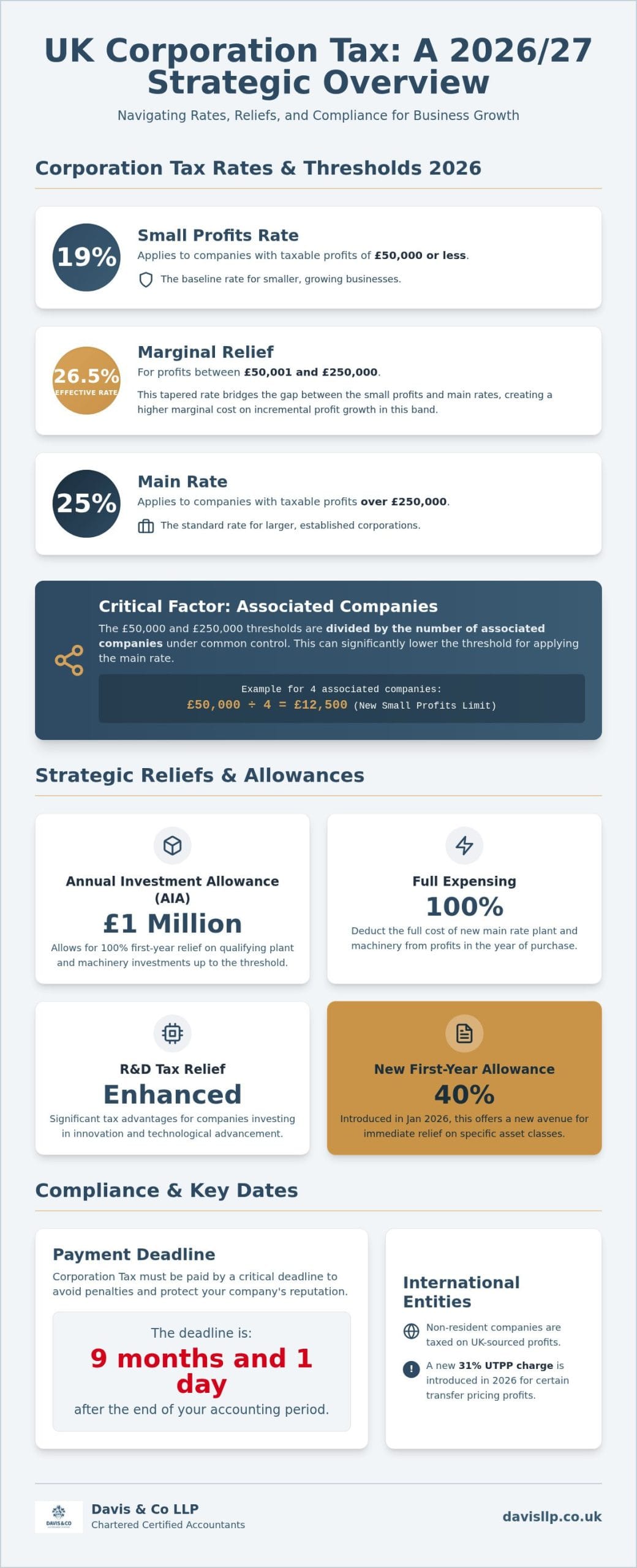
The UK fiscal landscape for 2026 remains structured around a tiered system that requires precise navigation to maintain commercial efficiency. For companies with taxable profits of £50,000 or less, the small profits rate of 19% applies. Conversely, those exceeding the upper threshold of £250,000 are subject to the main rate of 25%. These Official Corporation Tax rates serve as the baseline for corporate financial planning. We often find that the most significant complexities arise for firms positioned between these two markers, where the marginal relief mechanism creates a sliding scale of liability.
A critical, and often overlooked, factor in determining which rate applies is the impact of associated companies. If a business is under the same control as another entity, the £50,000 and £250,000 thresholds are divided equally among them. For a group of four associated companies, the lower limit drops to just £12,500. Understanding this interaction is essential when considering how to reduce corporation tax uk, as it prevents unexpected escalations into higher tax brackets. We recommend a proactive review of your corporate structure to ensure thresholds are utilised effectively across all entities.
Calculating Tapered Relief for Mid-Sized Profits
When profits fall between £50,001 and £250,000, the effective tax rate on that specific portion of income is 26.5%. This taper is designed to bridge the gap between the 19% and 25% rates, yet it can create a high marginal cost for incremental profit growth. We assist directors in modelling these outcomes to ensure that expansion doesn’t lead to a disproportionate tax burden. Engaging The Strategic Small Business Accountant can help you align your profit extraction and investment timing to manage these thresholds with greater foresight.
Sector-Specific Tax Considerations
Different industries face unique pressures within this framework. For example, our work as a dental tax specialist involves balancing the corporate tax liabilities of a practice against the personal tax positions of associate dentists. Similarly, property-holding companies must distinguish between trading profits and investment income, as the latter may not always qualify for the same reliefs. Whether you operate a professional partnership or a property portfolio, we provide the audit and assurance services needed to maintain your corporate reputation while optimising your tax position.
Strategic Reliefs and Capital Allowances
Identifying how to reduce corporation tax uk effectively requires a transition from passive compliance to active fiscal management. We view tax reliefs not as loopholes, but as government-sanctioned incentives designed to reward businesses that invest in their own infrastructure and innovation. By aligning your commercial expenditure with these available allowances, you can significantly lower your taxable profit while simultaneously strengthening your balance sheet. The complexity of these claims, however, necessitates a disciplined approach to documentation and timing.
Capital allowances remain one of the most potent tools for tax mitigation. The Annual Investment Allowance (AIA) provides a £1 million cap, allowing most firms to deduct the full value of qualifying plant and machinery from their profits in the year of purchase. For larger investments, Full Expensing offers a 100% first-year deduction for new main-rate assets. We also guide clients through the strategic use of loss relief, where trading losses can be carried back one year to secure a refund of previously paid tax or carried forward to offset future liabilities. Securing professional tax advice in the UK is essential to ensure these reliefs are prioritised in a way that supports your long-term cash flow.
Capital Allowances for Plant and Machinery
Qualifying expenditure extends beyond heavy machinery to include essential office equipment such as computers, furniture, and integral building features like climate control systems. It’s vital to note that from 1 April 2026, the main rate for Writing Down Allowances (WDA) reduces from 18% to 14%, making the timing of your acquisitions even more critical. We often recommend utilising the new 40% First-Year Allowance, introduced in January 2026, for assets that don’t qualify for Full Expensing. Accelerating a purchase into the current accounting period can provide an immediate reduction in your tax bill, whereas delaying by even a few days might defer that relief by an entire year.
Incentivising Innovation via R&D Relief
The R&D tax relief landscape has undergone significant reform, with HMRC now requiring mandatory digital submissions and detailed technical justifications for every claim. Whether you’re operating under the SME scheme or the Research and Development Expenditure Credit (RDEC), the focus remains on rewarding genuine technological advancement. We help firms distinguish between routine commercial development and qualifying research to avoid the risk of enquiry. A qualifying R&D project must seek to achieve an advance in science or technology by resolving a specific scientific or technological uncertainty.
Deadlines, Filing Obligations, and Compliance
Compliance in the UK corporate tax regime is defined by a rigorous schedule that demands foresight. For a newly incorporated entity, the first obligation is to register with HMRC for Corporation Tax within three months of beginning to trade. Failure to meet this initial window can lead to avoidable penalties. We observe that the most common source of confusion for directors is the “9 months and 1 day” rule. Unlike personal tax, where payment and filing often coincide, a company’s tax liability is usually due nine months and one day after the end of the accounting period. This means you must settle your bill before the actual Company Tax Return (CT600) is legally due.
We believe that a proactive compliance strategy is the foundation of effective fiscal management. It’s often the first step in discovering how to reduce corporation tax uk, as it allows for the early identification of reliefs before the payment window closes. HMRC applies immediate fines for late filing, starting at £100 for a single day’s delay and escalating to 10% of the unpaid tax if the return is six months late. We view these costs as entirely preventable through disciplined management and a structured approach to your financial year-end. Maintaining a clear timeline ensures you aren’t siphoning off growth capital to pay interest on overdue liabilities.
The Annual Compliance Cycle
A successful compliance cycle follows a logical progression that prioritises accuracy over speed. We guide our partners through a structured framework to ensure every obligation is met with composure:
- Statutory Preparation: Developing statutory accounts and tax computations to determine the precise liability.
- Advance Payment: Settling the estimated tax liability with HMRC before the nine-month deadline expires.
- Digital Submission: Filing the CT600 return via iXBRL software to ensure full compliance with mandatory digital standards.
Quarterly Instalment Payments for Large Companies
Companies with taxable profits exceeding £1.5 million are classified as “large” and must transition to a quarterly payment schedule. This requirement accelerates the outflow of cash, as tax must be paid in four instalments during the current accounting period rather than after it. For “very large” companies with profits over £20 million, these deadlines are pulled even further forward. Managing this accelerated cycle requires sophisticated cash flow management to ensure liquidity remains available for operational needs. We help firms model these payments to prevent fiscal drag and maintain steady investment in business growth acceleration.
Navigating Corporate Tax with Davis & Co LLP
We believe that managing a corporate tax profile requires more than just administrative accuracy; it demands a partner who understands the intricate relationship between tax efficiency and commercial momentum. Since 1901, Davis & Co LLP has acted as a trusted advisor to growth-oriented firms, providing the professional gravitas necessary to manage sensitive fiscal matters with discretion. Our approach transcends basic filing obligations. We provide a framework for business growth acceleration by ensuring your tax strategy is a driver of success rather than a hurdle. When directors ask how to reduce corporation tax uk, we look beyond the current year’s numbers to build a long-term roadmap for resilience.
Our partnership model is built on a foundation of reliability and deep-seated expertise. We recognise that for high-calibre businesses, tax isn’t an isolated concern but a component of a broader organizational strategy. By positioning ourselves as a strategic partner rather than a mere service provider, we help you navigate the complexities of the 2026 tax landscape with composed confidence. Whether you’re a domestic SME or an entity with complex cross-border interests, we provide the steady, measured guidance required to maintain stability in a volatile environment.
Integrated Audit and Tax Solutions
Our specialist audit and assurance services do more than satisfy regulatory requirements. They provide a robust, independent examination of your financial statements, which is the essential foundation for accurate tax planning. By ensuring that your reporting is precise, we can identify specific efficiencies that might otherwise remain hidden within complex accounts. This integrated approach allows us to align your corporate reputation with a lean tax position, ensuring you remain fully compliant while avoiding unnecessary liabilities. It’s this level of detail that distinguishes a professional practice from a standard consultancy.
Strategic Advisory for Long-Term Success
As your business evolves, your tax requirements naturally become more complex. Whether you’re expanding into new markets or restructuring for a future exit, we provide the international tax planning expertise needed to manage cross-border liabilities with precision. Our solutions are never off-the-shelf. Instead, they’re tailored to your specific business lifecycle and the organizational impact of complex issues. We focus on creating a steady, reliable rhythm for your tax affairs, allowing you to concentrate on your core operations. Taking the next step toward a more efficient corporate structure begins with a conversation. We invite you to consult with our Chartered Certified Accountants to discuss how a bespoke tax strategy can support your objectives for 2026 and beyond.
Strengthening Your Corporate Fiscal Resilience
Managing the 2026 tax landscape requires a shift from reactive filing to proactive planning. We’ve explored how the tiered rate system and the 26.5% marginal band necessitate careful threshold management. By identifying how to reduce corporation tax uk through strategic capital allowances and R&D reliefs, your business can transform a statutory obligation into a mechanism for growth. Compliance remains a non-negotiable foundation for corporate reputation; however, it’s the integration of these rules with your broader commercial objectives that creates lasting value.
As Chartered Certified Accountants since 1901, we provide the steady guidance needed to navigate these complexities. Our deep-seated expertise in international tax planning and our role as advisors to dental and medical professionals ensure that your strategy is as unique as your practice. We invite you to consult with our expert Chartered Certified Accountants to optimise your corporate tax strategy. With the right partnership, you can face the coming financial years with composed confidence and clear strategic direction. We look forward to supporting your continued success.
Frequently Asked Questions
When is the deadline to pay Corporation Tax in 2026?
For most companies, the deadline to pay Corporation Tax is nine months and one day after the end of your accounting period. If your financial year ended on 31 December 2025, your payment is due by 1 October 2026. This precedes the 12-month filing deadline for the CT600 return. Large companies with profits exceeding £1.5 million follow an accelerated quarterly instalment schedule. We recommend settling liabilities early to maintain a flawless compliance record.
Do I have to pay Corporation Tax if my company made a loss?
You don’t pay Corporation Tax if your company makes a loss, but you must still file a return to record that loss with HMRC. These trading losses are valuable strategic assets. You can carry them back one year to reclaim tax paid previously or carry them forward to offset future taxable profits. We assist clients in managing these losses to ensure they provide the maximum benefit to your company’s long-term cash flow.
What is the current Corporation Tax rate for small businesses?
The small profits rate for the 2026/27 financial year is 19% for companies with taxable profits of £50,000 or less. If your profits exceed £250,000, the main rate of 25% applies. Firms with profits between these two thresholds benefit from marginal relief, which effectively applies a 26.5% rate to the portion of profit within that band. Understanding these thresholds is essential when exploring how to reduce corporation tax uk through strategic investment.
How do I register my new limited company for Corporation Tax?
You must register for Corporation Tax within three months of starting business activities, which includes buying, selling, or renting property. Most directors complete this process online via the government’s registration service while setting up their limited company. You’ll need your company’s ten-digit Unique Taxpayer Reference (UTR), which HMRC sends to your registered office shortly after incorporation. We provide company secretarial services to ensure these initial statutory obligations are handled with professional precision.
Can I claim capital allowances on my business car?
Capital allowances for business cars are determined by their CO2 emissions and whether the vehicle is new or second-hand. Electric cars with zero emissions currently qualify for a 100% first-year allowance, allowing the full cost to be deducted from profits immediately. For cars with higher emissions, you’ll typically claim a writing down allowance of either 18% or 6% annually. We help you evaluate vehicle procurement strategies to align with your wider tax efficiency goals.
What happens if I miss the deadline for my CT600 tax return?
HMRC applies an immediate £100 penalty if you miss the 12-month filing deadline for your CT600 tax return. This fine doubles to £200 if the return is three months late, and further penalties of 10% of the estimated tax bill are applied at six and twelve months. Persistent late filing can lead to increased scrutiny and higher penalty rates. We prioritise timely submissions to protect your corporate reputation and avoid unnecessary financial friction.
Is Corporation Tax different for foreign companies with UK branches?
Foreign companies are generally only liable for UK Corporation Tax on profits generated through a UK permanent establishment or branch. While the 25% main rate applies to these profits, specific rules govern the allocation of income and expenses between the branch and the overseas head office. From 1 January 2026, the Diverted Profits Tax was replaced by a 31% charge on unassessed transfer pricing profits. We specialise in international tax planning to navigate these cross-border complexities.
How can R&D tax credits reduce my Corporation Tax bill?
R&D tax credits allow companies to either deduct an extra percentage of their qualifying costs from their taxable profit or claim a payable cash credit. This is a primary method for how to reduce corporation tax uk while fostering innovation. In 2026, HMRC requires more detailed technical justifications and digital submissions for all claims. We ensure your research projects meet the scientific or technological uncertainty criteria required to secure these significant tax savings.