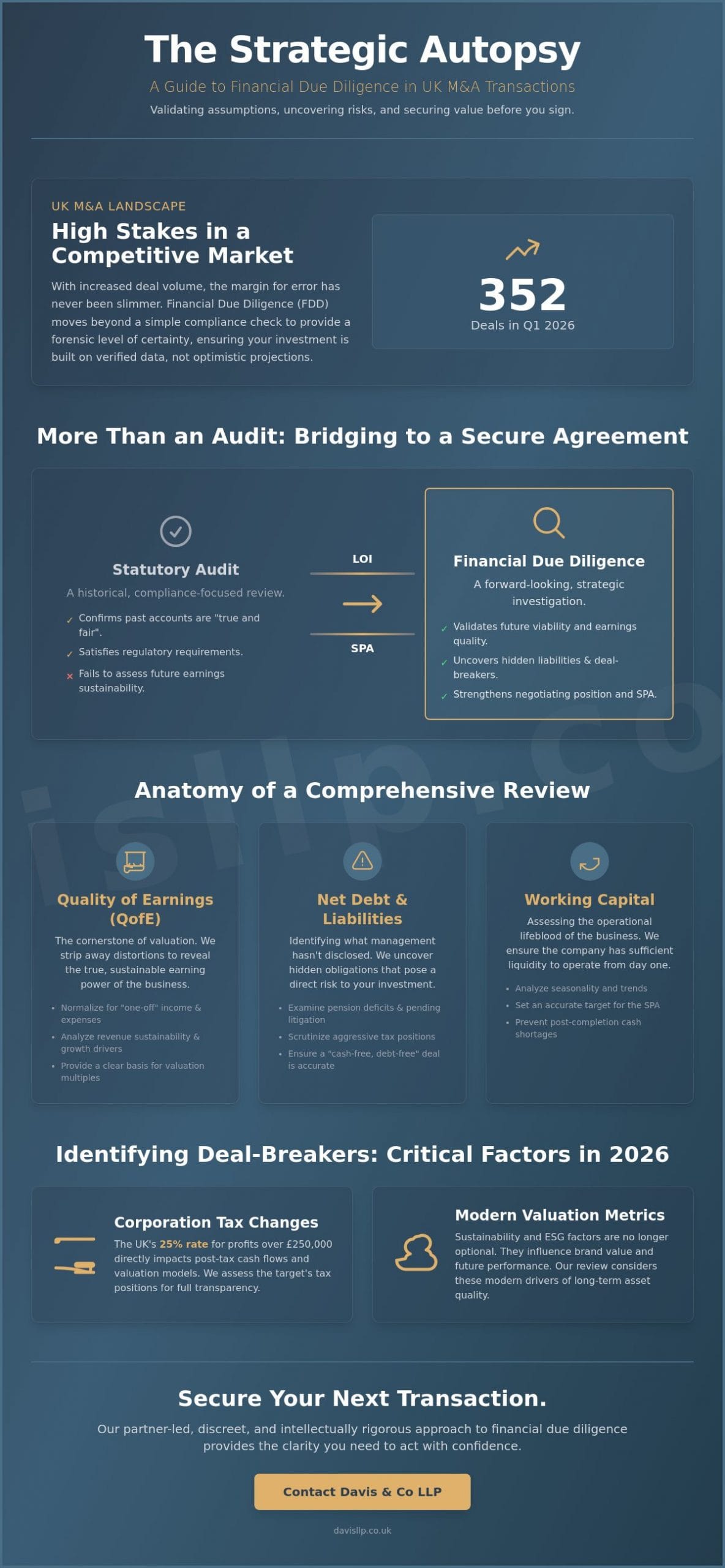
If a transaction appears flawless during the initial handshake, it’s likely that the most significant risks remain tucked away in the balance sheet. You understand that a successful acquisition requires more than just a matching of strategic goals; it demands a forensic level of certainty. With UK M&A volume reaching 352 deals in the first quarter of 2026, the competition for quality assets is high, but the margin for error has never been slimmer. Engaging professional financial due diligence services uk is no longer a mere box-ticking exercise; it’s a strategic autopsy of a business’s future viability.
We recognize the pressure to move quickly, yet we also know the cost when hidden liabilities surface post-completion or inaccurate EBITDA reporting compromises your investment. You’ve worked hard to identify a target, and you deserve to see the reality behind the numbers. This guide will show you how to validate every financial assumption and secure a robust Sale and Purchase Agreement. We’ll explore how current 2026 tax rates and the updated Money Laundering Regulations impact your transaction, providing the peace of mind that comes from expert scrutiny and a composed, professional partnership.
Key Takeaways
- Understand why historical audits fail to capture transaction-level risks and how a strategic autopsy reveals the true future viability of a UK target.
- Identify the critical pillars of professional financial due diligence services uk, ensuring that Quality of Earnings and working capital adjustments are accurately validated.
- Explore the strategic nuances between buy-side and vendor due diligence to determine which approach best secures your commercial interests during the deal lifecycle.
- Prepare for 2026 market shifts by evaluating how recent corporation tax changes and sustainability metrics influence modern valuation models.
- Learn to select a strategic partner who prioritizes discretion and a high-calibre, partner-led delivery model over junior-heavy operational structures.
The Strategic Role of Financial Due Diligence in UK Transactions
Financial due diligence is an independent, rigorous investigation into a target’s financial health. It’s often helpful to revisit the fundamental question: What is Due Diligence? in a modern corporate context. It isn’t a mere audit. While a statutory audit confirms that historical accounts are “true and fair” for compliance purposes, it doesn’t assess whether the business can sustain its earnings under new ownership. Professional financial due diligence services uk bridge the gap between a high-level Letter of Intent (LOI) and a binding Sale and Purchase Agreement (SPA). This process validates your investment thesis, ensuring the capital you’re committing rests on a foundation of verified data rather than optimistic projections.
We view this process as a bridge. It connects the initial excitement of a potential deal with the cold reality of a final contract. Without this scrutiny, the assumptions made during the LOI stage remain unproven. By the time you reach the SPA, every financial claim must be substantiated. This transition requires a shift from strategic optimism to analytical skepticism, ensuring that the price you pay reflects the actual value you’ll receive.
Beyond the Balance Sheet: Assessing Future Viability
Historical success doesn’t always guarantee future performance, especially with the UK’s 25% corporation tax rate for profits over £250,000 in 2026. We look past the raw numbers to identify non-recurring items or “one-off” gains that might artificially inflate a target’s valuation. By stripping away these distortions, we reveal the underlying Quality of Earnings. This clarity is vital for supporting or, where necessary, challenging a proposed valuation. We analyze whether revenue growth is driven by sustainable market share or temporary anomalies that won’t survive the transition. In the 2026 economic environment, understanding these nuances is the difference between a growth asset and a stagnant liability.
Mitigating Deal Risk through Intellectual Rigour
The true value of financial due diligence services uk lies in the discovery of what management hasn’t disclosed. This includes hidden liabilities like pension deficits, pending litigation, or aggressive tax positions that could trigger future HMRC inquiries. We examine the reliability of internal controls and management information. If the data is messy, the risk is higher. Our findings directly influence the final price negotiations and the strength of warranty protections in the SPA. By identifying these risks early, we empower you to walk away from a bad deal or restructure a good one to protect your interests. This intellectual rigour transforms a speculative bet into a calculated strategic move.
The Anatomy of a Comprehensive Due Diligence Review
A robust review rests on three fundamental pillars: Quality of Earnings (QofE), Net Debt, and Working Capital. These components provide the structural integrity of any transaction, yet their application must be highly specific to the target’s industry. For instance, a review for a medical practice requires the insights of a dental tax specialist to account for unique regulatory and revenue patterns, while real estate transactions demand rigorous property accounting scrutiny. We don’t believe in a one size fits all approach. Instead, we customize the scope of our financial due diligence services uk to reflect the specific risks inherent in your sector, ensuring no stone is left unturned.
The chronological flow of a review typically begins with data room access, where we ingest vast quantities of management information. This process follows established best practices, often aligning with the ICAEW’s financial due diligence guideline to maintain the highest standards of intellectual rigour. Throughout this sensitive period, discretion remains our priority. We understand that the mere whisper of a transaction can destabilize staff or alert competitors, so we operate with a quiet excellence that protects the confidentiality of all parties involved.
Quality of Earnings (QofE): The Cornerstone of Valuation
Determining a business’s true value requires looking past the reported EBITDA. We adjust for “one-off” income or non-recurring expenses to establish the underlying run-rate of the business. Quality of Earnings is the most critical metric for determining a deal’s multiple. Beyond the numbers, we analyze customer concentration. If a significant portion of revenue relies on a single contract, the risk profile changes immediately. We help you understand if the earnings you’re buying today will still be there tomorrow.
Net Debt and Debt-like Items: Protecting the Purchase Price
Most UK transactions are negotiated on a “cash-free, debt-free” basis, making the bridge between Enterprise Value and Equity Value essential. We identify “debt-like” items that management might not have categorized as such, including deferred tax, unfunded pension liabilities, or significant capital expenditure arrears. These hidden costs can drastically reduce the final cash consideration at completion. By uncovering these items early, we ensure that the price you pay is fair and that the final SPA includes the necessary protections for your investment.
Buy-Side vs. Vendor Due Diligence: Navigating the Lifecycle
Every transaction involves an inherent tension between the buyer’s quest for certainty and the seller’s desire for value. Choosing the right entry point for financial due diligence services uk determines how this tension is managed. While buy-side reviews focus on defensive scrutiny, vendor-led initiatives are increasingly used to accelerate timelines and preserve equity value. The choice between these two approaches isn’t just a matter of who pays the fee; it’s a strategic decision that dictates the flow of information and the level of control each party maintains over the deal’s narrative.
We see a growing trend in 2026 where mid-market SMEs opt for Vendor Assistance as a tactical alternative to full-scope Vendor Due Diligence (VDD). This lighter-touch approach helps smaller businesses organize their management accounts and cash flow data before a purchaser’s team arrives. It’s about preparation. By addressing internal inconsistencies early, sellers can present a professional front that suggests a well-managed operation, which often translates to a smoother negotiation process and a higher level of trust from the outset.
Empowering the Purchaser: Buy-Side Scrutiny
Buy-side diligence is about more than just finding reasons to say no. It’s an objective deep dive designed to empower the purchaser with a clear-eyed view of what they’re actually buying. We focus on identifying potential deal breakers early, but we also look for “Value Drivers” that justify the investment. These findings don’t just sit in a report. They’re used to refine the Sale and Purchase Agreement (SPA) terms, ensuring that the financial protections and warranties reflect the specific risks uncovered during our review. It’s a process of turning raw data into strategic leverage.
Strengthening the Seller’s Position: Vendor Due Diligence
Commissioning a VDD report allows a seller to maintain control of the data room. It’s a proactive move. By identifying and fixing “red flags” before a buyer’s team discovers them, you significantly reduce the risk of a “price chip” late in the transaction. When a seller provides a high-quality, independent report to multiple bidders, it creates a level playing field and can even spark a more competitive bidding environment. This approach demonstrates a level of transparency and confidence that can shave weeks off the closing timeline, providing certainty in an often volatile market.
Ultimately, the depth of the review impacts the deal’s velocity. A transaction supported by robust, partner-led scrutiny moves faster because the “difficult” questions have already been answered. Whether you’re acquiring a competitor to accelerate business growth or preparing a family-owned firm for exit, the intellectual rigour applied during the diligence phase is what prevents a promising handshake from turning into a post-completion dispute.
Identifying Deal Breakers: Critical Risk Factors in 2026
In the current transaction market, the definition of a deal breaker has expanded beyond simple accounting errors. Investors in 2026 must now account for a 25% corporation tax rate on profits exceeding £250,000, which fundamentally alters the net cash flow available for debt servicing. When we perform financial due diligence services uk, we look for latent risks that could erode the value of your investment long after the initial handshake. This includes evaluating the target’s resilience against the Money Laundering and Terrorist Financing Regulations 2026, where monetary thresholds have transitioned from euros to sterling. Failure to align with these updated UK frameworks represents a significant regulatory and financial liability.
The role of ESG and sustainability has also moved from the periphery to the centre of financial risk modelling. We analyze how a target’s carbon footprint or supply chain ethics might impact its future cost of capital or insurance premiums. Similarly, cybersecurity is now viewed as a primary financial risk. A history of data privacy lapses can lead to substantial fines and reputational damage, effectively acting as an off-balance-sheet debt that the purchaser inherits. We assess whether management has the intellectual rigour and operational systems to execute a post-deal growth plan in this complex environment.
Working Capital Volatility and Cash Flow Analysis
Determining the “normalised” level of working capital is a delicate exercise that requires deep analytical thought. We strip away seasonal fluctuations and aggressive window-dressing to find the true cash requirement of the business. Working capital adjustments are the most common source of post-deal disputes because they directly impact the final cash consideration paid at completion. By analyzing the cash conversion cycle, we ensure you aren’t inheriting a business that has been artificially starved of investment to temporarily inflate its bank balance. If you are concerned about the liquidity of a potential target, we recommend a thorough review of their Cash Flow Management history.
Tax and Regulatory Compliance Scrutiny
Historical irregularities in VAT, PAYE, or corporation tax can surface years after a deal closes, often with significant penalties attached. We scrutinize the target’s compliance with the latest HMRC guidance, including the £90,000 VAT registration threshold and the specific 2026 rules for marginal relief. For cross-border acquisitions, international tax planning becomes essential to ensure the transaction structure remains efficient under evolving global standards. Our approach is to identify these exposures early, allowing for appropriate price adjustments or the inclusion of robust indemnities in the final agreement. This level of scrutiny provides the security necessary to proceed with confidence.
Selecting a Strategic Partner for Transaction Services
Choosing a firm to deliver financial due diligence services uk is a decision that dictates the tone and security of your entire transaction. In the UK market, where discretion is the currency of trust, the concept of “quiet excellence” is paramount. We believe that a partner-led approach is essential for high-stakes deals. Unlike junior-heavy delivery models where the most experienced eyes only see the final draft, our senior team is involved at every stage of the review. This ensures that subtle financial nuances and potential risks are identified in real time, providing the reassurance you need during complex negotiations.
A successful acquisition requires a holistic view that extends beyond the current balance sheet. By integrating our findings with expert tax advice in the UK, we ensure that your post-deal structure is as robust as the initial valuation. Davis & Co LLP offers the professional gravitas typically associated with global institutions, yet we maintain the boutique focus necessary for highly individualized service. We position ourselves as a strategic partner, offering the intellectual rigour of a large firm with the agility and discretion of a dedicated advisor.
The Davis & Co Approach: Composed Partnership
We move beyond providing a static report to offer actionable strategic advice. Our commitment to clarity and precision means we don’t just identify problems; we help you understand their impact on your long-term objectives. We provide the secure environment necessary for sensitive commercial matters, ensuring that all communications are handled with the utmost reliability. This composed partnership allows you to focus on the strategic goals of the deal while we manage the analytical heavy lifting with steady, measured expertise.
Integrating Specialist Expertise for Niche Sectors
Niche sectors like dental practices or property portfolios require a specialized lens that generalist firms often lack. Our background as a strategic small business accountant informs our approach to SME deals, allowing us to apply sector-specific insights to your transaction. Whether it’s navigating complex property accounting rules or understanding the unique revenue cycles of a medical practice, our individualized service delivery ensures your diligence is relevant and thorough. We invite you to contact us for a confidential discussion regarding your upcoming transaction and how our financial due diligence services uk can secure your investment.
Advancing Your Strategy with Transactional Certainty
Navigating the UK’s evolving corporate landscape requires a shift from historical observation to strategic foresight. We’ve detailed how robust scrutiny uncovers hidden liabilities and validates the underlying quality of earnings, ensuring your investment thesis remains sound under the weight of 2026’s 25% corporation tax rate. Success doesn’t happen by accident in a volatile market; it’s the result of meticulous preparation. Whether you’re managing a complex carve-out or a niche dental practice acquisition, the intellectual rigour applied today defines the commercial success of tomorrow.
Selecting a partner who offers the right blend of discretion and deep-seated expertise is essential. As Chartered Certified Accountants since 1901, we provide a partner-led approach that prioritizes your specific objectives. Our specialists in international tax planning and niche sectors ensure every nuance of your deal is handled with professional gravitas. We invite you to partner with Davis & Co LLP for your next strategic transaction and experience the quiet excellence of our financial due diligence services uk. Your next successful deal begins with a foundation of verified certainty.
Frequently Asked Questions
What is the primary difference between an audit and financial due diligence?
An audit focuses on historical compliance and statutory requirements to confirm accounts are “true and fair,” whereas financial due diligence services uk examine the commercial viability and future earnings potential of a target. While our audit and assurance work confirms that historical records are free from material misstatement, it doesn’t assess whether the business model is sustainable post-acquisition. We focus on the quality of earnings and the underlying cash flow to ensure the investment thesis holds up under intense scrutiny.
How long does a standard financial due diligence process take in the UK?
A standard review usually takes between two and four weeks to complete, though this timeline depends heavily on the quality of the target’s management information. If the data room is well-organized and the target’s bookkeeping services are up to date, the process moves swiftly. Delays often occur when we encounter incomplete records or complex inter-company transactions that require deeper analysis to untangle and verify.
Why is Quality of Earnings (QofE) more important than simple EBITDA?
Quality of Earnings is more important because it strips away non-recurring income and artificial distortions that a simple EBITDA calculation often includes. A raw EBITDA figure can be window-dressed through aggressive revenue recognition or deferred maintenance. We analyze the “run-rate” of the business, ensuring you’re paying a multiple based on sustainable, repeatable profit rather than a one-off financial peak that won’t continue under your ownership.
Can financial due diligence help in negotiating a lower purchase price?
Yes, the findings from a professional review frequently provide the evidence needed to negotiate a “price chip” or a reduction in the headline price. If we uncover hidden liabilities or overstated earnings, the initial valuation is no longer supported by the facts. This objective data empowers you to recalibrate the offer or request specific indemnities in the Sale and Purchase Agreement to protect your capital and future returns.
What are ‘debt-like items’ and why do they matter in a deal?
Debt-like items are liabilities that aren’t classified as bank debt but still represent a future cash outflow for the purchaser. Common examples include unfunded pension deficits, deferred tax liabilities, or significant arrears in capital expenditure. These matter because they’re typically deducted from the enterprise value during the “cash-free, debt-free” bridge, directly reducing the final cash consideration paid to the seller at completion.
What is the difference between Buy-Side and Vendor Due Diligence?
Buy-side diligence is commissioned by the purchaser to identify risks, while vendor due diligence (VDD) is prepared for the seller to provide to multiple bidders. VDD allows a seller to address “red flags” before the business is marketed, which often leads to a faster and more certain closing process. Buy-side diligence remains a more defensive tool, offering the purchaser an independent and unvarnished view of the target’s financial health.
How much does financial due diligence typically cost for a UK SME?
The investment required for professional financial due diligence services uk varies based on the target’s size and the complexity of its financial history. Factors such as the volume of transactions, the presence of international tax planning requirements, or complex property accounting structures influence the final fee. We recommend discussing the scope of your transaction early to ensure the diligence plan is tailored to your specific risk profile and commercial objectives.
What happens if due diligence uncovers a significant financial risk?
If a significant risk is uncovered, it doesn’t necessarily mean the deal is dead; instead, it changes how the risk is managed and priced. We might suggest adjusting the purchase price, restructuring the deal to include an earn-out, or drafting specific warranties and indemnities to protect you. In cases where the risk is fundamental and cannot be mitigated, our findings provide the intellectual rigour necessary to walk away before capital is committed.