What if the significant turnover your practice generates is actually obscuring a narrowing net margin? Across the UK dental sector, many principals find themselves on a treadmill of high production, yet the actual take-home profit remains stagnant due to rising laboratory fees and the 2026 adjustments to the tax burden. Volume isn’t always value. Understanding how to increase dental practice profitability requires looking past the gross billings and addressing the ‘Efficiency Gap’ that exists within many clinical environments.
In this guide, we’ll demonstrate how to transform your clinic from a high-turnover operation into a high-margin business through strategic financial analysis. We’ll provide a clear framework for increasing net margins, evaluating clinician-level profitability, and securing long-term wealth protection through specialist tax planning. Our goal is to ensure your clinical expertise results in a robust, sustainable commercial entity that serves your long-term interests.
Key Takeaways
- Identify the “Efficiency Gap” to understand why increasing patient volume can often lead to diminishing net returns without proper margin control.
- Utilise chair-level analysis and the “Profit by Treatment” matrix to prioritise the procedures that contribute most significantly to your bottom line.
- Shift your focus from historical KPI tracking to strategic growth levers that provide a forward-looking perspective on your clinic’s performance.
- Discover the specific financial frameworks for how to increase dental practice profitability by addressing overhead “leaky buckets” and 2026 wage adjustments.
- Secure your long-term commercial viability by transitioning from basic tax compliance to a strategic partnership with a specialist dental accountant.
Understanding the Efficiency Gap: Why Turnover Isn’t Profit
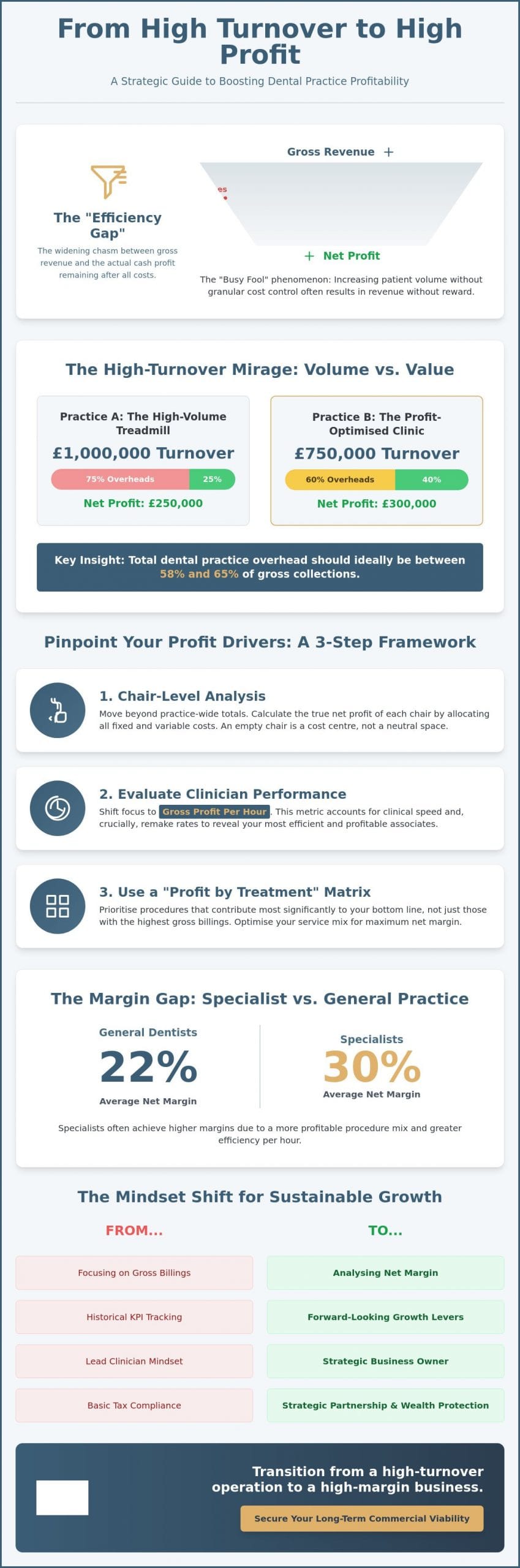
In the modern UK dental sector, the “Efficiency Gap” represents the widening chasm between a practice’s gross revenue and the actual cash that remains after every obligation is met. Many principals operate under the assumption that a fuller diary naturally leads to a healthier bank balance. However, in a high-fixed-cost clinical environment, increasing patient volume without granular cost control often results in revenue without reward. This is the primary hurdle for those seeking how to increase dental practice profitability in an increasingly complex economic climate.
We often observe the “busy fool” phenomenon among highly skilled clinicians. This psychological trap occurs when a principal works longer hours and sees a higher volume of patients, yet finds their net margin shrinking. This happens because variable costs, such as materials, lab fees, and associate commissions, scale linearly with production. Meanwhile, fixed overheads and tax burdens can accelerate. Understanding the distinction between production (the value of work done), collection (the actual cash received), and EBITDA (your true earnings) is essential for sustainable growth. If your production is climbing while your EBITDA remains stagnant, you aren’t building a business; you’re simply increasing your operational risk.
The High-Turnover Mirage
A practice generating £1 million in turnover is not inherently more successful than one generating £750,000. In fact, the lower-turnover clinic often enjoys higher liquidity and significantly lower stress. As we move through 2026, the impact of inflation on laboratory overheads and specialized materials has reached a critical tipping point. Research indicates that total dental practice overhead should ideally sit between 58% and 65% of gross collections. Beyond a certain volume, you may find that the cost of the additional surgery, support staff, and administrative burden required to service more patients actually reduces your overall net margin. It’s about optimizing the yield per chair, not just filling the diary at any cost.
From Clinical Excellence to Commercial Success
True growth requires a fundamental mindset shift from being a lead clinician to becoming a strategic business owner. This transition is supported by the regular review of management accounts, which reveal hidden losses that a standard year-end return might miss. Securing expert tax advice in the UK provides the structural foundation needed to ensure that your clinical success translates into personal wealth. By analyzing clinician-level profitability, we can identify which treatments are driving growth and which are merely occupying valuable surgery time. This data-driven approach ensures that every decision made in the boardroom is as precise as the work performed in the surgery.
Granular Profit Analysis: Evaluating Clinician and Treatment Margins
Moving beyond the broad strokes of practice turnover requires a disciplined look at the economics of each individual surgery. Real insight into how to increase dental practice profitability isn’t found in the total revenue figure but in the net contribution of every chair. To achieve this, we must move away from viewing associate pay as a simple percentage of production and instead calculate the true net profit after all variable and allocated fixed costs are considered.
To calculate the net profit of a specific chair, you must first allocate fixed costs, such as rent, utilities, and compliance fees, across your total operational surgery hours. Many principals overlook this step, failing to realize that an empty chair costs the business money every minute it sits idle. Once these baseline costs are established, you can subtract associate commissions, specific material usage, and laboratory fees from the gross production of that surgery. According to ADA Health Policy Institute data, specialists often achieve net margins closer to 30% compared to the 22% average for general dentists, primarily due to a more profitable procedure mix and higher efficiency per hour.
The Clinician Profitability Framework
Evaluating associate performance requires a shift toward “Gross Profit per Hour” as a primary metric. This calculation should account for the clinical speed of the practitioner and, crucially, their remake rate. An associate who produces high volume but requires frequent laboratory remakes significantly erodes the practice’s margin. Using these granular data points allows for more transparent performance reviews and informs associate contract negotiations based on actual value rather than arbitrary percentages. Implementing robust management accounts is the most effective way to track these metrics in real time, ensuring that every clinician is contributing to the practice’s long-term stability.
High-Margin Treatment Strategy
While general check-ups are essential for patient health and pipeline building, they often function as “loss-leaders” when you factor in the full cost of staffing and overhead. High-performing practices optimize their diaries by balancing these essential services with high-value procedures like implants or cosmetic dentistry. These treatments require different KPI tracking because their laboratory costs and surgery time requirements are significantly higher. By identifying your most profitable treatment categories, you can strategically direct your marketing efforts and internal referrals to ensure the most lucrative work is being performed by your most efficient clinicians.
Beyond KPIs: Implementing Strategic Growth Acceleration
While most practice owners are diligent in tracking daily production and collection rates, these metrics often serve as “rear-view mirror” accounting. They tell you where you’ve been, but they offer little guidance on where you’re going. True how to increase dental practice profitability lies in shifting your focus from purely operational metrics to strategic growth levers. This requires a transition from reactive management to proactive financial forecasting, ensuring every investment is backed by data-driven confidence.
Strategic growth acceleration involves more than just filling more chairs. It’s about optimizing your existing capacity and identifying the precise moments when capital expenditure will yield the highest return. By utilizing sophisticated management accounts, we can help you forecast cash flow and determine your practice’s true investment capacity. This level of foresight allows you to plan for future growth without compromising your current liquidity.
KPI Tracking vs. Strategic Growth
Operational KPIs like “Collection %” or “Daily Production” are necessary baseline indicators, but they don’t drive growth on their own. We categorize these as reactive metrics. In contrast, strategic levers focus on proactive indicators such as Investment ROI and capacity utilization rates. Instead of setting goals based on last year’s performance, we look at your practice’s latent capacity. If your hygienist’s diary is consistently at 98% capacity, the strategic move isn’t just to work faster; it’s to analyze the ROI of adding a second hygiene surgery or a therapist. This forward-looking approach turns “stretch goals” from aspirational targets into achievable milestones.
Growth Acceleration Levers
The decision to invest in digital dentistry is a prime example of a strategic growth lever. While the upfront cost of intraoral scanners or AI-driven diagnostic software is high, the long-term impact on margins is profound. These tools reduce laboratory turnaround times, decrease material waste, and significantly improve patient acceptance rates for high-value treatments. Similarly, strategic recruitment plays a vital role. Adding a specialist, such as an endodontist or implantologist, can often be more profitable than adding another generalist. A specialist allows you to keep complex cases in-house, capturing the full margin rather than referring it elsewhere. Whether you’re scaling from a single-handed practice to a multi-surgery clinic or simply refining your current setup, these decisions should always be guided by a specialist dental tax specialist to ensure your capital expenditure is structured for maximum tax efficiency.
Optimising the Bottom Line: Tax Efficiency and Overhead Management
Managing the bottom line is not merely about cutting costs; it’s about surgical precision in where your capital flows. Many principals focus heavily on gross revenue while ignoring the “leaky buckets” in their overheads. These leaks often appear in lab fees, material waste, and recurring software subscriptions that no longer serve a strategic purpose. In a climate where staff costs typically account for 25% to 28% of collections, the upcoming minimum wage rates for 2026 will place additional pressure on margins. Understanding how to increase dental practice profitability now requires a dual focus on operational efficiency and aggressive tax retention.
Strategic tax planning remains one of the most effective tools for profit retention. For example, the availability of 100% bonus depreciation in 2026 offers a significant opportunity to deduct the full cost of qualifying dental equipment in the year of purchase. This can transform a necessary capital investment into a powerful mechanism for reducing your immediate tax liability, keeping more liquid cash within the business for reinvestment or personal wealth building.
Specialist Dental Tax Services
A generic accountant may understand the basics of a balance sheet, but they often lack the nuance required for a clinical environment. Choosing a dental tax specialist ensures you’re utilising niche reliefs and the most efficient business structure for your specific circumstances. Whether you operate as a sole trader, a partnership, or a limited company, your structure must reflect your long-term commercial goals. We also help navigate the complex distinction between associate and employee status, a distinction that carries heavy tax implications for your practice’s payroll and National Insurance obligations.
Overhead Benchmarking
High-performing practices aim to maintain total overhead between 58% and 65% of gross collections. If your material or lab spend exceeds industry benchmarks, it’s time for a data-led review of your suppliers. While large DSOs often leverage centralised purchasing to lower these costs by 10% to 15%, independent practices can achieve similar results through tighter inventory control and strategic negotiation. Investing in team training also offers a high ROI by reducing staff turnover. Replacing a single team member can cost between £6,000 and £12,000 in lost productivity and recruitment fees; retaining talent is a direct contribution to your net margin.
The Strategic Partner: How Specialist Dental Accounting Secures Longevity
A year-end tax return is a retrospective look at history, but for a principal, it’s rarely enough to navigate the complexities of a modern clinic. Securing a chartered accountant with a deep understanding of the dental industry lifecycle is the difference between merely surviving and truly thriving. We provide the foresight necessary to turn operational success into long-term wealth protection. When considering how to increase dental practice profitability, the focus shouldn’t just be on the current financial year. Longevity is built on a foundation of consistent, data-led strategy that anticipates market shifts and regulatory changes before they impact your cash flow.
At Davis & Co LLP, our approach goes beyond standard bookkeeping. We act as a strategic partner, offering a suite of services tailored to the unique needs of dental professionals. This includes everything from business growth acceleration to international tax planning, ensuring that both your practice and your personal finances are structured for maximum efficiency. By delegating these complex tasks to specialists, you gain the intellectual space to focus on what you do best: providing exceptional clinical care to your patients.
Exit Planning and Valuation
Profitability today is the primary driver of your practice’s valuation tomorrow. Whether you intend to sell to a corporate entity or a private buyer, your “Normalised EBITDA” is the metric that dictates the final sale price. We help you clean up your balance sheet years in advance, ensuring that discretionary expenses don’t artificially lower your earnings before interest, taxes, depreciation, and amortization. For those planning a post-exit life overseas, our expertise in international tax planning ensures your wealth remains protected across borders. A well-prepared exit strategy often begins five years before the planned date, allowing time to optimize margins and demonstrate a history of sustainable growth.
Composed Partnership for Growth
Our approach is centered on a composed partnership. We act as your strategic advisors, providing regular management accounts that offer a clear, forward-looking view of your clinic’s health. This reduces the administrative burden on you, the principal, and provides the clarity needed to make confident investment decisions. Requesting a profitability audit is often the first step in understanding how to increase dental practice profitability through structured, professional oversight. We offer a range of specialized services to support this journey:
- Bespoke business growth acceleration and cash flow management.
- Personal and trust tax services for long-term wealth protection.
- Audit, assurance, and company secretarial services to maintain rigorous compliance.
- Specialist dental tax advice to maximize capital allowances on surgery equipment.
By shifting from a transactional relationship with your accountant to a strategic one, you secure the commercial future of your practice. This ensures your clinical expertise is matched by financial precision, creating a legacy of success that lasts long after you’ve stepped away from the chair.
Securing Your Clinical Legacy Through Financial Precision
The transition from a high-turnover clinic to a high-margin enterprise requires a disciplined departure from traditional reactive accounting. By addressing the efficiency gap and implementing chair-level profit analysis, you move beyond the limitations of turnover to focus on sustainable net growth. We’ve explored how identifying high-margin treatment mixes and utilizing strategic tax planning can fundamentally reshape your practice’s fiscal trajectory. Mastering how to increase dental practice profitability isn’t a one-time adjustment; it’s a continuous process of refining operational metrics and protecting your capital from unnecessary tax burdens.
As Chartered Certified Accountants with over 120 years of history, Davis & Co LLP provides the niche expertise required to navigate the dental industry’s unique challenges. We act as strategic partners for both national and international dental professionals, ensuring that your commercial success is matched by robust wealth protection. Discover how our specialist dental tax services can accelerate your practice growth. We’re here to help you turn your clinical excellence into a lasting financial legacy that provides security for both your practice and your future.
Frequently Asked Questions
What is a healthy net profit margin for a UK dental practice in 2026?
A healthy net profit margin for a high-performing private practice in the UK typically ranges between 35% and 40%. While many general practices average closer to 20% to 25%, reaching the upper quartile requires a disciplined approach to how to increase dental practice profitability through chair-level efficiency. Monitoring these margins monthly is essential to ensure that rising operational costs don’t erode your personal drawings.
How can I reduce my dental practice overheads without compromising patient care?
Reducing overheads effectively involves benchmarking your laboratory and material spend to ensure they remain within 12% to 15% of your total turnover. With the 2026 increases to the National Minimum Wage, focus on enhancing team productivity through better surgery workflow rather than reducing headcount. Implementing digital inventory tracking can also prevent capital from being tied up in excess stock, directly improving your practice’s liquidity.
Is it more profitable to hire an associate or a therapist?
Hiring a dental therapist is often the more profitable choice for routine restorative and preventative work, as it allows the principal to focus on high-margin specialized treatments. This model optimizes the revenue generated per surgery hour by matching the complexity of the task to the most cost-effective clinician. It’s a strategic shift that helps balance the diary and ensures the most lucrative procedures are prioritized.
How do capital allowances work for new dental chairs and imaging equipment?
Capital allowances allow UK practices to deduct the cost of qualifying plant and machinery, such as dental chairs and digital scanners, from their taxable profits. Under 2026 regulations, many clinics can utilize full expensing or the Annual Investment Allowance to receive immediate tax relief on these investments. This effectively reduces the net cost of clinical upgrades, supporting your growth acceleration strategy without depleting your cash reserves.
What are the most important dental KPIs I should be tracking daily?
You should track daily production versus targets, your collection percentage, and surgery utilization rates. While production shows the value of clinical work, the collection rate reveals the actual cash flow entering the business. Surgery utilization is equally vital, as an empty chair represents a significant fixed-cost drain. Daily visibility of these metrics allows you to make proactive adjustments to the diary before performance gaps impact the monthly bottom line.
How can tax planning increase the take-home profit of a dental partner?
Strategic tax planning increases take-home profit by ensuring you aren’t unnecessarily exposed to the highest tax brackets or missing out on clinical tax reliefs. By optimizing the structure of your drawings and utilizing specialist allowances for equipment, you can retain a larger portion of the practice’s earnings. This approach is a fundamental component of how to increase dental practice profitability, as it focuses on what you keep rather than just what you bill.
Should I incorporate my dental practice to increase profitability?
Incorporating a practice can increase profitability by providing access to corporation tax rates, which can be more favorable than personal income tax for high-earning principals. A limited company structure also offers greater flexibility for reinvesting profits back into the clinic or managing dividend payments for tax efficiency. However, the decision depends on your individual circumstances and long-term exit strategy, and should always be preceded by a formal structural review.
How does associate pay affect the overall profitability of the clinic?
Associate pay is typically the largest variable expense and can significantly impact your net margin if commission rates aren’t carefully managed. If pay is based purely on a percentage of gross production without accounting for laboratory fees or material waste, the practice’s profit per chair may be lower than expected. We recommend a model that evaluates the “Gross Profit per Hour” to ensure that both the associate and the practice owner are incentivized toward efficiency.