Bookkeeping is a credible starting point for chartered accountancy. Moving from a bookkeeper to a chartered accountant usually involves building on your practical skills, completing a professional qualification such as ACCA, ACA or CIMA, and gaining relevant supervised experience. Chartered accountancy qualifications generally combine professional study with relevant practical experience in a supervised setting.
If you already manage transactions and keep financial records accurate, you have a useful foundation. The next step is to build your ability to interpret financial information, prepare accounts and contribute to wider business decisions. This guide explains what chartered accountants do, how to broaden your experience and professional development, and where AAT qualifications can fit into a route towards ACCA, ACA or CIMA. It also helps you identify the steps that suit your current skills and career aims.
Key Takeaways
- Build on bookkeeping by learning to interpret financial statements and contribute to budgeting, forecasting and tax work.
- Seek practical accounting experience that broadens your exposure to preparing accounts, audit support and financial planning.
- Use AAT as a possible stepping stone, then compare ACCA, ACA and CIMA routes against your career goals and existing qualifications.
- Understand how bookkeeping, general accounting and chartered accountancy differ so you can identify the skills and responsibilities to develop next.
What is a Chartered Accountant and what are their responsibilities?
Chartered accountants prepare financial statements, conduct audits and advise organisations on financial decisions. However, holding a chartered designation alone does not necessarily grant authority to sign audit reports or practise independently. Check the relevant professional body’s additional authorisation requirements.
Identify Chartered Qualifications and Bodies
Compare the qualification with the professional body awarding it before planning your transition. ACCA, ICAEW and ICAS are UK accountancy bodies; ICAEW awards the ACA, while ACCA awards its professional qualification. ICAS, the Institute of Chartered Accountants of Scotland, was founded in 1854. ACCA membership is recognised in more than 180 countries. Check the qualification’s entry route and membership conditions, rather than assuming that every accounting certificate grants chartered status.
Check Membership and Professional Requirements
Confirm a member’s current standing with their professional body, then review its rules for practising, audit work and continuing professional development. Ask whether the intended work requires separate audit approval or a practising certificate. Professional indemnity insurance requirements depend on the work and membership rules, so establish the relevant cover before providing services independently. A qualification alone does not prove that someone has these permissions.
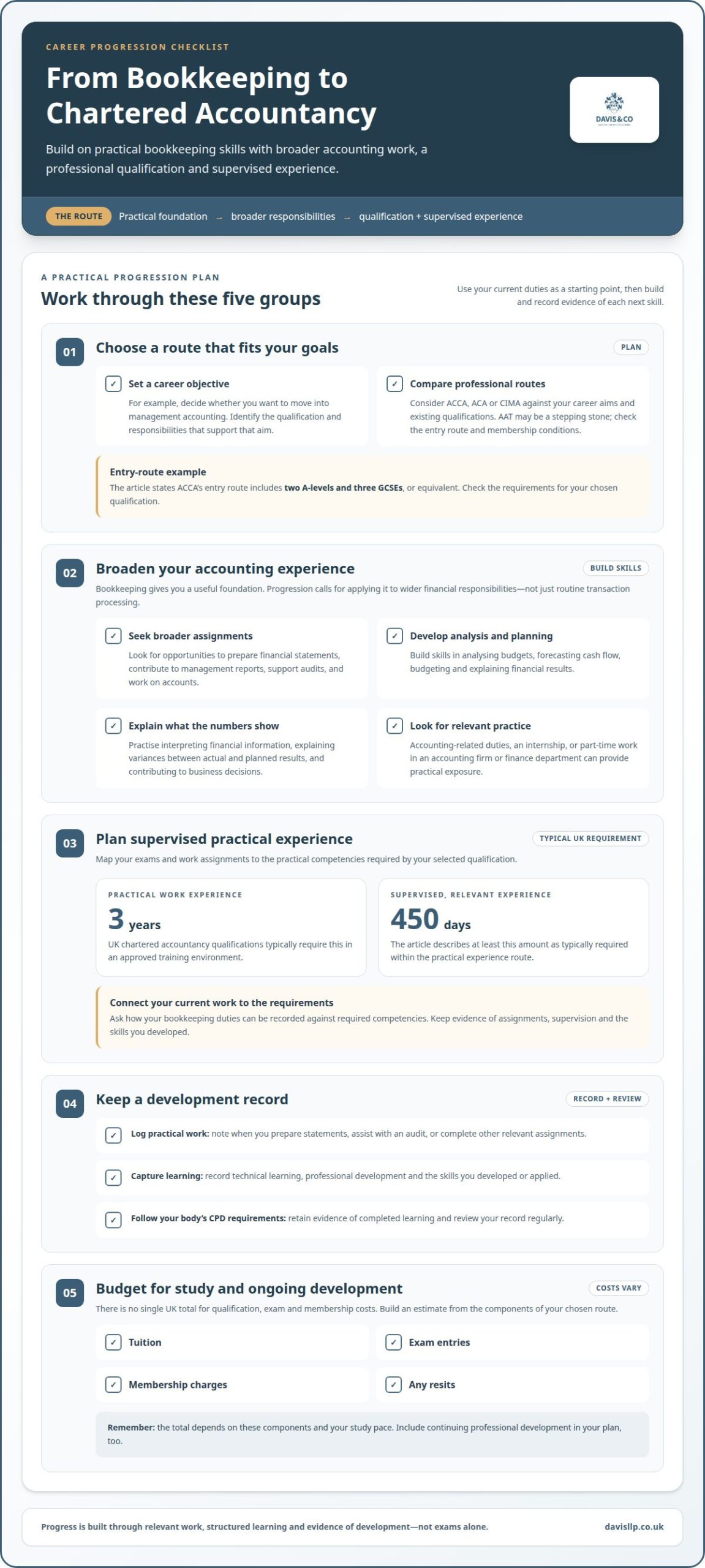
- Plan the education and experience route. Check the entry requirements for your chosen qualification; ACCA’s stated route includes two A-levels and three GCSEs, or equivalent. UK chartered accountancy qualifications typically require three years of practical work experience in an approved training environment, including at least 450 days of supervised, relevant experience. Ask how your bookkeeping duties can be recorded against the required competencies.
- Keep a structured development record. Log practical experience, technical learning and professional development as you progress. For example, record when you prepare statements or assist with an audit, then note the skills you developed. Follow your body’s CPD requirements and retain evidence of completed learning. This helps connect your bookkeeping experience with the broader responsibilities expected of a chartered accountant.
Practical experience and continuing professional development
Plan your development around the accounting work you want to take on. Moving from a bookkeeper to a chartered accountant means applying your existing skills to wider financial responsibilities.
Assess Experience and Role Requirements
Compare your current duties with the responsibilities in your target role. Bookkeeping provides a useful foundation, but progression also calls for skills such as analysing budgets, forecasting cash flow and explaining financial results. Seek assignments that develop these capabilities, then record your contribution and what you learned. A junior accounting role may offer supervised technical practice; a more senior role may involve advising on business decisions.
Look for opportunities to progress through relevant duties, not job titles alone. For example, ask to contribute to management reports and explain variances between actual and planned results.
Plan Exams and Supervised Work
Map your professional exams against the practical competencies required by your chosen qualification. If you’re moving from a bookkeeper to a chartered accountant, your experience should demonstrate accounting work beyond routine transaction processing. Keep evidence of assignments, supervision and skills developed so your progress can be assessed against the route’s requirements.
Build practical experience through accounting-related duties, an internship or part-time work in an accounting firm or finance department. Seek exposure to financial statements, audit support, budgeting or forecasting. These assignments help you apply bookkeeping knowledge with accounting judgement and identify areas for further learning.
Review Qualification Costs and CPD
There is no single UK total for qualification, exam and membership costs. Estimate your budget by adding the chosen route’s tuition, exam entries, membership charges and any resits. The total depends on these components and your study pace. Include continuing professional development in your plan, recording learning relevant to your current work and future responsibilities.
Review your record regularly and note how you have applied new knowledge. Moving from a bookkeeper to a chartered accountant also involves developing expertise over time, not simply passing exams. If your work involves business finances, business financial planning can help clarify the decisions your accounts need to support.
AAT qualifications and progression to ACCA, ACA or CIMA
Choose a qualification route that matches the work you want to do. Moving from a bookkeeper to a chartered accountant involves planning both your studies and relevant career experience.
Assess Career Progression
Review your current role and identify whether it offers opportunities to prepare financial statements or analyse results. Industry roles do not always provide a set development structure: some accountants progress quickly, while others find their progress stalls. Set a career objective, such as moving into management accounting, then identify the qualification and responsibilities that support it. Discussing broader duties with your manager can help reveal practical next steps.
Review Bookkeeping Experience and Exemptions
List your bookkeeping duties and compare them with the practical experience requirements for your chosen professional route. Relevant bookkeeping experience may count towards practical requirements, but keep clear records of your responsibilities and the accounting skills they demonstrate. Treat experience assessment and exam exemptions as separate matters. AAT Level 4 holders may receive exemptions from some ACCA and CIMA exams.
Choose an AAT Starting Point
Consider the AAT Level 3 Diploma in Accounting as a starting qualification when building beyond bookkeeping. It can develop accounting knowledge before you commit to a professional route. Full AAT members, known as MAAT, may have access to fast-track routes with certain accounting bodies. Check the relevant entry conditions and exemptions rather than assuming membership shortens every route.
Match the Route to Your Career Goal
Compare pathways against the work you want to do. The AAT route is estimated at 12-18 months, the ACA route through ICAEW at 3-5 years, and the ACCA route at 3-4 years. Moving from a bookkeeper to a chartered accountant through AAT, a professional qualification and required experience may take 5-7 years overall. Use these estimates to plan your career and study commitments.
Differences between bookkeepers, regular accountants and chartered accountants
Separate the work each role involves from the qualifications its holder has. This distinction helps you identify which skills to develop next.
Compare Bookkeeping and Accounting
Start by comparing the work itself. Bookkeeping records daily financial transactions, maintains ledgers and keeps financial records accurate and current. For example, a bookkeeper may record supplier invoices and reconcile bank transactions. Accounting uses those records to interpret, analyse and summarise financial data, helping explain a business’s financial health.
Consider a month-end report: bookkeeping keeps the underlying entries organised, while accounting examines what the figures mean for decisions. Both functions matter, but analysis requires going beyond accurate record-keeping.
Compare Bookkeepers and Chartered Accountants
Compare your duties with the technical judgement required in each role. A bookkeeper typically focuses on transaction records and routine processes. An accountant may prepare or interpret financial statements, analyse performance and support planning. A chartered accountant has also completed a professional qualification and belongs to a chartered professional institute, such as ICAEW, ICAS or ACCA.
Don’t assume every accountant without a chartered designation has the same experience or responsibilities. Compare qualifications, practical experience and the work actually performed. For instance, a chartered accountant might advise on financial reporting, while another accountant’s role may centre on preparing accounts.
- Identify the capability gap. Choose one task beyond your current bookkeeping scope, such as explaining a cash-flow movement from a set of statements. Practise interpreting the figures, not just keeping the records accurate, and note the reasoning behind your conclusion.
- Connect the distinction to your next decision. If a business needs clearer reporting, discuss its accounting needs with an adviser. This can help clarify whether the priority is organised bookkeeping, financial analysis or more specialised accountancy input.
Davis & Co LLP: International Tax Planning
Davis & Co LLP provides International Tax Planning for individuals and businesses managing tax matters across borders. This can be a relevant next step when international activity makes tax planning more complex than routine bookkeeping or accounts preparation.
For businesses, Davis & Co LLP also provides Business Growth Acceleration and Cash Flow Management. These services may be relevant when financial reporting needs to support decisions about growth or cash flow. Personal Tax Services are available for individual tax needs. The right support depends on the issue you need to address, so identify whether your priority is cross-border tax planning, business finances or personal tax.
Contact Davis & Co LLP to discuss your requirements, or visit davisllp.co.uk.
Shape your next career move with purpose
Moving from a bookkeeper to a chartered accountant is more than a change of title. It means choosing the responsibilities you want to take on and shaping your development around that aim. Before committing to your next step, define the work you want to be trusted with, then use that goal to guide your decisions about study, practical opportunities and professional direction.
A considered plan can also take account of the needs of the organisations and individuals you support. If your work increasingly involves business growth, cash flow or cross-border tax matters, sound financial guidance can help you understand the wider context behind those responsibilities. The right career direction develops your expertise while staying aligned with the work you find meaningful.
For support with financial matters alongside your career plans, contact Davis & Co LLP. Take the next step with a clear sense of the expertise you want to build.
Frequently Asked Questions
What Actually Makes Someone an Accountant in the UK?
An accountant analyses financial information and uses it to explain an organisation’s financial position. The role can include interpreting accounts, reviewing performance and helping management make informed decisions. For example, an accountant might investigate why a business’s costs rose between reporting periods. A job title alone does not reveal someone’s qualification level, so consider their training, membership and actual responsibilities when assessing their experience.
What could go wrong?
A common risk is choosing a qualification before deciding which work you want to do. You could end up studying material that does not support your intended role. Another is assuming routine bookkeeping duties automatically demonstrate broader accounting competence. Keep a record of projects, feedback and responsibilities, and discuss your development with a supervisor. This makes gaps visible early and gives you a clearer basis for choosing work experience.
What qualifications do you need to become a chartered accountant in the UK?
You need a professional qualification recognised by the relevant accountancy body, along with its required practical experience and membership conditions. The designation depends on the route: examples include ACA through ICAEW, ACCA’s qualification, or CA through ICAS. Check the body’s entry route and the experience it accepts before enrolling. This helps align your study plan with the designation and work you intend to pursue.
Can a bookkeeper qualify as a chartered accountant through AAT, ACCA, ICAEW or CIMA?
Yes. A bookkeeper can use AAT as a foundation and then progress towards a professional accountancy qualification. AAT Level 4 holders may receive exemptions from some ACCA and CIMA exams, while full AAT members may have fast-track routes with certain bodies. For ACA, examine ICAEW’s entry and training requirements. Exemptions depend on the qualification held, so map them against your chosen route.
What are the steps to progress from bookkeeper to chartered accountant in the UK?
Start by choosing the kind of accounting work you want, such as audit, management accounting or financial reporting. Then compare ACCA, ACA, ICAS and CIMA pathways, including entry conditions and exemptions for your existing study. Arrange work that develops accounting judgement, not just transaction-processing skills. Keep evidence of assignments and supervision, and review your progress with your employer or training supervisor regularly.
How long does it take to qualify as a chartered accountant while working?
Allow for several years of study and work experience. Published route estimates include 3-4 years for ACCA and 3-5 years for ACA through ICAEW; career switchers completing AAT, a professional qualification and experience may take 5-7 years overall. Studying while employed depends on your study pace, exam progress and the practical experience your role provides. Plan around work commitments and recorded training time.