Good UK arrival and departure tax planning can begin before a move. Qualifying new UK residents may claim 100% UK tax relief on foreign income and gains under the Foreign Income and Gains (FIG) regime during their first four years of UK tax residency, subject to exceptions. The regime was introduced on 6 April 2025, and eligibility and the treatment of different income and assets matter.
It’s understandable to focus first on whether relief is available after arrival. Timing can also affect which planning opportunities remain open and how income or gains are treated. The UK tax year runs from 6 April to 5 April, according to HM Revenue & Customs, so a move may fall across different tax-year periods.
This article explains tax reliefs that may apply to new UK residents, the residence rules relevant to arrivals and departures, and why planning ahead can be valuable. Reviewing assets, income sources and timing may reveal options involving gifts, rebasing or bringing income forward. We also cover departure-year treatment and how tailored tax advice can bring these considerations together.
Key Takeaways
- Reliefs and departure-year treatment depend on your circumstances, so consider how your move affects your UK tax position.
- Planning before arrival can help identify options involving assets, income timing and allowances.
- The Statutory Residence Test considers UK days, connections and work abroad when assessing residence status.
- International tax planning can bring arrival, departure and continuing UK tax obligations into a coordinated view.
Are there any reliefs for new residents?
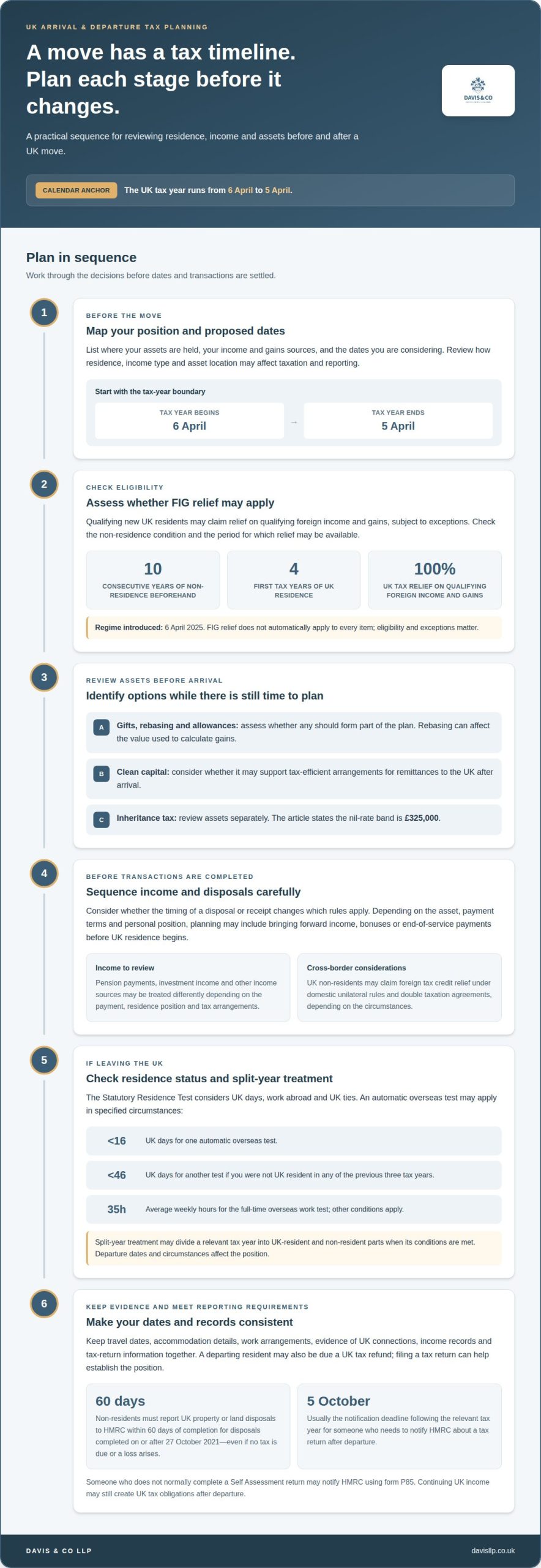
The UK tax year runs from 6 April to 5 April, according to HM Revenue & Customs. Qualifying new UK residents may claim 100% UK tax relief on foreign income and gains under the Foreign Income and Gains (FIG) regime, subject to exceptions. Eligibility requires ten consecutive years of non-residence beforehand, and relief may apply during the first four tax years of UK residence. FIG was introduced on 6 April 2025.
Leaving the UK can raise different timing considerations. Someone moving abroad may qualify for split-year treatment, which divides the relevant tax year into UK-resident and non-resident parts when the conditions are met. They may also be due a UK tax refund for that year; filing a tax return can help establish the position.
UK residence and split-year treatment apply across the UK, although income tax rates can differ between England, Scotland, Wales and Northern Ireland. Arrival and departure dates help establish the relevant tax period, but National Insurance follows separate rules, so residence alone does not determine contributions.
For new arrivals, FIG relief concerns qualifying foreign income and gains, not every item automatically. From 6 April 2025, the FIG regime provides relief to eligible residents meeting the non-residence condition. Departing residents may still owe UK tax on UK income, depending on the income and their circumstances. The remittance basis is distinct from the new FIG rules.
The Statutory Residence Test considers days spent in the UK, work abroad and UK ties. Someone leaving may meet an automatic overseas test by spending fewer than 16 days here; another test uses fewer than 46 days for people not resident in any of the previous three tax years. Full-time overseas work averaging at least 35 hours weekly is another test. Sufficient-ties outcomes depend on days and connections.
For residence or split-year claims, keep records such as travel dates, accommodation details, work arrangements and evidence of UK connections. Store these with relevant income records and tax-return information so you can substantiate dates and circumstances consistently.
Inheritance tax also matters when reviewing assets: according to HM Revenue & Customs, the nil-rate band is £325,000. Consider this alongside arrival or departure timing, foreign income relief and any potential refund, rather than treating one relief as a complete tax plan.
Pre-arrival and return-timing considerations
Before moving, assess how your residence dates may affect income, assets and reporting obligations. After departure, continuing UK income may still give rise to UK tax obligations.
Tax treatment of assets and income
This means assessing how residence, income type and asset location affect taxation. It matters because selling property, realising capital gains or receiving pension income can have different implications across a move. From 6 April 2026, individual capital gains within the basic income tax band are taxed at 18%; gains above that band are taxed at 24%.
Timing risks and professional advice
Timing advice reviews the tax consequences of a proposed move before dates and transactions are settled. This matters because residence, overseas taxation and double tax relief can interact. UK non-residents may claim foreign tax credit relief under domestic unilateral rules and double taxation agreements. An adviser can assess the relevant income sources and treaties before a move.
Property needs particular attention. Non-residents must report UK property or land disposals to HMRC within 60 days of completion for disposals completed on or after 27 October 2021, even if no tax is due or a loss arises. The reporting deadline can therefore affect sale planning.
Pension payments and investment income need separate consideration because their treatment depends on the type of payment, residence position and applicable tax arrangements. A plan should distinguish UK-source income from overseas income and consider whether double tax relief may apply.
After leaving, someone who does not normally complete a Self Assessment return can notify HMRC using form P85. A person who needs to notify HMRC about a tax return after departure will usually do so by 5 October following the relevant tax year.
For tailored international tax planning, bring proposed move dates, asset details and expected income into the discussion before transactions are completed.
Pre-arrival tax planning
Planning in the tax year before becoming UK resident gives you time to assess how arrival may affect your tax position. Effective UK arrival and departure tax planning starts with your circumstances, including where your assets are held and the sources of your income and gains. An early review can identify opportunities before UK residence changes how those items are treated.
For eligible arrivals, the Foreign Income and Gains regime applies during the first four tax years of residence after at least ten consecutive years of non-residence. A pre-arrival assessment can consider whether your foreign income and gains meet its conditions and how exceptions may apply. It can also identify clean capital, which may support tax-efficient arrangements for remittances to the UK after arrival.
Reviewing your assets before arrival may show whether gifts, rebasing or using allowances should be part of your plan. Rebasing can affect the value used to calculate gains, while the timing of a disposal can influence which tax rules apply. You may also consider bringing forward income, bonuses or end-of-service payments before UK residence begins. The right approach depends on the asset, payment terms and your individual position.
Inheritance tax merits a separate review. From 6 April 2025, a person is a long-term UK resident for inheritance tax purposes if they have been UK tax resident for ten consecutive years or ten years within the previous twenty. Long-term status can continue for up to ten tax years after UK residence ends. That connection between residence history and worldwide assets makes earlier planning relevant, including for people expecting a later departure.
A practical review brings together your proposed arrival date, residence history, asset ownership, expected income and planned transactions. It can identify which actions need to happen before arrival and which can wait until you become UK resident. The right UK arrival and departure tax planning depends on your assets, income sources and intended time in the UK.
What UK tax residency rules apply when arriving in or leaving the UK?
The Statutory Residence Test determines whether someone is UK resident for a tax year. It has been in legislation since 2013, and assesses days spent in the UK alongside other residence conditions.
For someone leaving, an automatic overseas test may apply if they spend fewer than 16 days in the UK during the tax year. Someone not resident in any of the previous three tax years may qualify under a separate test by spending fewer than 46 days here. Full-time work abroad averaging at least 35 hours a week is another automatic overseas test.
Where automatic tests do not settle residence, the sufficient-ties test weighs UK days against UK connections. A person resident in at least one of the previous three tax years needs four UK ties when spending 16 to 45 days here. The threshold is three ties for 46 to 90 days, and two ties for 91 to 120 days. The relevant range and ties must be considered together.
For arrivals, the same statutory framework assesses whether a person becomes UK resident. The outcome depends on UK presence and the applicable residence conditions, rather than arrival date alone. A tax year runs from 6 April to 5 April, so a move during the year may require analysis of residence across that period.
Departure planning involves more than counting travel days. Your UK connections, work pattern and records help establish whether your UK residence has ended. HM Revenue & Customs says temporary non-residence rules may apply to people who were non-UK resident for five tax years or less. Leaving the UK does not, by itself, settle the tax treatment of every later transaction.
Keep travel calendars, work records and evidence of relevant UK connections together. These records help support the day count and the residence position reported in a tax return. For a considered review of residence records, discuss your position with Davis & Co LLP.
Davis & Co LLP: International Tax Planning
Davis & Co LLP provides International Tax Planning for individuals and businesses managing a move to or from the UK. Its advice can bring residence status, overseas income, assets and planned transactions into one considered tax position.
Consider seeking advice before a move or significant transaction, such as selling an asset or changing how you receive income. A review can account for your circumstances, relevant reliefs and reporting responsibilities. Personal Tax Services can address individual tax matters alongside international considerations.
For business owners, planning may also need to account for business income and cash flow as personal residence changes. The scope of advice depends on your position and the issues arising from the move.
Contact Davis & Co LLP to discuss your international tax planning needs.
Make your next move with a clear tax plan
Cross-border decisions are easier to manage when personal and business priorities are considered together. Thoughtful UK arrival and departure tax planning can help you make informed choices about the timing and structure of your next steps while keeping your wider financial position in view.
For business owners, a move can affect more than personal tax. Davis & Co LLP also offers Business Growth Acceleration and Cash Flow Management, which may be relevant when relocation coincides with operational or financial decisions. The advice is shaped around your circumstances and the decisions ahead.
If you’re preparing for a move or reviewing its tax implications, contact Davis & Co LLP to discuss your next steps. A considered conversation can help you approach the transition with greater clarity.
Davis & Co LLP can support your UK arrival and departure tax planning
Davis & Co LLP provides International Tax Planning alongside Personal Tax Services and Trust Tax Services. If you are planning a move to or from the UK, or reviewing the tax implications of a change in residence, these services can help you consider your personal and tax affairs together.
For business, property or administrative needs connected with your move, Davis & Co LLP also offers Business Growth Acceleration, Cash Flow Management, Property Accounting, Company Secretarial Services, Payroll Services, VAT Compliance, Management Accounts, Bookkeeping Services, Audit and Assurance, and specialist dental tax support. Contact the firm to discuss which services suit your circumstances.
Frequently Asked Questions
Can you be tax resident in more than one country at the same time?
Yes. Two countries can each treat you as tax resident under their domestic rules, creating overlapping tax obligations rather than automatically invalidating one country’s status. A double taxation agreement may set out how to resolve residence when both countries claim it, while foreign tax credit relief may help address tax charged twice on income. The relevant treaty and type of income matter.
What are the UK’s temporary non-residence rules?
HM Revenue & Customs says the UK’s temporary non-residence rules may apply to people who were non-UK resident for five tax years or less. They can affect the UK tax treatment of certain income or gains during a period abroad when someone later returns. The impact depends on residence history and the relevant income or transaction, so departure alone does not settle the position.
What tax planning should be done before returning to the UK?
Before returning, gather your residence history, overseas income details and information about assets or planned transactions. For example, records showing when an investment was acquired and how its value changed can help explain a later disposal. Also review when income is received and any foreign tax already paid. This gives an adviser the context to assess available reliefs and reporting requirements.
When do you become UK tax resident after returning to the UK?
Returning to the UK does not, by itself, establish the precise date you become tax resident. The Statutory Residence Test assesses the tax year using relevant circumstances, including UK presence, work patterns and connections. Your position can therefore depend on your activities throughout the year, not just your arrival date. The assessment may also need to consider whether split-year treatment applies.
What split-year treatment rules apply in the year someone arrives in or departs from the UK?
Split-year treatment can divide a tax year into a UK-resident part and a non-resident part, but only when the relevant conditions are met. It may apply in qualifying arrival or departure cases, but moving during the year does not automatically qualify. Your circumstances and residence position determine whether the year can be treated this way and which part applies.
What temporary non-residence rules can tax income or gains after leaving the UK?
Temporary non-residence rules can bring certain income or gains into the UK tax calculation after someone returns from a period abroad. HM Revenue & Customs identifies people who were non-resident for five tax years or less as potentially within scope. The rules do not mean every overseas receipt is taxed in the same way. The type and timing of the income or gain, alongside residence history, affect the analysis.