The UK import bill depends on the goods and where they enter. In Great Britain, non-excise goods worth £135 or less aren’t charged Customs Duty, according to HM Revenue & Customs. The standard VAT rate is 20%, although the rate applied depends on the goods.
It’s reasonable to focus on the supplier’s price, but import VAT can also include freight and customs duty in its calculation. Rules differ between Great Britain and Northern Ireland, so the destination matters as much as the shipment’s contents.
This guide explains how to estimate import VAT and customs duty, how the HS code and country of origin affect the duty rate, and how the calculation works in Great Britain and Northern Ireland. It also covers key VAT accounting considerations to help you plan landed costs and decide when specialist advice may be useful.
Key Takeaways
- According to HM Revenue & Customs, the standard UK VAT rate is 20%, but the goods’ VAT treatment affects the calculation.
- In Great Britain, non-excise goods worth £135 or less are not charged Customs Duty, according to HM Revenue & Customs.
- Classifying goods correctly with the relevant commodity code helps determine the applicable duty rate, alongside their origin.
- Great Britain and Northern Ireland have different customs considerations, so the destination can change how import costs are assessed.
How do I calculate UK import duty and other taxes?
Start with the customs value, then apply the relevant duty rate and VAT treatment. The amount depends on the goods, the costs included in the customs value and the declaration method.
Customs Value and Included Costs
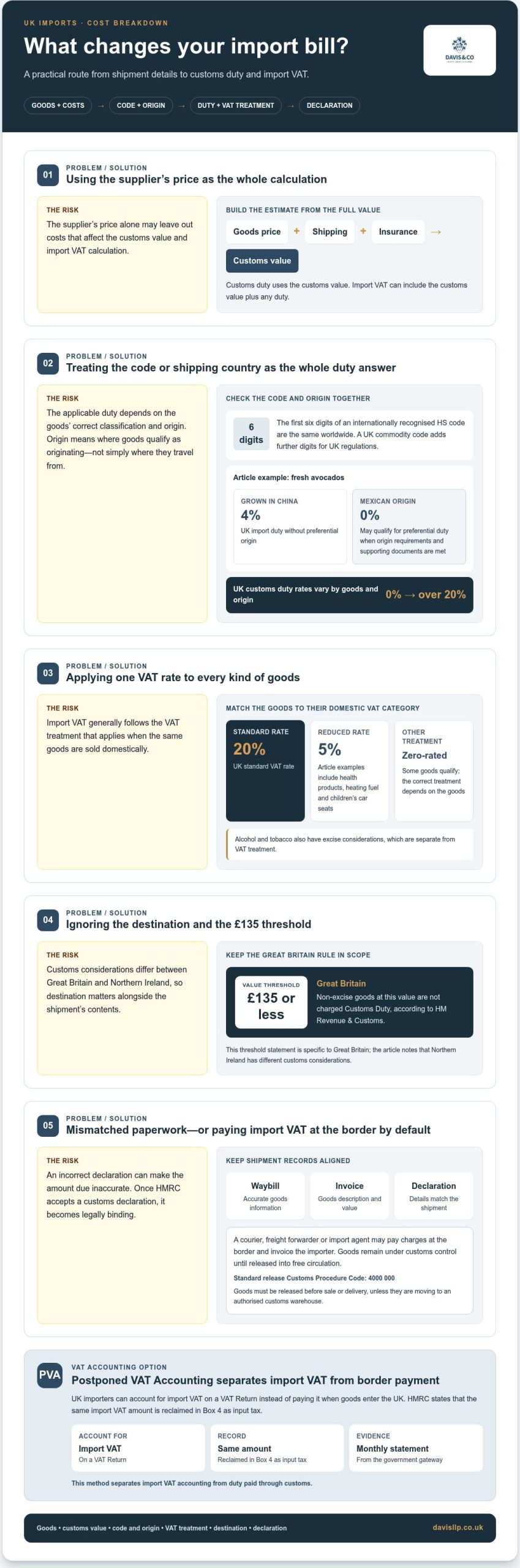
The UK customs value is based on the goods’ price, including shipping and insurance costs. Customs duty uses this value, while import VAT can include the customs value plus any duty. HM Revenue & Customs states that the standard UK VAT rate is 20%. A complete valuation gives a more useful estimate than the supplier’s price alone, particularly where freight or insurance is charged separately.
Paying and Declaring Import VAT
A customs declaration records an import for clearance and provides information used to calculate duty and VAT. International shipments require declarations and supporting documents, including a commercial invoice that describes the goods and states their value. Import, export and transit declarations cover different types of movement, so the declaration must match the shipment’s route and customs status.
A courier, freight forwarder or import agent may pay charges at the border, then invoice the importer. Goods remain under customs control until released into free circulation. The standard Customs Procedure Code for this release is 4000 000. Goods must be released before sale or delivery, unless they are moving to an authorised customs warehouse.
Postponed VAT Accounting for Imports
Postponed VAT Accounting lets UK importers account for import VAT on a VAT Return instead of paying it when goods enter the UK. HM Revenue & Customs states that the same import VAT amount is reclaimed in Box 4 as input tax. The importer uses the monthly postponed import statement from the government gateway as evidence. This method separates import VAT accounting from duty paid through customs.
Business and Private Import Tax Differences
Businesses and private individuals may both pay import duty and VAT, but their VAT accounting differs. A business may reclaim import VAT through its VAT Return when it is recoverable; private individuals do not submit a business VAT Return for this purpose. Customs duty is not normally recoverable, so businesses generally treat it as a cost. Tailored import VAT and customs duty advice can help businesses understand how declarations affect their records and cash flow.
An incorrect declaration can lead to an inaccurate calculation of the amount due. Once HMRC accepts a customs declaration, it becomes legally binding. If duty was overpaid, the importer can apply to HMRC for reimbursement. Advice on import VAT and customs duty can help businesses understand the accounting and declaration implications before making decisions.
Customs tariff classification and HS codes
Classification assigns goods a code for customs declarations. The code, together with the goods’ origin, helps determine the applicable tariff and duties.
Customs Tariff Classification
Customs tariff classification means matching goods to the correct code in the tariff. The description must accurately reflect the product, because the code affects the duty rate applied to the import.
The first six digits of an internationally recognised HS code are the same worldwide. However, the correct code depends on the goods themselves, not just the wording on an invoice. Providing accurate goods information on an international shipment waybill can help with customs processing. Keeping the waybill, commercial invoice and customs declaration consistent helps ensure the shipment details match.
Commodity Codes and Product Origin
A UK commodity code starts with the first six HS code digits, followed by additional digits for UK regulations. These digits identify the applicable UK tariff treatment, so an international code may need more detail for a UK declaration.
Origin also matters: it means where goods qualify as originating, not merely the country from which they travel. Fresh avocados grown in China, for example, are subject to 4% UK import duty without preferential origin. Mexican-origin avocados shipped directly from Mexico may qualify for 0% preferential duty when origin requirements and supporting documentation are met.
How HS Codes Affect Import Duties
HS codes connect a product’s classification with the tariff rate used to calculate import duty. Rates can depend on the goods, their origin and the destination tariff. UK customs duty rates range from 0% to over 20%, depending on goods and origin, so classification can materially affect the amount payable.
For gifts valued above £630, customs duty rates vary according to the specific commodity code. Before submitting a declaration, compare the goods’ description, origin evidence and code across shipment documents. Businesses aligning import records with financial reporting may also find audit and assurance support relevant to their wider reporting controls.
How import VAT follows the domestic VAT treatment of goods
Import VAT generally follows the VAT treatment that applies to the same goods when sold domestically. The goods’ classification and destination therefore affect the tax due.
Domestic VAT Treatment of Imported Goods
The domestic VAT treatment determines whether imported goods are standard-rated, reduced-rated or zero-rated. Applying the correct treatment matters because it affects the import VAT calculation as well as the VAT on a later sale.
For example, UK goods including health products, heating fuel and children’s car seats are taxed at 5%. Alcohol and tobacco also have excise considerations, which are separate from VAT treatment. Keep the product description and supporting commercial invoice aligned, so the customs record reflects the goods actually imported.
Import VAT Rates for Different Goods
UK import VAT rates follow the goods’ domestic VAT category. HM Revenue & Customs states that the standard UK VAT rate is 20%, while some goods qualify for a reduced rate or other treatment.
You cannot determine the VAT rate from the country of export alone. Identify the goods correctly, then apply the VAT treatment that applies to that product. This helps businesses estimate the amount payable and keep accurate records for their VAT Return.
Northern Ireland has additional customs considerations for goods arriving from outside the UK and EU. Excise goods, goods worth more than £135, or goods considered at risk of entering the EU may incur Customs Duty. For goods considered at risk, businesses pay the EU duty rate unless they claim a waiver or relief.
International shipping documents should describe the goods accurately. Commercial invoices support customs declarations, while excise goods such as alcohol, tobacco and vaping products need particular attention to applicable charges. For goods arriving in Northern Ireland from outside the EU, check that Excise Duty is included in the price; otherwise, the goods may be seized.
Temporary imports and returned goods need clear movement records. Keep export and return documents to show what left and re-entered the UK. You can request a VAT or Customs Duty refund when goods are returned or when you believe too much tax was charged. A clear record helps explain the goods’ journey and support the refund request.
Import VAT and customs duty on imports into Great Britain and Northern Ireland
The destination determines which customs rules apply to an international shipment. Great Britain and Northern Ireland have different thresholds and treatments, so establish the destination before calculating charges.
In Great Britain, non-excise goods worth £135 or less are not charged Customs Duty, according to HM Revenue & Customs. Goods sent from outside the UK may incur Customs Duty if they are excise goods or worth more than £135. For chargeable goods, duty rates depend on classification and origin. VAT is a separate consideration and may still apply, including to goods below the Customs Duty threshold.
Gift treatment has its own threshold. VAT is not charged on gifts worth £39 or less sent to Great Britain from outside the UK, or to Northern Ireland from outside the UK and the EU, according to HM Revenue & Customs. For other consignments, identify whether the shipment is a gift or a sale, then assess its value and destination. A gift threshold should not be confused with the general Customs Duty rules for commercial goods.
Northern Ireland requires particular attention to goods entering from outside the UK and the EU. Excise goods, goods worth more than £135, or goods considered at risk of entering the EU may incur Customs Duty. If goods are considered at risk, businesses pay the EU duty rate unless they claim a waiver or relief. The applicable treatment therefore depends on the goods, their value, and their destination or onward movement.
For international trade, record the destination, product description, origin, value and shipment route together. These details help determine which duty rates apply and support accurate declarations. If cross-border imports affect wider business planning, discuss international tax planning in the context of your trading arrangements.
Davis & Co LLP: International Tax Planning
Davis & Co LLP provides International Tax Planning for businesses assessing the tax implications of cross-border trade. This support can be useful when imports are part of wider international operations and you need to consider VAT, cash flow and business growth together.
For individuals, Personal Tax Services can help with personal tax matters connected to international circumstances. The right support depends on whether your concern relates to business activity, personal tax or wider planning. Customs declarations and commodity classification remain separate operational matters.
If import costs affect your international tax planning or business finances, contact Davis & Co LLP to discuss your circumstances, or visit davisllp.co.uk.
Make import decisions part of your wider plan
Import costs affect more than customs accounting. They can influence pricing, working capital and the timing of commercial decisions. Including them in your financial planning helps you assess how international trade fits your business objectives and cash-flow needs.
For businesses considering these connections, Davis & Co LLP offers Business Growth Acceleration and Cash Flow Management alongside International Tax Planning. This support can bring trading plans and financial priorities into clearer alignment, rather than treating each import decision in isolation.
If you need import VAT and customs duty advice in the context of your wider business plans, contact Davis & Co LLP about your requirements. A considered approach can help you move forward with greater clarity as your trading arrangements develop.
Davis & Co LLP for import VAT and customs duty advice
Davis & Co LLP offers International Tax Planning and VAT Compliance to help businesses consider import VAT and customs duty within their wider tax and compliance needs.
Turn to Davis & Co LLP for support with international tax planning or VAT compliance. The firm also offers Cash Flow Management, Management Accounts and Bookkeeping Services to support related business finances.
Frequently Asked Questions
What is import tax?
Import tax is a collective term for charges that may apply when goods cross a customs border, including import VAT and Customs Duty. Excise Duty can also apply to goods such as alcohol and tobacco. The charges depend on the shipment’s goods, value, origin and destination. For budgeting, distinguish each charge on the customs or carrier paperwork instead of treating the total as a single tax.
Can I refuse to pay overcharged customs duties?
Refusing an invoice does not, by itself, correct a customs declaration. Once HMRC accepts a declaration, it becomes legally binding. If duty was overpaid, an importer can apply to HMRC for reimbursement. Businesses can recover customs duty overpayments going back up to three years. Keep the declaration and agent’s invoice together so you can match the disputed amount to the customs entry and its supporting details.
How do import duties and taxes impact your shipment?
These charges affect the landed cost and determine who pays before the goods are delivered. Under Delivered Duty Paid (DDP), the seller is responsible for transportation costs, including import taxes and duties. Under Delivered Duty Unpaid (DDU), the customer pays these charges to the carrier on receipt. Confirming the agreed delivery term helps both parties understand who should budget for the border bill.
What are tariffs?
Tariffs set the customs duty treatment for goods imported into a country. In the UK, the applicable duty rate depends on the product’s commodity classification and origin. For instance, fresh avocados grown in China are subject to 4% import duty in the UK without preferential origin. A tariff rate is therefore not a single charge for every shipment; it follows the goods and their qualifying origin.
What is the difference between duty and tax?
Customs Duty is a charge on imported goods determined by their classification and origin. Import VAT is calculated using the relevant VAT treatment and import value. The distinction matters for accounting and records. A VAT-registered business may reclaim import VAT when it is recoverable and supported by the required evidence, while customs duty is not normally recoverable.
How are import VAT and customs duty calculated in the UK?
First establish the customs value, then apply the duty rate for the goods and their origin. For example, a £1,100 CIF value at a 5% duty rate produces £55 duty. The example shows why freight and insurance can affect the tax calculation.