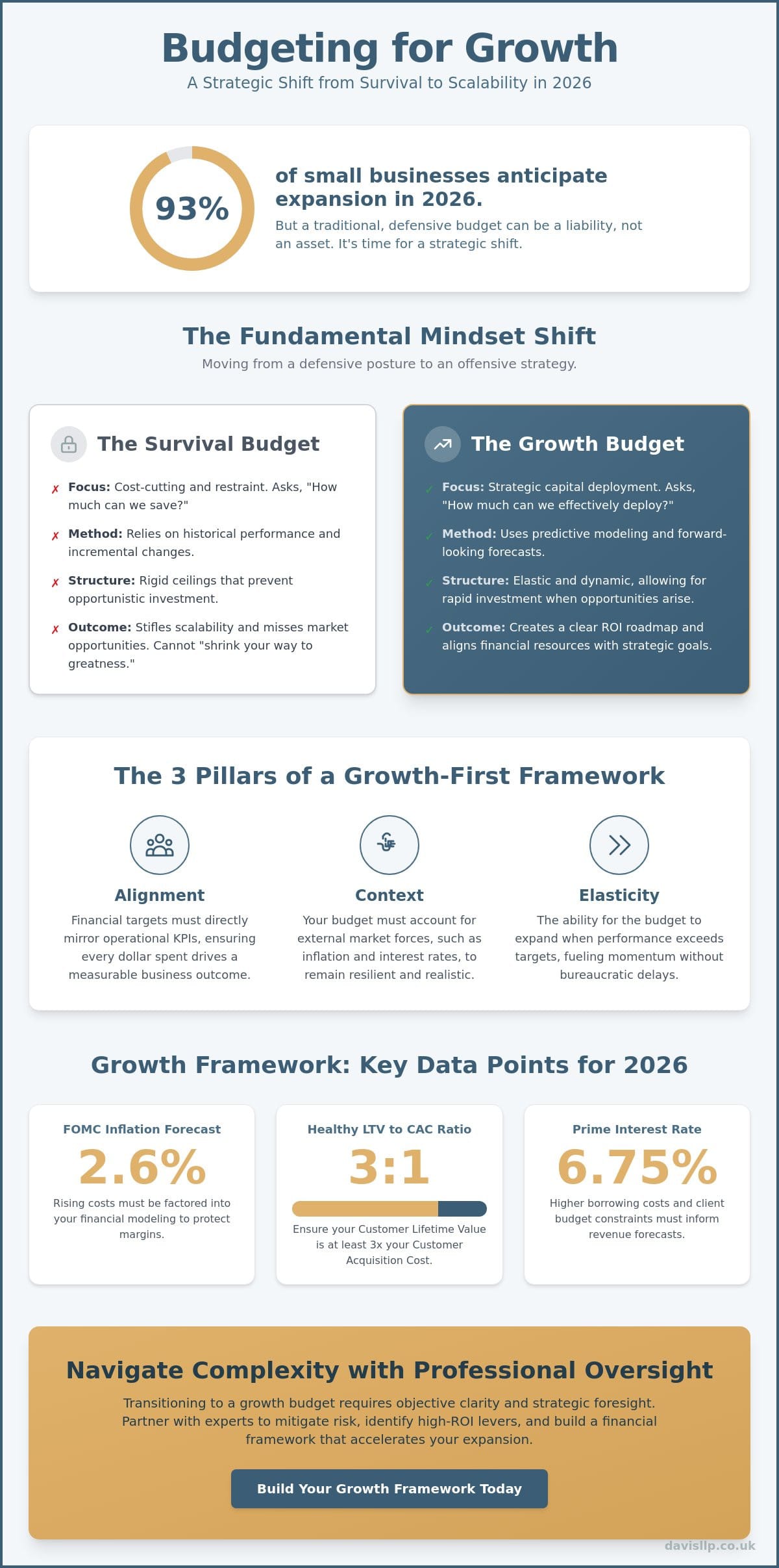
While 93% of small businesses anticipate expansion in 2026, the process of scaling often feels like a precarious balancing act. Cash flow has now overtaken inflation as the leading concern for many owners, suggesting that the traditional, defensive approach to finance is becoming a liability. Creating a business budget for growth requires a fundamental shift toward a strategic capital allocation model that treats every dollar as a tool for expansion rather than just a cost to be managed.
We recognize the persistent tension between the desire to invest in infrastructure and the fear of over-leveraging in a shifting economy. You’ll learn how to transition from reactive spending to a proactive financial strategy that secures a clear ROI on your growth investments. We will examine the essential components of a 2026 framework, including predictive forecasting and managing the rising costs of customer acquisition, to give you the confidence to hire and build for the future.
Key Takeaways
- Transition from a defensive survival mindset to a strategic framework that views capital as a primary engine for business expansion.
- Balance ambitious growth targets with conservative revenue forecasting to maintain financial stability during scaling phases.
- Understand how creating a business budget for growth involves identifying high-ROI levers and planning for high-impact talent acquisition.
- Adopt rolling forecasts and real-time management accounts to replace static annual budgets that can’t keep pace with market volatility.
- Recognize the value of professional financial oversight in providing the objective clarity needed to navigate complex organizational expansion.
The Strategic Shift: Budgeting for Growth vs. Survival
Many executives view budgeting as an annual exercise in restraint, a process designed primarily to curb excess and ensure survival. However, in an environment where 32% of businesses anticipate significant growth in 2026, this defensive posture can be counterproductive. Creating a business budget for growth requires transitioning from a “survival” mindset to an “offensive” model. Instead of asking how much we can save, we must ask how much we can effectively deploy. This shift transforms the budget into a forward-looking investment roadmap that aligns financial resources with strategic ambitions.
Traditional incremental budgeting often fails in high-growth environments because it relies too heavily on historical performance. When market conditions shift rapidly, simply adding a small percentage to last year’s figures doesn’t account for new opportunities or emerging risks. We believe that effective capital allocation strategies must be rooted in a firm’s specific risk appetite. It’s about determining the precise threshold where investment meets return, ensuring that capital is directed toward high-impact growth levers rather than being spread thin across maintenance tasks. This requires a level of intellectual rigour that moves beyond simple expense tracking.
Why Defensive Budgeting Stifles Scalability
A purely defensive approach focuses on rigid ceilings. This often prevents opportunistic market captures. If a budget is set in stone, a business cannot pivot to take advantage of a sudden drop in customer acquisition costs or a competitor’s exit. Cost-cutting your way to success is largely a myth in scaling; you cannot shrink your way into greatness. By moving away from historical data and toward predictive modeling, we help organizations anticipate needs before they become crises. This proactive stance is essential when creating a business budget for growth that remains resilient against cash flow volatility.
The Core Pillars of a Growth-First Framework
A growth-first framework rests on three pillars: alignment, context, and elasticity. Financial targets must mirror operational KPIs, such as the healthy 3:1 LTV:CAC benchmark, rather than just bottom-line profit. With the FOMC forecasting an inflation rate of 2.6% by the end of 2026, your plan needs to account for rising costs while remaining flexible. Elasticity allows the budget to expand when performance exceeds expectations. This ensures that funding is available to fuel momentum without the delays of a traditional mid-year review process. We focus on building these dynamic structures to ensure your capital works as hard as your leadership team.
Designing Your Growth Framework: Revenue Forecasting and Variable Costs
Precision is paramount when creating a business budget for growth. While 93% of small businesses expect growth in the coming year, only those who model their drivers with granular detail will successfully navigate the transition from a small-scale operation to a robust enterprise. We view revenue forecasting not as a hopeful projection, but as a rigorous analysis of market capacity and internal capability. It’s about moving away from the “finger in the wind” approach and toward a model that accounts for the specific economic pressures of 2026.
We recommend a sensitivity analysis that prepares your organization for multiple outcomes. With the FOMC forecasting an inflation rate of 2.6% by the end of 2026, your cost base is unlikely to remain static. When calculating business costs, it’s vital to distinguish between baseline operations and the capital required to trigger a new tier of revenue. A growth budget must be “stress-tested” against both conservative and ambitious scenarios. This ensures that even if revenue hits only 80% of your target, your cash flow remains secure and your expansion plans stay viable.
Advanced Revenue Modeling for 2026
Modern forecasting requires a departure from simple year-on-year percentage increases. We look for leading indicators specific to your sector, such as the 2.1% increase in business applications recorded in April 2026, which signals a competitive but active marketplace. Your model should account for current market volatility and the impact of interest rates, such as the 6.75% prime rate, on your clients’ purchasing power. By identifying these external variables, you can build a more resilient revenue roadmap that adapts as economic conditions evolve.
Scaling Your Cost Structure
As you scale, your cost structure will inevitably encounter “step-costs.” These are significant expenditures, such as hiring a new senior associate or expanding into a larger facility, that don’t increase linearly with revenue. It’s critical to protect your margins during these jumps. We also consider the impact of VAT compliance on your gross revenue projections. Failing to account for tax thresholds and international obligations can quickly erode the capital you’ve earmarked for expansion, turning a growth phase into a liquidity crisis.
Integrating management accounts into the forecasting cycle provides the real-time visibility needed to make these adjustments. Rather than waiting for year-end figures, you can see how your variable costs are performing against your growth levers today. If you’re looking for a partner to help provide this level of oversight, we offer bespoke cash flow management services to ensure your financial strategy remains aligned with your long-term goals.
Capital Allocation for Scalability: Identifying Your Growth Levers
Effective capital allocation serves as the bridge between a static financial plan and a dynamic expansion strategy. When creating a business budget for growth, we categorise expenditure into three distinct tiers: maintenance, growth, and innovation. Maintenance capital ensures the continuity of existing operations, while growth capital is deployed to scale proven revenue streams. Innovation capital, often the most overlooked, is reserved for exploring new markets or service lines. Distinguishing between these categories prevents the common error of allowing operational “creep” to consume the funds intended for your 2026 expansion goals.
Human capital remains the most significant multiplier in any professional practice. With employers planning to increase salary budgets by 3.4% in 2026, the ROI of talent must be weighed against the potential for technological leverage. We’ve seen that 58% of small businesses now report using AI to improve efficiency. Budgeting for high-impact recruitment should therefore be paired with infrastructure investments that allow your team to focus on high-value advisory roles. This dual approach ensures that your payroll expenditure acts as a catalyst for scalability rather than a fixed burden on your margins.
The Tax-Growth Connection
A significant gap in many growth strategies is the failure to integrate tax planning with the budgeting process. Obtaining expert tax advice can uncover substantial capital that would otherwise be lost to inefficiency. By maximising R&D tax credits and capital allowances within your framework, you can effectively reclaim capital for reinvestment. We also focus on the strategic timing of Corporation Tax payments. Managing these liabilities with precision helps preserve liquidity during critical investment windows, ensuring you have the cash on hand to act when opportunities arise.
Prioritising High-ROI Levers
Successful scaling requires a disciplined focus on high-ROI levers, particularly the relationship between customer acquisition costs and lifetime value. A healthy LTV:CAC ratio of 3:1 or 4:1 is a benchmark we use to validate growth investments. We also account for the necessity of specialist compliance. For instance, a practice requiring a dental tax specialist or international VAT expertise must budget for these specific regulatory requirements to avoid costly delays. Finally, we recommend maintaining a “contingency for opportunity” fund. This allows your business to remain agile, providing the financial freedom to capture unexpected market advantages without disrupting your core operational budget.
The Role of Management Accounts in Real-Time Adjustment
A static annual budget is often a liability for an expanding firm. While it provides a necessary baseline, a rigid document cannot account for the rapid shifts inherent in a growth phase. Creating a business budget for growth requires a transition to rolling forecasts. This model allows you to update your projections every month or quarter based on actual performance. It ensures your financial strategy remains a living document rather than a historical artifact. By closing the gap between raw data and strategic insight, you can identify “red flag” variances before they escalate into liquidity crises.
We believe that the bridge between daily bookkeeping and high-level strategy is built on the quality of your reporting. It isn’t enough to simply record transactions; you must interpret them in the context of your long-term objectives. This real-time visibility allows you to adjust your capital allocation as market conditions change. It provides the intellectual rigour needed to decide whether to accelerate investment or preserve cash. Without this constant feedback loop, even the most well-constructed budget can quickly become disconnected from operational reality.
Moving from Hindsight to Foresight
Statutory accounts serve a regulatory purpose, but they look backward. In contrast, management accounts provide the foresight required to lead. We focus on key metrics that dictate your scaling speed: your burn rate, remaining runway, and contribution margin. These figures tell you exactly how much capital is available to fuel your next move. Management accounts are the GPS for business growth. They provide the coordinates needed to navigate the complexities of 2026’s economic environment with precision.
The Monthly Review Process
A meaningful monthly review is more than a glance at a spreadsheet. It’s a rigorous variance analysis that asks why actual figures deviated from the plan. If your customer acquisition cost is lower than the $536 average for B2B SaaS, for example, you might decide to pivot and increase your marketing spend immediately. Conversely, if overheads are creeping up faster than revenue, you can implement controls before your margins are compromised. We use cloud accounting to ensure this data is both accurate and accessible.
Effective oversight turns bookkeeping from a chore into a competitive advantage. If you’re ready to move beyond basic compliance and gain deeper insight into your operations, we provide specialist Management Accounts to help you maintain control as you scale.
Partnering for Acceleration: How Professional Oversight Mitigates Risk
While modern software offers real-time data, it cannot replace the strategic nuance of a seasoned financial advisor. Scaling a business often introduces complexities that simple automation is ill-equipped to handle. We provide an external “Financial Director” perspective, offering the objective clarity required to make high-stakes decisions. By creating a business budget for growth with professional oversight, you ensure that your financial framework isn’t just a spreadsheet, but a robust engine for Business Growth Acceleration. This partnership allows you to move beyond the limitations of historical data and embrace a mindset focused on future potential.
Rapid expansion often masks underlying operational risks that can destabilise even the most promising firms. Our Audit and Assurance services act as a vital safeguard, identifying potential vulnerabilities in your reporting or internal processes before they compromise your stability. This level of professional scrutiny builds necessary confidence for stakeholders and ensures that your internal controls evolve alongside your revenue. We view this as a composed partnership; it’s about providing the reliability and discretion essential for a professional practice dealing with sensitive commercial matters.
Bespoke Growth Advisory
We understand that every sector has unique financial pressures that generalist software often overlooks. Whether you require a dental tax specialist or property accounting expertise, our frameworks are tailored to your specific operational realities. For those looking beyond domestic borders, International Tax Planning becomes a critical component of the growth roadmap, ensuring that cross-border expansion doesn’t lead to unforeseen liabilities. Moving from a “compliance-only” relationship to a strategic partnership allows you to focus on your core vision while we manage the intricate financial structures that support it.
Your Growth Roadmap Starts Here
As you finalise your plans for 2026, consider this checklist for a growth-ready budget:
- Establish rolling forecasts to replace static annual projections and maintain agility.
- Align operational KPIs with capital allocation targets to ensure every pound spent drives value.
- Integrate tax planning into your framework to maximise reinvestment capital and protect liquidity.
- Maintain a “contingency for opportunity” fund to capture unexpected market advantages.
Professional gravitas in your financial reporting isn’t just about accuracy; it’s about projecting the stability of a mature institution to investors and partners alike. A well-constructed budget, backed by expert oversight, signals that your business is prepared for the challenges of 2026. We invite you to Contact our growth specialists for a tailored consultation to begin the next phase of your expansion with the security of a trusted advisor by your side.
Defining Your Path to Sustainable Expansion
Transitioning from a reactive financial posture to a proactive growth model is the defining challenge for leadership in 2026. We have explored how the shift from survival budgeting to strategic capital allocation allows a firm to fund expansion without compromising its operational stability. By integrating real-time management accounts and identifying high-ROI growth levers, you can navigate market volatility with composed confidence. Creating a business budget for growth is ultimately about ensuring your financial infrastructure is as ambitious as your vision. It’s a process that rewards precision and long-term thinking over short-term cost-cutting.
As Chartered Certified Accountants since 1901, we bring a history of reliability and deep expertise in business growth acceleration to every client engagement. Our specialists provide the sophisticated oversight necessary for complex international and specialist tax planning, ensuring your capital is always working toward your specific objectives. We invite you to partner with Davis & Co LLP to accelerate your business growth today. With the right strategic framework in place, your organization is well-positioned to turn the opportunities of the coming year into lasting success.
Frequently Asked Questions
What is the difference between a traditional budget and a growth budget?
A traditional budget is primarily a tool for expense control and operational maintenance, whereas a growth budget serves as a strategic roadmap for capital deployment. While the former seeks to ensure the business remains within set limits, the latter prioritises investments that drive expansion. Creating a business budget for growth involves identifying specific levers, such as talent acquisition or infrastructure, that will generate a measurable return on investment rather than simply tracking costs.
How much of my revenue should I reinvest into growth activities?
The appropriate reinvestment rate typically ranges from 10% to 30% of gross revenue, depending on your industry and growth stage. High-growth firms often lean toward the upper end of this spectrum to capture market share rapidly. We recommend balancing this reinvestment against your cash flow requirements to ensure that expansion doesn’t compromise your operational liquidity or core service delivery. This ensures your growth remains sustainable over the long term.
How often should I update my business budget in 2026?
We recommend updating your budget monthly or quarterly through a rolling forecast model to account for the economic volatility anticipated in 2026. A static annual document is insufficient in an environment where interest rates and consumer spending can shift quickly. Regular updates allow you to adjust your spending based on actual performance and emerging data, ensuring your financial strategy remains aligned with the current market reality and your broader organizational goals.
What are the biggest mistakes businesses make when budgeting for expansion?
One of the most common errors is underestimating “step-costs,” such as the significant expenditure required for senior hires or expanded facilities. Another frequent mistake is focusing solely on the profit and loss statement while ignoring the timing of cash inflows and outflows. These oversights can lead to liquidity crises even when a business appears profitable on paper, highlighting the need for a more comprehensive and forward-looking financial framework during scaling.
Can management accounts really help me grow my business faster?
Management accounts facilitate faster growth by providing the real-time data necessary for agile decision-making. Unlike statutory accounts, which look at historical performance for regulatory reasons, management reports focus on current trends and future projections. This visibility allows you to double down on successful initiatives or pivot away from underperforming ones with precision. It effectively reduces the time between identifying a market opportunity and taking the necessary financial action to capture it.
How does tax planning impact my available growth budget?
Strategic tax planning directly increases your available growth capital by ensuring you don’t overpay on your liabilities. By utilising available reliefs, such as R&D tax credits or capital allowances, you can reclaim funds for reinvestment into the business. This approach transforms tax from a mandatory cost into a strategic variable that can be managed to support your expansion goals. It ensures your budget is as capital-efficient as possible during critical investment windows.
Do I need a professional accountant to create a growth budget?
While software handles basic arithmetic, a professional accountant provides the strategic nuance and sector-specific insight required for complex expansion. Creating a business budget for growth involves navigating intricate tax obligations and capital allocation strategies that standard tools often overlook. A professional partner acts as a high-calibre advisor, offering the intellectual rigour and objective perspective needed to mitigate risk during periods of rapid organizational change and market shifts.
How do I account for inflation and economic changes in my 2026 budget?
You should integrate sensitivity analysis into your framework to account for the 2.6% inflation rate forecasted for late 2026. This involves modeling multiple scenarios to see how rising costs might impact your gross margins and overall profitability. By building these variables into your projections, you can create a more resilient budget that maintains its integrity even if the broader economic environment becomes volatile. This proactive approach ensures your growth plans remain viable under different conditions.