The era of the pension as a tax-efficient legacy vehicle is effectively coming to an end. For decades, retirees have prioritised spending other assets first to keep their pension pots shielded from HM Revenue and Customs, but the Finance Act 2026 has fundamentally altered this landscape. This shift is particularly poignant for those considering the tax implications of moving abroad from uk, as UK-sited pension assets will remain firmly within the inheritance tax net regardless of your new residency status.
We recognise the concern many feel regarding the potential for double taxation, where a single pension pot might face both a 40% inheritance tax charge and subsequent income tax liabilities for beneficiaries. This guide provides a comprehensive analysis of the new rules and a strategic roadmap to help you adjust your drawdown strategies before the 6 April 2027 deadline. We’ll explore the specific pension types captured by these changes and confirm the vital exemptions that remain available to protect your legacy. By understanding the transition between current protections and the upcoming requirements, you can make informed decisions that secure your family’s financial future with confidence and clarity.
Key Takeaways
- Prepare for the 6 April 2027 deadline when unused pension funds and death benefits will be included in your estate for inheritance tax purposes.
- Evaluate the tax implications of moving abroad from uk, as UK-sited pensions remain liable for inheritance tax even if you establish residency in another jurisdiction.
- Navigate the “double tax trap” by understanding how the 40% inheritance tax charge interacts with beneficiary income tax for those who pass away after age 75.
- Leverage strategic exemptions for spouses and registered charities to protect your legacy and potentially reduce your estate’s headline tax rate to 36%.
- Reassess your decumulation strategy by considering whether to spend pension assets before other investments to minimise the impact of the Finance Act 2026.
Understanding Inheritance Tax on Pensions: The 2027 Shift
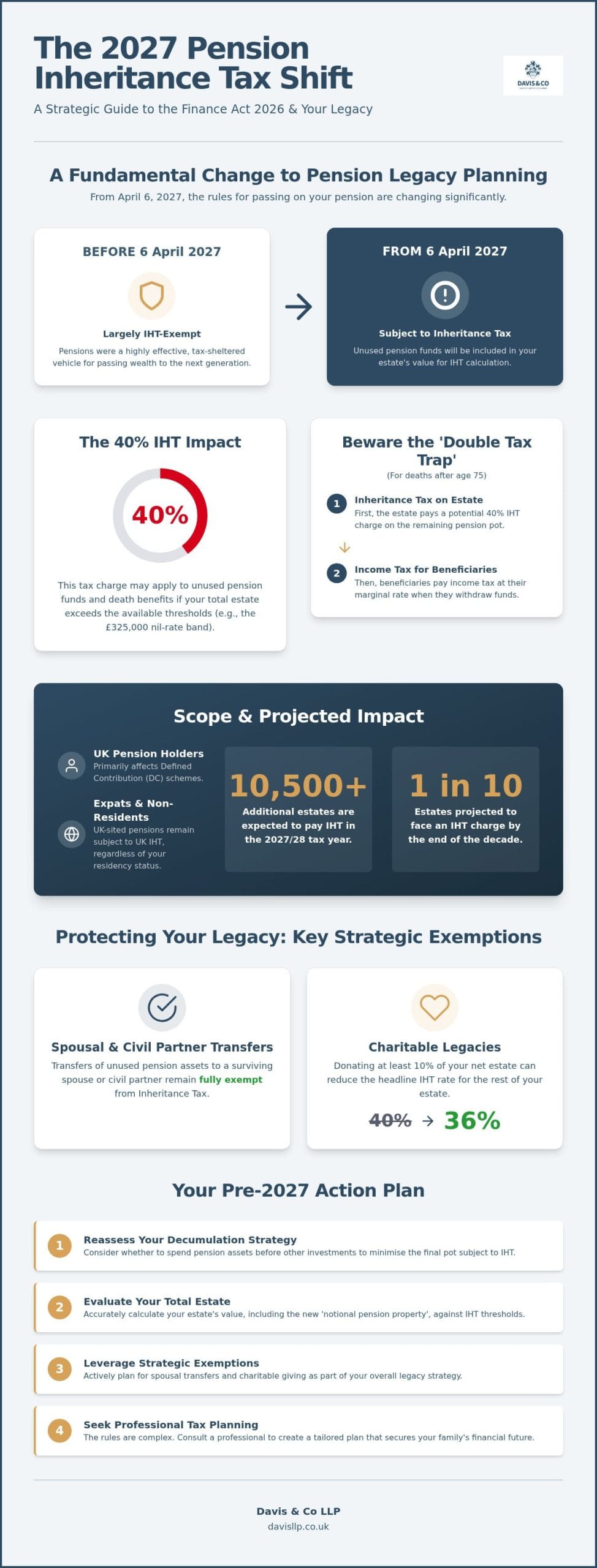
Historically, Pensions in the United Kingdom enjoyed a privileged status, remaining largely outside the reach of HM Revenue and Customs for inheritance tax (IHT) purposes. This exemption turned pension pots into highly effective vehicles for passing wealth to the next generation, as they didn’t count towards the value of an estate. However, the Finance Act 2026 has introduced a fundamental shift that requires immediate attention from anyone planning their legacy. From 6 April 2027, most unused pension funds and death benefits will be brought into the value of a person’s estate. This means that if your total assets, including these pension pots, exceed the available thresholds, a 40% tax charge may apply.
The new regime distinguishes between “unused pension funds,” which refers to the capital remaining in your drawdown or accumulation account, and “death benefits,” which are payments triggered by your passing. For those considering the tax implications of moving abroad from uk, it’s vital to remember that UK pensions are considered UK-sited assets. Even if you are no longer a UK resident, these funds will likely remain subject to UK inheritance tax under the long-term residence tests established in April 2025. We’ve seen that many clients are surprised to learn that their international status doesn’t automatically shield their UK pension from these new rules.
What is Notional Pension Property?
The legislation introduces the concept of “notional pension property” to bring these assets into the IHT net. In essence, while you don’t technically “own” the pension fund in the same way you own a bank account, the law will treat it as part of your estate for tax calculations. This primarily affects Defined Contribution (DC) schemes, where the remaining balance can be substantial. While certain statutory schemes may have specific exclusions, most private and workplace pensions are now within scope. Scheme administrators will play a central role, as they’ll be responsible for reporting these values to HMRC and, in many cases, paying the tax directly from the fund.
Why the Rules are Changing in 2027
The government’s stated objective is to restore the original purpose of pensions: providing an income in retirement. By removing the “tax planning distortions” that encouraged individuals to leave their pensions untouched, the Treasury expects to significantly increase tax receipts. The Office for Budget Responsibility (OBR) estimates that these changes will bring an additional 10,500 estates into the inheritance tax system in the 2027/28 tax year. By the end of the decade, it’s projected that approximately one in ten estates will face an IHT charge. This shift forces a total re-evaluation of how we approach retirement spending and legacy planning to ensure your family remains well-protected.
The Finance Act 2026: How Pension Death Benefits are Valued
Under the Finance Act 2026, the valuation of pension assets becomes a collaborative effort between the pension scheme administrator and the personal representative of the estate. The scheme administrator is now mandated to provide the market value of the unused funds or death benefits as of the date of death. This information is critical for the executor to accurately calculate the total estate value against the UK Inheritance Tax rules. While the process may seem administrative, the precision of these figures determines whether an estate triggers a significant tax liability.
For those assessing the tax implications of moving abroad from uk, the valuation process remains consistent regardless of your residency status. HMRC views the pension as a UK-sited asset, and its value will be reported in GBP. This means exchange rate fluctuations at the time of death could inadvertently push an international estate over the £325,000 nil-rate band. We often find that clients living overseas overlook how these UK-based valuations interact with their global wealth, making professional oversight essential.
Valuing Defined Contribution (DC) Pots
The valuation of DC pots is generally straightforward, following a three-step protocol. First, the administrator identifies the total market value of the unused fund on the date of death. Second, they deduct any outstanding administrative charges or liabilities permitted under the scheme rules. Finally, the resulting figure is reported to the personal representative to be aggregated with other estate assets. If the total value exceeds the available thresholds, the 40% IHT rate is applied to the excess.
Defined Benefit (DB) and Lump Sum Death Benefits
Defined Benefit schemes present more complexity. Unlike DC pots, which represent a tangible “pot” of money, DB schemes often pay out a “pension protection lump sum” if the member dies shortly after retiring. The valuation here focuses on the specific lump sum payable rather than a residual fund value. It’s also vital to distinguish between “vested” benefits, where the member had an immediate right to the funds, and “non-vested” benefits. Given these nuances, our international tax planning services can help clarify how these specific valuations affect your broader estate strategy.
The liability for paying the tax typically falls on the scheme administrator, who must pay HMRC directly from the pension funds. However, the personal representative remains responsible for the overall accuracy of the IHT return. This reporting must usually be completed within six months of the end of the month in which the death occurred to avoid interest charges. This dual-responsibility framework ensures that tax is collected efficiently while maintaining the integrity of the estate’s total valuation.
Strategic Exemptions: Spousal Transfers and Charitable Legacies
While the 2027 rule changes represent a significant tightening of the tax net, they don’t eliminate the robust exemptions that have long anchored UK estate planning. The most powerful of these remains the spousal exemption. Even after 6 April 2027, any pension funds or death benefits passing to a surviving spouse or civil partner will remain entirely free of inheritance tax. This provides a vital buffer for many families, though it essentially delays the tax liability rather than removing it entirely. When the surviving spouse eventually passes away, the remaining pension assets will be aggregated with their estate, potentially triggering the 40% charge at that later stage.
To navigate these complexities, the ‘Nomination of Beneficiaries’ form has become an indispensable strategic tool. In the past, this form was primarily used to guide the scheme administrator’s discretion to keep the pension outside the estate. Post-2027, its role shifts. It’s now the primary mechanism for directing funds toward exempt parties, such as a spouse or a registered charity, to mitigate the headline tax burden. For those managing the tax implications of moving abroad from uk, ensuring these forms are updated to reflect current residency and relationship status is paramount. UK-sited assets remain subject to these rules even if the beneficiaries reside overseas.
The Spousal Exemption and Civil Partnerships
The unlimited transfer between spouses remains a cornerstone of the new regime. However, we’re advising clients to look closely at the structure of these transfers. Choosing between a ‘dependants’ pension’ and a lump sum can have varied effects on the surviving spouse’s own IHT exposure. A lump sum immediately increases the survivor’s taxable estate; a dependants’ pension might offer more flexibility in how wealth is drawn down and managed over time. This ‘two-step’ IHT hit requires a long-term view that accounts for the eventual passing of both partners.
Charitable Giving and the 36% IHT Rate
For estates that will inevitably exceed the nil-rate bands, charitable legacies offer a practical way to reduce the overall tax rate. If you leave at least 10% of your net estate to a registered charity, the IHT rate on the remainder of the estate is reduced from 40% to 36%. Directing pension funds toward a charity can be particularly efficient, as these donations are exempt from IHT. This approach not only supports a chosen cause but also softens the impact on the assets intended for your heirs. Given the nuances of these calculations, seeking professional tax advice in the UK is essential to ensure your estate is structured to take full advantage of every available relief.
The Double Tax Trap: Balancing IHT with Beneficiary Income Tax
A primary concern for many of our clients is the emergence of a “double tax trap” under the new legislation. While much of the public discourse focuses on the 40% inheritance tax charge, the true impact lies in how this levy interacts with the beneficiary’s own income tax obligations. If a pension holder passes away after the age of 75, the funds are first subjected to inheritance tax at the estate level. The remaining balance, when withdrawn by the beneficiary, is then treated as taxable income. This layering of taxes can result in an effective tax rate exceeding 60% or even 70% for those in higher tax brackets.
For individuals considering the tax implications of moving abroad from uk, this trap is especially relevant. If you retire overseas but maintain a UK pension, your beneficiaries, regardless of their location, may find the net value of their inheritance significantly eroded by this dual-taxation framework. We help clients model these outcomes to ensure their legacy isn’t inadvertently diminished by a lack of foresight. Professional Personal Tax Services are essential to navigate these overlapping regimes and protect the long-term value of your estate.
Why Age 75 Remains a Critical Milestone
The age of 75 continues to be a pivotal threshold in pension tax planning. If death occurs before 75, beneficiaries generally receive the remaining funds free of income tax, although the new 40% IHT charge will still apply from April 2027. Once the holder passes 75, the “double tax” becomes a reality. This shift necessitates a proactive approach to withdrawal strategies as one approaches this milestone. It may be more tax-efficient to accelerate pension drawdowns earlier in retirement, effectively spending the “tax-heavy” assets first while preserving other, more tax-efficient investments for your heirs.
Mitigating the Impact for High-Rate Taxpayers
Beneficiaries aren’t required to take the entire inherited pension as a lump sum, which is a critical point for mitigation. By using “Successor Flexi-Access Drawdown,” a beneficiary can keep the funds within a tax-advantaged environment and withdraw the money over several tax years. This “staggered” approach allows them to manage their own tax brackets, potentially keeping withdrawals within the basic rate band rather than being pushed into the 40% or 45% tiers. Scheme administrators typically have a two-year window to pay out death benefits; failing to act within this timeframe can lead to further tax complications, making timely advice indispensable.
Professional Tax Planning: Preparing for the 6 April 2027 Deadline
The approach of the 6 April 2027 deadline represents a pivotal moment for estate planning. We’re advising clients that the historical “pensions last” decumulation strategy, which prioritised spending ISAs and other assets while leaving pensions to grow IHT-free, is now fundamentally flawed. With pensions entering the inheritance tax net, your strategy must pivot toward a more holistic view of wealth distribution. This often involves considering a “Gift Inter Vivos” approach, where wealth is transferred during your lifetime to reduce the eventual size of the taxable estate. By acting sooner, you can utilise the seven-year rule to ensure these gifts fall entirely outside the scope of IHT.
For those living overseas or planning a relocation, the tax implications of moving abroad from the UK are multifaceted. Even if you’ve established residency elsewhere, your UK pension remains a UK-sited asset subject to these new rules. We’ve observed that many individuals overlook how their global footprint interacts with HMRC’s long-term residence tests. In such cases, utilising sophisticated trust structures can provide a layer of protection for multi-jurisdictional assets, ensuring your family’s interests are shielded across borders. Our expertise in Trust Tax Services is particularly valuable here, as we help manage the nuances of complex family protection.
Revisiting Your Drawdown Strategy
The new regime necessitates a complete re-evaluation of how you access your retirement funds. It’s often more tax-efficient to draw down from your pension pot earlier, potentially using those funds to support your lifestyle while allowing other assets to remain untouched. Alternatively, you might use the annual gift allowance of £3,000 to move capital out of your estate incrementally. By gifting cash today rather than retaining a pension pot that will face a 40% charge after 2027, you can significantly enhance the net value passed to your heirs. We work with you to model these scenarios, ensuring the order of decumulation is optimised for the new legislative landscape.
The Value of Professional Partnership
At Davis & Co LLP, we provide a steady, measured approach to these complex legislative changes. Our deep-seated expertise in Personal Tax Services allows us to conduct a comprehensive review that encompasses your entire portfolio, from property to private pensions. We don’t just look at taxes in isolation; we act as strategic partners to ensure your legacy reflects your personal values and family needs. Scheduling a comprehensive estate review before the 2027 deadline is the most effective way to secure your financial future. We invite you to begin this collaborative process with us to ensure no detail is overlooked in an increasingly complex tax environment.
Securing Your Family’s Financial Future
The transition toward the 6 April 2027 deadline marks a fundamental change in how we must view retirement assets. Pensions are no longer the shielded legacy vehicles they once were; they’re now integral components of a taxable estate. We’ve explored how the Finance Act 2026 necessitates a reversal of traditional drawdown strategies to avoid the potential double tax of both inheritance and income tax. For those managing the tax implications of moving abroad from uk, these changes require particularly careful navigation to ensure UK-sited assets don’t undermine a global estate plan.
As Chartered Certified Accountants serving clients since 1901, we offer a discreet, partner-led advisory service tailored to these sensitive matters. Our specialist expertise in trust and international tax planning provides the intellectual rigour needed to adapt your strategy effectively. By acting now, you can transform uncertainty into a clear, actionable roadmap that preserves your wealth for the next generation.
Secure your legacy with a professional estate review from Davis & Co LLP. We look forward to helping you navigate these changes with confidence and poise.
Frequently Asked Questions
Will my pension be subject to inheritance tax if I die before 6 April 2027?
No, the current exemptions remain in place until the new regime officially begins. Under existing rules, most pension schemes are held in trust and fall outside the scope of your estate for tax purposes. However, any deaths occurring on or after 6 April 2027 will be subject to the Finance Act 2026 provisions. It’s vital to review your current nominations now to ensure they align with the upcoming transition.
Does the 2027 rule change apply to both private and state pensions?
The changes primarily target unused funds in private and workplace pension schemes, such as Defined Contribution (DC) and certain Defined Benefit (DB) pots. State pensions don’t have a residual fund value that can be inherited as a lump sum in the same way, so they aren’t captured by these specific inheritance tax changes. Most private schemes will now be treated as “notional pension property” within the valuation of your estate.
How is the value of a pension pot calculated for inheritance tax?
Valuation is based on the market value of the unused funds or death benefits at the date of death. Scheme administrators are responsible for providing this figure to the personal representative after deducting any permitted administrative charges. This reported value is then aggregated with your other assets, such as property and savings, to determine if the total estate exceeds the £325,000 nil-rate band or other available thresholds.
Can I avoid inheritance tax on my pension by nominating my spouse?
Yes, the unlimited spousal exemption remains a cornerstone of UK tax law. Transfers to a legal spouse or civil partner are exempt from inheritance tax, effectively deferring any liability until the second partner passes away. However, it’s important to consider that these funds will then increase the survivor’s taxable estate value. Strategic planning is required to manage the eventual tax impact when the surviving spouse’s own estate is settled.
What is the “double tax trap” regarding pensions and inheritance tax?
This trap occurs when a pension is subject to both 40% inheritance tax and the beneficiary’s marginal rate of income tax. If the original holder dies after age 75, the fund is first taxed as part of the estate. When the beneficiary subsequently withdraws funds, they pay income tax on the remainder. For higher-rate taxpayers, this combined burden can result in an effective tax rate of 60% or more on the original pot.
Is it better to spend my pension or my savings first under the new rules?
The optimal order of decumulation has changed significantly. Previously, it was often best to spend ISAs and savings first to keep pensions sheltered. Now, it’s often more tax-efficient to draw down your pension earlier to reduce the taxable pot that remains at death. Since ISAs remain subject to inheritance tax but don’t carry the same income tax burden for beneficiaries, they may now be considered better legacy vehicles in some scenarios.
What are the tax implications of moving abroad from the UK regarding my pension?
Understanding the tax implications of moving abroad from uk is essential, as UK-based pensions are considered UK-sited assets. Regardless of your new residency, these funds remain liable for UK inheritance tax. Since 6 April 2025, exposure is determined by a long-term residence test rather than domicile. This means you could be liable for UK tax on your worldwide assets for a period of up to ten years after leaving the country.
How do the new rules affect beneficiaries who live abroad?
Beneficiaries living overseas are still affected by UK inheritance tax, as the tax is typically deducted from the pension fund by the UK scheme administrator before any distribution occurs. While the beneficiary’s local jurisdiction may have its own rules for taxing the receipt of these funds, the UK’s 40% charge on the estate value takes precedence for UK-sited pension assets. We recommend professional advice to manage these complex multi-jurisdictional tax liabilities.