Why does your dental practice show a healthy profit on paper while your bank balance remains stubbornly stagnant? It’s a common frustration for UK principals who find themselves caught between delayed NHS reimbursements and the constant pressure of material inflation. Managing dental practice cash flow effectively in 2026 requires more than just diligent bookkeeping; it demands a strategic synchronisation of clinical revenue cycles with precise tax planning. When your liquidity doesn’t match your ledger, it’s often a sign that your financial framework isn’t keeping pace with the complexities of modern practice management.
We understand that addressing high associate costs and the new requirements of Making Tax Digital can make your fiscal position feel volatile. You’re likely seeking a way to eliminate tax bill surprises and secure the capital needed for essential equipment reinvestment. This guide provides the sophisticated financial frameworks required to stabilise your cash flow and optimise your tax position. We’ll explore the impact of the 2026 NHS contract reforms, detail the latest Corporation Tax thresholds, and provide a clear roadmap for achieving predictable monthly liquidity and long-term financial peace of mind.
Key Takeaways
- Distinguish between accounting profit and actual liquidity to ensure your practice maintains the agility required for daily operations.
- Identify how integrating clinical platforms with robust bookkeeping systems helps you recover “leaking” revenue before it impacts your bottom line.
- Evaluate the contrasting impacts of NHS contract delivery and private fee-per-item models to build a more resilient monthly bank balance.
- Master the frameworks for managing dental practice cash flow effectively by aligning your tax liabilities with clinical revenue cycles.
- Explore the strategic advantages of partnering with a dental tax specialist to navigate complex regulations and accelerate reinvestment in your practice.
The Fundamentals of Dental Practice Cash Flow Management
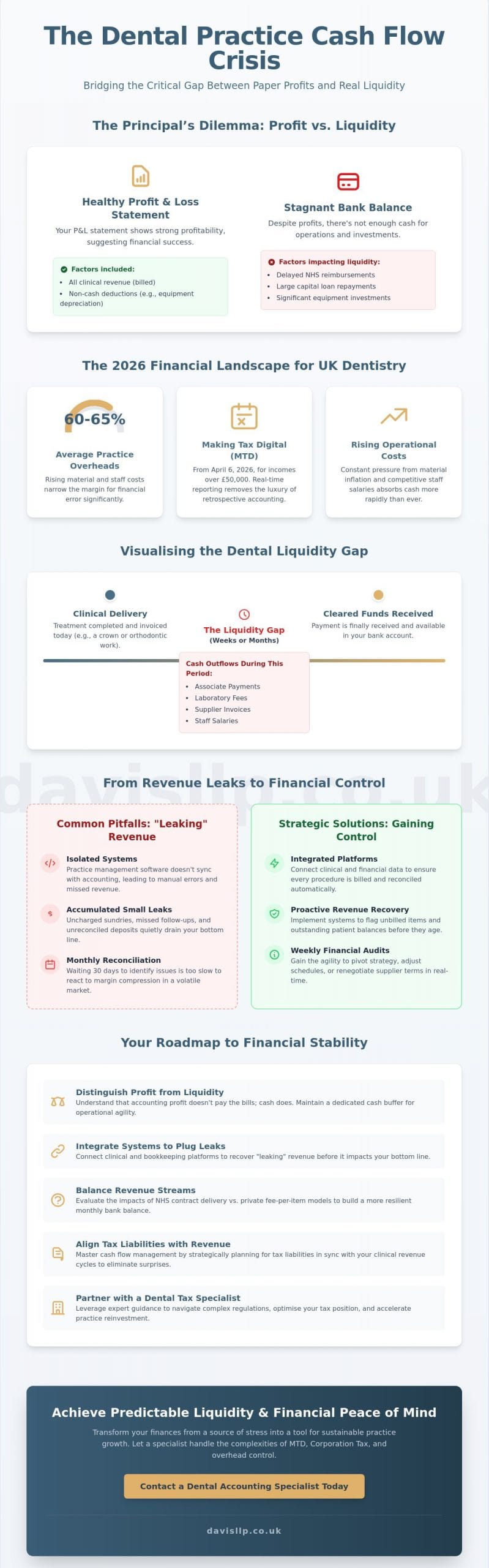
Effective fiscal management in a clinical setting begins with a precise understanding of the Fundamentals of Dental Practice Cash Flow. In its simplest form, cash flow represents the timing-specific movement of liquid assets through your practice. For a dental principal, this isn’t merely a calculation of revenue minus expenses. It’s a complex cycle where the clinical delivery of a crown or a course of orthodontic treatment today might not translate into cleared funds for several weeks or even months. This structural delay creates what we identify as the “Dental Liquidity Gap”. Managing dental practice cash flow effectively requires you to anticipate these lulls, ensuring that operational obligations, such as associate payments and laboratory fees, are met without straining your reserves.
Profit vs. Liquidity: The Principal’s Dilemma
A common pitfall for many successful dentists is the assumption that a profitable Profit and Loss (P&L) statement equates to a healthy bank balance. It’s entirely possible to be profitable on paper while facing a liquidity crisis. This discrepancy often arises because accounting profit includes non-cash items like depreciation on expensive imaging equipment, which reduces your taxable profit but doesn’t actually remove cash from your account. Conversely, large capital repayments on practice loans or significant investments in new surgery chairs require immediate cash but aren’t fully reflected as expenses on the P&L. Without a dedicated cash buffer, over-investing in the latest technology can ironically destabilise the very business it was intended to grow.
The 2026 Economic Context for UK Dentistry
The current fiscal year presents unique challenges that make real-time visibility essential. With average practice overheads now reaching between 60% and 65% of collections, the margin for error has narrowed significantly. Rising material costs and the necessity of maintaining competitive staff salaries mean that cash is absorbed more rapidly than in previous years. Additionally, the mandate for Making Tax Digital (MTD) for Income Tax, effective from April 6, 2026, for those with income over £50,000, removes the luxury of retrospective accounting. You now require a framework that provides a clear, forward-looking view of your financial position. Securing expert tax advice in the UK is no longer just about compliance; it’s a strategic necessity for maintaining resilience. By managing dental practice cash flow effectively, you transform your finances from a source of stress into a tool for sustainable practice evolution.
Optimising the Revenue Cycle: From Patient Intake to Reconciliation
The operational success of a modern practice depends on the seamless integration of clinical activity and financial reporting. Managing dental practice cash flow effectively is difficult when your practice management software remains isolated from your accounting platform. In 2026, the transition to real-time reporting under Making Tax Digital (MTD) makes this connectivity essential. When clinical data flows directly into your ledger, you eliminate the manual entry errors that often lead to “leaking” revenue. These leaks are rarely the result of a single large error; they are typically the cumulative effect of uncharged sundries, missed follow-up appointments, or unreconciled deposits that sit dormant in patient accounts.
Shifting from monthly to weekly financial reconciliations provides the agility needed to respond to rising overheads. Waiting thirty days to identify a dip in private fee collections or a spike in laboratory spending can be catastrophic when margins are compressed. Regular oversight allows for strategic pivots, such as adjusting associate schedules or renegotiating supplier terms before a minor deficit becomes a liquidity crisis. By managing dental practice cash flow effectively through weekly audits, you ensure that every clinical decision is backed by current financial data. This level of rigour is a hallmark of Strategic Tax Planning and Overhead Control, allowing you to maintain a stable trajectory even in volatile economic conditions. Implementing structured management accounts provides the granular detail necessary for this proactive approach.
Refining Patient Financial Policies
The traditional “invoice and wait” model is increasingly incompatible with high-overhead dentistry. Transitioning toward a “payment at time of treatment” policy is one of the most effective ways to accelerate cash inflow. For large-scale restorative or orthodontic cases, third-party patient finance offers a compelling solution. It provides the practice with the full fee upfront, minus a small service charge, while offering patients manageable monthly terms. This removes the risk of staged payments failing mid-treatment. It’s vital to balance these options with clear communication to ensure patient trust remains high. If you find your current billing processes are creating bottlenecks, our team can help you implement more efficient bookkeeping services tailored to clinical workflows.
Internal Controls and Fraud Prevention
Financial slippage often occurs at the point of patient departure. Reception workflows must be robust, with a clear separation of duties between those who handle cash and those who reconcile the daily reports. An individual shouldn’t be in a position to both delete a treatment charge and balance the till at the end of the day. Utilising the audit trail features within your practice management software is not an act of mistrust; it’s a fundamental component of professional governance. These internal controls protect the practice’s assets and provide the transparency required for accurate financial forecasting and long-term stability.
Navigating the Dichotomy: NHS vs. Private Revenue Streams
The financial architecture of a UK dental practice is often split between the rigid predictability of NHS contracts and the high-margin volatility of private services. While the monthly NHS schedule provides a dependable baseline for meeting fixed costs, it’s a capped revenue stream that leaves little room for expansion. Conversely, private work allows for uncapped growth but introduces the risk of inconsistent monthly bank balances. Managing dental practice cash flow effectively requires a nuanced understanding of how these two streams interact. We’ve observed that practices relying solely on fee-per-item private work often struggle with “lumpy” income, whereas those incorporating capitation schemes enjoy a smoother liquidity profile.
A significant risk within the NHS framework is the Unit of Dental Activity (UDA) delivery cycle. Falling short of your contracted targets doesn’t just result in lost revenue; it triggers clawbacks that can suddenly deplete your cash reserves months after the clinical work was performed. Conversely, over-delivery provides no financial benefit, effectively wasting clinical time that could have been allocated to private growth. These strategies for improving cash flow emphasise the need to treat your NHS contract as a fixed commitment to be met precisely, rather than a flexible target. This precision ensures that your resources are utilised where they generate the most value.
Associate pay scales also play a decisive role in your net margin. When associate remuneration remains high while material and laboratory costs inflate, the cash remaining for the practice principal can diminish rapidly. It’s essential to model the net cash impact of every revenue stream after all variable costs are deducted. If your associate costs are fixed at a high percentage of gross fees, your ability to absorb inflation is limited, making it harder to maintain a healthy cash buffer.
Managing the NHS Contract Cycle
The delay between clinical delivery and NHS reimbursement can create a significant gap in your working capital. We recommend forecasting your UDA performance at least quarterly to avoid year-end surprises. A small business accountant with specific dental expertise is invaluable here. They provide the oversight needed to ensure you’re meeting targets without over-extending your resources or risking a clawback that could destabilise your monthly liquidity.
Accelerating Private Fee Collection
Private dentistry often suffers from high “Days Sales Outstanding” (DSO), particularly when large-scale restorative or orthodontic cases are involved. Work in progress (WIP) represents cash tied up in laboratory fees and clinical time that hasn’t yet been billed. Managing dental practice cash flow effectively in the private sector involves securing deposits for all high-value treatments. We suggest implementing membership plans that convert one-off patients into recurring revenue, providing a stable foundation that offsets the natural fluctuations of fee-per-item work.
Strategic Tax Planning and Overhead Control
The semi-annual “cash crunch” that many principals face in January and July is rarely a sign of poor clinical performance; it’s a symptom of a tax strategy that operates in isolation from daily operations. Managing dental practice cash flow effectively requires a shift from retrospective reporting to a forward-looking tax strategy that anticipates liabilities before they impact your bank balance. When corporation tax sits at 25% for profits over £250,000, failing to set aside a dedicated tax reserve can lead to a sudden depletion of working capital. We advise maintaining an “ear-marked” reserve account, separate from your main operational funds, where a percentage of monthly gross income is transferred immediately. This practice ensures that tax obligations are treated as a fixed monthly overhead rather than a sudden, destabilising expense.
Leveraging Capital Allowances for Cash Retention
Strategic reinvestment in your practice can serve as a powerful tool for cash retention. By utilising Capital Allowances, you can offset the cost of essential equipment, such as digital scanners, dental chairs, and X-ray units, against your taxable profits. The timing of these purchases is critical. Aligning significant capital expenditure with the end of your financial year can provide immediate tax relief, effectively reducing your next tax bill and keeping more liquid capital within the business. In 2026, the Annual Investment Allowance (AIA) permits practices to claim 100% relief on the first £1 million of qualifying capital expenditure, providing a robust mechanism for accelerating practice growth without compromising liquidity.
Managing Associate and Staff Costs
With staff costs typically accounting for 25% to 30% of collections, managing this overhead is essential for maintaining a healthy net margin. The 2026 economic environment, characterised by average practice overheads of 60% to 65%, leaves little room for inefficient remuneration models. It’s vital to analyse the cash flow impact of associate pay scales, ensuring that the split of fees remains sustainable after laboratory costs and material inflation are factored in. Beyond gross pay, principals must also account for “hidden” costs, including pension contributions and the latest requirements for minimum wage compliance. Regular budget-to-actual variance analysis for material and lab spend will help identify where costs are exceeding projections, allowing for swift negotiations with suppliers.
If you find that your current financial reporting isn’t providing the clarity needed to make these strategic decisions, our dental tax specialists can help you implement a more sophisticated framework for managing dental practice cash flow effectively. By synchronising your overhead control with proactive tax planning, you create the financial stability required to reinvest in the latest clinical technologies and secure long-term growth.
The Role of Specialist Accounting in Sustainable Growth
Generalist accounting often fails to address the intricate financial nuances of clinical practice. While a standard accountant might provide accurate retrospective compliance, they frequently lack the industry-specific insight required for managing dental practice cash flow effectively. A dental practice isn’t a typical high-street business; its revenue cycles are dictated by complex NHS contract reconciliations and the “lumpy” nature of private restorative work. We believe that true financial stability comes from a partnership with a dental tax specialist who understands these variables and can transform raw data into a strategic roadmap for evolution.
For multi-surgery practices, the need for real-time visibility is even more pronounced. Relying on data that is several months old makes it impossible to identify which surgeries are underperforming or where overheads are eroding margins. Implementing real-time financial dashboards allows principals to monitor performance across multiple sites simultaneously. This transparency ensures that you can make informed decisions about associate recruitment or equipment acquisition based on current liquidity rather than historical profit figures. It’s the difference between reacting to a financial shortfall and proactively steering the practice toward a predetermined goal.
The Value of Niche Expertise
Understanding dental-specific Key Performance Indicators (KPIs) is the foundation of modern practice management. One of the most critical metrics we monitor is the surgery hourly rate. By calculating the net contribution of each surgery after all variable costs are deducted, we help principals identify the most profitable clinical pathways. This level of detail is essential when managing partnership finances, where discretion and professional gravitas are paramount. We shift the focus from simple compliance to a forward-looking advisory model that prioritises the long-term health of both the organisation and the individual partners.
Developing a 12-Month Cash Flow Forecast
A robust 12-month forecast is the primary tool for transitioning from financial uncertainty to composed authority. This forecast must include anticipated tax liabilities, planned capital expenditure, and the impact of the 2026 NHS contract reforms discussed earlier. We also incorporate “stress testing” into our models. This allows us to simulate the financial impact of unforeseen events, such as a sudden increase in laboratory fees or the temporary absence of a high-grossing associate. Managing dental practice cash flow effectively means being prepared for these scenarios before they occur. If you’re ready to secure your practice’s future, we invite you to contact us for a comprehensive financial health check and bespoke cash flow strategy.
Securing the Financial Future of Your Practice
Achieving fiscal stability in the modern UK dental sector requires more than just clinical excellence; it demands a sophisticated approach to financial governance. We’ve explored how transitioning from retrospective reporting to real-time visibility allows you to anticipate the structural delays inherent in clinical revenue cycles. By synchronising your tax strategy with your operational needs and balancing the unique demands of NHS and private streams, you move from a position of reactive management to one of composed authority. Managing dental practice cash flow effectively is the cornerstone of sustainable growth, providing the liquidity needed to reinvest in both your team and your technology.
As Chartered Certified Accountants since 1901, we provide the specialist niche expertise in dental tax and compliance required to navigate these complexities. Our comprehensive business growth and management accounting services ensure that your practice remains resilient against economic shifts. We invite you to consult our specialist dental accountants to secure your practice cash flow. Taking control of your financial framework today ensures you can focus on providing exceptional patient care with absolute confidence in your practice’s long-term prosperity.
Frequently Asked Questions
Is it better to lease or buy dental equipment for cash flow purposes?
Leasing often preserves more liquid capital than buying, though the latter provides immediate tax benefits through the Annual Investment Allowance. The decision rests on whether your priority is long-term tax efficiency or immediate monthly liquidity. For practices looking to maintain a healthy cash buffer during economic volatility, leasing spreads costs over the asset’s useful life. This avoids the sudden depletion of reserves that often accompanies a major capital purchase.
How much cash reserve should a typical UK dental practice maintain?
We recommend that a resilient UK practice maintains a liquid reserve equivalent to three to six months of fixed operating expenses. This fund acts as a vital safeguard against delayed NHS reimbursements or sudden equipment failures. Having this capital readily available ensures that you don’t have to rely on expensive short-term financing. It provides the financial peace of mind necessary to focus on clinical excellence and strategic practice development.
Can I improve my cash flow by changing how I pay my dental associates?
Yes, refining associate remuneration is a potent strategy for improving your net margin. Moving away from traditional high-percentage splits toward models that account for rising material and laboratory costs ensures the practice remains profitable. This adjustment is a core part of managing dental practice cash flow effectively. It ensures that the principal’s share remains sufficient to cover increasing overheads while still rewarding associates for their clinical contributions.
What is the most common reason for cash flow failure in expanding practices?
The most frequent reason for failure during expansion is over-trading, where the upfront costs of new surgeries outstrip the timing of fee collections. Principals often underestimate the “Dental Liquidity Gap” between hiring staff and receiving cleared funds from treatments. Without a detailed 12-month forecast, the rapid increase in fixed costs can quickly exhaust your cash reserves. Expansion must be paced to match the actual movement of liquid assets.
How does the 2026 Making Tax Digital (MTD) update affect my bookkeeping?
The 2026 Making Tax Digital update requires self-employed dentists with income exceeding £50,000 to maintain digital records and submit quarterly updates to HMRC. This shift ends the era of annual retrospective accounting. You must now adopt MTD-compliant software that provides real-time visibility into your finances. This transition encourages a more disciplined approach to bookkeeping, ensuring that your financial data is always current and actionable.
What happens if I have an NHS UDA clawback and no cash reserve?
An NHS UDA clawback without a cash reserve can lead to immediate financial distress and the inability to meet payroll or supplier obligations. Because these clawbacks are often significant and non-negotiable, they represent a major risk to practice continuity. This risk highlights the necessity of monitoring contract performance quarterly. It’s far better to adjust clinical delivery early than to face a sudden, unbudgeted demand for repayment from the NHS.
How can I reduce my laboratory and material costs without compromising quality?
Consolidating your purchasing with a smaller number of preferred suppliers allows you to negotiate more competitive volume-based discounts. We also suggest implementing digital workflows, as intraoral scanning significantly reduces recurring costs for impression materials and laboratory couriers. Regular variance analysis helps you track material spend against your budget. This identifies areas of waste or inefficient ordering patterns without ever compromising the clinical quality provided to your patients.
Is a private capitation scheme better for cash flow than fee-per-item?
Capitation schemes are generally more beneficial for cash flow because they provide a stable, predictable monthly income. This recurring revenue acts as a financial floor, making it much easier to plan for fixed overheads and tax liabilities. In contrast, fee-per-item work is inherently volatile and sensitive to diary fluctuations. A balanced mix, underpinned by a strong capitation base, is a key element of managing dental practice cash flow effectively.