National Minimum Wage 2025 and 2026: A Strategic Guide for UK Employers
What if the most significant risk to your firm’s stability isn’t the headline rate increase, but the hidden administrative friction that follows? As the UK prepares for the implementation of the national minimum wage 2025 on 1 April, the transition involves far more than a simple payroll adjustment. We understand that for many employers, the primary concern lies in the intricate ripple effects, from the sudden compression of internal pay scales to the 15% Employer National Insurance contributions that amplify every penny of the uplift. It’s a complex landscape where a minor oversight in age-band transitions can lead to a place on HMRC’s public naming-and-shaming list, which featured over 500 companies in the last reporting cycle.
This guide provides a comprehensive analysis of the 2025 and 2026 wage projections, offering the clarity you need to maintain statutory compliance while protecting your commercial margins. We’ll examine the specific impact on pension auto-enrolment costs and provide a pragmatic framework for managing these rising overheads. By looking beyond the immediate figures, we’ll help you develop a bespoke strategy that ensures your business remains both legally secure and financially resilient in the face of evolving employment regulations.
Key Takeaways
- Understand the evolving National Living Wage thresholds for the 2025 and 2026 fiscal years to ensure your long-term financial planning remains accurate.
- Clarify the statutory definitions of worker categories and the critical importance of age-band tracking to prevent inadvertent payroll non-compliance.
- Assess the comprehensive financial impact of the national minimum wage 2025 by analysing the interplay between base rate increases and Employer National Insurance Contributions.
- Establish a robust internal audit framework to identify historical underpayment risks and navigate the regulatory complexities of salary sacrifice arrangements.
- Discover how bespoke payroll oversight and integrated tax planning can transform legislative transitions into a structured commercial advantage for your firm.
The Evolution of UK Wage Standards: Comparing 2025 and 2026 Rates
Since the inception of the National Minimum Wage Act 1998, the UK’s approach to statutory pay has transitioned toward more aggressive annual adjustments. Over the last 24 months, we’ve seen the National Living Wage (NLW) threshold expand to include workers aged 21 and over, a move that fundamentally altered payroll structures for thousands of employers. The Low Pay Commission’s recommendations for the 2025 and 2026 fiscal years reflect a commitment to maintaining the real-term value of earnings against volatile inflationary pressures.
Accurate application of the national minimum wage 2025 standards isn’t just a matter of forward planning; it’s a critical component of current compliance audits. We often find that back-pay assessments hinge on precise historical rate application, particularly when HMRC investigates records from the 2024/25 transition. Maintaining a clear record of these shifts allows our clients to mitigate the risk of financial penalties and reputational damage. The transition from the 2024/25 tax year into the current 2026 requirements marks a period of significant fiscal adjustment for British businesses.
Statutory Rates for April 2025 to March 2026
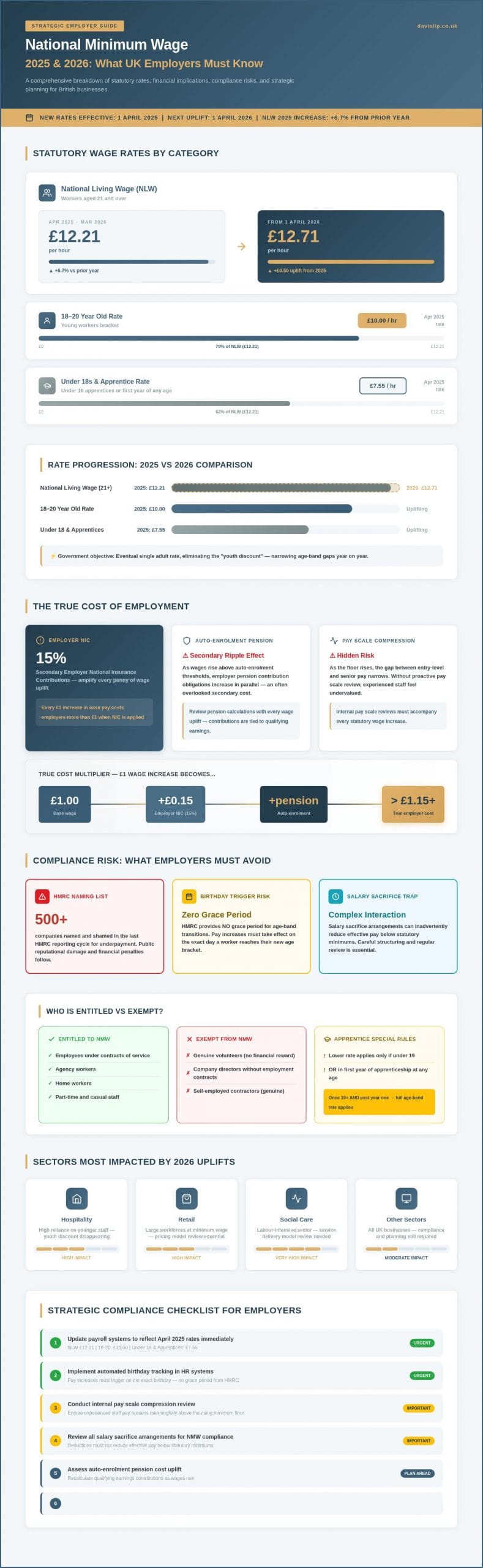
The rates effective from 1 April 2025 established a new baseline for overheads across all sectors. The 2025 NLW increase represents a 6.7% rise from the previous year. Employers must ensure their payroll systems reflect these specific figures for the 2025/26 period:
- National Living Wage (21 and over): £12.21 per hour.
- 18-20 Year Old Rate: £10.00 per hour.
- Under 18s and Apprentice Rate: £7.55 per hour.
We advise our clients to review their existing contracts to ensure that those on the 18-20 bracket are moved to the NLW immediately upon their 21st birthday. This prevents accidental non-compliance during the 2025/26 cycle.
The 2026 Landscape: Current Statutory Requirements
Looking ahead to 1 April 2026, the statutory requirements continue their upward trajectory with the NLW set to reach £12.71. This increase is part of a broader government strategy to align the National Minimum Wage with two-thirds of median earnings. A defining feature of the 2026 landscape is the deliberate narrowing of the gap between age bands. The government’s objective is the eventual implementation of a single adult rate, which will simplify payroll but increase costs for businesses that rely on younger staff.
For labour-intensive sectors like hospitality, retail, and social care, these 2026 uplifts necessitate a pragmatic review of pricing models and service delivery. We work with our clients to develop bespoke strategies that balance these rising costs with commercial objectives. The shift toward a unified rate means that the historical “youth discount” is rapidly disappearing, requiring a more sophisticated approach to workforce planning and retention.
Defining Entitlement: Age Bands, Apprentices, and Special Categories
Determining who qualifies for the statutory minimum is a foundational step in payroll compliance. The legal definition of a ‘worker’ for these purposes is broad, extending beyond traditional employees to include agency staff and individuals working from home. Maintaining compliance with the national minimum wage 2025 requirements means looking beyond the headline figures. We often find that businesses overlook the precise timing of age-related pay increases. Compliance requires immediate action on the day a worker reaches a new age bracket. Since HMRC doesn’t provide a grace period for these transitions, robust birth date tracking is a necessity for your HR systems. While most staff are entitled to the National Minimum Wage 2025 rates, certain categories remain exempt. This group includes genuine volunteers who receive no financial reward and company directors who don’t have a contract of employment.
The Apprentice Rate Technicalities
Apprenticeships present specific challenges for payroll departments. The lower apprentice rate applies only to those under 19, or those aged 19 and over in the first 12 months of their programme. Once an apprentice over 19 completes their first year, the ‘Second Year Rule’ mandates an immediate shift to the standard age-appropriate rate. We’ve seen HMRC scrutinise contracts where the training element isn’t clearly defined. If the contract doesn’t satisfy statutory requirements, the individual may be reclassified as a standard worker, triggering significant backpay liabilities and potential penalties. It’s a risk that requires careful legal drafting during the onboarding process.
The Accommodation Offset and Benefit-in-Kind
The accommodation offset is the only benefit-in-kind that can count towards NMW. This mechanism allows employers providing living quarters to deduct a specific amount from the worker’s gross pay, or count it as part of their hourly rate. For the 2025/26 period, the daily limit is set at £10.66. Employers must be cautious; any other deductions for tools, uniforms, or transport can’t reduce pay below the legal minimum. If you’re unsure how these deductions apply to your specific workforce, our team can provide tailored employment law advice to ensure your practices remain beyond reproach. This pragmatic approach helps protect your firm’s reputation and commercial interests in an increasingly regulated environment. We focus on providing the intellectual rigour needed to handle these sensitive payroll calculations with absolute precision.
The True Cost of Employment: Secondary Financial Implications
A common misconception in payroll planning is that a rise in the statutory floor represents a linear increase in overheads. In reality, for every £1 added to the national minimum wage 2025, the actual financial burden on a business is significantly higher. Employers must account for a cascade of secondary costs that inflate the total employment package. These include Employer National Insurance Contributions (NICs) and mandatory auto-enrolment pension contributions, which typically add 13.8% and 3% respectively above certain earnings thresholds. This reality requires a shift from simple compliance to a broader commercial strategy. When the national minimum wage 2025 takes effect, the true cost of an hour of labour is often 25% to 30% higher than the headline rate.
Beyond these statutory additions, businesses face the challenge of wage compression. When the pay floor rises, the differential between entry-level workers and experienced supervisors narrows. To maintain a clear career progression and retain middle management, firms often find they must increase salaries for staff already earning above the minimum. This ripple effect can expand a projected 6% payroll increase into a much larger budgetary requirement across the entire workforce. Failure to address this can lead to a loss of morale among senior staff who see their relative value diminished.
NICs and Pension Thresholds in 2026
The interaction between wage increases and the Secondary Threshold for NICs requires precise calculation. As wages rise, more employees cross these thresholds, or those already above them generate higher liability for the employer. When reviewing the official 2026 minimum wage figures, it becomes evident that the cumulative impact on annual budgets will be substantial for high-headcount sectors like retail or hospitality. We recommend seeking bespoke tax advice uk to model these costs accurately and identify potential efficiencies in remuneration structures, such as salary sacrifice schemes.
Budgeting for Overtime and Holiday Pay
Statutory holiday pay must reflect “normal remuneration,” which includes the new hourly rates. This means any uplift in the base wage automatically increases the cost of every hour of annual leave taken by the employee. Similarly, overtime premiums, often calculated as a multiple of the base rate, will scale upwards. For businesses with seasonal fluctuations, managing cash flow during peak periods becomes a critical exercise in precision. You should review your employment contracts to ensure that overtime clauses remain commercially viable under the new statutory floors. Detailed forecasting is the only way to prevent these “hidden” costs from eroding thin margins during high-demand months.
Mitigating Risk: A Strategic Compliance Framework for Employers
Compliance isn’t a static achievement. It requires ongoing vigilance. As the national minimum wage 2025 rates take effect, historical errors often surface during the transition. We recommend conducting a comprehensive internal payroll audit to identify any discrepancies from previous cycles. This proactive stance is the most effective defense against future litigation. It’s often the small, overlooked details, such as unpaid training time or uniform deductions, that lead to systemic breaches.
Employers must maintain detailed records proving compliance for at least six years. This isn’t merely a suggestion; it’s a statutory requirement under the National Minimum Wage Regulations. If HMRC initiates a formal investigation, the burden of proof rests entirely on the employer. Without clear documentation of hours worked and payments made, defending a claim becomes nearly impossible. Digital archives should be backed up and easily accessible to ensure you can respond to queries within the standard 14-day window typically requested by inspectors.
Salary Sacrifice and the NMW Floor
Salary sacrifice arrangements, while tax-efficient, present a significant risk to payroll integrity. Schemes for pensions, cycle-to-work, or ultra-low emission vehicles must never reduce a worker’s gross pay below the statutory floor. Even if an employee requests the deduction, the employer remains liable for the breach. As we approach the implementation of the national minimum wage 2025 benchmarks, these schemes require rigorous testing. We advise implementing technical fail-safe mechanisms within your payroll software to block any transaction that would result in non-compliance. Collaborating with a small business accountant is vital here. They can review sacrifice agreements to ensure they remain viable as rates increase.
HMRC Enforcement and the Cost of Non-Compliance
HMRC’s enforcement budget has seen substantial increases, leading to a rise in nudge letters and full-scale audits. These letters often serve as a final warning to check your records before a formal investigation begins. The financial penalties are severe. You’ll face charges of 200% of the total arrears, with a maximum cap of £20,000 per worker. Beyond the immediate cost, the Department for Business and Trade regularly publishes a list of non-compliant employers. This Naming and Shaming scheme can inflict permanent damage on a firm’s reputation and recruitment efforts. If you discover an error, making a voluntary disclosure is usually more prudent than waiting for an inspector to arrive. It demonstrates a commitment to rectification and may influence the final penalty calculation.
If you’re concerned about your current payroll structures, contact Davis LLP for a confidential compliance review.
Navigating Payroll Complexity with Davis & Co LLP
The shift toward the national minimum wage 2025 standards requires more than a simple adjustment to your software. It demands a proactive evaluation of your entire compensation framework. At Davis & Co LLP, we provide the technical precision needed to handle these transitions without friction. Our payroll team manages the granular details, ensuring that as 2025 rates shift into the projected 2026 requirements, your business remains compliant and commercially viable.
We believe that payroll shouldn’t be a source of administrative stress. Instead, it should be a source of data-driven insight. By moving beyond basic record-keeping, we help you understand the true cost of your workforce. This allows you to make informed decisions about hiring, retention, and long-term expansion. Our approach is defined by a sense of reliability and discretion, giving you the space to focus on your primary commercial objectives.
Bespoke Payroll and Advisory Solutions
We don’t just process numbers; we provide tailored reporting that identifies exactly when staff members will move between age bands. This foresight prevents accidental underpayment and aids in precise budgeting for the 2025 and 2026 financial years. For those in specialised fields, the process of finding a chartered accountant who understands the nuances of sectors like dentistry or healthcare is vital. We integrate these payroll insights directly with your management accounts to provide real-time cash flow visibility.
Managing total labour costs involves more than just meeting the national minimum wage 2025 requirements. It requires a holistic view of your financial health. By combining payroll with integrated tax planning and advice, we help you mitigate the impact of rising costs on your bottom line. We look at the bigger picture, ensuring your remuneration strategies are both tax-efficient and legally robust.
Securing Your Business Future
Regulatory volatility is a constant in the current economic climate. Davis & Co LLP acts as a steady partner, offering “quiet excellence” in HMRC compliance and dispute resolution. We handle the complexities of statutory obligations with a calm authority, protecting your reputation and your capital. This professional oversight provides the peace of mind necessary to navigate a shifting legal landscape.
Our firm is built on the principle of composed partnership. We don’t just react to legislative changes, we prepare your infrastructure for them. Whether you’re managing a small team or a large corporate workforce, our bespoke solutions scale with your ambitions. If you’re looking to insulate your operations from the risks of non-compliance and accelerate your growth, it’s time to consult our experts on your 2026 payroll strategy.
Preparing Your Business for Statutory Wage Adjustments
Adapting to the national minimum wage 2025 increases requires more than a simple payroll update. Employers must navigate the convergence of age bands and the specific requirements for apprentices while accounting for the secondary financial impact on National Insurance and pension liabilities. These shifts demand a pragmatic approach to ensure your commercial objectives remain intact as statutory obligations evolve through 2026. Precision in these calculations is vital to avoid the reputational and financial risks associated with non-compliance.
Since 1901, Davis & Co LLP has provided the sophisticated guidance necessary to manage complex regulatory changes. As Chartered Certified Accountants, we offer bespoke professional gravitas to every engagement. Our specialists deliver tailored expertise in niche sectors, including dental practices and international tax matters, ensuring your payroll strategy is both robust and efficient. We invite you to discuss your payroll and tax strategy with Davis & Co LLP to secure your firm’s financial stability. With the right partnership, you’ll find the clarity needed to lead your business through these transitions with confidence.
Frequently Asked Questions
What were the National Minimum Wage rates for 2025?
From 1 April 2025, the National Living Wage increased to £12.21 per hour for workers aged 21 and over. This adjustment represents a 6.7% increase from the previous year. For those aged 18 to 20, the rate rose to £10.00, while the rate for workers under 18 and apprentices was set at £7.55. These figures are central to maintaining compliance with the national minimum wage 2025 regulations.
Does the National Living Wage apply to workers aged 21 and over in 2026?
Workers aged 21 and over are entitled to the National Living Wage throughout 2025 and into 2026. The government lowered the age threshold from 23 to 21 in April 2024 to ensure a broader range of the workforce receives the highest statutory rate. Employers must audit their payroll systems to ensure all staff hitting their 21st birthday are automatically transitioned to this higher pay bracket.
Can an employer deduct uniform costs if it brings pay below the minimum wage?
Employers cannot legally deduct the cost of uniforms or required equipment if the deduction reduces an employee’s hourly rate below the statutory minimum. This rule applies even if the worker’s signed a contract agreeing to the charge. If a uniform costs £30 and a worker is paid exactly the minimum rate, the employer must cover the full expense to avoid a breach of HMRC regulations.
How is the apprentice rate calculated for those over 19 years old?
Apprentices aged 19 or over are entitled to the apprentice rate only during the first year of their program. Once they complete their first 12 months and remain aged 19 or older, they must be paid the full National Minimum Wage applicable to their specific age group. For a 20 year old apprentice in their second year, the rate would rise from £7.55 to £10.00 per hour under the national minimum wage 2025 standards.
What happens if I accidentally underpay the National Minimum Wage?
Accidental underpayment requires the immediate settlement of all arrears at the current increased rates rather than the historic rate when the error occurred. HMRC enforces a penalty of 200% of the total underpayment, which can reach £20,000 per worker. Businesses also risk being included in the government’s public naming and shaming list, which can cause lasting damage to a firm’s professional reputation.
Does the National Minimum Wage apply to international workers in the UK?
All workers performing duties in the United Kingdom are entitled to the statutory minimum, regardless of their nationality or residency status. This includes individuals on seasonal worker visas, student visas, or sponsored skilled worker routes. We advise our commercial clients to treat every member of their UK based workforce with the same rigorous adherence to pay standards to ensure full legal compliance.
How often do the National Minimum Wage rates change?
The UK government reviews and updates the statutory pay rates annually, with new figures taking effect on 1 April each year. These adjustments follow recommendations from the Low Pay Commission, an independent body that monitors the economic impact of wage floors. Employers should begin their budgetary planning in the preceding October when the government usually announces the forthcoming rates for the next financial year.
Are company directors entitled to the National Minimum Wage?
Company directors aren’t entitled to the National Minimum Wage unless they have an explicit contract of employment that classifies them as a worker. If a director’s relationship with the firm is purely office holding, the statutory minimums don’t apply. However, if the director performs duties under a contract of service, the firm must ensure their remuneration meets the legal threshold for every hour worked.