Price alone is a poor measure of whether an accountant will serve you well. A useful set of 10 questions to ask a new accountant should cover their experience with businesses like yours, how they communicate, the software they use, fees and what they include, references, and how they support financial decisions. Ask each candidate the same questions, then compare how clearly their answers address your circumstances.
You may know which services you need, but the right fit also depends on whether the working relationship suits you over time. These questions to ask a new accountant will help you assess expertise, communication, technology, fees and service scope, while clarifying the guidance you can expect. Use them to compare accountants and choose one whose experience and approach match your personal or business needs.
Key Takeaways
- Match an accountant’s experience and communication style to the complexity of your finances and the guidance you want.
- Explore how their accounting technology supports access to records, reporting and day-to-day collaboration.
- Clarify what the fee covers, how extra work is handled and whether support continues throughout the year.
- Use references and examples of past work to assess how an accountant approaches challenges similar to yours.
1. Assessing an accountant’s experience and communication
Ask whether the accountant has worked with clients similar to you, including businesses in your industry and at your stage of growth. An accountant familiar with a sector’s reporting needs may recognise relevant tax and operational issues more quickly. Ask for an example of a comparable challenge they helped address, and what their role involved. This reveals more than a general claim of experience.
Find out who will handle your work and act as your main contact. Ask which services and specialists suit your needs, such as international tax planning or cash-flow management, and how the firm will coordinate a handover if you are changing accountants. For business decisions, clarify whether support includes management accounts and advice on growth or cash flow.
Sole traders should ask whether support covers ongoing accounting or mainly the Self Assessment return, often prepared around January. Limited company directors should ask how the accountant will explain the company’s obligations and financial position, while remembering that appointing an accountant does not transfer the director’s legal responsibilities.
Agree on communication before work begins. Ask which channels the accountant uses, how often they provide updates, and whether check-ins are monthly or quarterly. A remote accountant may work through online meetings and accounting software, while another may prefer face-to-face discussions. Choose a working arrangement that lets you share records and discuss decisions comfortably.
Ask how quickly routine enquiries are answered, who handles urgent issues, and how financial reports will be explained. For example, ask the accountant to show how a report highlights cash-flow pressures or changing costs. Professional qualifications can also inform your assessment: ask about relevant training and continuing development, and whether the accountant belongs to a recognised body such as ACCA or ICAEW. Clear answers help you compare experience, expertise and communication on consistent terms.
2. Accounting software and automation
Ask which digital accounting solutions and tools the accountant uses, and how they fit your records and reporting needs. Find out whether you can view transactions, cash flow and outstanding invoices in real time. For example, a business owner who wants to monitor customer payments should understand where that information appears and how often it updates. Ask whether the accountant can explain the reports without relying on software terminology.
Discuss how records will be collected and reviewed. Ask what information you need to provide, how transactions are checked and who follows up on missing details. Organised records can make reporting clearer, but unusual or incorrectly recorded transactions still need attention. Ask how corrections are handled and what you are responsible for supplying.
Training matters, especially if you or your staff will use the system between meetings. Ask what guidance is provided when you start, how questions are handled, and whether the accountant can demonstrate tasks such as uploading receipts or reconciling a bank account. A clear process helps staff enter information consistently, rather than leaving missing records for the year-end return.
Clarify how your information is shared and who can access it. Ask how the accountant and your team use the same records, what happens if you change software, and how you can retrieve your data. If you use separate systems for payroll, sales or expenses, discuss how those records are brought together for reporting. The aim is a workflow that supports accurate decisions, not simply a longer list of tools.
Before agreeing to a system, ask the accountant to walk through a typical month using a sample transaction, from receipt to report. This practical demonstration shows whether the process suits your business and whether the resulting figures help you understand performance. For a clearer view of financial performance, management accounts can provide reporting for business decisions.
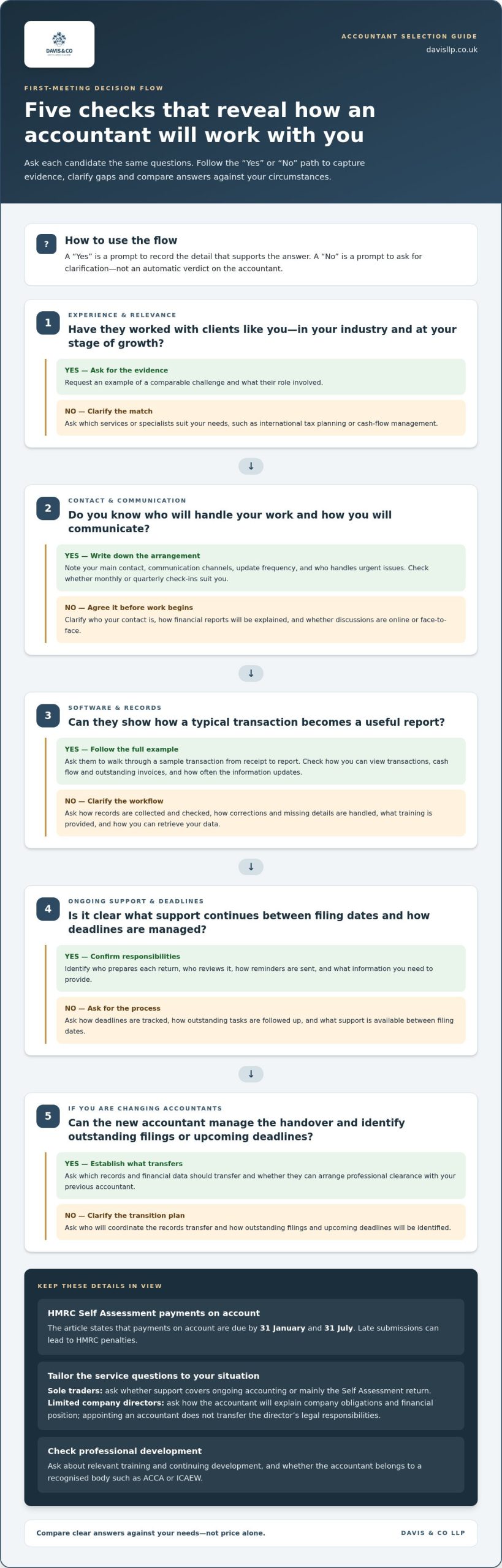
3. What 10 questions should I ask an accountant?
Use your first meeting to see how the accountant turns tax developments into practical advice. Ask: “How do you monitor tax law changes?” and “How could a change affect my tax position or business decisions?” Follow with: “What action would you recommend, and when?” Ask for an example that relates to your circumstances, such as overseas income or a property transaction. These questions to ask a new accountant help distinguish tailored guidance from a general summary.
Clarify the ongoing service: “What support do you provide between filing dates?” and “Can we arrange monthly reporting or check-ins?” Ask how they track deadlines, required filings and documents, and whether reminders come through email, accounting software or meetings. Find out who prepares each return and who reviews it. Ask how they’ll explain a tax change that affects your records, so you know what to do differently.
Ask directly: “How will you help me meet HMRC deadlines and avoid penalties?” A useful answer should explain how deadlines are tracked, what information you must provide, and how outstanding tasks are followed up. Late submissions can lead to HMRC penalties. HMRC states that Self Assessment payments on account are due by 31 January and 31 July.
If you are changing accountants, ask: “Can you manage the handover from my current accountant?” and “Which records and financial data should transfer?” A new accountant can arrange professional clearance and the transfer of records with the previous accountant. Ask how they will identify outstanding filings or upcoming deadlines during the transition. In the UK, a business owner can change accountants at any time; a new engagement letter sets out the terms and fees.
Before deciding, ask how the accountant handles complex issues and explains recommendations. A useful final question is: “What information do you need from me to prepare my next return?” The answer should give you a practical starting point, such as a list of documents to provide and how to submit them. Compare the responses with your priorities, including tax planning, reporting and the level of contact you expect.
4. Client references and reputation
Ask for examples or testimonials that show how the accountant has supported clients with needs similar to yours. A useful example should explain the challenge, the accountant’s role and the work completed. If cash flow is a concern, ask how management accounts or cash-flow advice could help you understand your position. This gives you a practical basis for assessing their approach.
References from current clients can help you understand the working relationship. Ask whether you can speak with a client whose needs are comparable to yours. Prepare focused questions: Does the accountant explain reports clearly? Are updates proactive? Do they follow through on agreed actions? You can also ask how the firm supports clients facing a complex financial decision or incomplete records.
Listen for specifics in each answer. A reference who describes regular cash-flow reviews gives you a clearer picture than broad praise alone. Ask how often the accountant communicates, whether the client knows who to contact and how routine enquiries are handled. Compare those answers with the communication approach discussed in your own meeting.
Consider reputation alongside service scope and fees. Ask references whether the work matched their expectations, what services were included and how additional work was explained or charged. A testimonial offers context, but it cannot tell you whether the same arrangement suits your needs. Use references to identify practical strengths, then ask the accountant how they would support your priorities.
If you’re ready to discuss the accounting support your circumstances call for, arrange a conversation about your needs.
Davis & Co LLP: International Tax Planning
Davis & Co provides International Tax Planning for individuals and businesses with cross-border tax considerations. If your circumstances involve income, assets or business activity in more than one country, specialist planning can help you understand the tax implications and make informed decisions. Bring a clear outline of your situation and the questions you want addressed, such as how overseas income affects your wider tax position.
For business owners planning growth or managing financial pressures, Davis & Co provides Business Growth Acceleration and Cash Flow Management. Personal Tax Services can support individuals with their tax affairs. The right support depends on the decisions you need to make and the details of your circumstances.
Contact Davis & Co LLP to discuss your accounting needs.
Choose an adviser for the decisions ahead
The right accountant should fit your current obligations and the decisions you expect to face next. Before committing, identify your priorities, such as planning across borders, supporting business growth or managing cash flow. The questions to ask a new accountant can help you establish whether their expertise and approach align with those needs.
Davis & Co LLP provides International Tax Planning, Business Growth Acceleration and Cash Flow Management. These services may be relevant when your tax position spans countries, your business is preparing to grow, or you need clearer insight into cash movement. A focused discussion about your circumstances can help define the accounting support that fits your needs.
Take the next step at a pace that feels appropriate. Contact Davis & Co LLP to discuss your accounting needs and begin a considered conversation about your priorities.
Frequently Asked Questions
Given the current tax regulations, what should my tax objectives be?
Set priorities around accurate reporting, meeting your obligations and making informed decisions within the rules. Your needs may differ depending on whether you are self-employed, a company director, a property owner or have overseas income. For example, someone with foreign income may need to understand how it affects their UK tax position. Ask the accountant to explain the relevant considerations and options in plain terms.
What should I ask a new accountant about their qualifications and experience in the UK?
Ask which professional body they belong to, what qualifications they hold and whether their membership remains current. You can also ask how they keep their knowledge up to date and which UK tax or accounting matters they handle regularly. For example, a landlord may want experience with property accounting, while a director may need advice suited to company finances.
What accounting services does a new accountant provide, and what is included in their fee?
Ask for a written breakdown of the work covered, such as bookkeeping, tax return preparation or regular financial reporting. Clarify whether advice during the year is included or treated separately, and how the accountant handles work outside the agreed scope. For example, a one-off request may be billed differently from recurring work. The engagement terms should make responsibilities and fees clear.
How will an accountant communicate with me and how quickly do they respond?
Agree on a communication plan that distinguishes routine updates from urgent matters. Ask which channels the accountant uses, who will receive your messages and how decisions or agreed actions will be recorded. For example, you might prefer email for document requests and a scheduled call to discuss a financial decision. Clear expectations help keep the work moving.
Which accounting software does the accountant use, and can they work with my current software?
Tell the accountant which accounting software you use and ask how they will work with your records and reports. If you use separate systems for sales or expenses, discuss how the information will be brought together. Ask what happens to historic records if a change is needed and how you can access the information used to prepare accounts and tax filings.