The UK Self Assessment is often viewed as a mere administrative burden, yet for the discerning taxpayer, it serves as a critical annual audit of financial efficiency. While the 31 January deadline typically triggers a sense of urgency, the most successful individuals treat their self assessment tax return uk as a strategic opportunity rather than a compliance hurdle. We understand that the complexity of reporting diverse income streams, coupled with the fear of HMRC penalties, can make the process feel overwhelming. This is particularly true as we approach the significant 6 April 2026 rollout of Making Tax Digital for those with incomes exceeding £50,000.
Our guide provides the expert insights required to master these complexities, ensuring you remain fully compliant with 2026 regulations while identifying legitimate allowances to reduce your tax liability. We’ll explore the latest thresholds, detail the transition to quarterly reporting, and provide a roadmap for meticulous record-keeping. By the end of this article, you’ll have a clear strategy to secure total peace of mind and professional confidence in your financial standing. We’ll help you transform a time-consuming obligation into a streamlined process that protects your personal and professional interests.
Key Takeaways
- Identify the specific 2026 filing cohorts to determine if your self-employed profits or high-earner status necessitate a self assessment tax return uk.
- Prepare for the mandatory transition to Making Tax Digital for Income Tax, shifting from annual reporting to a structured quarterly digital update system.
- Learn strategic methods to mitigate the Personal Allowance Taper and use pension contributions to effectively manage your adjusted net income.
- Understand the nuances of reporting complex income streams, including international assets, property portfolios, and specialized professional fees such as those in dental practices.
- Assess the risk-mitigation benefits of professional oversight, which reduces the likelihood of HMRC inquiries and addresses the opportunity costs of DIY filing.
Understanding the UK Self Assessment Framework in 2026
The UK tax return system serves as the primary mechanism for HMRC to collect Income Tax on earnings not captured by the PAYE (Pay As You Earn) framework. For most, this involves submitting a self assessment tax return uk to declare income from self-employment, dividends, or property. As we move into 2026, the landscape is shifting toward a digital-first model. This transition requires a more proactive approach to compliance, moving away from retrospective annual reporting toward real-time digital record-keeping. The 2025/26 tax year cycle culminates in the critical 31 January 2027 deadline for online submissions. Missing this date isn’t just an administrative lapse; it’s a financial risk that can disrupt your long-term capital strategy.
Who Must File a Return in 2026?
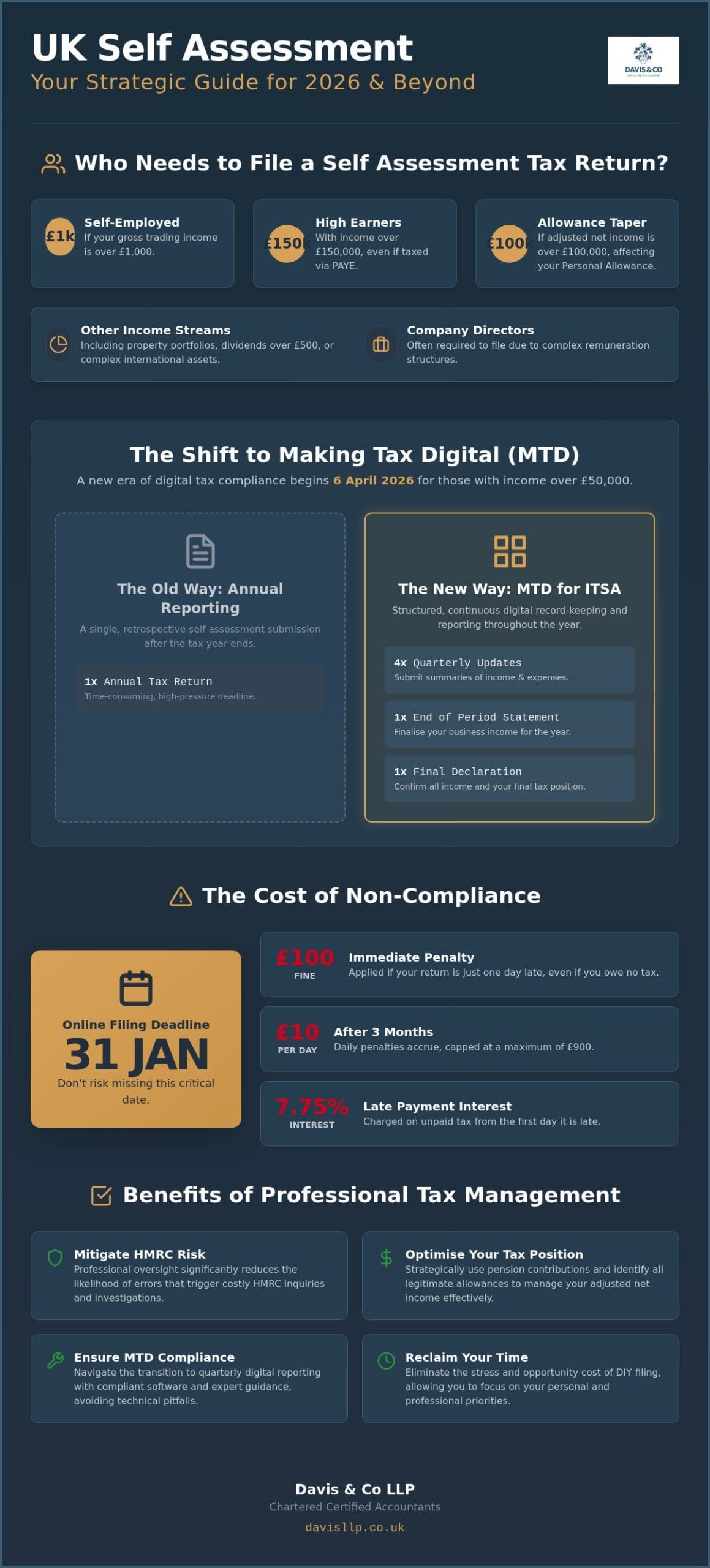
Determining your obligation to file depends on both the source and scale of your income. Self-employed individuals must register if their gross trading income exceeds the £1,000 trading allowance. However, the requirements extend far beyond the self-employed. For the 2026/27 cycle, directors and high earners with an income exceeding £150,000 are typically required to submit a self assessment tax return uk, even if all tax appears to have been paid through PAYE. This is often due to the tapering of the Personal Allowance, which reduces by £1 for every £2 earned over the £100,000 threshold. Those managing significant dividend income above the £500 allowance or complex international portfolios should seek expert tax advice in the UK to ensure all cross-border liabilities are correctly disclosed.
The Consequences of Non-Compliance
HMRC maintains a strict penalty regime to encourage timely submissions. An immediate £100 fine applies if your return is even one day late, regardless of whether you owe tax. If the delay extends to three months, daily penalties of £10 accrue, capped at a maximum of £900. Beyond the flat-rate fines, the financial impact of late payment is significant. Interest on unpaid liabilities is currently charged at 7.75% as of January 2026, calculated from the first day of arrears. We’ve found that early filing is the most effective way to eliminate “January stress.” It allows for precise cash flow forecasting, giving you months to arrange payment rather than reacting to a surprise bill at the eleventh hour.
Strategic Record Keeping and Making Tax Digital (MTD)
The transition from retrospective annual filing to real-time digital compliance represents the most significant evolution of the self assessment tax return uk system in decades. This shift moves the focus away from a year-end “shoebox” of receipts toward a structured, continuous digital record. Starting 6 April 2026, taxpayers with qualifying income over £50,000 must adopt Making Tax Digital for Income Tax Self Assessment (MTD ITSA). This requirement isn’t merely about software; it’s about maintaining a disciplined, real-time view of your financial standing. Robust digital records serve as your primary defence against HMRC enquiries, providing a clear, chronological audit trail that demonstrates professional rigour.
The 2026 Digital Transition
The 2026 MTD milestones affect a broad cohort of self-employed individuals and landlords. If your total business or property income exceeds £50,000, you’ll need to submit digital quarterly updates, with the first deadline falling on 7 August 2026. Engaging a small business accountant who implements cloud-based software can automate bank feeds, ensuring transactions are categorised as they occur. This automation simplifies the year-end reconciliation process, as most of the heavy lifting is completed throughout the months rather than in a frantic January rush. It also allows us to provide more accurate cash flow forecasting, helping you set aside the correct tax provisions well in advance.
Essential Documentation for a Robust Return
Precision in your documentation remains the foundation of a successful self assessment tax return uk. You must aggregate various certificates of income, including P60s for employment, P11Ds for benefits in kind, and dividend vouchers from limited company interests. Categorising these correctly is vital to avoid overpayment. When tracking expenses, the “wholly and exclusively” rule is the cornerstone of UK business expense claims, mandating that any deduction must be incurred solely for the purposes of your trade. Distinguishing between personal and business costs requires a meticulous approach to avoid HMRC scrutiny. While the official Self Assessment guidance provides the basic rules, the application of these rules to complex professional lives often requires a more nuanced perspective. We find that clients who integrate professional bookkeeping services into their routine gain a significant advantage, as their management accounts offer a reliable, real-time reflection of their actual tax liabilities.
Navigating Complex Income: International, Property, and Professional Fees
For individuals with multifaceted financial portfolios, the tax return represents a convergence of multiple, often conflicting, regulatory requirements. We view the self assessment tax return uk not as a static filing, but as a dynamic component of international tax planning. Managing these complexities requires a holistic understanding of how diverse income streams interact within the UK tax framework. Whether you are managing a dental practice or overseeing a global investment portfolio, your return must reflect a cohesive financial narrative that withstands rigorous scrutiny. Our approach ensures that every nuance of your income is captured with the precision required for high-net-worth compliance.
Cross-Border Interests and Foreign Income
Cross-border financial interests necessitate a precise navigation of the Statutory Residence Test (SRT). This test is the primary determinant of your liability for UK tax on worldwide income, including overseas rental properties and foreign investment dividends. Failing to correctly apply these rules can lead to significant double taxation risks. While the official government guidance on Self Assessment provides a foundational overview, the practical application of Foreign Tax Credit Relief often requires bespoke tax advice uk. We ensure that taxes paid in foreign jurisdictions are correctly credited against your UK liability. This meticulous reconciliation protects your global capital from being taxed twice, providing the security and discretion essential for international professionals and expatriates.
Specialist Considerations for Dental Professionals and Landlords
Certain sectors demand a highly specialized accounting approach to ensure both compliance and efficiency. For dental professionals, the distinction between Associate and Principal status fundamentally alters how income is reported and which expenses are deductible. Associates must carefully manage their self-employed status, while Principals face additional complexities regarding practice overheads and VAT. Similarly, landlords must navigate the restricted relief on finance costs, commonly known as Section 24. This regulation prevents the full deduction of mortgage interest from rental income, which can inadvertently push property owners into higher tax bands. When disposing of residential assets, the Capital Gains Tax (CGT) must be reported and paid within 60 days of completion. These details are then integrated into your self assessment tax return uk to provide a final, accurate summary of your annual liabilities. This layered reporting ensures your total tax position remains robust, defensible, and strategically aligned with your long-term wealth goals.
Optimising Your Tax Position: Allowances and Deductions
While the mechanics of filing ensure you meet your legal obligations, strategic optimisation ensures you do not overpay. The self assessment tax return uk is more than a reporting tool; it’s a yearly opportunity to recalibrate your tax exposure against your broader financial goals. Many high earners find themselves caught in tax traps created by frozen thresholds and fiscal drag. We focus on identifying these inefficiencies early, allowing for proactive adjustments that protect your capital and enhance your long-term wealth. Precision in applying allowances is the hallmark of a well-managed financial life.
Reducing Your Taxable Income Legally
One of the most significant challenges for high earners is the Personal Allowance Taper. For individuals earning over £100,000, the standard £12,570 allowance reduces by £1 for every £2 earned above this threshold. This creates an effective marginal tax rate of 60% on income between £100,000 and £125,140. Strategic pension contributions into a SIPP or workplace scheme can restore this allowance by reducing your “Adjusted Net Income” back below the £100,000 mark. Pension contributions can effectively lower your tax bracket by shifting income out of higher or additional rate bands. Similarly, Gift Aid donations extend your basic rate tax band, allowing more of your income to be taxed at 20% rather than 40% or 45%. We help you document these contributions to ensure you receive the full higher-rate relief you’re entitled to.
Capital Allowances and Business Expenses
Identifying often-overlooked professional expenses is vital for maintaining a robust self assessment tax return uk. For specialists, such as dental professionals, mandatory costs like General Dental Council (GDC) fees and professional indemnity insurance are fully deductible. If you operate from a home office, you must choose between simplified flat-rate allowances or the actual cost method. While the flat rate is convenient, the actual cost method often yields higher relief for those with significant utility and maintenance overheads. For those investing in technology or equipment, the Annual Investment Allowance (AIA) provides 100% tax relief on qualifying plant and machinery up to £1 million. Accelerating these claims can significantly reduce your taxable profit in the year of purchase, providing an immediate boost to your cash flow. To ensure every allowance is fully leveraged for your specific circumstances, we invite you to explore our bespoke Personal Tax Services for a comprehensive review of your position.
Why Professional Tax Management Outperforms DIY Filing
The decision to manage your own self assessment tax return uk often stems from a desire for control. However, the true cost of a DIY approach isn’t found in a software fee but in the “Opportunity Cost” of missed allowances and inefficient tax structures. While HMRC’s portal is a functional tool for entry, it lacks the analytical depth to alert you to tax-saving opportunities or potential compliance risks. We provide a sophisticated layer of protection, acting as a strategic buffer between you and the revenue authorities. Our oversight ensures that your filing isn’t just a submission, but a robust financial statement that reflects professional rigour.
Risk mitigation is a primary pillar of our service. HMRC’s automated systems are designed to identify “red flags,” such as inconsistent expense claims or unaligned income streams across different years. By engaging Davis & Co LLP, you benefit from a meticulous pre-submission audit. We identify and resolve these anomalies before they trigger an enquiry. This proactive stance transforms the tax season from a period of uncertainty into a controlled, predictable component of your annual financial cycle. A long-term partnership with a Chartered Certified Accountant offers the stability required to navigate an increasingly volatile regulatory environment.
Discretion, Accuracy, and Peace of Mind
There is a distinct assurance that comes with having “Chartered Certified” expertise behind every figure on your return. This accreditation signifies a commitment to the highest standards of technical accuracy and ethical conduct. Our involvement prepares you for complex scenarios, such as those detailed in our hmrc tax warning guide, where changes to savings interest and compliance thresholds can catch the unwary off guard. We don’t view tax as a once-a-year transactional event. Instead, we provide year-round advice that allows you to make informed decisions in real-time, ensuring your self assessment tax return uk is always part of a larger, coherent wealth management strategy.
Transitioning to a Managed Tax Service
Moving from a DIY model to a managed service is a seamless process. By appointing us as your authorised agent, we deal directly with HMRC on your behalf, handling all correspondence and technical queries. This allows you to focus on your professional and personal pursuits while we manage the complexities of compliance. For those with cross-border interests, we integrate your return into a broader international tax planning strategy, ensuring your global assets are managed with the utmost discretion and efficiency. We invite you to contact Davis & Co LLP for a tailored personal tax consultation to discuss how we can secure your financial position for 2026 and beyond.
Mastering Your 2026 Financial Compliance
The transition to a digital-first compliance model in 2026 requires a proactive shift in how you manage your annual obligations. We’ve highlighted the importance of preparing for MTD and using strategic allowances, such as pension contributions, to protect your personal allowance from tapering. Successfully filing your self assessment tax return uk is ultimately a matter of precision; it’s about ensuring every international interest or professional expense is documented with total accuracy. This disciplined approach is what separates mere compliance from true financial optimisation.
Relying on a partnership-led approach provides the discretion and reliability needed to manage sensitive financial matters securely. As Chartered Certified Accountants since 1901, we offer specialist dental and international tax expertise with national UK coverage and a strategic focus. We invite you to secure your financial future with expert personal tax services from Davis & Co LLP. Taking these steps today ensures you remain well-advised and prepared for any future HMRC scrutiny. You don’t have to manage these complexities alone when a strategic partnership is within reach.
Frequently Asked Questions
What is the deadline for filing a Self Assessment tax return in 2026?
The deadline for submitting your online 2025/26 self assessment tax return uk is 31 January 2027. If you prefer to file a paper return, the cut-off is 31 October 2026. It’s essential to meet these dates to avoid the immediate £100 late-filing penalty. We recommend completing the process well in advance to ensure your tax liability is calculated accurately and to provide sufficient time for financial planning before the payment deadline.
Do I need to file a tax return if I am a high earner on PAYE?
You are generally required to file if your total taxable income exceeds £150,000 for the 2025/26 tax year, even if all tax is paid via PAYE. HMRC uses this process to reconcile your total liability, particularly regarding the tapering of the Personal Allowance for those earning over £100,000. Additionally, you must file if you have untaxed income from property, investments, or foreign assets that exceeds the relevant allowances.
Can I claim back tax on my pension contributions through Self Assessment?
Yes, higher and additional rate taxpayers must use Self Assessment to claim the extra 20% or 25% tax relief they’re entitled to on pension contributions. While basic rate relief is usually applied automatically at source, the remaining relief is reclaimed by declaring your gross contributions on your return. This adjustment either reduces your total tax bill or results in a refund, making it a vital component of efficient tax planning.
What happens if I make a mistake on my submitted tax return?
If you discover an error after submission, you typically have 12 months from the original filing deadline to amend your return. You can make these changes through the HMRC online portal or by writing to them for older returns. We advise making a voluntary disclosure as soon as a mistake is identified. This proactive approach demonstrates transparency and can help mitigate potential penalties that might otherwise arise from an HMRC discovery.
How does Making Tax Digital (MTD) affect my 2026 tax return?
Making Tax Digital for Income Tax begins on 6 April 2026 for self-employed individuals and landlords with qualifying income over £50,000. This shift replaces the single annual self assessment tax return uk with quarterly digital updates and a final end-of-period statement. You’ll need to use MTD-compatible software to maintain your records digitally. This transition aims to provide a more real-time view of tax obligations, reducing the likelihood of year-end surprises.
Is interest from a joint savings account included in my Self Assessment?
Interest earned from a joint savings account is usually split 50/50 between the account holders and must be reported on your return. Each individual is taxed on their respective share according to their own Personal Savings Allowance. If you earn interest above your allowance, it must be disclosed. It’s important to keep accurate records of these statements to ensure the split is correctly reflected and to avoid discrepancies in your reporting.
How much does a professional accountant charge for a Self Assessment return?
Professional fees for managing a tax return vary significantly based on the complexity of your financial affairs and the level of strategic advice required. Factors such as international assets, property portfolios, or specialized professional status influence the time required for a thorough reconciliation. We focus on providing a high-calibre service that prioritises accuracy and risk mitigation. While fees represent an investment, they often result in long-term savings by ensuring all legitimate allowances are correctly applied.
What is a UTR number and where can I find mine?
A Unique Taxpayer Reference (UTR) is a 10-digit number issued by HMRC when you register for Self Assessment. You can find this number on your previous tax returns, statements of account, or any official correspondence from HMRC, such as a “Notice to file a tax return.” It’s a permanent identifier that remains with you throughout your life. If you can’t locate it, you can find it via your Personal Tax Account online or the HMRC app.