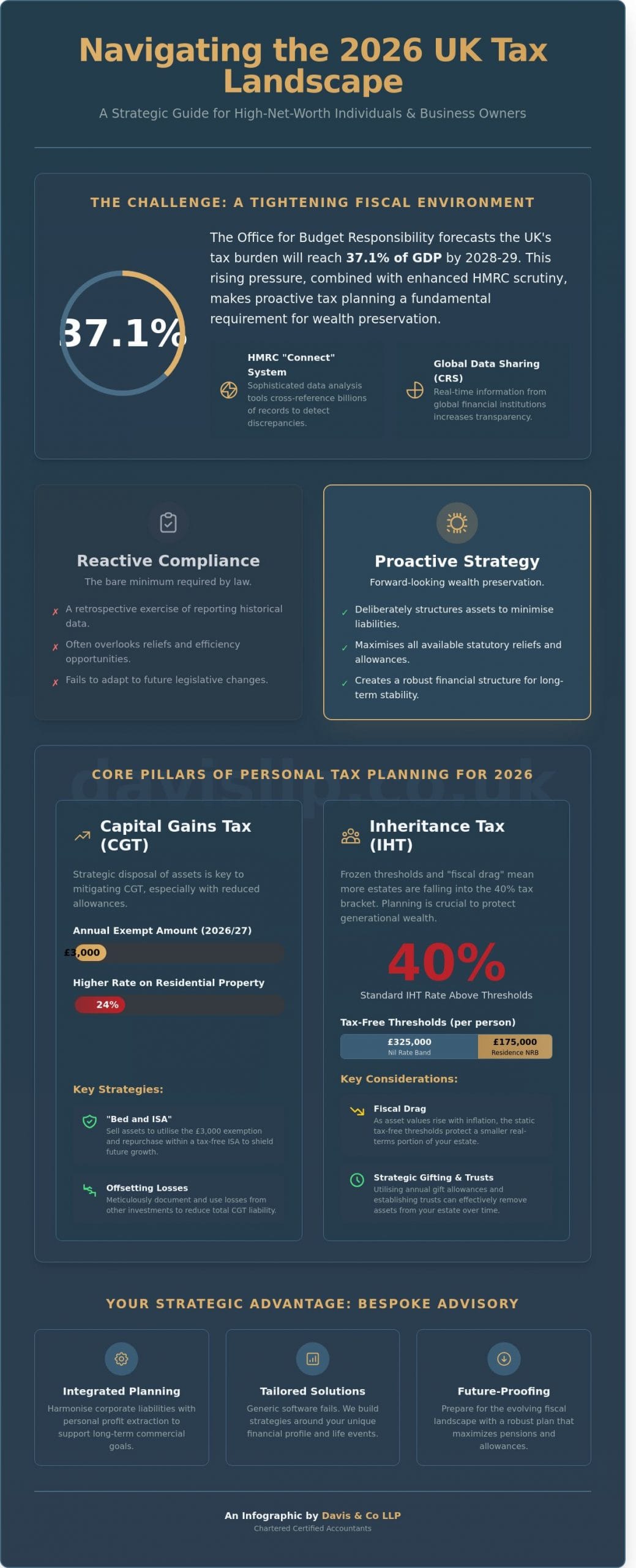
Could your current financial structure withstand a tax burden that the Office for Budget Responsibility forecasts will reach 37.1% of GDP by the 2028-29 period? As we approach 2026, many high-net-worth individuals find that traditional methods of managing wealth are no longer sufficient against a backdrop of tightening UK legislation. You likely recognise that the friction between your personal and business tax structures is costing more than just time; it’s eroding the capital you’ve worked to build. Engaging professional tax planning services isn’t merely a matter of compliance. It’s a fundamental requirement for those who value long-term stability and discretion.
We understand the quiet anxiety that accompanies shifting statutory requirements and the persistent risk of an HMRC enquiry. This article demonstrates how a bespoke, integrated strategy can protect your assets and optimise your financial position within the 2026 regulatory framework. We’ll examine the specific reliefs available to you and outline a methodical path toward wealth preservation that resolves technical complexity with professional precision.
Key Takeaways
- Distinguish between reactive compliance and forward-looking strategies to ensure your financial affairs are organised for maximum efficiency.
- Learn how to structure personal assets to mitigate the impact of Capital Gains and Inheritance Tax, safeguarding wealth for future generations.
- Discover how bespoke tax planning services can harmonise corporate liabilities with personal profit extraction to support long-term commercial objectives.
- Prepare for the 2026 fiscal environment by understanding the latest thresholds and the strategic importance of maximising pension contributions.
- Understand why a composed, expert partnership is essential for navigating the complexities of the UK’s evolving regulatory landscape with confidence.
Understanding Tax Planning: Beyond Compliance to Strategic Advantage
Tax planning is the legitimate organisation of financial affairs to maximise reliefs and minimise liabilities. It’s a proactive discipline. While tax compliance is a retrospective exercise in reporting historical data, professional tax planning services offer the foresight needed to shape future outcomes. We focus on the deliberate positioning of assets and income streams before taxable events occur. This distinction is critical for those seeking to protect their capital in a tightening fiscal environment where reactive measures often fall short.
By 2026, the landscape has shifted significantly. HMRC now employs more sophisticated data-sharing tools, including the expanded Connect system and real-time information from financial institutions via the OECD Common Reporting Standard. This increased transparency means that traditional methods are no longer sufficient. Our firm provides a sense of quiet excellence. We offer the security and discretion required to manage complex financial matters without drawing unnecessary attention. Our role is to act as a steady partner, ensuring your affairs remain both efficient and compliant in an era of total digital visibility.
The Distinction Between Avoidance and Efficient Planning
Navigating the legal and ethical boundaries of UK tax requires precision. Understanding Tax Planning involves a clear grasp of the difference between illegal evasion and legitimate efficiency. We utilise statutory reliefs in a way that respects the spirit of the law. Our professional gravitas ensures that every plan is robust. We don’t rely on aggressive schemes that invite scrutiny, focusing instead on established legal frameworks to protect your interests and reputation while securing your long-term wealth.
Why One-Size-Fits-All Solutions Fail
Standardised software cannot replace bespoke professional advice. Generic tools often overlook the unique variables of a client’s life, such as a planned business exit or complex family succession needs. These events require a deep understanding of both commercial and private client sectors. We provide tax planning services that are specifically tailored to your individual objectives. A partner who understands the practical realities of your business is essential for success, ensuring your strategy is as unique as your financial profile and capable of withstanding future legislative changes.
The Core Pillars of Effective Tax Planning for Individuals
The 2026 tax environment demands a proactive stance. UK residents face a complex web of Income Tax, Capital Gains Tax (CGT), and Inheritance Tax (IHT). Each requires a specific strategy to ensure your capital continues to serve your family’s long-term interests. Professional tax planning services provide the framework for this protection. We focus on the precise structuring of assets to ensure your money works harder for future generations.
Timing is a critical factor. Recognising income in a specific tax year or delaying a disposal by just a few days can result in significant savings. While the specifics of UK legislation are paramount, the principles of Navigating the 2026 Tax Landscape often mirror global best practices, especially regarding the benefit of year-round preparation rather than year-end rushing. Effective planning is not a seasonal event; it’s a continuous process of adjustment and refinement.
Mitigating Capital Gains Tax (CGT) Liabilities
The 2026/27 tax year sees the annual exempt amount for CGT held at £3,000. This makes the use of “bed and ISA” strategies more relevant than ever. By selling assets to use the exemption and immediately repurchasing them within an ISA, you shield future growth from tax. For property owners, the nuances of Private Residence Relief are vital. Since the higher rate for residential property disposals sits at 24%, offsetting losses from other investments is a pragmatic way to lower the total liability. We assist clients in documenting these losses meticulously to ensure they’re available for future use.
Inheritance Tax (IHT) and Estate Organisation
The standard IHT threshold remains at £325,000. For many, the Residence Nil Rate Band provides an additional £175,000 of protection. However, these figures have been static for some time, dragging more estates into the 40% tax bracket through fiscal drag. Gifting rules remain a powerful tool for reduction. Potentially Exempt Transfers (PETs) allow for unlimited gifts, provided you survive the seven-year window. For clients who require more control, bespoke trust structures provide a sophisticated method for wealth preservation. These vehicles allow you to protect assets from external risks while ensuring they’re managed according to your specific wishes. At Davis LLP, we provide the bespoke advisory needed to navigate these complexities with discretion.
Integrated Tax Planning for Business Owners and Professionals
Effective wealth management for entrepreneurs requires a seamless alignment between corporate obligations and personal financial goals. Our approach to tax planning services focuses on the delicate calibration of profit extraction. Since the Corporation Tax rate reached 25% for companies with profits exceeding £250,000, the traditional preference for dividends over salary has become a more nuanced calculation. Business owners must now weigh the 33.75% higher rate on dividends against the benefit of employer pension contributions, which remain a highly effective method for reducing a company’s taxable profit while securing the owner’s future.
The transition from a sole trader to a limited company structure remains a pivotal moment for growing enterprises. This shift typically becomes commercially viable when annual profits consistently surpass the £40,000 mark, allowing for greater control over the timing of tax liabilities. By retaining profits within the business or utilising Core Pillars of Effective Tax Planning, directors can often manage their personal tax brackets with higher precision. We often hear the objection that the complexity of an integrated plan isn’t worth the administrative effort. However, for a business generating £150,000 in annual profit, a lack of coordination between corporate and personal filings can result in overpayments exceeding £10,000 per year.
Specialist Guidance for Dental Professionals
Dental practices face unique financial pressures, from high capital expenditure on digital imaging tech to complex staffing structures. We assist principals in utilising Full Expensing, which allows for a 100% first-year tax deduction on qualifying plant and machinery investments. Precision is equally vital when managing the employment status of associates. Ensuring that contracts and working practices clearly distinguish between self-employed associates and employees is essential to mitigate risks related to HMRC’s IR35 assessments and National Insurance contributions. Our budget 2025 analysis outlines how the structural changes to employer National Insurance contributions specifically affect dental practice principals and their staffing cost projections.
International Tax Planning and Cross-Border Interests
For clients with global interests, 2026 represents a period of significant transition. The UK’s shift away from the traditional non-domicile regime towards a residence-based system requires a complete reassessment of how offshore income is structured. We help clients navigate double taxation treaties to ensure they aren’t taxed twice on the same capital. Whether you’re managing a family office with European property or an expat returning to the UK, our tax planning services provide the statutory clarity needed to protect international assets from unnecessary exposure.
Navigating the 2026 Tax Landscape: Allowances and Timelines
The 2026/27 tax year presents a landscape defined by static thresholds and evolving allowances. We observe that the personal allowance remains frozen at £12,570, while the higher rate threshold stays at £50,270. These figures, unchanged since 2021, continue to subject more income to the 40% and 45% tax bands. Effective tax planning services are no longer optional; they’re a necessity for wealth preservation in a climate of persistent fiscal drag.
Pensions remain a cornerstone of tax efficiency. With the annual allowance set at £60,000, high earners must carefully manage their contributions to avoid the tapered annual allowance. This can reduce relief to as little as £10,000 for those with an adjusted income over £260,000. While the Lifetime Allowance was abolished on 6 April 2024, the new Lump Sum Allowance (LSA) of £268,275 requires precise monitoring. We ensure our clients don’t inadvertently trigger charges upon retirement by exceeding these revised limits.
Diversification extends beyond asset classes into tax wrappers. Individual Savings Accounts (ISAs) retain their £20,000 annual limit, providing a vital shield against Capital Gains Tax (CGT) and dividend tax. For sophisticated investors, Venture Capital Trusts (VCTs) and the Enterprise Investment Scheme (EIS) offer 30% upfront income tax relief. These vehicles are essential for balancing a portfolio against the current 20% CGT rate on residential property and 24% for higher-rate taxpayers. Understanding the full strategic tax implications of the budget 2025 announcements is critical for ensuring these investment decisions remain optimally structured in the year ahead.
- 31 January 2026: Deadline for online self-assessment tax returns and balancing payments.
- 5 April 2026: The final day of the 2025/26 tax year and the deadline for utilising annual allowances.
- 6 April 2026: Commencement of the new tax year and the reset of all statutory allowances.
- 31 July 2026: Second payment on account deadline for the self-employed and landlords.
The 2026 Tax Year-End Checklist
Before the 5 April deadline, we recommend a rigorous review of your financial position. Ensure you’ve utilised the £500 dividend allowance and the £3,000 CGT annual exempt amount. For business owners, reconciling director loan accounts is vital to avoid Section 455 tax charges. We also ensure that claims for R&D tax credits under the merged scheme and capital allowances, such as Full Expensing, are submitted before the statutory windows close. It’s often the small, overlooked reliefs that yield the most significant cumulative savings.
Preparing for Future Legislative Shifts
Fiscal drag is a silent drain on capital. We combat this by producing monthly management accounts to identify tax-saving opportunities in real-time. Flexibility is the priority. Our approach ensures your structures can adapt to sudden Budget announcements or shifts in corporation tax, which remains at 25% for profits over £250,000. Proactive planning prevents the inertia that leads to overpayment. We focus on building resilience into your commercial and private structures. For business owners, this resilience must also account for rising labour costs; understanding the minimum wage 2025 thresholds and their impact on your 2025/26 payroll forecasts is an essential component of any forward-looking financial plan.
Secure your financial future by partnering with our experts for a bespoke tax planning strategy tailored to the 2026 landscape.
Bespoke Advisory: Why Davis & Co LLP is Your Strategic Partner
Davis & Co LLP brings a sense of quiet excellence to every engagement, a trait refined over our 125-year history. We don’t believe in aggressive hyperbole or the loud marketing tactics often found in the financial sector. Our approach is one of understated confidence; we provide a composed partnership that ensures you feel secure and well-advised. This reliability is vital when managing sensitive commercial and personal tax matters. We act as a steady hand for our clients, offering the intellectual rigour required to manage wealth in a volatile economic climate. Our reputation isn’t built on self-promotion, but on the consistent delivery of results for the families and businesses we’ve represented since 1901.
A Tailored Approach to Professional Services
Our firm combines the technical precision of Chartered Certified Accountants with a deep understanding of commercial reality. By choosing a single firm to manage your audit, assurance, and tax planning services, you gain a cohesive overview of your financial position. This integrated model eliminates the friction often caused by using multiple advisors who may not communicate effectively. We focus on building long-term relationships based on reliability and discretion. Our commitment to your success involves several core pillars:
- Integrated Oversight: We align your statutory audit requirements with proactive tax strategies to ensure no opportunities are missed.
- Commercial Pragmatism: Our advice isn’t just technically sound; it’s designed to support your actual business operations and growth targets.
- Long-term Continuity: We prioritise stability, ensuring you have a consistent point of contact who understands your history and your future goals.
We don’t offer off-the-shelf solutions. Every recommendation we make is filtered through the lens of your specific commercial or private interests, ensuring that your tax position remains robust against the regulatory changes anticipated in 2026.
How to Begin Your Tax Planning Journey
The process begins with a detailed initial consultation to identify your specific strategic goals. We look beyond the immediate tax year to consider the long-term impact of shifting UK regulations. Following this meeting, our team produces a bespoke tax report. This document isn’t a generic summary; it’s a precise implementation plan tailored to your unique circumstances, whether that involves corporate restructuring or estate preservation. We provide clear, actionable steps rather than vague suggestions.
You can contact our London or Harpenden teams to arrange a confidential discussion. We don’t rush the process; we take the time necessary to ensure every detail is considered before any action is taken. This measured rhythm is why Davis & Co LLP remains a trusted advisor for those who value sophistication and results over empty promises. Securing your financial legacy requires a partner who understands that tax planning services are a matter of precision, not just compliance. We invite you to experience a partnership defined by professional gravitas and a commitment to your long-term prosperity.
Securing Your Financial Legacy for 2026 and Beyond
The shifting fiscal landscape of 2026 demands a transition from simple compliance to a sophisticated, strategic outlook. Effective wealth preservation relies on understanding how evolving allowances and timelines impact your specific circumstances. By integrating personal and professional financial goals, you create a robust shield against volatility while ensuring your assets are managed with precision. This proactive approach is essential for maintaining stability in an increasingly complex regulatory environment. It’s no longer enough to look back at the previous year; success requires looking a decade ahead.
Since 1901, Davis & Co LLP has acted as a dependable constant for those seeking clarity in their financial affairs. As Chartered Certified Accountants with specialist dental and international expertise, we offer a composed partnership focused on long-term prosperity. Our tax planning services are designed to provide the intellectual rigour and bespoke guidance necessary to protect your interests. It’s about more than just numbers; it’s about the peace of mind that comes from professional discretion and a history of success. We invite you to enquire about our bespoke tax planning services to discuss how we can support your commercial and private objectives. Your financial future deserves the quiet excellence of a partner who understands the weight of your legacy.
Frequently Asked Questions
What is the difference between tax planning and tax compliance?
Tax compliance focuses on meeting your statutory obligations by filing accurate returns on time, whereas tax planning involves a proactive strategy to minimise future liabilities. While compliance looks backward at what you’ve already earned, our tax planning services look ahead to structure your affairs efficiently. HMRC reported a £39.8 billion tax gap for the 2022/23 period. Much of this gap arises from avoidable errors that a robust, forward-looking strategy prevents.
How often should I review my personal tax plan?
You should review your personal tax plan at least once a year or whenever a significant life event occurs. Legislative changes, such as the adjustments to Capital Gains Tax thresholds in the 2024 Autumn Budget, can render previous strategies obsolete. We recommend a formal review every 12 months to ensure your wealth preservation remains aligned with current UK statutes. This consistency helps you adapt to shifting economic conditions without haste.
Can tax planning services help me if I have assets abroad?
Yes, strategic planning is essential for managing international assets and navigating the complexities of double taxation. The UK maintains over 100 double taxation treaties to ensure you aren’t taxed twice on the same income. We help you utilise these agreements effectively while ensuring full disclosure through HMRC’s Worldwide Disclosure Facility. Our bespoke approach ensures your global portfolio remains compliant and tax-efficient across multiple jurisdictions.
Is inheritance tax planning only for the very wealthy?
Inheritance tax planning is necessary for anyone whose estate exceeds the £325,000 nil-rate band. Because the government has frozen this threshold until 2028, rising property values mean 4% of deaths now result in an inheritance tax charge. We help families use the residence nil-rate band, which provides an additional £175,000 allowance. Early action ensures you pass more of your legacy to your beneficiaries rather than the Exchequer.
How do tax planning services benefit a small business owner?
Small business owners benefit by optimising profit extraction and managing the 25% Corporation Tax rate effectively. Our tax planning services identify the most efficient balance between salary, dividends, and pension contributions. We also explore Business Relief, which can provide 50% or 100% tax relief on certain business assets. This pragmatic approach ensures your commercial objectives aren’t hindered by unnecessary fiscal leakage.
What are the most common tax reliefs that people miss?
The Marriage Allowance and Research and Development (R&D) tax credits are frequently overlooked by eligible taxpayers. HMRC data suggests that roughly 2.1 million couples fail to claim the Marriage Allowance, which can reduce their tax bill by £252 per year. Similarly, many small companies don’t realise they qualify for R&D relief on technical problem-solving. We meticulously audit your finances to ensure every statutory relief is utilised to your advantage.
Can a dental tax specialist really save my practice money?
A specialist understands the unique nuances of NHS pension schemes and the specific capital allowances available for clinical equipment. For instance, the Annual Investment Allowance allows practices to deduct up to £1 million of qualifying expenditure from their taxable profits. We analyse your UDA contracts and private income splits to create a tailored financial structure. This industry-specific expertise often uncovers savings that generalist accountants might overlook.
What should I bring to my first tax planning consultation?
You should bring your most recent three years of tax returns, your latest P60 or P45, and a comprehensive list of your global assets. If you own a business, provide your latest sets of accounts and any existing shareholder agreements. This data allows us to form a clear picture of your current standing. We use this information to begin the logical progression toward a bespoke wealth preservation strategy.