Most people assume that staying compliant with HMRC is simply a matter of filing on time and paying what’s owed. That assumption, for anyone with property interests, international income, or a complex employment structure, can prove costly. Seeking quality tax advice UK professionals actually trust means far more than ticking a box once a year; it means building a strategy that works continuously in your favour.
If that resonates, you’re not alone. The anxiety of not knowing whether you’ve missed an allowance, misclassified income, or overlooked a cross-border obligation is something many individuals and business owners carry quietly. The rules change, thresholds shift, and generic guidance rarely accounts for the specifics of your situation.
This guide is designed to change that. Drawing on the kind of expertise that has informed sound financial decisions since 1901, we’ll walk you through the current UK tax landscape for 2026, covering personal allowances, property considerations, international obligations, and the principles of long-term wealth preservation. By the end, you’ll have a clear framework, not just information, for making confident, well-informed decisions about your tax position.
Key Takeaways
- The 2026 UK tax environment places greater emphasis on digital compliance and transparency, making proactive planning more important than reactive filing.
- Quality tax advice UK professionals rely upon goes beyond annual returns — it aligns your personal, property, and business interests into a coherent, long-term strategy.
- Cross-border income and property holdings introduce layered obligations that standard HMRC guidance is not designed to resolve; specialist advice is essential.
- Knowing when to move beyond HMRC’s published guidance and engage a professional advisor can be the difference between a compliant position and an optimised one.
- A firm with deep experience across personal tax, international planning, and property accounting can serve as a single, trusted point of expertise for even the most complex financial structures.
Understanding the UK Tax Landscape in 2026
Tax advice in the UK encompasses far more than the annual ritual of completing a Self Assessment return. At its core, it is the professional guidance that helps individuals and businesses meet their statutory obligations while structuring their financial affairs in the most efficient way possible. The distinction between compliance and strategy is significant: one keeps you out of trouble, the other actively works in your favour.
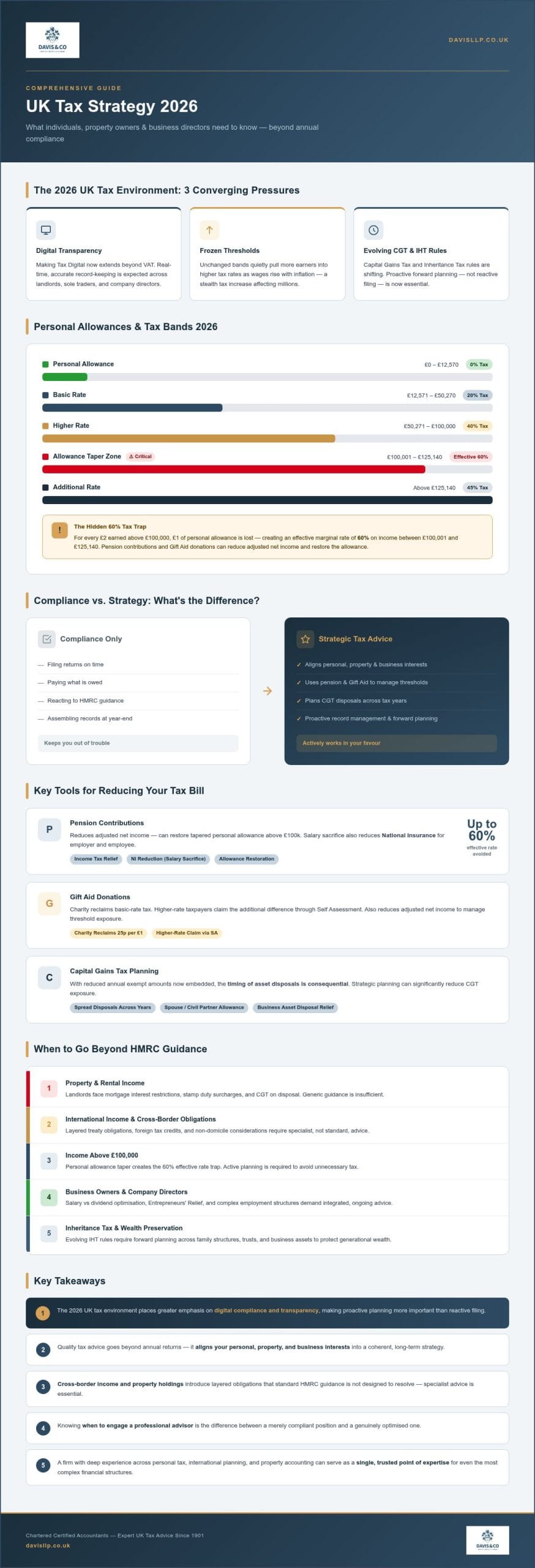
The 2026 tax environment is defined by three converging pressures: a continued drive toward digital transparency, frozen thresholds that are quietly pulling more earners into higher tax bands, and an evolving set of rules around Capital Gains Tax and Inheritance Tax that demand careful forward planning. Income Tax remains the most immediate concern for most individuals, but the interaction between these three pillars is where genuine complexity, and genuine opportunity, tends to reside.
The Role of HMRC and Digital Compliance
Making Tax Digital has fundamentally altered the relationship between taxpayers and HMRC. What began as a requirement for VAT-registered businesses has progressively extended its reach, and the expectation of real-time, accurate record-keeping now applies across a much broader population. For landlords, sole traders, and company directors alike, the days of assembling records once a year are effectively over.
The practical implication is that a “set and forget” approach to tax planning carries measurable risk. Errors that might once have been corrected quietly at year-end can now surface in real time, attracting scrutiny that a well-maintained digital record would have prevented. Proactive record management isn’t administrative housekeeping; it’s a core component of sound tax advice UK professionals now consider non-negotiable.
Personal Allowances and Thresholds for the Current Year
The standard personal allowance remains £12,570, but its real-world value has been eroded by sustained threshold freezes. As earnings rise with inflation, more individuals find themselves crossing into the 40% higher-rate band, which begins at £50,270, without any meaningful change to their purchasing power. For those earning above £100,000, the personal allowance tapers by £1 for every £2 of income above that threshold, creating an effective marginal rate of 60% on income between £100,000 and £125,140.
Navigating these thresholds intelligently is where statutory reliefs become genuinely valuable. Pension contributions, Gift Aid donations, and certain business expenses can each reduce adjusted net income, potentially restoring some or all of a tapered allowance. The key is knowing which reliefs apply to your specific income structure, something that generic published guidance is rarely equipped to address with the precision your situation requires.
Strategic Personal Tax Services and Wealth Preservation
Effective tax planning is not simply a response to each year’s filing deadline; it’s the foundation upon which long-term financial security is built. A well-constructed personal tax strategy considers not just your current income position, but the trajectory of your wealth, your family’s future needs, and the business interests that may sit alongside your personal affairs. These elements rarely operate in isolation, and the most valuable tax advice UK professionals provide is the kind that treats them as a coherent whole.
Two reliefs that consistently reward deliberate planning are pension contributions and charitable giving. Both reduce your adjusted net income, which carries direct implications for threshold management, but their value extends beyond that. Pension contributions made through salary sacrifice arrangements can also reduce National Insurance liabilities for both employer and employee. Gift Aid donations, meanwhile, allow the charity to reclaim basic-rate tax while higher-rate taxpayers claim the difference through Self Assessment. Used together within a structured annual plan, these tools can meaningfully alter your effective tax rate without requiring any artificial or aggressive arrangements.
Capital Gains Tax deserves particular attention in the current environment. With reduced annual exempt amounts now firmly embedded in the landscape, the timing of asset disposals has become genuinely consequential. Spreading disposals across tax years, making full use of a spouse or civil partner’s allowance, and identifying qualifying reliefs such as Business Asset Disposal Relief where applicable are all strategies that can reduce the tax cost of realising value from investments or business interests. The difference between an unplanned disposal and a timed one can be substantial.
Inheritance Tax and Succession Planning
Inheritance Tax planning is where the interaction between personal, family, and trust structures becomes most complex. The seven-year rule governing potentially exempt transfers remains central to any gifting strategy, but it’s rarely sufficient on its own. The annual gifting exemption, small gift allowances, and gifts from surplus income each play a role, and understanding how they interact requires careful record-keeping from the outset. Trusts offer a further dimension, providing a mechanism to manage the timing and control of wealth transfers while potentially reducing the taxable estate. For families with significant or diversified assets, a trust structure can be the difference between an orderly succession and a costly one. Our UK Personal Tax and Inheritance Planning guidance explores these structures in greater depth for those managing complex estate considerations.
Optimising Income for Business Owners and Professionals
For company directors and self-employed professionals, the split between salary and dividends remains one of the most consequential annual decisions. The optimal balance shifts as thresholds change and dividend tax rates evolve, which is why this calculation warrants fresh scrutiny each year rather than a standing instruction. Dental professionals face a particular version of this complexity, given the mixed income structures common across NHS and private practice arrangements, and the specific considerations around practice ownership and incorporation. Management accounts, reviewed regularly rather than retrospectively, provide the real-time financial data needed to make these adjustments at the right moment rather than after the fact.
Specialized Advice for International and Property Interests
For individuals whose financial lives extend beyond UK borders, or whose wealth is substantially tied to property, the standard self-assessment framework offers limited guidance. The complexity isn’t incidental; it’s structural. Cross-border income streams, foreign asset holdings, and layered property portfolios each introduce obligations that interact with one another in ways that generic tax advice UK resources simply aren’t designed to address.
International Tax Planning and Compliance
The UK maintains double taxation treaties with over 130 countries, yet knowing a treaty exists is very different from knowing how to apply it correctly to your specific income profile. A UK resident receiving rental income from a property in France, dividends from a US brokerage account, or employment income from a company headquartered in Singapore faces a distinct set of reporting obligations under both domestic law and the relevant treaty. Getting this wrong doesn’t just create an administrative problem; it can result in dual taxation that a properly structured arrangement would have prevented entirely.
For non-domiciled residents, the regulatory environment has shifted considerably. The remittance basis of taxation, which once provided meaningful shelter for foreign income and gains kept offshore, has been subject to sustained legislative pressure. Individuals who previously relied on these provisions need to reassess their position carefully, as the rules governing what constitutes a taxable remittance are interpreted broadly by HMRC. Transparency is equally non-negotiable: the Common Reporting Standard means that foreign financial institutions routinely share account information with HMRC, and undisclosed offshore income carries serious consequences.
UK expats face a parallel set of challenges. Statutory residence test determinations are fact-specific and unforgiving; a miscalculation about the number of days spent in the UK can alter an individual’s tax residency status for an entire year. Family offices managing multi-jurisdictional assets require a coordinated approach that aligns reporting obligations across each relevant territory, something that demands specialist expertise rather than a piecemeal response.
Tax Efficiency for Property Investors
The buy-to-let landscape has been reshaped significantly by the restriction of mortgage interest relief to the basic rate of Income Tax. For higher and additional rate taxpayers who hold property in their own name, this change has materially altered the profitability of leveraged portfolios. Many landlords have responded by considering incorporation, and in the right circumstances a limited company structure can restore a more favourable tax position. However, the decision to incorporate isn’t straightforward: it typically triggers a disposal for Capital Gains Tax purposes, and the Stamp Duty Land Tax implications of transferring existing properties into a company require careful modelling before any action is taken.
SDLT itself warrants close attention. The higher rates applicable to additional residential properties, the interaction with mixed-use property classifications, and the availability of multiple dwellings relief each represent areas where the difference between a considered approach and an uninformed one can run to tens of thousands of pounds. Our Property Accounting services are structured to address precisely these considerations, providing landlords and investors with the kind of bespoke analysis that turns a complex legislative environment into a manageable one.
When to Seek Professional Tax Advice vs. HMRC Guidance
HMRC’s published guidance is comprehensive, accurate, and entirely free. It is also, by design, neutral. HMRC can tell you what the rules are; it cannot tell you how to structure your affairs to pay less tax within them. That distinction is not a criticism of HMRC; it’s simply a reflection of its statutory role. The moment your financial situation moves beyond a single employer and a straightforward savings account, the gap between what HMRC provides and what you actually need begins to widen.
Identifying Complexity in Your Financial Affairs
Certain signals suggest that self-assessment tools and HMRC guidance have reached their practical limits. If any of the following apply, professional engagement is worth serious consideration:
- You receive income from multiple sources, including employment, self-employment, rental income, or dividends
- You hold assets in more than one jurisdiction or have recently changed your residency status
- You’re a company director making annual decisions about salary and dividend splits
- You’ve made or are planning a significant disposal of property or business assets
- Your estate is approaching or exceeding Inheritance Tax thresholds
- You operate in a sector with specific tax considerations, such as dental practice ownership
Working with a Chartered Certified Accountant brings a depth of oversight that extends well beyond annual filing. For dental professionals in particular, the interaction between NHS contract income, private earnings, and practice ownership structures creates a genuinely distinct tax position that generalist tools aren’t equipped to handle. High-net-worth individuals face a comparable challenge: the more diversified the asset base, the greater the risk that a piecemeal approach leaves legitimate reliefs unclaimed.
Proactive Planning vs. Reactive Compliance
The cost of professional tax advice uk practices recommend is frequently recovered through reliefs and efficiencies that a well-informed advisor identifies in the ordinary course of a year-round relationship. Filing a return correctly is the floor, not the ceiling. A standing advisory relationship means that threshold changes, new relief provisions, and shifts in your personal circumstances are addressed as they arise, not retrospectively in January when the options have narrowed.
There’s also a less quantifiable benefit: the peace of mind that comes from knowing your affairs have been reviewed for both accuracy and opportunity. During an HMRC enquiry or compliance check, having a professional advisor who knows your financial history in detail is a meaningful form of protection. They can respond with precision, provide the necessary documentation, and ensure the process doesn’t become more disruptive than it needs to be.
Beyond compliance, a structured advisory relationship supports better business decisions. Cash flow management, growth planning, and remuneration strategy all benefit from real-time financial insight rather than retrospective reporting. Tax advice, at its most useful, becomes a tool for building the business rather than simply accounting for it.
If your financial affairs have grown beyond the reach of standard guidance, speak with our team about a tailored tax planning review that covers your full position, not just the return.
Partnering with Davis & Co LLP for Your Tax Strategy
Since 1901, Davis & Co LLP has operated on a straightforward principle: that the best tax advice UK clients can receive is advice that treats their financial circumstances as genuinely unique. Over more than a century of practice, the firm has evolved alongside the legislative landscape, adding international tax planning, trust structures, and specialist dental accounting to a service offering that now spans the full spectrum of personal and business financial management. What hasn’t changed is the underlying commitment to independent, partner-led advice that places the client’s long-term interests at the centre of every decision.
Our Approach to Client-Centric Tax Advisory
Effective advisory relationships are built on understanding, not just expertise. When we work with a client, the first priority is developing a clear picture of their financial life in full: the income sources, the asset base, the family considerations, and the business interests that may sit alongside personal affairs. That understanding shapes everything that follows. It means that when thresholds shift or legislation changes, we’re already positioned to respond on your behalf rather than waiting for you to notice the impact.
As an independent partnership, we’re not constrained by institutional targets or product-led incentives. Our advice is shaped entirely by what’s appropriate for your position. Discretion is central to how we operate; clients managing complex or sensitive financial structures need a firm they can trust to handle their affairs with the same care they would apply themselves. That combination of independence and discretion has defined our client relationships for generations.
Our services cover every dimension of this work:
- Personal tax and international tax planning
- Trust tax services and inheritance structuring
- Property accounting and VAT compliance
- Audit and assurance, company secretarial, and payroll services
- Management accounts, bookkeeping, and cash flow management
- Specialist advice for dental professionals across NHS and private practice structures
Next Steps: Securing Your Professional Consultation
Timing matters in tax planning. Early engagement gives us the room to model scenarios properly, identify reliefs before they become inaccessible, and structure your affairs ahead of significant events rather than after them. For inheritance planning and international obligations in particular, the window for effective action is often narrower than people expect.
If the complexity of your financial position has outgrown standard guidance, the right next step is a structured conversation with an advisor who can assess your full picture. Contact us today to discuss your bespoke tax requirements and take the first step toward a strategy that works continuously in your favour.
Your Next Step Toward a Tax Position That Works for You
The 2026 UK tax landscape rewards those who plan ahead and penalises those who don’t. Frozen thresholds, tightened Capital Gains Tax allowances, and expanding digital reporting obligations mean that reactive compliance is no longer enough. The difference between a well-structured tax position and an unnecessarily costly one often comes down to the quality of advice you receive and when you receive it.
Good tax advice UK professionals trust isn’t simply about accuracy; it’s about identifying the opportunities that generic guidance consistently overlooks. Whether your complexity lies in international income, property portfolios, or the specific demands of dental practice ownership, a bespoke approach consistently outperforms a standard one.
Davis and Co LLP has been providing partner-led, Chartered Certified Accountant expertise since 1901, with specialist depth across international tax planning, trust structures, and property accounting. National coverage, genuine independence, and over a century of client-focused practice sit behind every engagement.
If your financial affairs deserve more than a one-size-fits-all approach, request a professional tax consultation with Davis and Co LLP and take confident control of your position.
Frequently Asked Questions About Tax Advice in the UK
What is the difference between a tax return and tax planning?
A tax return is a statutory obligation: it records what happened in the previous year and calculates what you owe. Tax planning is the proactive process of structuring your affairs before transactions occur so that you pay the correct amount of tax, nothing more. One is retrospective; the other is forward-looking. Filing accurately keeps you compliant; planning strategically keeps you efficient.
The distinction matters because the window for action closes once a transaction completes. A well-timed disposal, a pension contribution made before year-end, or a restructured remuneration arrangement all require decisions in advance. Reactive compliance simply doesn’t create those opportunities.
Can a UK tax advisor help with assets I own in other countries?
Yes, and specialist tax advice UK residents with overseas assets genuinely need extends well beyond what HMRC’s published guidance covers. A qualified advisor can determine how the relevant double taxation treaty applies to your specific income profile, whether foreign rental income, dividends, or capital gains need to be reported in the UK, and how to avoid dual taxation through correctly claimed reliefs.
The Common Reporting Standard means foreign financial institutions routinely share account data with HMRC, so undisclosed overseas assets carry real risk. Early, structured advice is considerably less costly than a retrospective disclosure or compliance investigation.
Why should a dental professional use a specialist accountant for tax advice?
Dental professionals face a genuinely distinct tax position that generalist accountants aren’t always equipped to navigate. The combination of NHS contract income, private earnings, and the complexities of practice ownership creates a mixed income structure where the optimal salary and dividend split, VAT treatment, and incorporation decisions each require sector-specific knowledge to get right.
The implications of getting it wrong compound over time. A specialist who understands dental practice accounting can identify reliefs and structures appropriate to that income profile, rather than applying a standard template that doesn’t reflect the reality of how dental businesses actually operate.
What are the current rules for gifting money to avoid Inheritance Tax in 2026?
The seven-year rule remains the foundation of any gifting strategy: outright gifts to individuals become fully exempt from Inheritance Tax if the donor survives seven years from the date of the gift. Each individual also benefits from an annual exemption of £3,000, which can be carried forward one year if unused, plus a small gifts allowance of £250 per recipient to any number of people.
Gifts made from surplus income, rather than capital, can also qualify for a separate exemption provided they’re regular and don’t reduce the donor’s standard of living. Documenting these gifts carefully from the outset is essential; HMRC interprets these provisions strictly, and incomplete records can undermine an otherwise valid claim.
How does the 2026 VAT threshold impact my small business tax plan?
Crossing the VAT registration threshold changes your business’s cost structure and administrative obligations materially. If your customers are VAT-registered businesses themselves, charging VAT is broadly neutral for them; if they’re end consumers, it effectively increases your prices unless you absorb the cost. That distinction should shape how you approach the threshold, not just whether you’ve crossed it.
Some business owners deliberately manage their turnover to stay below the threshold, but this requires care: artificially suppressing income to avoid registration carries its own risks. A VAT compliance review with a qualified advisor can clarify whether voluntary registration might actually benefit your position, particularly if you’re incurring significant input VAT on purchases.
What should I do if I receive a tax warning or investigation notice from HMRC?
Don’t respond without taking professional advice first. HMRC enquiries range from routine checks on a single return entry to full investigations into several years of accounts, and the appropriate response differs significantly depending on the scope and nature of the notice. Engaging an advisor before you reply ensures your response is accurate, appropriately scoped, and doesn’t inadvertently widen the enquiry.
An advisor who knows your financial history in detail is a meaningful asset in this situation. They can provide the necessary documentation, communicate with HMRC on your behalf, and ensure the process is resolved as efficiently as possible. Trying to manage an enquiry without professional support rarely saves time or money.
Is it possible to reduce the amount of Capital Gains Tax I pay on a property sale?
Several legitimate strategies can reduce a Capital Gains Tax liability on a property disposal, but they require planning before the sale completes. Making full use of both spouses’ or civil partners’ annual exempt amounts by transferring a share of the asset prior to sale, timing the disposal across two tax years where possible, and identifying any allowable costs that can be deducted from the gain are all worth examining.
In specific circumstances, reliefs such as Private Residence Relief for a former main home, or Business Asset Disposal Relief where qualifying conditions are met, can substantially reduce the liability. The key point is that these options narrow or disappear once contracts are exchanged, which is why early engagement with a property accounting specialist is consistently more valuable than retrospective advice.
How often should I review my personal tax strategy with an advisor?
At minimum, once a year before the tax year ends in April, when there’s still time to act on the findings. In practice, the most effective advisory relationships involve more frequent contact: when your income changes materially, when you’re considering a significant asset disposal, or when personal circumstances shift in ways that affect your tax position, such as marriage, inheritance, or a change in residency.
The value of regular reviews compounds over time. Threshold changes, new relief provisions, and shifts in your financial profile are addressed as they arise rather than discovered retrospectively. For those with complex or multi-jurisdictional affairs, a standing relationship with a qualified advisor isn’t a luxury; it’s a practical necessity for maintaining an efficient and compliant position.