Is your tax code a precise reflection of your financial reality, or is it a silent drain on your annual liquidity? For many professionals, the alphanumeric string issued by HMRC is often accepted without question, yet it remains one of the most common sources of unnecessary overpayment. Relying on automated systems to manage your personal tax position can lead to significant frustration, especially when those systems fail to account for the nuances of multiple income streams or complex benefit structures.
We understand that the intricacies of the UK tax system often feel designed to obscure rather than clarify. This is why understanding your tax code uk is essential for maintaining a robust financial strategy in the 2026/27 tax year. In this guide, we’ll provide a comprehensive breakdown of how to interpret your specific code and identify the errors that frequently lead to unexpected penalties. We’ll also outline a clear path to ensuring your £12,570 personal allowance is fully optimised, giving you total confidence that your tax affairs are handled with the precision they deserve.
Key Takeaways
- Translate the alphanumeric characters of your HMRC notice into precise monetary figures to determine your exact tax-free allowance for the year.
- Identify how adjustments for Benefits in Kind or the High Income Child Benefit Charge can lead to inaccuracies that result in unexpected tax liabilities.
- Master a systematic verification process for understanding your tax code uk, ensuring that PAYE deductions remain consistent with your total annual income.
- Explore why high earners and individuals with international interests often require bespoke code oversight to manage complex residency or domicile statuses.
- Learn to reconcile your P11D forms and employer benefit statements against HMRC’s automated records to secure your personal tax position for the 2026/27 cycle.
The Fundamentals: What is a UK Tax Code?
At its core, a tax code is a specific instruction issued by HMRC to your employer or pension provider. It dictates exactly how much Income Tax should be deducted from your pay or pension before it reaches your bank account. This mechanism is the engine of the UK PAYE tax code system, which is designed to collect tax at the source of income rather than requiring a manual settlement at the end of the year. For most professionals, this automated process remains invisible until a discrepancy arises, making a proactive approach to understanding your tax code uk essential for financial stability.
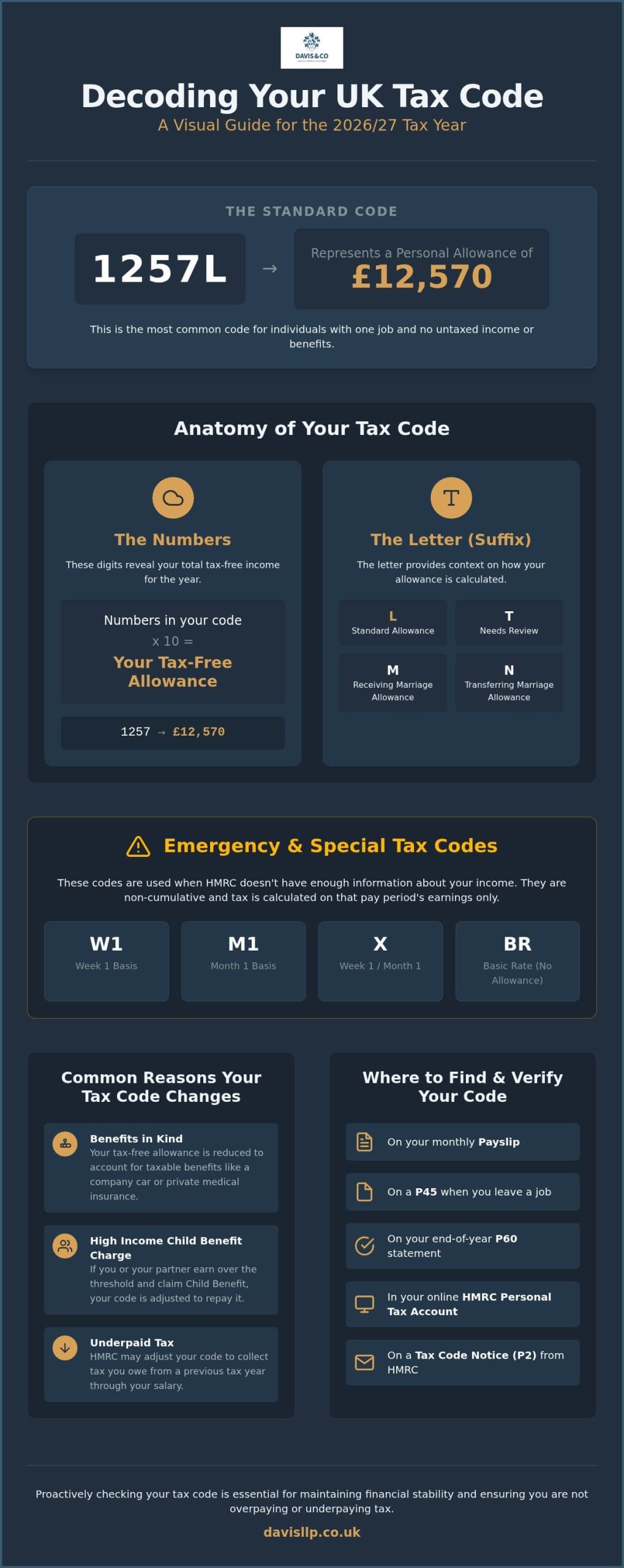
For the 2026/27 tax year, the standard code for an individual with a single source of income and no complex benefits is 1257L. This code isn’t arbitrary; it represents your entitlement to the full standard Personal Allowance. However, relying on the assumption that HMRC’s automated systems have assigned you the correct code is a significant risk. Even a minor clerical error or a failure to update your records after a change in circumstances can lead to significant cumulative underpayments. These errors often result in unexpected tax bills that can disrupt your cash flow, or conversely, overpayments that unnecessarily restrict your monthly liquidity.
We’ve observed that many taxpayers view these codes as static labels. In reality, they’re dynamic indicators of your current tax position. When your income structure evolves, perhaps through a salary increase, a new company benefit, or a change in professional status, your code must shift to reflect that reality. Maintaining a clear line of sight on these changes ensures you aren’t left vulnerable to the administrative lag that often plagues large-scale automated systems.
The Role of the Personal Allowance
The Personal Allowance is the foundational tax-free layer of UK income. For the 2026/27 year, this threshold is set at £12,570, meaning you can earn up to this amount before any Income Tax is applied. The numeric part of your code, such as 1257, relates directly to this allowance; HMRC simply removes the final digit to create the prefix. If your code is lower than 1257, it typically indicates that your tax-free threshold has been reduced to account for taxable benefits, such as a company car or medical insurance, or to recover tax owed from a previous period.
Where to Locate Your Current Tax Code
Identifying your code is a straightforward process, yet it’s a step many overlook until a problem occurs. You’ll find it prominently displayed on your monthly payslip, your P45 when leaving a job, or your annual P60 statement. For those seeking real-time updates, the HMRC Personal Tax Account offers a digital portal to view current and upcoming codes. You should never ignore a ‘Tax Code Notice’ (P2) sent via post or digital notification. This document is HMRC’s formal explanation of why your code has changed, and verifying its accuracy immediately is the best way to prevent long-term payroll errors.
Decoding the Characters: What the Numbers and Letters Actually Mean
A tax code is essentially a shorthand summary of your financial profile. To begin understanding your tax code uk, you must first interpret the numeric prefix. This number indicates your tax-free allowance for the year; by multiplying it by ten, you reveal the precise amount of income you can receive before tax is applied. For example, the standard 1257 prefix represents the £12,570 Personal Allowance frozen for the 2026/27 tax year. While this appears simple, the letters that follow provide the specific context HMRC uses to adjust your deductions.
The ‘L’ suffix is the most frequent marker, signifying that you are entitled to the standard Personal Allowance. However, if your affairs are more complex, you might see a ‘T’ suffix. This indicates that HMRC needs to review your information annually, often because of complex income structures or high-value benefits. If you’ve opted into the Marriage Allowance, the letters ‘M’ (receiving the transfer) or ‘N’ (transferring the allowance) will appear. You can find a full list of these identifiers through the official UK government source for tax codes, which serves as a baseline for verification.
Special and Emergency Tax Codes
If you see ‘W1’, ‘M1’, or ‘X’ on your payslip, you’ve been placed on an emergency code. These are non-cumulative, meaning your tax is calculated solely on that pay period’s earnings rather than your total yearly income. This often happens when you start a new role without a P45. A ‘BR’ code applies the basic rate of 20% to your entire income from that source, which is common for second jobs. More critical is the ‘0T’ code; this suggests your Personal Allowance has been fully exhausted, perhaps because your income exceeds £125,140, or your employer lacks the necessary data to apply any allowance at all.
High-Income and Complex Suffixes
For individuals with significant benefits, the ‘K’ prefix is a vital indicator. It signifies a “negative” allowance, occurring when your taxable benefits, such as a high-value company car or medical insurance, exceed your £12,570 threshold. In these cases, the excess is added to your taxable income. High earners may also see ‘D0’ or ‘D1’ codes, which instruct payroll to collect tax at the higher rate of 40% or the additional rate of 45% on every pound of that specific income stream. For those with international residency nuances, an ‘NT’ (No Tax) code may be applied. Our personal tax services provide the necessary oversight to ensure these automated labels reflect your true liability rather than an HMRC estimation.
Common Triggers: Why HMRC Might Change Your Tax Code in 2026
HMRC’s primary objective with the PAYE system is to collect the correct amount of tax in real-time. However, your financial life is rarely static. When your circumstances shift, HMRC issues a new code to reflect these changes. Understanding your tax code uk requires recognizing these triggers before they impact your net take-home pay. One of the most frequent catalysts for a code change is the provision of ‘Benefits in Kind’. If your employer provides private medical insurance or a company car, the value of these perks is deducted from your Personal Allowance. This reduces your numeric code, ensuring the tax due on these benefits is spread across your monthly salary payments.
The High Income Child Benefit Charge also plays a significant role in code volatility. If you or your partner receive Child Benefit and your individual income exceeds the statutory threshold, HMRC may adjust your tax code to recoup the charge directly through your payroll. While this prevents a large, unexpected bill at the end of the tax year, it requires careful monitoring to ensure the deduction is accurate. Similarly, those with multiple income streams often find their allowance split. HMRC typically allocates the full £12,570 allowance to your main source of income, while secondary roles are taxed at the basic or higher rate without an allowance. For a detailed breakdown of these identifiers, you can refer to the government’s explanation of What your tax code means.
International residency and domicile status add another layer of complexity to the 2026/27 tax year. If you’re an expat or have dual-residency status, your tax code might be adjusted to account for double taxation treaties or specific relief claims. These adjustments are rarely handled accurately by automated systems, making professional verification a necessity for those with global financial interests. Understanding your tax code uk in this context is less about following a standard template and more about ensuring your specific residency nuances are legally reflected.
Professional and Industry-Specific Adjustments
Many professionals are entitled to specific tax reliefs that can be integrated directly into their codes. If you pay for professional subscriptions, indemnity insurance, or specialized uniforms, these costs can be used to increase your tax-free threshold. From a dental tax specialist perspective, it’s common to see GDC fees and high-value indemnity premiums omitted from automated codes. Ensuring these are included can provide a modest but consistent boost to your monthly cash flow. For deeper insights into managing these professional nuances, you may find our guide on Expert Tax Advice in the UK particularly useful.
Investment and Property Income
HMRC often employs a process known as ‘coding out’ to collect tax on untaxed income, such as rental profits or savings interest. By lowering your tax code, they effectively tax this additional income at source. It’s vital to remember that HMRC often ‘guesses’ your future investment income based on past data. If your investment landscape changes, failing to update HMRC can lead to the ‘double taxation’ of income that is also being declared via Self Assessment. This friction between PAYE and Self Assessment is a frequent source of overpayment for property investors and high-net-worth individuals.
The Verification Process: How to Ensure Your Tax Code is Correct
Ensuring your tax code aligns with your financial reality requires more than a cursory glance at a monthly payslip. We advocate for a structured reconciliation process that moves beyond HMRC’s automated assumptions. Understanding your tax code uk involves comparing the static characters on your notice against your actual expected annual income. This proactive verification is the only way to safeguard against the administrative lag that often follows a change in salary or professional benefits.
- Step 1: Collate Benefit Documentation. Gather all P11D forms and benefit statements provided by your employer. These documents list the cash value of perks like company cars or health insurance, which must be subtracted from your personal allowance to arrive at your correct numeric prefix.
- Step 2: Monitor the Personal Allowance Taper. If your income exceeds £100,000, your £12,570 allowance is reduced by £1 for every £2 earned above this threshold. HMRC often fails to adjust this in real-time, leading to substantial underpayments if your income fluctuates throughout the year.
- Step 3: Identify Duplicate Codes. When you transition between roles or begin drawing multiple pensions, HMRC may inadvertently apply a full personal allowance to more than one source. This creates a “duplicate” code scenario that inevitably results in a significant tax debt once the error is identified.
If your financial structure has outgrown simple automated codes, the Davis & Co LLP approach provides the high-level oversight needed to maintain compliance and protect your monthly cash flow. Our personal tax services are designed to manage these complexities on your behalf, ensuring your payroll deductions remain precise.
Correcting an Incorrect Code with HMRC
For minor updates, such as notifying HMRC of a small change in untaxed interest, the ‘Check your Income Tax’ online service is usually sufficient. However, when addressing complex errors involving multiple income streams or international tax treaties, we recommend formal written correspondence. This creates a definitive paper trail that is invaluable if a dispute arises. Once an update is processed, it typically takes one to two payroll cycles for the revised code to reflect in your take-home pay.
Reclaiming Overpaid Tax
If you’ve spent months on an incorrect code, you may be due a P800 tax calculation. This document outlines whether you’ve overpaid or underpaid tax for the previous year. You can reclaim overpaid tax for up to four years back, but the burden of proof rests with the taxpayer. For broader context on maintaining compliance across all your assets, see our HMRC Tax Warning 2026. Acting swiftly ensures that capital which should be in your accounts isn’t sitting needlessly with the Revenue.
Strategic Tax Management: When a Standard Code Isn’t Enough
For individuals with sophisticated financial profiles, a standard tax code is rarely sufficient to manage the complexities of their total liability. When your income exceeds £125,140, the statutory withdrawal of your Personal Allowance results in the application of an ‘0T’ code. This isn’t merely an administrative label; it’s a signal that every pound of your earnings is subject to taxation at the relevant bands without the foundational £12,570 buffer. Understanding your tax code uk in this high-earning bracket is vital for cash flow management, as it prevents the accumulation of significant underpayments that often trigger a substantial balancing payment during the Self Assessment cycle.
We’ve found that many clients view their PAYE deductions and Self Assessment obligations as two distinct silos. In reality, they’re deeply interconnected. A poorly managed tax code often leads to the ‘January Surprise’—a large, unexpected tax bill that arises because the monthly deductions failed to account for the true scale of your annual income. By integrating your code into a broader tax strategy, we ensure that your monthly contributions are precisely calibrated, providing a level of financial predictability that automated systems simply cannot offer.
International and Cross-Border Considerations
Managing the tax affairs of expats or individuals with dual-residency status requires a nuanced approach to coding. If you have interests outside the UK, your code must reflect the application of relevant Double Taxation Agreements to prevent your income from being taxed twice. Failing to ensure these treaties are correctly applied to your coding notice can lead to unnecessary capital being tied up in HMRC’s systems. For those managing global assets, our expertise in International Tax Planning provides the strategic oversight needed to align your UK coding with your international obligations.
The Value of Professional Oversight
The role of a Chartered Accountant extends beyond mere compliance; we act as a definitive buffer between you and the often-inflexible automated systems used by HMRC. By shifting from a reactive ‘checking’ mindset to a proactive ‘tax optimisation’ model, we identify opportunities to refine your code that software might overlook. This includes the precise application of professional expenses, the management of trust-related income, and the reconciliation of complex benefit structures. If you’re seeking total clarity on your personal tax position, contact Davis & Co LLP for a comprehensive personal tax review. Understanding your tax code uk is the first step toward a more disciplined and efficient financial future, ensuring your personal allowance is used with the utmost precision.
Securing Your Personal Tax Position for 2026 and Beyond
Managing your tax affairs with precision is not just about compliance; it’s about protecting your annual liquidity. We’ve explored how the alphanumeric string issued by HMRC acts as a dynamic instruction for your payroll, and why understanding your tax code uk is the cornerstone of a healthy financial strategy. Whether you’re navigating the complexities of the £100,000 allowance taper or reconciling Benefits in Kind, the objective remains the same: ensuring your £12,570 personal allowance is used with absolute efficiency.
As Chartered Certified Accountants since 1901, we provide the specialist expertise required to manage these nuances, particularly for those with international interests or niche professional costs like those in the dental sector. Our bespoke service for high-net-worth individuals moves beyond the limitations of automated systems to offer proactive tax optimisation. Secure your financial future with a professional tax review from Davis & Co LLP. Taking control of your tax code today provides the stability and clarity you need for a prosperous 2026/27 tax year.
Frequently Asked Questions
What should I do if my tax code has changed suddenly?
You should immediately verify the reason for the change by accessing your HMRC Personal Tax Account or reviewing your P2 Notice of Coding. Sudden adjustments often occur when HMRC receives new information regarding a change in salary, a new company benefit, or an adjustment to your estimated untaxed income. If the new code appears to be based on inaccurate data, notifying HMRC promptly is essential to prevent incorrect deductions in your next pay cycle.
Why does my tax code start with the letter K?
A ‘K’ prefix indicates that your taxable benefits, state pension, or tax owed from previous years exceed your total tax-free Personal Allowance. This essentially creates a “negative” allowance where the excess value is added to your taxable income for the period. It’s a mechanism used to ensure that tax is collected on perks like company cars or medical insurance that aren’t fully offset by your standard £12,570 threshold.
Is 1257L the correct tax code for everyone in 2026?
No, while 1257L is the standard code for an individual with one job and no complex benefits, it’s not a universal requirement. Professionals with multiple income streams, those receiving taxable benefits, or high earners with tapered allowances will have bespoke codes. Understanding your tax code uk involves recognizing that your specific financial profile dictates your code; relying on the standard 1257L prefix without verification can lead to significant overpayments.
How can I claim back tax if I’ve been on an emergency code?
You can reclaim overpaid tax by ensuring HMRC has your correct details, which typically triggers an automatic refund through your payroll once a cumulative code is applied. If the tax year has already ended, HMRC will issue a P800 tax calculation letter outlining your overpayment and how to claim the funds. You generally have a four-year window to claim back any tax that was overcharged due to being placed on an emergency marker.
Can I have different tax codes for two different jobs?
Yes, you’ll have a different tax code for every source of PAYE income to ensure your Personal Allowance is only applied once. HMRC usually allocates your full £12,570 allowance to your primary job, while your second role is assigned a code like ‘BR’, ‘D0’, or ‘D1’. This ensures that all income from your secondary employment is taxed at the correct flat rate, preventing a large debt from accumulating by the end of the year.
What happens to my tax code if I earn over £100,000?
Your tax code will be adjusted to reflect the gradual withdrawal of your Personal Allowance, which reduces by £1 for every £2 you earn above £100,000. If your income reaches or exceeds £125,140, your allowance is removed entirely, often resulting in the application of an ‘0T’ code. This transition is a critical point in understanding your tax code uk, as it significantly increases your effective tax rate on earnings within that specific bracket.
Does my tax code affect how much National Insurance I pay?
No, your tax code is used exclusively to calculate your Income Tax liability and has no impact on your National Insurance contributions. National Insurance is calculated based on your gross earnings in each specific pay period, regardless of your tax-free threshold or any benefits in kind. These two deductions operate under distinct sets of legislation, meaning an error in your tax code won’t directly result in an incorrect National Insurance deduction.
How often does HMRC update or change tax codes?
HMRC typically issues new codes at the start of the tax year in April, but they can update your code at any time if your circumstances change. Common triggers for an in-year update include starting a new role, receiving a taxable benefit, or HMRC adjusting your code to recover a previous underpayment. You’ll receive a formal notification whenever an adjustment is made, allowing you to reconcile the change against your actual expected income.