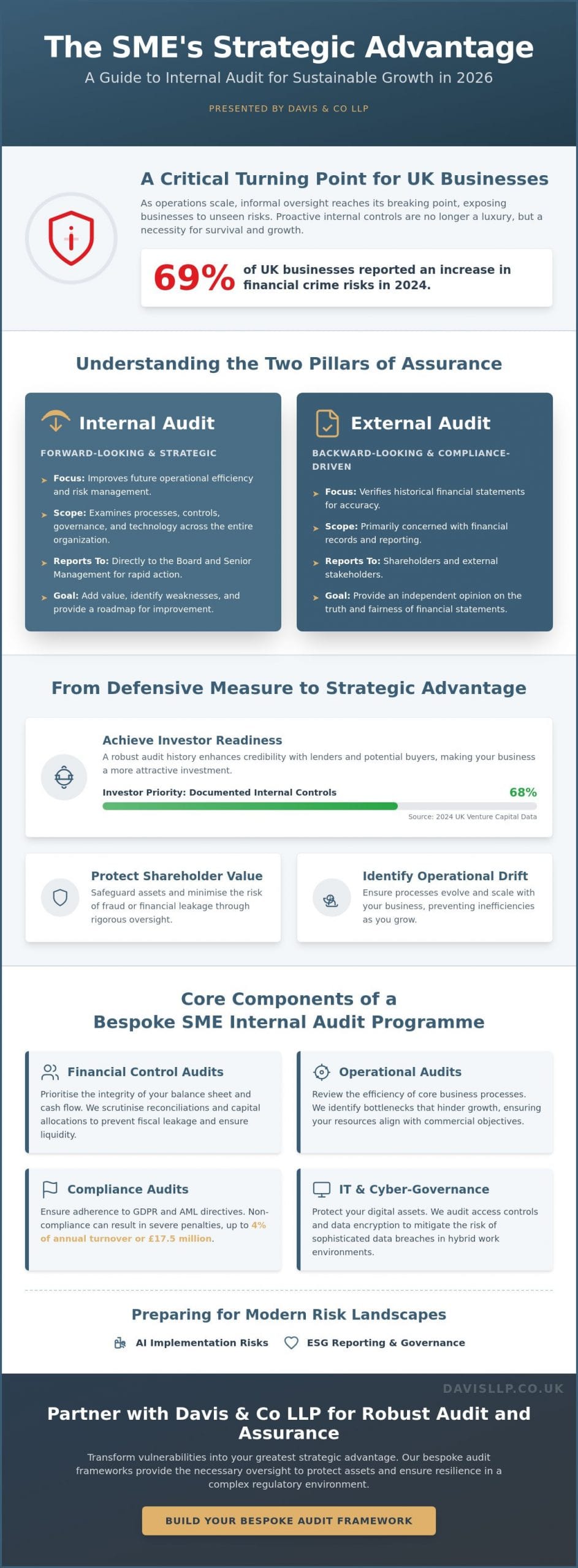
If you believe that rigorous internal oversight is a luxury reserved for the FTSE 100, you’re overlooking the reality that 69% of UK businesses reported an increase in financial crime risks in 2024. For a growing enterprise, the informal “eyes on everything” approach inevitably reaches a breaking point as operations become more complex. This shift often leaves leaders feeling exposed to risks they can no longer see.
We understand that as your business scales, you’ve likely felt the weight of maintaining compliance while manual processes begin to drain your profitability. It’s a common challenge. You might worry about undetected errors or the rising expectations of lenders. Our guide demonstrates how bespoke internal audit services for smes transform these vulnerabilities into a strategic advantage. We’ll explore how robust controls provide the assurance your stakeholders require and offer a clear roadmap for process improvement through 2026. By the end of this article, you’ll see why a disciplined audit programme isn’t just a defensive measure, it’s a foundation for sustainable growth.
Key Takeaways
- Distinguish between mandatory statutory requirements and the strategic value of internal assurance to support sustainable business growth.
- Identify how to safeguard your balance sheet and cash flow by integrating rigorous financial controls with optimised operational processes.
- Explore why outsourcing internal audit services for smes, particularly those with a turnover under £50 million, provides more cost-effective access to specialised technical expertise.
- Learn the methodology for establishing a risk-based audit universe and a multi-year strategic plan tailored to your specific commercial objectives.
- Discover how a bespoke audit framework provides the necessary oversight to protect assets and ensure resilience within a complex regulatory environment.
The Strategic Role of Internal Audit Services for SMEs in 2026
As we approach 2026, the UK economic climate demands a level of agility that many small-to-medium enterprises (SMEs) are still working to master. For a growing business, the traditional view of audit as a mere statutory obligation is no longer sufficient. To understand the transition, one must first ask: What is Internal Audit? It’s an independent, objective assurance activity designed to add value and improve an organisation’s operations. While large corporations have long utilised these functions, bespoke internal audit services for smes have become a vital tool for those scaling beyond the £10 million turnover mark.
The evolution of SME governance in 2026 requires a proactive rather than reactive stance. Relying on year-end financial checks doesn’t protect a business from the rapid shifts in digital security or supply chain volatility. We see internal audit as a prerequisite for strategic small business growth, providing the clarity needed to make bold commercial decisions with confidence.
Beyond Compliance: The Value Proposition for SME Owners
For the SME owner, an internal audit function acts as a guardian of shareholder value. It moves the focus from “did we follow the rules?” to “are our processes actually working?” This shift is crucial for several reasons:
- Protecting Shareholder Value: Rigorous oversight of internal controls ensures that assets are protected and that the risk of fraud or financial leakage is minimised.
- Investor Readiness: According to 2024 UK venture capital data, 68% of investors prioritised firms with documented internal controls. A robust audit history enhances your credibility with lenders and potential buyers.
- Identifying Operational Drift: Processes that worked for a team of 15 often fail when the headcount reaches 60. Internal audit identifies where these processes no longer match your current business objectives.
Internal vs. External Audit: Understanding the Difference
It’s vital to distinguish between these two functions to ensure your business is fully protected. External audits are primarily backward-looking; they verify that historical financial statements provide a true and fair view for external stakeholders. In contrast, internal audit services for smes are forward-looking. They focus on risk management and operational efficiency, identifying potential pitfalls before they manifest as financial losses.
The reporting lines also differ significantly. While external auditors report to the shareholders, the internal function reports directly to the board and senior management. This creates a direct feedback loop that allows for rapid adjustments to the business model. The unique synergy between these two functions ensures that historical accuracy is matched by future-proofed operational resilience.
Core Components of a Bespoke SME Internal Audit Programme
Effective internal audit services for smes go beyond mere tick-box exercises; they act as a strategic safeguard for your firm’s future. We focus on four primary pillars to ensure comprehensive coverage and resilience. Financial control audits prioritise the integrity of your balance sheet and cash flow. In 2026, liquidity management remains paramount. We scrutinise reconciliations and capital allocations to prevent fiscal leakage and ensure that every pound is accounted for accurately.
Operational audits review the efficiency of core business processes. We identify bottlenecks that hinder growth, ensuring your resources align with commercial objectives. Compliance audits are equally non-negotiable. The 2026 regulatory environment requires strict adherence to GDPR and Anti-Money Laundering (AML) directives. Penalties for non-compliance are severe, often reaching 4% of annual turnover or £17.5 million, whichever is higher. Finally, IT and cyber-governance protect digital assets in hybrid work environments. Securing the perimeter is no longer enough. We audit access controls and data encryption protocols to mitigate the risk of sophisticated breaches.
Modern Risk Landscapes: AI and ESG in 2026
Assessing the risks associated with the implementation of AI in SME operations is now a standard requirement. We examine algorithmic bias and data privacy within automated workflows to prevent reputational damage. Additionally, small firms face increasing ESG (Environmental, Social, and Governance) reporting requirements within their supply chains. Large-scale partners now demand transparency regarding carbon footprints and ethical sourcing as a condition of contract. We also note that international tax planning requires internal control over cross-border data to maintain compliance with global transparency standards.
Fraud Prevention and Detection Frameworks
Smaller, trust-based teams are often uniquely vulnerable to the “Fraud Triangle”: pressure, opportunity, and rationalisation. Internal audit services for smes must address these human elements through robust frameworks. Implementing segregation of duties doesn’t have to stifle SME agility. It involves distributing key tasks so no single individual has total control over a financial transaction from inception to completion.
Developing an effective whistleblowing policy is essential for small organisations. It provides a secure, confidential channel for staff to report concerns without fear of reprisal. According to The Institute of Internal Auditors (IIA), internal tips remain the most frequent method for detecting occupational fraud. If your organisation requires a more robust approach to risk, our team can provide a bespoke internal audit review tailored to your specific commercial needs.
Evaluating Internal Audit Models: Outsourcing vs. Co-sourcing
For UK businesses with a turnover below £50 million, the traditional in-house audit model frequently presents more challenges than solutions. Maintaining a permanent department requires significant capital for salaries and continuous training, yet these small teams often lack the breadth of experience found in dedicated external practices. When a team remains within the same four walls for years, their perspective can narrow. This proximity risks a gradual loss of the professional scepticism required to identify subtle systemic weaknesses or emerging risks.
Utilising internal audit services for smes through an outsourced or co-sourced model offers a more pragmatic alternative. Full outsourcing grants your board access to a wide pool of specialists, from cybersecurity experts to forensic accountants, exactly when they’re needed. Co-sourcing acts as a middle ground; it pairs your existing internal knowledge with external technical skill to tackle complex projects. This approach ensures that specific, high-risk areas receive the scrutiny they deserve without the burden of permanent headcount costs.
The financial rationale is compelling. While professional fees are a visible line item, the cost of control failure is often hidden until it’s catastrophic. Industry data indicates that small and medium enterprises can lose roughly 5% of their annual revenue to fraud and operational inefficiencies. For a company with a £20 million turnover, that represents a potential £1 million annual leak. Investing in structured audit services isn’t just a compliance exercise; it’s a strategic move to protect your bottom line and ensure long-term stability.
The Benefits of Professional Outsourcing
External auditors provide a level of objectivity that’s difficult to replicate internally. They aren’t influenced by office politics or historical “ways of doing things.” Beyond this independence, professional firms bring sophisticated data analytics tools usually reserved for the largest corporations. These platforms process thousands of transactions in seconds to identify anomalies that manual testing would miss. This scalability means you can ramp up audit intensity during a period of rapid growth or scale back when the risk environment is stable.
Selecting the Right Audit Partner
A successful engagement depends on finding a partner who aligns with your corporate values and understands your specific sector. It’s about more than just checking boxes. You need to focus on finding a chartered accountant who possesses a genuine audit specialism and a track record of delivering bespoke solutions. We believe in a “composed partnership” approach. This means working as an extension of your leadership team, providing the calm, authoritative guidance you need to make informed decisions. We focus on clarity and precision, ensuring our internal audit services for smes provide actionable insights rather than just a list of observations.
Implementing a Risk-Based Internal Audit Framework
Transitioning from a reactive stance to a proactive governance model requires a structured, five-step methodology. For a UK business with an annual turnover exceeding £10.2 million, the complexity of operations necessitates a framework that prioritises the most volatile threats. Our approach to internal audit services for smes focuses on intellectual rigour and commercial reality. We begin by establishing the audit universe, which identifies every process from procurement to payroll. By mapping these against the firm’s strategic goals for 2026, we isolate high-risk areas that require immediate scrutiny.
The second stage involves developing a multi-year strategic audit plan. This ensures that core financial controls and regulatory obligations, such as those mandated by the Companies Act 2006, are reviewed on a rolling cycle. During the execution of fieldwork, we test the effectiveness of key controls. This isn’t a mere theoretical exercise; it involves verifying that a £10,000 expenditure limit is actually enforced within the accounting software. We then report findings with pragmatic recommendations. Finally, we monitor remedial actions to ensure that 90% of high-priority issues are resolved within the agreed timeframe.
Creating a Dynamic Risk Register
A static spreadsheet is insufficient for modern governance. We help clients build a dynamic risk register that categorises threats into four pillars: Strategic, Financial, Operational, and Reputational. By scoring the impact against the likelihood on a five-point scale, we ensure that limited audit resources are never wasted on trivialities. A well-defined risk appetite statement is the foundation of this process. For an SME board, this might be expressed as: “The Board maintains a zero-tolerance policy toward regulatory non-compliance while accepting moderate operational risk to facilitate a 15% annual growth target in the domestic market.”
The Audit Report: Turning Observations into Action
The value of an audit lies in the clarity of its communication. We’ve moved away from archaic “tick-box” reporting in favour of executive-level insights that speak directly to the business owners. Each report balances critical findings with constructive process improvements, showing exactly how a change in procedure can reduce costs or enhance security. Presenting these results to stakeholders with transparency builds a culture of trust. It transforms the auditor from a “policeman” into a strategic partner who understands the practicalities of the UK business environment.
Effective governance requires a bespoke approach tailored to your specific commercial objectives. Learn how our internal audit services for smes can protect your business by visiting Davis LLP today.
Partnering with Davis & Co LLP for Robust Audit and Assurance
Our firm operates on a foundation of understated confidence. We believe that true professional authority isn’t found in aggressive marketing, but in the depth of technical expertise we bring to every engagement. When providing internal audit services for smes, we focus on delivering a calm, reassuring presence that allows business owners to focus on growth while we manage the complexities of risk and compliance. Our approach is characterized by a composed partnership; we act as a steady hand, ensuring your internal controls are both resilient and practical.
We don’t believe in one-size-fits-all checklists. Every SME has a unique operational DNA, and our audit solutions are bespoke to your specific scale and sector requirements. By aligning our methodology with your commercial objectives, we identify systemic risks that could impede your progress. These insights are not delivered in isolation. We integrate our findings into your broader strategy for UK tax planning, ensuring that your governance structure supports tax efficiency and statutory obligations simultaneously. This holistic view creates a sense of intellectual rigour that reinforces your business’s credibility with stakeholders and lenders.
Specialist Audit Services for Niche Sectors
Our team provides targeted assurance for sectors with complex regulatory demands. We understand the specific pressures facing various industries:
- Healthcare and Dental: We conduct internal control assessments for dental practices, focusing on patient data security and financial oversight.
- Property Portfolios: Our assurance services for property investment trusts ensure that asset valuations and rental income streams are accurately governed.
- International Subsidiaries: We provide robust compliance frameworks for international businesses operating UK subsidiaries, ensuring they meet local statutory standards.
Your Strategic Journey Starts Here
The path to enhanced governance begins with a confidential consultation. During this initial meeting, we assess your current control environment without judgment or haste. We then develop a clear roadmap that supports your 2026 growth ambitions, ensuring your internal audit services for smes are a catalyst for stability rather than a mere administrative burden. Our practitioners in London and Harpenden are available for a measured discussion regarding your specific needs. We invite you to contact our offices to discover how our commitment to quiet excellence can secure your firm’s future.
Future-Proofing Your Business Strategy
As we approach 2026, the landscape for small and medium enterprises requires more than simple compliance. A robust, risk-based framework transforms the audit process from a statutory obligation into a strategic asset. By evaluating the merits of co-sourcing and implementing bespoke programmes, your business gains the clarity needed to navigate complex international tax regulations and market volatility.
Davis & Co LLP has served as a trusted advisor since 1901. We provide sophisticated internal audit services for smes that prioritise discretion and commercial precision. Our status as Chartered Certified Accountants ensures your growth is underpinned by over a century of professional excellence. It’s this commitment to quiet authority that allows our partners to focus on their core objectives while we manage the intricacies of assurance with a polished, strategic approach.
Secure your business growth with bespoke audit and assurance from Davis & Co LLP
The right partnership doesn’t just protect your current position; it builds the foundation for your next decade of success.
Frequently Asked Questions
Is an internal audit mandatory for UK SMEs in 2026?
Internal audits aren’t mandatory for the majority of UK SMEs under the Companies Act 2006. Unless your business exceeds at least two of the three statutory thresholds, such as a £10.2 million annual turnover or 50 employees, the process remains a voluntary strategic choice. We find that proactive firms adopt these reviews to strengthen governance well before they reach the legal requirement for external oversight.
How much do internal audit services typically cost for a small business?
Market data from 2024 indicates that outsourced internal audit services for UK small businesses typically start from £2,500 for a focused departmental review. Larger SMEs with complex supply chains may see costs rise towards £7,500 per engagement. These figures vary based on your specific risk profile and the depth of the investigative scope required to provide meaningful assurance.
What is the difference between an internal audit and a statutory year-end audit?
A statutory audit provides external assurance that your year-end accounts are true and fair, whereas internal audit services for smes evaluate operational processes and internal controls. While the statutory version is a backward-looking compliance exercise required by law, internal audits are forward-looking. They aim to improve efficiency and mitigate risks before they impact your commercial bottom line.
Can our existing bookkeeper or accountant perform the internal audit?
Your existing accountant can technically perform the work, but it often compromises the independence necessary for a robust review. Professional standards suggest that the person auditing the controls shouldn’t be the same person who designed or operates them. We recommend using a separate team for internal audit services for smes to ensure findings remain objective and provide genuine commercial value.
How often should an SME conduct an internal audit?
Most UK SMEs should schedule an internal audit at least once every 12 months to maintain effective oversight. If your business is scaling rapidly or operating in a regulated sector, a biannual schedule is more appropriate. This frequency ensures that your risk management framework evolves alongside your commercial growth and prevents the accumulation of undetected operational inefficiencies.
What happens if the internal audit uncovers fraud or errors?
If fraud is detected, the business must immediately trigger its internal response plan and consult legal counsel regarding reporting obligations. Under the Proceeds of Crime Act 2002, certain discoveries may require a Suspicious Activity Report to the National Crime Agency. Handling these matters with discretion and precision is vital to protect the firm’s reputation and legal standing during the remediation process.
How do internal audit services support a business sale or exit strategy?
Internal audits act as a pre-due diligence exercise that can increase a business’s final sale price by an estimated 10% to 20%. By identifying and fixing compliance gaps early, you present a de-risked asset to potential acquirers. This preparation often shortens the closing period of a sale by several weeks because the buyer’s investigators find fewer red flags during their review.
Does an internal audit help with HMRC compliance and investigations?
These audits are highly effective for HMRC readiness, especially as the 2026 Making Tax Digital requirements approach. By reviewing VAT and payroll processes internally, you can correct errors before an official investigation begins. This proactive stance significantly reduces the likelihood of penalties, which can reach 100% of the tax owed in cases where HMRC identifies deliberate or concealed inaccuracies.