Could a robust performance in the hsbc share price uk actually result in a diminished net return for the unprepared investor? While a strengthening share price is typically welcomed, the reality of the UK’s current fiscal regime means that capital growth often carries hidden costs. Many shareholders find themselves caught between the inherent volatility of the global banking sector and the increasingly restrictive tax environment, particularly following the reduction of the dividend allowance to £500 in April 2024. It’s a common frustration to see gross yields improve while the actual liquidity reaching your bank account is eroded by statutory obligations.
We’ll provide a professional overview of HSBC’s market trajectory leading into 2026, paired with expert accounting strategies designed to protect your capital. Our analysis moves beyond simple market trends to offer a bespoke framework for optimising dividend income and minimising tax liabilities on share disposals. You’ll gain a clear understanding of the bank’s valuation alongside pragmatic, commercial solutions that ensure your investment strategy remains as efficient as it’s ambitious.
Key Takeaways
- Gain an informed perspective on HSBC’s standing as a FTSE 100 leader and the impact of global interest rate cycles on its long-term market positioning.
- Evaluate the strategic drivers behind the hsbc share price uk, including the nuanced relationship between Net Interest Margins and geopolitical exposure in Asian markets.
- Review the professional considerations surrounding high-yield dividends, ensuring a precise understanding of ex-dividend dates and tax-efficient income management.
- Identify pragmatic Capital Gains Tax strategies for share disposals, focusing on the effective application of the Annual Exempt Amount for UK residents in 2026.
- Understand the value of an integrated financial strategy that aligns share performance with bespoke personal and business tax objectives.
Understanding the HSBC Share Price (HSBA) in 2026
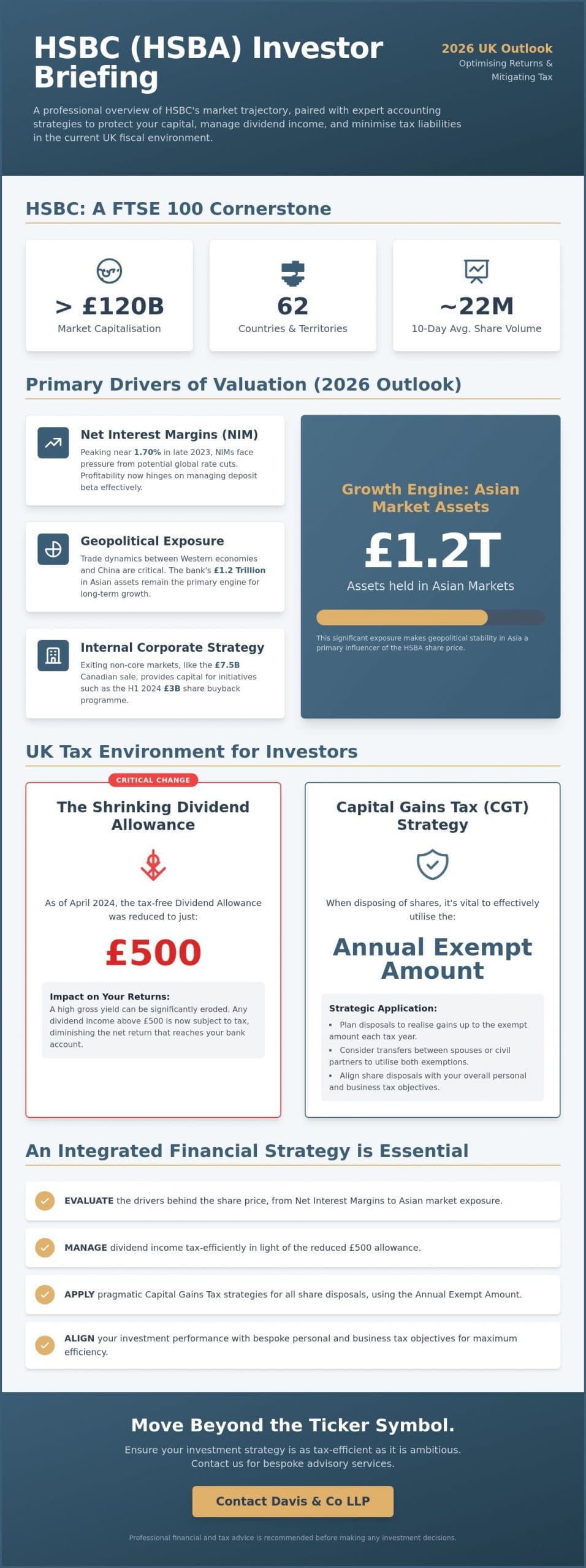
HSBC Holdings plc functions as a critical cornerstone of the FTSE 100 and a pre-eminent leader in global finance. For those monitoring the hsbc share price uk, the bank’s extensive reach across 62 countries and territories provides a unique vantage point on international commerce. Its evolution, detailed in this HSBC corporate history, illustrates a shift from its 1865 origins to a modern titan with a market capitalisation often exceeding £120 billion. Investor sentiment remains anchored in the bank’s ability to balance emerging market growth with the regulatory stability of the London market. We see this balance as essential for UK income investors who prioritise consistent dividend yields and capital preservation.
The bank maintains a sophisticated dual-primary listing structure in London and Hong Kong. This arrangement ensures deep liquidity for UK shareholders while facilitating nearly continuous trading across global time zones. It’s a structure that mitigates the risks associated with localised market shocks. For the private or commercial investor, this means HSBA shares are among the most liquid assets on the London Stock Exchange, allowing for efficient entry and exit even during periods of heightened market volatility. The relationship between the share price and market capitalisation reflects not just current earnings, but the collective confidence in the bank’s pivot to Asia.
The Role of HSBC in the UK Equity Market
We view HSBC as a definitive bellwether for global trade and banking stability. Its performance often mirrors the health of the UK’s financial services sector, yet its diversified revenue streams provide a buffer that domestic-only banks lack. In 2026, the bank’s valuation is heavily influenced by the Bank of England’s base rate policies. While the base rate stood at 5.25% in late 2023 and saw subsequent adjustments, the hsbc share price uk remains sensitive to the resulting net interest margins. Historical trends show HSBA often outperforms peers during periods of sterling weakness due to its significant dollar-denominated earnings from its global operations.
Key Metrics for HSBA Shareholders
Analysing the bank’s valuation requires a focus on specific, empirical data. The Price-to-Earnings (P/E) ratio offers a lens into how the market prices future dividend growth compared to the current fiscal year’s performance. We observe that the gap between the “Previous Close” and the “Open” price often signals overnight sentiment shifts from the Hong Kong exchange. Trading volume is another vital indicator; when volume exceeds the 10-day average of approximately 22 million shares, it suggests significant institutional repositioning. These metrics provide the foundation for bespoke investment strategies, ensuring that commercial objectives are met with the precision required in today’s fiscal environment.
Primary Drivers of HSBC’s Valuation and Performance
The valuation of HSBC remains a complex interplay between its domestic UK operations and its dominant Asian footprint. For the hsbc share price uk to sustain momentum through 2026, the market focuses heavily on Net Interest Margins (NIM). After peaking near 1.70% in late 2023, NIM faces pressure as global central banks begin their descent from peak interest rates. We anticipate that the bank’s ability to manage its deposit beta, the portion of rate changes passed to customers, will be the defining factor for its profitability in a lower-rate environment.
Macroeconomic Factors and Global Trade
UK inflation, which cooled to 2.3% in early 2024, directly dictates the Bank of England’s appetite for rate cuts. These domestic shifts are mirrored globally by the Federal Reserve’s influence on liquidity. For HSBC, geopolitical stability is a prerequisite for success. Trade tensions between Western economies and China create friction in the commercial banking segment, which facilitates billions in cross-border trade. Investors should monitor the £1.2 trillion in assets held within the Asian markets; these remain the primary engine for long-term growth and a significant influencer of the hsbc share price uk.
Internal Corporate Strategy and Restructuring
Management’s decision to exit non-core markets has streamlined the balance sheet significantly. The completion of the Canadian subsidiary sale for approximately £7.5 billion in March 2024 provided a substantial capital buffer. This liquidity supported the £3 billion share buyback programme announced in the first half of 2024. When considering the total yield, investors must remain mindful of UK dividend tax rules to accurately calculate their net returns. The bank’s commitment to a 50% dividend payout ratio suggests a focus on capital discipline and consistent shareholder returns.
The regulatory landscape adds another layer of complexity to the bank’s performance. The implementation of Basel 3.1 standards, scheduled for July 2025, requires meticulous capital management to maintain a Common Equity Tier 1 (CET1) ratio above the 14% target. Simultaneously, the bank’s annual £5 billion investment in digital transformation is reducing the cost-to-income ratio toward the desired 48% threshold. This shift from physical branches to digital platforms is a strategic evolution to capture the wealth management market in Hong Kong and Singapore. Our firm provides bespoke legal and commercial guidance for those managing substantial institutional holdings during such transitions.
Dividend Yields and Professional Tax Considerations
HSBC remains a cornerstone for income-focused investors within the FTSE 100. The hsbc share price uk often reflects its status as a premier high-yield asset, providing a consistent stream of returns that many banking peers struggle to match. For those looking toward 2026, the bank’s commitment to returning capital through both dividends and share buybacks creates a compelling case for inclusion in a diversified portfolio. However, the timing of these returns is governed by the ex-dividend date. This date marks the point at which the right to the next dividend payment stays with the seller rather than passing to the buyer. Investors who don’t hold the shares before this specific date will miss the immediate payout, which typically arrives in their accounts several weeks later.
Gross dividend yield represents the annual return based on the share price before any tax obligations are deducted, whereas post-tax income is the actual liquidity that remains once HMRC’s requirements are satisfied. Understanding this distinction is vital for accurate financial forecasting. When the hsbc share price uk fluctuates, the yield adjusts accordingly, making the entry point a critical factor for long-term income sustainability.
The 2026 Dividend Tax Landscape
For the 2026 tax year, the dividend allowance is set at £500. This threshold has seen a significant reduction in recent years, meaning more of your investment income is likely to fall within taxable bands. Once you exceed this £500 limit, the tax you pay depends on your total annual income. Basic rate taxpayers face a rate of 8.75%, while higher rate taxpayers are charged 33.75%. For additional rate taxpayers, the rate climbs to 39.35%. High-earning investors must be particularly diligent, as the combination of frozen personal allowances and high dividend tax rates can noticeably erode net returns. We recommend a proactive approach to ensure that your portfolio remains efficient under these enduring fiscal pressures.
Optimising Income Through Professional Planning
Shielding your yield from unnecessary tax leakage requires a structured approach. Utilising Individual Savings Accounts (ISAs) and Self-Invested Personal Pensions (SIPPs) remains the most effective way to ensure dividend growth is entirely tax-free. Within these wrappers, the £500 allowance becomes irrelevant as all income is protected from HMRC. For assets held outside these vehicles, inter-spousal transfers can be a pragmatic solution. By shifting share ownership to a spouse in a lower tax bracket, a household can utilise two sets of allowances and potentially lower the applicable tax rate from 33.75% to 8.75%.
Strategic disposals are another area where professional oversight adds value. It’s essential to consult official Capital Gains Tax guidance when rebalancing a portfolio, as the rules regarding annual exempt amounts continue to evolve. At Davis LLP, we provide the clarity required to manage these transitions smoothly. You can find further insights on managing your liabilities in our guide on Expert Tax Advice in the UK. Our focus is on delivering bespoke solutions that align with your broader commercial objectives, ensuring that your investment in the banking sector serves your long-term wealth goals.
Capital Gains Tax (CGT) Strategies for Share Disposals
Calculating the taxable gain on your holdings requires a precise comparison between the initial acquisition cost and the final disposal value. When you evaluate the hsbc share price uk at the point of sale in 2026, you’ve got to include incidental costs like brokerage fees and stamp duty reserve tax to arrive at the true net gain. For the 2026/27 tax year, the Annual Exempt Amount (AEA) for UK residents is £3,000. This threshold acts as a primary buffer; only gains exceeding this figure attract a tax liability. It’s a modest allowance that demands careful timing of disposals to avoid unnecessary fiscal leakage.
Reporting these disposals to HMRC is a statutory requirement if your total gains exceed the exemption or if the total proceeds are more than £12,000, representing four times the current allowance. We often advise clients to consider a “Bed and ISA” transaction, which is a legitimate tax mitigation strategy where you sell shares to utilize your annual exemption and immediately repurchase them within an ISA wrapper to ensure future dividends and gains remain tax-free.
Managing CGT Liabilities Effectively
Your specific income tax bracket determines the rate applied to your profits. Basic rate taxpayers typically face a 10% charge on gains, while higher and additional rate taxpayers see this rise to 20%. We apply Section 104 pooling rules to manage multiple tranches of shares bought at different times. This treats your entire holding as a single asset with an average cost, simplifying the calculation when you sell only a portion of your position. If you’ve realized losses on other investments during the same tax year, these can be offset against your HSBC gains to lower your overall bill. This offset can even be carried forward to future years if your losses exceed your current gains.
Long-term Wealth Preservation
For high-net-worth individuals, holding a substantial portfolio requires a look at the broader estate. Incorporating your shares into inheritance tax (IHT) planning is vital to avoid the standard 40% levy on assets above the nil-rate band. Some clients find that holding shares within a bespoke family trust structure offers better control over succession while providing a layer of protection against future tax legislative shifts. This is particularly relevant for those with cross-border interests who require International Tax Planning to align their UK disposals with global obligations. Our approach ensures that your 2026 investment strategy doesn’t create an unforeseen burden for the next generation.
Our team provides the intellectual rigour needed to structure your portfolio for maximum efficiency. If you’d like to discuss a tailored approach to your 2026 tax position, contact our private client solicitors for a confidential consultation.
Bespoke Advisory: Beyond the Ticker Symbol
An obsession with the daily fluctuations of the hsbc share price uk can often obscure the broader fiscal reality. While market valuation is a vital metric, it remains a solitary component of a sophisticated financial strategy. At Davis & Co LLP, we believe that true wealth preservation requires an integrated view of personal and business tax obligations. This approach ensures that capital gains from high-performing equities aren’t eroded by inefficient tax structures or overlooked statutory requirements.
Cross-border shareholders face a distinct set of challenges. HSBC’s global footprint means investors often deal with complex dividend distributions and varying international tax treaties. We position professional accounting as a catalyst for growth rather than a mere compliance exercise. By aligning your investment returns with your long-term commercial objectives, we transform raw market data into an actionable strategy. It’s about moving from reactive observation to proactive management.
Tailored Solutions for High-Net-Worth Individuals
Managing a significant equity portfolio requires more than passive observation. We provide a holistic review of your holdings to enhance tax efficiency across your entire estate. The timing of a disposal is as critical as the sale price itself; for instance, the reduction of the annual Capital Gains Tax allowance to £3,000 in April 2024 has made strategic timing essential for UK residents. Our team advises on how to align these moves with your wider financial goals. This level of precision is equally vital for entrepreneurs, as outlined in our guide on the Strategic Small Business Accountant. Understanding the hsbc share price uk in the context of your total net worth allows for more robust decision-making.
Securing Your Financial Future
Long-term partnerships with Chartered Certified Accountants offer a layer of security that digital platforms can’t provide. In an era where global tax transparency is the standard, maintaining rigorous compliance is non-negotiable. We act as a steady hand, helping you navigate the volatility of the financial markets with composed expertise. Our focus remains on your commercial and private interests, ensuring your portfolio remains resilient against legislative shifts. We invite you to a private consultation to discuss a comprehensive review of your portfolio’s tax position and your broader wealth objectives.
- Integrated tax planning for domestic and international holdings.
- Strategic timing of asset disposals to mitigate Capital Gains Tax.
- Comprehensive compliance management for cross-border dividend income.
- Alignment of private investment with corporate growth strategies.
Securing Your Financial Position for the 2026 Market
Managing your exposure to the hsbc share price uk demands a sophisticated understanding of both global banking trends and the intricacies of the UK tax system. Success in 2026 won’t rely solely on market timing; it’ll depend on how effectively you navigate dividend yields and the current £3,000 Capital Gains Tax allowance. Investors shouldn’t overlook the bank’s strategic pivot toward Asian growth sectors while ensuring their domestic tax obligations are handled with precision. It’s vital to integrate these market insights into a broader, more resilient financial plan.
At Davis & Co LLP, we’re Chartered Certified Accountants with over 120 years of expertise in helping high-net-worth individuals manage complex portfolios. We specialise in international tax planning and provide a bespoke, partner-led service tailored to your unique commercial objectives. By choosing a partner that values discretion and intellectual rigour, you ensure your wealth is managed with the care it requires. Consult with Davis & Co LLP for bespoke tax planning and portfolio optimisation to refine your approach to the 2026 financial landscape. We look forward to supporting your long-term success.
Frequently Asked Questions
How is the HSBC dividend taxed for UK residents in 2026?
UK residents pay tax on HSBC dividends at rates of 8.75% for basic rate taxpayers, 33.75% for higher rate taxpayers, and 39.35% for additional rate taxpayers. These rates apply to any dividend income that exceeds your annual tax-free allowance. Because HSBC is a UK-headquartered company, there’s no foreign withholding tax for UK residents to reclaim, simplifying your tax position.
What is the current dividend allowance for the 2026/27 tax year?
The dividend allowance for the 2026/27 tax year is £500. This threshold has been maintained since its reduction from £1,000 on 6 April 2024. You won’t pay any income tax on the first £500 of dividend income you receive across your entire share portfolio during this period.
Do I have to pay Capital Gains Tax if I sell my HSBC shares?
You’ll be liable for Capital Gains Tax if your total realized gains across all investments exceed the £3,000 annual exempt amount for the 2026/27 tax year. Basic rate taxpayers generally pay 10% on these gains, while higher and additional rate taxpayers are charged 20%. It’s important to calculate your gains using the average cost basis if you’ve purchased shares at different times.
Can I hold HSBC shares in a tax-efficient ISA or SIPP?
You can hold these shares in both an Individual Savings Account (ISA) and a Self-Invested Personal Pension (SIPP) to protect your investment from UK taxes. Holding shares within these wrappers ensures you pay zero Capital Gains Tax on price appreciation and zero Income Tax on dividends received. This is a highly effective strategy for managing your hsbc share price uk exposure while maximizing long-term net returns.
How does HSBC’s international presence affect its UK share price?
HSBC’s UK share price is heavily dictated by its Asian operations, which accounted for more than 80% of the group’s pre-tax profit in the 2023 financial year. Because the bank reports in US Dollars, the share price often fluctuates based on the GBP/USD exchange rate regardless of the bank’s underlying performance. Political developments in Hong Kong and economic growth rates in mainland China are often more influential than domestic UK economic data.
What happens to my shares from an inheritance tax perspective?
HSBC shares are considered part of your estate and are subject to Inheritance Tax at a rate of 40% on values above the £325,000 nil-rate band. The shares are valued based on the market closing price on the date of the holder’s death. We provide bespoke advice on using trusts or gifting strategies to help protect your family’s wealth from these statutory charges.
How do I report share dividends to HMRC on my self-assessment?
You report your dividend income by completing the relevant section of your Self-Assessment tax return if your total dividends exceed the £500 allowance. If your dividend income is between £500 and £10,000, you can often contact HMRC to have your tax code adjusted instead of filing a full return. For amounts exceeding £10,000, a formal tax return is mandatory to ensure all liabilities are correctly calculated.
Is it better to hold shares personally or through a limited company?
Holding shares through a limited company is often more tax-efficient for professional investors because companies don’t typically pay Corporation Tax on dividends received. However, personal ownership is generally more practical for individuals who can utilize the £20,000 annual ISA subscription limit. We recommend a strategic review of your commercial objectives to determine which structure offers the most pragmatic solution for your specific circumstances.