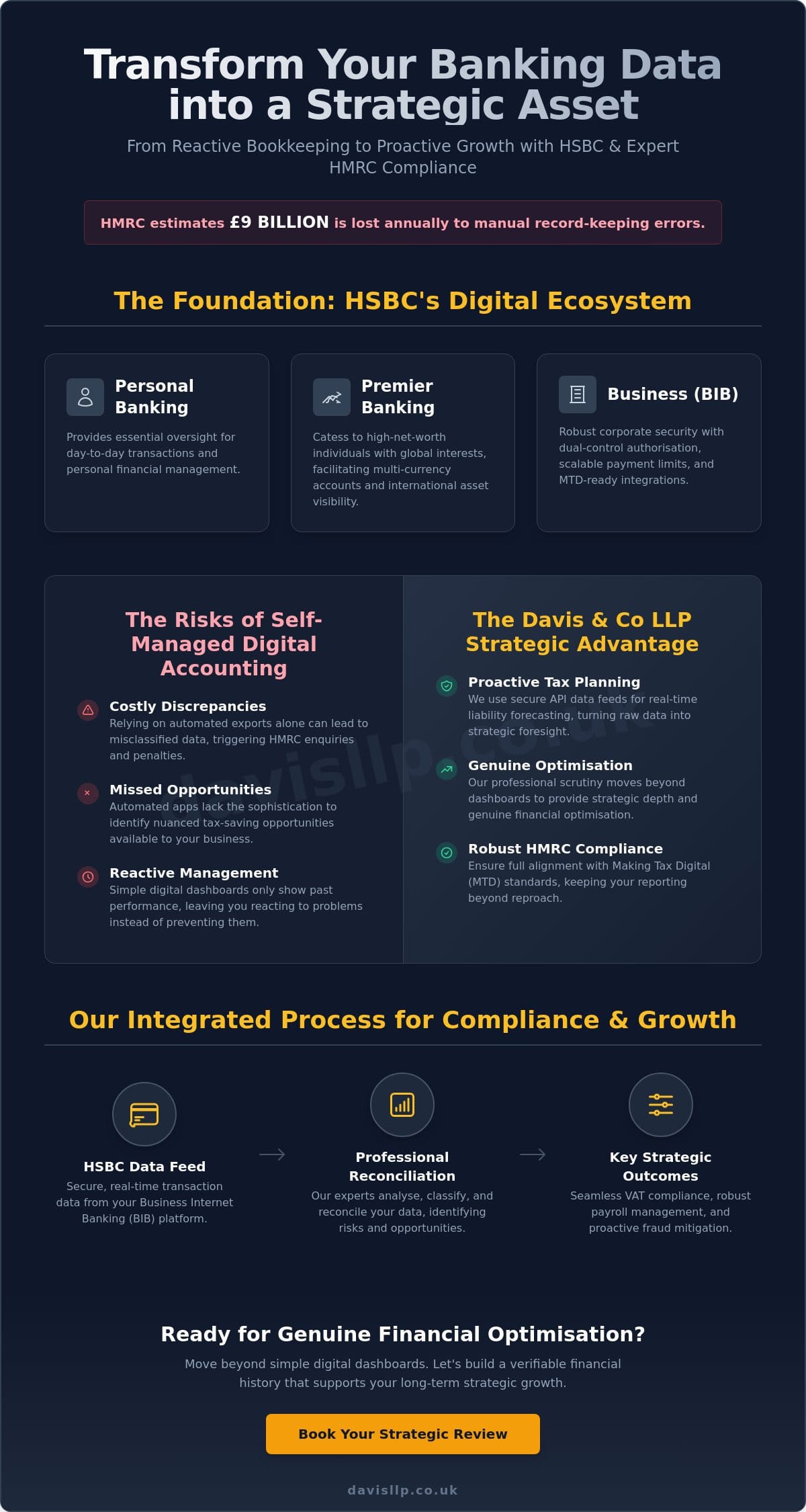
HMRC estimates that manual record-keeping errors cost the UK exchequer over £9 billion annually in lost tax revenue. For a modern director, your hsbc online banking platform shouldn’t merely be a repository for transactions; it’s a sophisticated data engine that, when harnessed correctly, eliminates these costly discrepancies. We understand that reconciling digital statements against evolving Making Tax Digital (MTD) requirements often feels like a moving target that distracts from your core commercial objectives, particularly when managing complex international transfers.
You likely recognize that real-time visibility is the only way to maintain a competitive edge in the 2026 fiscal environment. We’ll show you how to transform raw banking data into a strategic asset for sophisticated tax planning and robust HMRC compliance. This guide examines bespoke integration techniques and professional accounting insights to ensure your business moves from reactive bookkeeping to proactive, data-driven growth. We’ll explore how to mitigate tax liability through precise data analysis and ensure your financial reporting remains beyond reproach.
Key Takeaways
- Distinguish between HSBC’s various digital platforms to establish a robust foundation for both your commercial and private financial reporting.
- Learn to leverage hsbc online banking as a strategic data hub to ensure full alignment with Making Tax Digital (MTD) and HMRC compliance standards.
- Recognise the limitations of automated accounting apps and why professional scrutiny is essential to capture sophisticated tax-saving opportunities.
- Implement secure API data feeds to facilitate real-time tax liability forecasting and more informed decision-making for your business.
- Discover how a bespoke partnership with Davis & Co LLP provides the strategic depth required to move beyond simple digital dashboards toward genuine financial optimisation.
Navigating HSBC Online Banking for Business and Personal Finance
Within the UK’s evolving regulatory framework, hsbc online banking serves as more than a transactional interface; it’s a central repository for the financial data required to maintain statutory compliance. As we move through 2026, the shift toward real-time reporting by HMRC necessitates a disciplined approach to digital record-keeping. HSBC UK provides a tiered ecosystem designed to segregate personal wealth from commercial operations, ensuring that data remains clean for year-end audits and tax filings.
The distinction between Personal, Premier, and Business Internet Banking (BIB) platforms is fundamental to effective capital management. While personal accounts offer basic oversight, the Premier tier caters to complex requirements, and BIB provides the robust security protocols necessary for corporate entities. Open Banking protocols now allow these data streams to feed directly into professional accounting software. This reduces the risk of manual entry errors that often lead to avoidable HMRC inquiries, allowing for a more forensic approach to cash flow management.
Core Features for High-Net-Worth Individuals
For individuals with global interests, the Premier interface facilitates the management of multiple currency accounts and provides real-time visibility of international assets. This consolidated view is vital for tracking cross-border payments and ensuring that offshore income is correctly disclosed under the Statutory Residence Test. It’s essential to establish secure data-sharing permissions with your professional tax advisor within the portal. This ensures your representative has immediate access to the validated statements required for self-assessment filings without compromising your primary security credentials. Such transparency is a cornerstone of modern wealth preservation.
Business Internet Banking (BIB) Essentials
Corporate security relies on the dual-control authorisation features found within the BIB platform. These protocols require two separate users to approve significant transactions, a standard requirement for many UK firms to mitigate internal fraud risks. Daily payment limits are often set at £25,000 for standard business users, though these are scalable to meet specific commercial objectives. Integrating hsbc online banking with the HSBC Kinetic app allows for seamless synchronisation with cloud-based bookkeeping tools. This integration simplifies compliance by automating the following processes:
- VAT Compliance: Generating digital statement exports that align with Making Tax Digital (MTD) requirements.
- Payroll Management: Executing monthly salary payments while maintaining the audit trail necessary for PAYE reporting.
- Fraud Mitigation: Utilizing real-time payment tracking to identify discrepancies before they impact the balance sheet.
By leveraging these digital tools, businesses don’t just manage money; they build a verifiable financial history that supports long-term strategic growth and regulatory standing.
Leveraging Digital Banking Data for HMRC Compliance
The UK’s fiscal environment is moving toward a fully digital interface, making the precision of your financial records a matter of statutory necessity. For directors and high-net-worth individuals, hsbc online banking serves as more than a transactional tool; it’s the primary ledger for HMRC’s Making Tax Digital (MTD) requirements. By April 2026, self-employed individuals and landlords with income exceeding £50,000 must comply with MTD for Income Tax Self Assessment (ITSA). This mandate requires digital record-keeping and quarterly updates, which are most effectively managed through direct bank feeds. The Association of Taxation Technicians provides a comprehensive Making Tax Digital – Frequently Asked Questions resource that outlines the technical standards required for this transition.
Relying solely on automated exports can lead to significant discrepancies. Digital statements allow for the pre-emptive identification of tax risks, such as misclassified director loans or unexplained credits that HMRC might interpret as undisclosed income. We’ve observed that professional reconciliation remains essential to prevent common errors that trigger automated enquiries. These digital insights are particularly vital when aligning with the HMRC tax warning 2026 protocols, which highlight increased scrutiny on interest and dividend reporting. A bespoke approach to data management ensures that your hsbc online banking exports are not just raw numbers, but a verified foundation for your annual returns.
Capital Gains and Interest Reporting
Accurate reporting of capital disposals requires a clear audit trail of both the acquisition and the final sale proceeds. You can use your bank history to track the exact dates and amounts for property deposits or share purchases, which is critical for calculating indexation or relief eligibility. When managing self-assessment, calculating taxable interest on savings accounts must be precise to avoid the 20% to 45% tax traps associated with exceeding personal savings allowances. Our team helps clients distinguish between deductible business expenses and personal transactions within mixed-use accounts, ensuring only legitimate claims reach the final return.
VAT and Corporation Tax Alignment
Precision in VAT reporting depends on the strict alignment of bank transaction dates with quarterly periods. Using digital exports supports complex R&D tax credit claims by providing a granular view of qualifying expenditure, which is often a focal point during HMRC audits. Professional oversight during this process prevents the overpayment of corporation tax by ensuring all allowable liabilities are accounted for before the year-end deadline. If you require a more tailored analysis of your corporate liabilities, our advisors can review your digital records to ensure full statutory compliance.
The Risks of Self-Managed Digital Accounting
While hsbc online banking provides an efficient interface for daily transactions, relying solely on automated categorisation often creates a false sense of security. Digital visibility isn’t a substitute for strategic financial health. Many directors assume that because their bank feed syncs with an app, their books are inherently tax-compliant. This oversight often leads to missed capital allowances or incorrectly claimed VAT on items like client entertainment, which are generally non-deductible. HMRC’s ongoing transition toward Making Tax Digital (MTD) means that errors in DIY bank reconciliation are now more visible to authorities than ever before.
The gap between raw data and tax efficiency is where most self-managed businesses lose capital. Statistics from HMRC suggest that small businesses account for a significant portion of the UK’s “tax gap” due to a failure to take reasonable care. Engaging a small business accountant ensures that your transaction history is transformed into a robust tax strategy. We’ve seen that professional oversight can identify savings that automated software simply isn’t programmed to recognise, such as research and development tax credits or complex relief structures for property-holding companies.
Data Access vs. Strategic Analysis
Viewing a real-time balance through hsbc online banking helps with immediate liquidity decisions, but it doesn’t highlight underlying cash flow trends. Professional-grade software, when managed by a specialist, identifies seasonal patterns and burn rates that basic banking apps overlook. It’s the difference between seeing what you spent and understanding why your margins are narrowing. We move clients away from retrospective reporting; instead of looking at what happened last quarter, we focus on forward-looking growth. This involves identifying the precise moment to invest in new assets or expand the payroll without jeopardising your long-term stability.
Compliance and Audit Readiness
A professional audit trail requires significantly more detail than a chronological list of bank statements. For limited companies and partnerships, statutory compliance demands rigorous documentation of the business purpose behind every transaction. Professional assurance services provide peace of mind by ensuring your records meet the exacting standards of the Companies Act 2006. This level of diligence protects directors from personal liability and simplifies the process if HMRC initiates a compliance check. Our approach focuses on building a “defence file” for every tax return, ensuring that every claim is backed by statutory evidence rather than just a digital receipt.
- Ensures accurate VAT treatment on complex international transactions.
- Reduces the risk of HMRC penalties for “careless” inaccuracies.
- Provides a clear distinction between personal and business expenditure for directors.
- Facilitates smoother credit applications by providing lender-ready financial statements.
Best Practices for Integrating HSBC Data with Tax Planning
Precision in fiscal management begins with the seamless flow of information. Establishing a secure API link between hsbc online banking and your firm’s professional accounting software ensures that every transaction is captured without the latency or error risk of manual uploads. This direct connection utilizes the UK’s Open Banking framework, which recorded a 14% increase in corporate adoption throughout 2025. Automated data feeds provide the foundation for real-time tax liability forecasting. This allows directors to monitor Corporation Tax and VAT accruals as they happen, rather than reacting to figures weeks after a period ends.
We advise our clients to schedule monthly data synchronisation reviews with their Chartered Certified Accountant. These sessions aren’t merely for reconciliation; they’re a strategic necessity. By examining the live data feed well before the 5 April year-end, we can implement adjustments that align with current statutory reliefs. This proactive stance ensures that the digital record matches the legal reality of the business’s financial position, reducing the 20% discrepancy often found in unmonitored automated systems.
Optimising International Transactions
Cross-border operations require a sophisticated approach to mitigate currency volatility and regulatory friction. Effective international tax planning involves leveraging HSBC’s multi-currency capabilities to manage foreign exchange risks while remaining compliant with HMRC’s statutory residency tests. Businesses must navigate international double taxation treaties with care to avoid dual liabilities. For expats and firms with global interests, bespoke advice ensures that profits aren’t eroded by inefficient transfer pricing or misunderstood withholding tax requirements.
Structuring Accounts for Maximum Efficiency
Clarity is the foundation of any successful HMRC audit. Separating business and personal financial flows is a fundamental step to simplify self-assessment filings and protect the corporate veil. Strategic account structuring within hsbc online banking allows for a more granular view of liabilities. Consider the following structural priorities:
- Property and Trust Isolation: Dedicated accounts for property portfolios isolate rental income from trading profits, simplifying the management of specific tax charges.
- Interest Management: Strategic placement of surplus cash in tax-efficient wrappers to manage interest income exposure and maximise the personal savings allowance where applicable.
- Liquidity Reserves: Creation of specific sub-accounts to hold funds for the 31 January and 31 July payment deadlines, preventing liquidity shortages during peak tax seasons.
To ensure your digital banking setup aligns with your long-term commercial goals, you can consult our specialist tax advisors for a comprehensive review.
Beyond the Dashboard: How Davis & Co LLP Optimises Your Outlook
A digital interface like hsbc online banking offers an efficient window into your daily transactions, yet it remains a tool rather than a strategy. While the platform excels at categorising historical spend, it cannot anticipate the nuanced tax implications of a specific commercial acquisition or a complex partnership restructure. We provide the intellectual rigour necessary to translate raw data into actionable business intelligence. Our team doesn’t just record your history; we help you write your future.
Our role as your strategic partner involves looking past the screen to identify opportunities for capital efficiency that automated systems overlook. By integrating expert tax advice in the UK with your live banking feeds, we ensure every pound remains aligned with your long-term commercial objectives. This collaborative approach moves your financial management from a reactive compliance exercise to a proactive growth strategy. We bridge the gap between digital data and professional wisdom.
A Tailored Approach to Professional Accounting
Generic accounting services often fail to account for the unique fiscal pressures of specific industries. For instance, our specialised dental tax advisory addresses the distinct capital allowance requirements and associate fee structures that a standard banking app would simply miss. We provide a discretionary service that considers your entire financial portfolio, ensuring your personal wealth and corporate assets work in harmony. This sense of quiet excellence defines our practice. We focus on precision and reliability so you can focus on your professional output without distraction.
Securing Your Financial Future in 2026
The UK fiscal environment is rarely static. With anticipated regulatory shifts in 2026 and potential adjustments to Corporation Tax thresholds, maintaining a positive cash flow requires more than just monitoring a balance. We help you stay agile by stress-testing your financial structure against future budget changes. Our team evaluates your hsbc online banking data to identify trends, ensuring you’re prepared for the next phase of your business journey. This level of foresight is vital for maintaining liquidity during periods of economic transition.
- Detailed review of your current digital financial structure.
- Strategic alignment of banking data with UK tax obligations.
- Bespoke planning for high-net-worth individuals and corporate entities.
We invite you to book a comprehensive strategic assessment to review your digital financial framework. By securing a professional review now, you ensure your business remains resilient and compliant throughout 2026 and beyond. Contact our office to arrange a consultation with a senior partner who understands the practical realities of your industry.
Mastering Your Fiscal Strategy for 2026 and Beyond
Efficiently navigating hsbc online banking offers a significant advantage for modern UK businesses, yet the true value lies in how that data is synthesised for HMRC compliance. Digital tools alone can’t replace the intellectual rigour required to navigate the complexities of international tax planning or the specific financial structures of a dental practice. Since 1901, our firm has acted as a trusted advisor, ensuring that transactional accuracy translates into long-term commercial success. We’ve seen that self-managed accounting often leads to overlooked statutory obligations, whereas a structured, professional approach provides the stability necessary for growth.
Davis & Co LLP brings over a century of expertise as Chartered Certified Accountants to your specific challenges. As specialists in international and dental tax planning, we focus on delivering pragmatic solutions that align with your broader business objectives. It’s our role to provide the calm, authoritative guidance you need to feel secure in an evolving regulatory landscape. We invite you to contact Davis & Co LLP for a bespoke review of your tax and business strategy and discover how a partnership built on quiet excellence can optimise your outlook. We’re ready to help you build a resilient financial future.
Frequently Asked Questions
Is HSBC online banking data sufficient for HMRC tax returns?
HSBC online banking data provides a robust foundation for HMRC tax returns, though it’s rarely sufficient in isolation. You must retain original invoices and receipts to support the digital transaction history recorded in your accounts. Under the 2026 Making Tax Digital protocols, these digital records serve as the primary source for your quarterly updates. We recommend reconciling your digital statements monthly to ensure your statutory records remain accurate and defensible during any formal enquiry.
How do I export my HSBC business statements for my accountant?
You can export your business statements by navigating to the “Statements and Documents” section within your account dashboard. Select the relevant date range and choose a file format such as CSV, OFX, or PDF. Most UK accountants prefer CSV files for seamless integration into professional auditing software. This process ensures your financial advisor receives precise data without the risk of manual entry errors or omissions.
Does HSBC Business Internet Banking integrate with Making Tax Digital (MTD)?
HSBC Business Internet Banking fully integrates with Making Tax Digital through secure Open Banking APIs. By April 2026, self-employed individuals and landlords with income over £50,000 must use MTD-compatible software to report to HMRC. You can link your account directly to platforms like Xero or Sage. This connection automates the flow of transaction data, which significantly reduces the administrative burden on your commercial operations.
Can my accountant access my HSBC online banking directly and securely?
Your accountant can access your records securely if you designate them as a secondary user with specific permissions. We advise against sharing your primary login credentials; instead, use the “Manage Users” function to grant read-only access. This bespoke approach maintains your security while allowing your professional advisors to download the necessary data for your annual accounts and tax computations without compromising your primary account control.
What are the payment limits for HSBC Business Internet Banking in 2026?
The standard daily payment limit for hsbc online banking is typically £25,000 for Faster Payments as of 2026. If your commercial objectives require higher liquidity, you can request a bespoke limit increase up to £100,000 or more through your relationship manager. These limits apply to domestic transfers and are designed to balance operational efficiency with robust fraud prevention measures across your business accounts.
How does HSBC support international tax planning for expats?
HSBC supports international tax planning by providing a unified view of your global accounts through the Global View feature. This is particularly useful for expats managing the Statutory Residence Test, as digital records provide a clear timeline of UK-based financial activity. We often use these detailed transaction logs to help clients navigate complex cross-border tax liabilities and ensure compliance with both UK and overseas statutory requirements.
What should I do if HMRC asks for my digital bank records?
If HMRC requests your digital bank records, you should provide exported PDF statements or CSV files that correspond exactly to the tax years under review. HMRC has the authority to inspect records dating back 6 years in standard enquiries. You can retrieve these documents directly through your hsbc online banking portal. We suggest reviewing these files with your legal counsel before submission to ensure they align perfectly with your filed returns.
Can HSBC online banking help with my inheritance tax planning?
The banking platform doesn’t offer automated inheritance tax (IHT) planning, but it provides the essential valuation data required for HMRC Form IHT400. You can track lifetime gifts and potentially exempt transfers by monitoring your historical transaction data over the 7-year period required by UK law. This digital audit trail is vital for executors when they’re calculating the total value of an estate and claiming relevant reliefs.