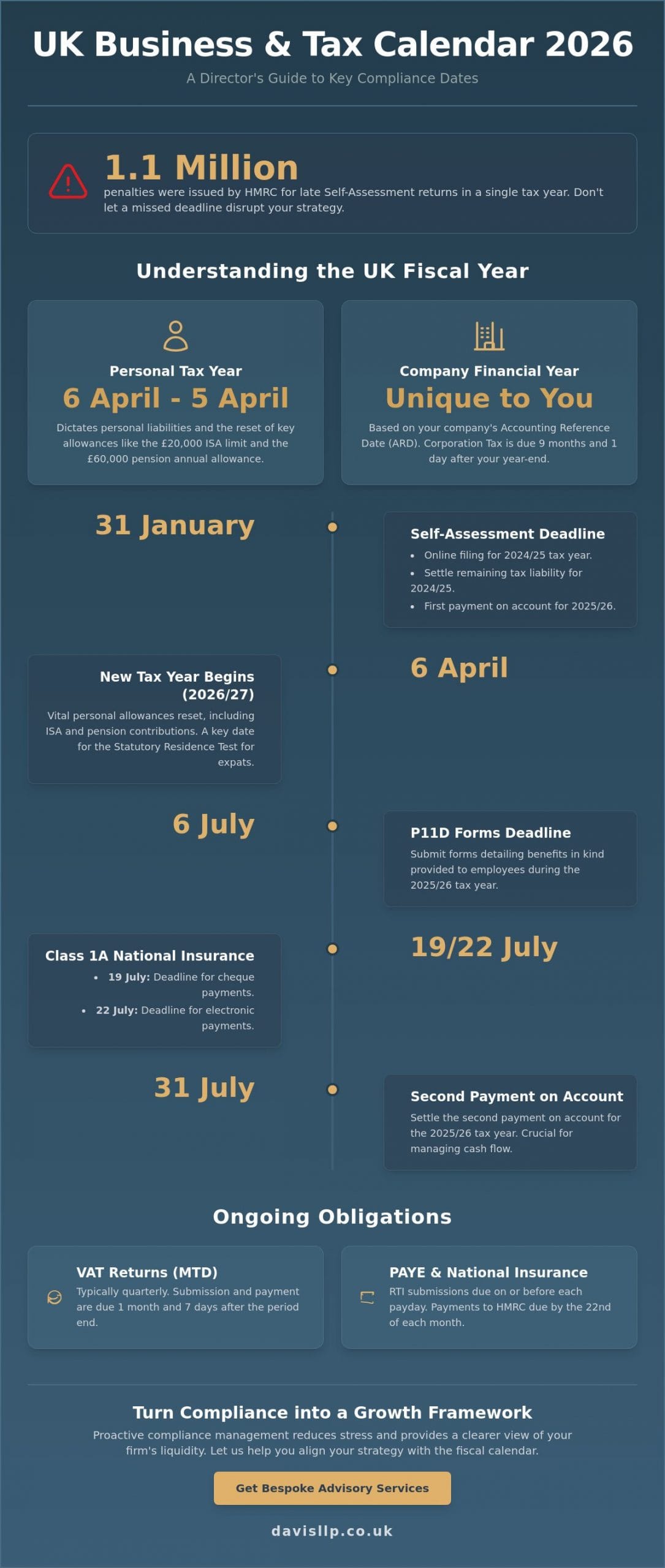
HMRC issued approximately 1.1 million £100 penalties for late self-assessment returns in a single tax year, a statistic that highlights how a single missed date can disrupt an otherwise meticulous financial strategy. We recognise that for many UK directors, the weight of statutory compliance often feels like a barrier to genuine commercial growth. It’s difficult to focus on strategic expansion when the threat of avoidable penalties looms over your monthly operations.
This guide offers a professional roadmap to the essential tax and business milestones you’ll encounter throughout 2026. By aligning your internal processes with the fiscal calendar, you can reduce compliance-related stress and maintain a clearer view of your firm’s liquidity. We’ll provide a chronological breakdown of VAT, Corporation Tax, and Self-Assessment deadlines, ensuring you remain securely positioned as a well-advised leader in an increasingly complex regulatory environment.
Key Takeaways
- Understand the fundamental distinction between the UK tax year and the corporate financial year to ensure precise statutory reporting.
- Identify every critical compliance date for the 2026 calendar year, including the pivotal 31st January deadline for Self-Assessment and payments on account.
- Evaluate the financial implications of HMRC’s penalty regime and the cumulative nature of interest on late tax liabilities.
- Learn to strategically time capital expenditure and investments to fully utilise the Annual Investment Allowance within the fiscal cycle.
- Discover how bespoke compliance management can transform administrative obligations into a structured framework for business growth.
The Anatomy of the UK Fiscal Year: Why the Start Date Matters
The United Kingdom’s approach to the financial calendar is distinct and deeply rooted in history. While many jurisdictions align their tax obligations with the Gregorian start of January, the UK fiscal year maintains its traditional commencement on the 6th of April. This specific date is a legacy of the 1752 calendar shift, where eleven days were suppressed to align with Europe. The Treasury of the time, unwilling to lose eleven days of tax revenue, simply moved the old tax deadline of Lady Day forward.
For the modern professional, this creates a dual-track system that requires careful navigation. We distinguish between the tax year, which dictates personal liabilities, and the financial year, which the government uses for its own budgetary purposes from 1st April to 31st March. Most private companies further complicate this by selecting their own unique accounting periods.
Accurate management depends on the precise date of recognition. We’ve seen that commercial clarity is often lost when businesses fail to distinguish between cash flow and statutory recognition. Revenue should be recorded when the service is performed or the risk transfers, not merely when the funds arrive in the bank. This precision ensures that management accounts provide a reliable basis for strategic decisions rather than a distorted view of performance.
The 6th of April: A Pivotal Date for Personal Tax
The arrival of a new tax year resets vital allowances. It’s the moment when the £20,000 ISA limit and the £60,000 pension annual allowance become available once more. We find that clients who engage in early-year planning avoid the inefficient “March scramble” that often leads to sub-optimal investment choices. For international clients, this date is the threshold for the Statutory Residence Test. It determines tax liability based on the specific number of days spent in the UK, making it a cornerstone of expat status management.
Company Accounting Reference Dates (ARD)
Your ARD is the anniversary of the last day of the month your company was incorporated. You can change this date via Companies House, though you can’t usually extend an accounting period beyond 18 months. It’s a strategic lever. A retail business might move its ARD to January to capture the full post-Christmas cycle in one reporting period. This choice dictates your Corporation Tax deadline, which falls nine months and one day after your year-end. Aligning your ARD with your industry’s natural seasonal cycle provides a clearer picture of your commercial health.
Key Tax Dates and Compliance Deadlines for 2026/27
Managing fiscal obligations requires more than just awareness; it demands a structured approach to the statutory calendar. The 2026 calendar year is punctuated by several critical milestones that dictate the liquidity and compliance standing of both individuals and corporate entities. Precision in these matters isn’t just about avoiding penalties; it’s about maintaining the professional reputation of your enterprise.
The first major date of significance is 31 January 2026. By this point, taxpayers must have completed their online filing for the 2024/25 tax year. This deadline also mandates the settlement of any remaining tax liability for that period, alongside the first payment on account for the 2025/26 year. Failing to meet these Self Assessment deadlines often results in immediate financial penalties and accruing interest that can complicate future filings.
Moving into the summer, 31 July 2026 marks the second payment on account. This requirement can place a strain on cash flow if it’s not anticipated during the preceding quarters. For employers, 6 July is the deadline for submitting P11D forms, detailing benefits in kind provided to employees during the 2025/26 tax year. The associated Class 1A National Insurance contributions must then be cleared by 22 July if you’re paying electronically, or 19 July for cheque payments. It’s a period that requires meticulous record-keeping to ensure all taxable benefits are captured accurately.
VAT and Payroll: The Recurring Deadlines
VAT compliance now operates almost exclusively under Making Tax Digital (MTD) protocols. Most businesses adhere to quarterly return cycles, though the specific date for submission and payment remains seven days and one month after the period end. Payroll obligations are equally rigid. RTI (Real Time Information) submissions must reach HMRC on or before every payday. Consequently, PAYE and National Insurance liabilities must be settled by the 22nd of each month to avoid unnecessary scrutiny. We provide bespoke advisory services to ensure these recurring obligations align with your broader commercial objectives.
International and Cross-Border Filing Dates
For clients with interests outside the UK, the complexity of the compliance calendar increases significantly. Reporting foreign income or offshore assets requires careful coordination to avoid double taxation. While the UK tax year ends on 5 April, international jurisdictions often operate on different cycles, such as the calendar year ending 31 December. If a business doesn’t align its internal reporting with these varying timelines, it risks non-compliance in multiple territories. We assist in navigating these discrepancies, ensuring that treaty relief is claimed correctly and that all statutory disclosures meet the rigorous standards expected by HMRC and overseas authorities.
The Cost of Delay: How Missing a Date Impacts Your Business
Missing a statutory filing date creates a ripple effect of financial and administrative friction. HMRC applies an immediate £100 penalty for late Self Assessment returns, even if no tax is owed. For limited companies, the initial fine for late accounts starts at £150, escalating to £1,500 if the delay exceeds six months. These costs aren’t static; they represent the beginning of a deteriorating relationship with the tax authorities. Beyond fixed penalties, interest on unpaid liabilities is calculated daily. With HMRC’s late payment interest rate currently set at 7.75%, procrastination becomes an expensive financial burden.
Persistent delays do more than drain cash reserves. They signal a lack of internal control to HMRC’s automated “Connect” system. This risk-profiling software monitors filing patterns to flag businesses for a full enquiry. We’ve observed that companies with a history of late submissions are significantly more likely to face a comprehensive audit, which often lasts between 6 and 18 months. Adherence to official HMRC deadlines is the most effective way to maintain a low-risk profile and avoid the intrusive nature of a formal investigation.
Public perception is also at stake. Every late filing at Companies House is recorded on the public register. This can damage your credit rating and deter potential investors who view late accounts as a sign of financial instability. We believe that professional precision in compliance isn’t just about avoiding fines; it’s about protecting the commercial integrity of your brand. It’s a matter of maintaining a reputation for reliability in a competitive market.
HMRC Compliance and Warning Signs
Taxpayers must stay alert to the latest HMRC tax warning regarding savings and interest. HMRC is increasingly focusing on undisclosed investment income, and missing a disclosure date can lead to “failure to notify” penalties of up to 100% of the tax due. If you’ve missed a deadline, don’t wait for a letter to arrive. Making a voluntary disclosure can reduce penalty percentages. While you can appeal based on a “Reasonable Excuse,” HMRC rarely accepts simple oversight. Valid excuses usually require evidence of exceptional circumstances, such as a localized natural disaster or a serious health emergency.
Audit and Assurance: Meeting the Statutory Window
For larger entities, the nine-month window to file audited accounts is a strict legal requirement. Rushing this process in the final weeks often leads to errors and increased audit fees. We recommend that your small business accountant begins year-end preparations at least 12 weeks before the deadline. This early engagement allows for the identification of complex accounting treatments before they become bottlenecks. A proactive approach ensures that the final audit is a validation of your success rather than a source of business disruption.
Strategic Date Planning: Aligning Growth with the Fiscal Cycle
Compliance shouldn’t be a reactive exercise. Successful UK firms treat the fiscal calendar as a strategic framework to accelerate investment and protect profit margins. By timing capital expenditure before the 5 April year-end, you can fully utilise the Annual Investment Allowance (AIA), which currently sits at £1 million. This allows for a 100% tax deduction on qualifying plant and machinery in the year of purchase. Similarly, the specific date of an asset sale can drastically alter your Capital Gains Tax liability. Delaying a disposal by even 24 hours until the start of a new tax year might provide an additional year of liquidity before the tax falls due.
Planning director remuneration requires a precise look at the £50,270 higher-rate threshold. Distributing dividends or bonuses across two fiscal years can prevent an unnecessary 33.75% or 39.35% tax hit. This level of foresight transforms a standard deadline into a tool for capital preservation.
Cash Flow Management and the Tax Calendar
Liquidity often tightens during “tax troughs,” particularly around the 31 January and 31 July payment deadlines. We’ve observed that businesses maintaining a 15% cash reserve specifically for HMRC liabilities avoid the high costs of emergency credit. Monthly management accounts are vital here. They provide a rolling 12-month view of upcoming liabilities, ensuring that VAT payments, which are due one month and seven days after the quarter ends, don’t disrupt your operational momentum or investment plans.
The Budget Date: Preparing for Legislative Shifts
The Autumn Statement and Spring Budget are the two most influential days for any CEO. These announcements often trigger immediate shifts in overheads and statutory obligations. For instance, staying informed on the minimum wage rates for 2026 is vital for accurate payroll forecasting and maintaining profit margins. If your operations extend beyond the UK, consulting an international tax planning expert before these legislative dates is essential to protect cross-border interests from sudden policy changes. Every date in the 2026 calendar represents an opportunity to refine your commercial strategy rather than just a box to tick.
If you require a bespoke analysis of your fiscal obligations, you can contact our commercial advisory team for a confidential consultation.
Bespoke Compliance Management with Davis & Co LLP
Effective financial management requires more than a reactive response to statutory deadlines. At Davis & Co LLP, we act as a strategic partner, curating your financial calendar to ensure every statutory date is met with precision. Our approach shifts the focus from simple filing to long-term fiscal stability. We operate a proactive notification system that alerts clients well in advance of impending deadlines, ensuring that the 5% late payment penalties often associated with HMRC delays are avoided entirely.
Our firm provides specialist oversight for sectors with unique regulatory rhythms. For dental practices, we manage the complexities of NHS contract reconciliations and UDA tracking alongside standard corporate filings. Similarly, for property portfolios, we oversee the specific requirements of Annual Tax on Enveloped Dwellings (ATED) and Stamp Duty Land Tax (SDLT) submissions. By integrating these niche requirements into a unified schedule, we provide a clear path through the 2026 compliance landscape.
The administrative burden on company directors is substantial, particularly regarding Companies House obligations. Our company secretarial services alleviate this pressure by managing the 14 day window required for notifying changes in directorship or share capital. We ensure that confirmation statements and statutory registers remain accurate, protecting directors from the personal liability and financial penalties that follow administrative oversight.
Tailored Tax Planning and Advisory
Compliance is merely the baseline of our service. We provide sophisticated tax advice in the UK that looks beyond the immediate filing period. For international families and those managing complex trust structures, we design bespoke solutions that respect both UK regulations and cross-border obligations. By synchronising your personal tax date with your business year-end, we create a holistic financial plan that maximises liquidity and tax efficiency throughout the 2026 fiscal year.
The Peace of Mind Provided by a Chartered Accountant
Professional representation serves as the primary defence against HMRC enquiries and errors. The value of our service lies in “quiet excellence”; we manage sensitive financial matters with a level of discretion and intellectual rigour that safeguards your reputation. When you seek to find a chartered accountant, it’s vital to select a partner who understands the nuances of your specific industry. We offer that steady, measured guidance, ensuring your financial affairs are handled with the composure and technical expertise they deserve.
Mastering Your 2026 Financial Obligations
Navigating the 2026/27 fiscal year requires more than just awareness; it demands a proactive approach to the UK’s rigid statutory framework. Missing a filing can trigger immediate HMRC penalties, such as the £100 initial fine for late self-assessment, which can escalate significantly if left unaddressed. We’ve explored how aligning your commercial growth with the April 6th start allows for better capital allocation and improved tax efficiency across your portfolio.
Davis & Co LLP has provided this level of intellectual rigour since 1901. As Chartered Certified Accountants with specialist expertise in international tax and dental accounting, we offer the bespoke strategic advice necessary to manage complex financial structures. Every statutory date represents an opportunity for precision rather than a source of administrative stress. Our team works as your strategic partner to ensure your business remains resilient against shifting UK regulations. We focus on the practical realities of your commercial objectives while maintaining the professional distance of a trusted advisor.
Secure your 2026 financial compliance with Davis & Co LLP
We’re ready to help you navigate the complexities of the next fiscal cycle with confidence and clarity.
Frequently Asked Questions
When is the deadline for filing my 2025/26 Self-Assessment tax return?
The deadline for filing your 2025/26 Self-Assessment tax return online is 31 January 2027. If you prefer to submit a paper return, you must do so by midnight on 31 October 2026. Failing to meet this specific date results in an immediate £100 penalty, even if there’s no tax to pay. We recommend early submission to ensure your liability is calculated with precision well before the payment deadline.
What happens if I miss a Companies House filing date for my accounts?
Missing a Companies House filing date for your annual accounts triggers automatic civil penalties starting at £150 for a delay of up to one month. This fine escalates to £1,500 for accounts filed more than six months late. For companies that fail to file on time in two consecutive financial years, these statutory penalties are doubled. Such oversights can also negatively impact your company’s credit rating and public record.
Can I change my company’s financial year-end date?
You can change your company’s financial year-end date by notifying Companies House through form AA01 or the online portal. This process allows you to shorten your accounting period as many times as you wish, though extending it’s restricted to once every five years and cannot exceed 18 months. We often assist clients with this adjustment to better align their reporting cycles with their commercial objectives or seasonal trading patterns.
How far in advance should I plan for the end of the tax year?
We advise clients to begin their year-end planning at least three months before the 5 April 2026 deadline. Starting this process in January allows sufficient time to review ISA contributions, pension allowances, and capital gains exemptions. Proactive preparation ensures you can implement bespoke tax-efficient strategies rather than rushing decisions in the final days of the financial year. Early action helps secure your personal and commercial wealth.
Are HMRC deadlines different for international businesses operating in the UK?
HMRC deadlines for international businesses with a UK permanent establishment generally mirror those of domestic companies, requiring Corporation Tax returns 12 months after the accounting period ends. However, the date for paying that tax is usually nine months and one day after the period concludes. Specific treaties or the diverted profits tax may apply, so we provide tailored advice to ensure cross-border compliance remains seamless and robust.
What is the date for the second payment on account in 2026?
The mandatory date for your second payment on account for the 2025/26 tax year is 31 July 2026. This payment’s designed to help spread the cost of your tax bill and is typically calculated as 50% of your previous year’s liability. If you anticipate your income will be lower than the prior year, we can assist in applying to HMRC to reduce these payments, ensuring your cash flow remains steady.
How does the date of a dividend payment affect my personal tax liability?
The date a dividend is legally paid or becomes payable determines which tax year it falls into for your personal assessment. For interim dividends, this is usually the date the money’s paid into your account, while final dividends are governed by the date they’re approved by shareholders. Careful timing of these payments can prevent you from moving into a higher tax bracket or exceeding your £500 dividend allowance.
Is there a specific deadline for VAT registration?
You must register for VAT if your taxable turnover exceeds the £90,000 threshold within any rolling 12-month period. The deadline for notifying HMRC is 30 days after the end of the month in which you crossed this limit. Late registration leads to a failure to notify penalty, which is calculated as a percentage of the VAT due from the date you should’ve been registered. We provide bespoke support for this transition.