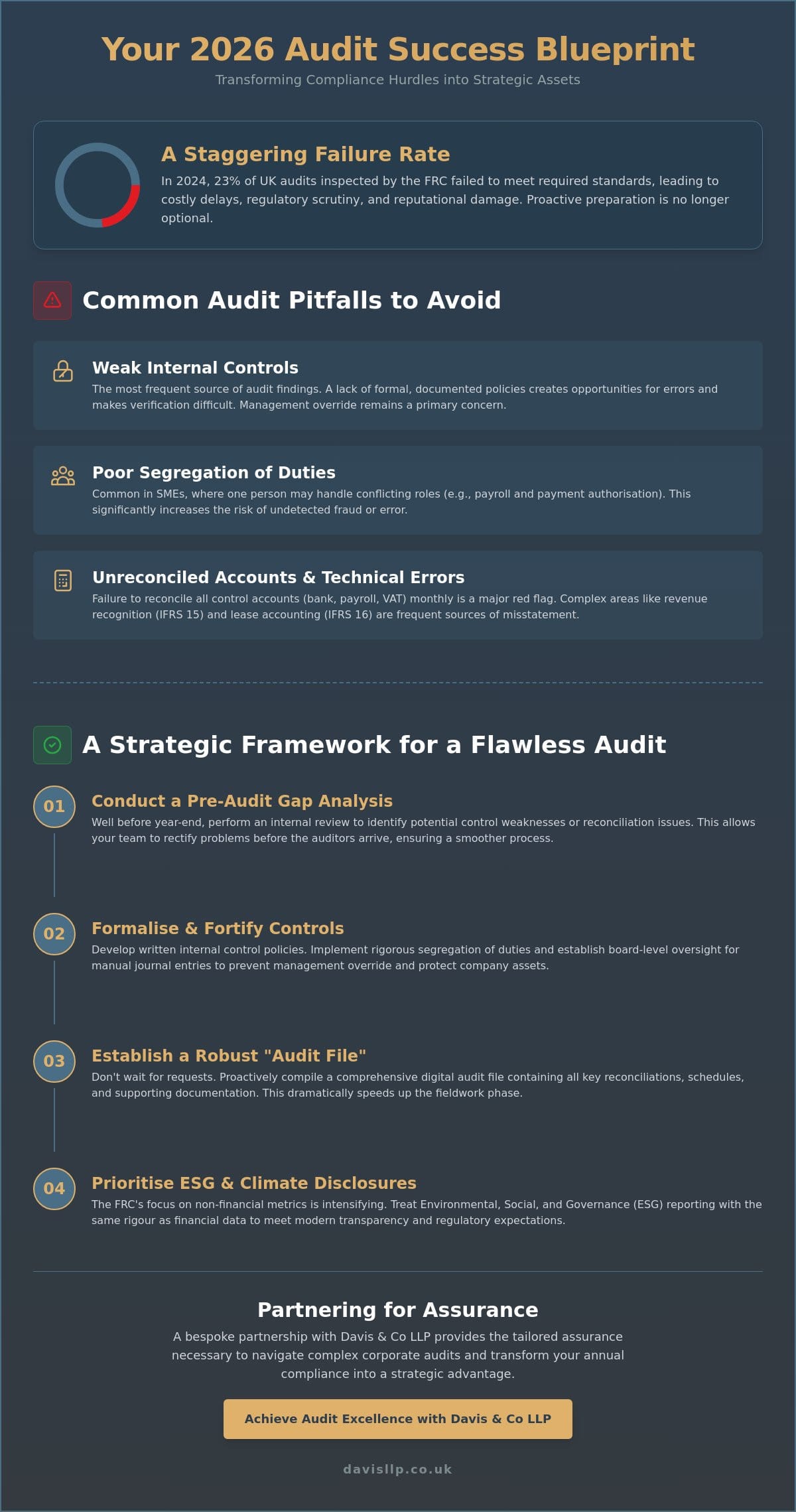
A staggering 23% of UK audits inspected by the Financial Reporting Council in 2024 failed to meet the required standards, often leading to costly delays and unwanted regulatory attention. We recognise that most finance directors view the annual audit as an arduous compliance exercise that drains management time and creates a lingering fear of HMRC scrutiny. However, recurring errors in revenue recognition or complex lease accounting shouldn’t be the norm for your organisation. By understanding common audit issues and how to avoid them, you can protect your firm’s reputation and ensure your financial statements reflect the true integrity of your operations.
We’ve developed this guide to help you transform your audit from a mandatory hurdle into a strategic asset. You’ll discover how to mitigate frequent financial reporting pitfalls and streamline your internal processes for a smoother, more efficient field-work period. We’ll examine the specific areas where UK businesses often falter and provide actionable, bespoke steps to ensure your 2026 audit is both rigorous and rewarding.
Key Takeaways
- Understand how the 2026 regulatory environment prioritises ESG and climate-related disclosures, transforming the audit into a vital diagnostic tool for corporate health.
- Identify the most common audit issues and how to avoid them by strengthening internal controls and formalising the segregation of duties within your digitised finance function.
- Learn to mitigate technical pitfalls in complex areas such as revenue recognition and ensure all control accounts are reconciled monthly to maintain financial precision.
- Implement a strategic framework for success by conducting a pre-audit gap analysis and establishing a robust “Audit File” well in advance of your year-end.
- Discover how a bespoke partnership with Davis & Co LLP provides the tailored assurance necessary to navigate both high-level corporate audits and niche sector requirements.
The Shifting Audit Landscape: Why Precision Matters in 2026
The UK corporate environment in 2026 demands a level of transparency that extends well beyond traditional ledger entries. We view the modern audit as a sophisticated diagnostic tool, providing a clear window into a company’s operational health and fiscal integrity. With the Financial Reporting Council (FRC) intensifying its focus on Environmental, Social, and Governance (ESG) metrics, climate-related financial disclosures are now a central pillar of the reporting cycle. Securing capital or pursuing aggressive growth requires more than just profitability; it requires the “clean” bill of health that only a rigorous independent review can provide. At Davis & Co LLP, we approach this process as a collaborative partnership, ensuring that identifying common audit issues and how to avoid them becomes a catalyst for institutional strength rather than a seasonal burden.
The Evolution of Statutory Requirements
As of 2026, the thresholds for a statutory audit remain aligned with the 2024 uplifts, meaning most private limited companies must undergo an audit if they meet two of three criteria: an annual turnover exceeding £15 million, a balance sheet total over £7.5 million, or more than 50 employees. Despite these higher limits, roughly 22% of exempt UK SMEs now opt for voluntary audits to fortify stakeholder trust and simplify future exit strategies. This proactive stance helps bridge the “expectation gap,” which is the persistent disconnect between the auditor’s legal duty to provide reasonable assurance and the public’s assumption that an audit guarantees the detection of every instance of fraud or confirms absolute business viability. Precision is the new currency. Trust is hard won.
The Strategic Value of Independent Assurance
A robust audit does more than satisfy the regulator; it acts as a foundation for complex financial manoeuvres. For instance, companies looking to expand their footprint will find that high-quality assurance facilitates smoother international tax planning by providing verified data that tax authorities in multiple jurisdictions can rely upon. Modern assurance has moved past “ticking and vouching” to offer value-added business insights that highlight operational inefficiencies before they crystallise into liabilities.
By adhering to Generally Accepted Auditing Standards, our experts identify patterns in your financial data that might suggest internal control weaknesses or missed commercial opportunities. Understanding common audit issues and how to avoid them allows a firm to transition from defensive compliance to strategic resilience. We don’t just look at where your money went; we examine how your financial structures support your long-term objectives. This methodical approach ensures your business remains a dependable constant in a volatile market.
Structural Weaknesses: Addressing Internal Control Deficiencies
Internal control failures represent the single most frequent source of significant audit findings for UK companies. Data from the Financial Reporting Council (FRC) consistently highlights that deficiencies in control environments lead to a higher volume of adjusted and unadjusted misstatements. Understanding these common audit issues and how to avoid them requires a shift from informal, legacy processes toward a robust, documented framework. A formalised, written internal control policy isn’t just a compliance requirement; it’s the foundation of a reliable finance function. It provides the clarity needed for both staff and auditors to verify that assets are protected and financial records are accurate.
Management override remains a primary concern for auditors in 2026. This occurs when those in leadership positions bypass established controls to manipulate financial results or conceal transactions. To safeguard against this, businesses must implement rigorous oversight mechanisms. This includes regular board-level reviews of manual journal entries and ensuring that the internal audit function, where it exists, reports directly to an independent audit committee. Establishing a culture of transparency ensures that even senior figures are subject to the same scrutiny as junior staff.
The Perils of Poor Segregation of Duties
Within SME finance teams, conflicting roles often arise by necessity rather than design. A common example involves a single individual managing payroll while also possessing BACS authorisation rights. This creates a structural vulnerability that auditors will inevitably flag as a material weakness. When full segregation isn’t possible due to a smaller headcount, we recommend implementing compensatory controls. This might include a monthly independent review of the bank mandate or a director-level sign-off on all new supplier additions. These layers of oversight mitigate the risk of error or fraud without requiring an immediate increase in staff numbers.
Digital Controls and Cyber Security in Audit
Cloud accounting software has become the standard for UK businesses, yet it presents unique challenges. While these platforms automate many tasks, they also require precise access controls to remain secure. Auditors now focus heavily on IT General Controls (ITGCs), examining who has administrative rights and how audit trails are preserved. Unrestricted access for all staff members is a significant red flag. Businesses should ensure that user permissions are strictly aligned with specific job descriptions. Maintaining a secure digital environment is a core part of a bespoke advisory strategy designed to protect commercial integrity. Robust password protocols and multi-factor authentication are no longer optional extras; they’re essential components of a clean audit report. By 2026, the integration of AI-driven anomaly detection in software has also become a focal point for auditors looking for evidence of proactive monitoring.
Technical Pitfalls: From Payroll to International Complexity
Revenue recognition remains a primary area where common audit issues and how to avoid them become most apparent. Under FRS 102, we frequently observe discrepancies where revenue is recognised before a performance obligation is fully satisfied. This is particularly prevalent in service-led contracts or multi-stage projects. To maintain compliance, your finance team must establish clear cut-off procedures. If a service is 80% complete at year-end, the accounting records should reflect that exact proportion rather than the total contract value.
Control account reconciliations represent another critical failure point. We find that approximately 12% of audit adjustments stem from unreconciled VAT, payroll, or bank accounts. Leaving these reconciliations until the year-end audit is a high-risk strategy. A monthly reconciliation cycle ensures that errors are caught within a 30-day window, preventing small discrepancies from compounding into material misstatements. This disciplined approach provides the “quiet excellence” required for a smooth statutory review.
For organisations with complex balance sheets, seeking professional tax advice in the UK is essential for managing deferred tax assets. Auditors scrutinise the recoverability of these assets with increasing rigour. You must provide robust evidence, such as three-year profit forecasts, to demonstrate that future taxable profits will be sufficient to offset these assets. Without this documentation, auditors may insist on a valuation allowance, which directly impacts your reported net assets.
Payroll and VAT: The Compliance Minefield
Discrepancies between payroll records and HMRC Real Time Information (RTI) submissions are a frequent red flag. We often see mismatches in pension contributions or taxable benefits that lead to audit queries. Accuracy is non-negotiable here. Additionally, VAT on international services is often miscoded. If you’re importing services from the EU or elsewhere, the reverse charge mechanism must be applied correctly to avoid understating both input and output tax. Ensuring minimum wage 2025 compliance is also vital. Even minor technical breaches in pay for salaried staff can create significant contingent liabilities that auditors are required to disclose.
International Tax and Transfer Pricing Issues
Verifying the “arm’s length” nature of intercompany transactions is a significant challenge for UK businesses with overseas subsidiaries. Auditors require contemporary documentation to justify the pricing of goods or services shared between group entities. Foreign exchange volatility also poses a risk. During the 2024 fiscal year, currency fluctuations led to substantial balance sheet adjustments for many of our clients. We recommend using consistent closing rates from a single, reputable source to ensure your local statutory filings align perfectly with group reporting requirements. This proactive management of common audit issues and how to avoid them protects your firm’s reputation and financial stability.
A Strategic Framework for Avoiding Audit Findings
Transitioning from a reactive to a proactive stance is the most effective way to manage common audit issues and how to avoid them. This requires a structured methodology that integrates audit preparation into the regular financial cycle rather than treating it as an isolated annual event. By adopting a disciplined framework, UK businesses can reduce the time spent on queries and minimise the risk of adjusted figures.
- Step 1: The 90-Day Gap Analysis. Three months before the financial year-end, management should perform a comprehensive gap analysis. This involves reviewing internal controls and identifying areas where documentation might be sparse. If a control failure occurred in Q2, addressing it in Q4 allows the business to implement a workaround or additional testing before the auditors arrive.
- Step 2: Formalise the Audit File. Constructing a formal Audit File is the bedrock of a smooth engagement. This file should contain lead schedules that reconcile directly to the trial balance. Every material balance, such as fixed assets or trade debtors, needs a clear link to its supporting evidence, such as invoices or bank statements.
- Step 3: Resolve Complex Judgements Early. Complex accounting judgements often cause the most significant delays. Whether it’s a goodwill impairment test or a revenue recognition assessment under FRS 102, these should be resolved by month 11. Waiting for the audit to begin before discussing these with stakeholders often leads to protracted debates and potential adjustments.
- Step 4: Proactive Communication. Engaging in open, proactive communication with your small business accountant provides an external perspective on your readiness. They can spot technical inconsistencies that might otherwise trigger an audit query, ensuring your statutory reporting remains robust.
The Importance of Robust Documentation
A lack of evidence is frequently cited as the most frustrating audit finding for management because it’s usually a matter of record-keeping rather than a financial error. When documenting management estimates, such as bad debt provisions or warranty reserves, you must record the specific logic, market data, and assumptions used to reach the final figure. The audit trail is the chronological evidence of financial transactions. Without this trail, auditors are forced to increase sample sizes, which inevitably drives up costs and extends timelines.
Cultivating an Audit-Ready Culture
Finance teams occasionally view auditors as an obstacle to their daily operations. Shifting this perception requires training staff to understand the purpose behind specific requests. When a finance officer understands how a bank reconciliation supports the existence and valuation of cash, they’re more likely to provide high-quality evidence. Establishing a monthly closing routine that mirrors year-end requirements ensures that the team isn’t overwhelmed during the final audit. This creates a psychological shift, moving the relationship from viewing auditors as “police” to seeing them as professional advisors. This collaborative environment fosters “quiet excellence” and ensures the business remains compliant with minimal friction.
Contact Davis LLP to refine your financial compliance and audit strategy.
Partnering for Assurance: The Davis & Co LLP Approach
Davis & Co LLP doesn’t view an audit as a mere box-ticking exercise. We approach every engagement with a sense of quiet excellence, providing the professional gravitas necessary for high-level corporate scrutiny. Whether your business requires a standard statutory audit or the nuanced expertise of a dental tax specialist, our team delivers a service that’s both intellectual and pragmatic. By understanding common audit issues and how to avoid them, we ensure your financial reporting becomes a pillar of strength rather than a source of anxiety.
Our firm prioritises a composed partnership. We aim to make every client feel secure and well-advised, maintaining the necessary distance of a professional expert while deeply understanding your commercial reality. This balance allows us to identify risks that others might overlook, ensuring your accounts reflect the true health of your enterprise.
Bespoke Solutions for Complex Entities
We tailor our methodology to the specific risk profile of your industry. A retail group’s inventory challenges differ vastly from the revenue recognition complexities of a software firm. Our partner-led service ensures that senior expertise is present at every stage, aligning our findings with your commercial objectives. It’s about providing clarity where there’s complexity.
In 2025, we worked with an international client to resolve long-standing internal control issues that had plagued their UK subsidiary for three years. By implementing a bespoke reporting framework, we helped them achieve a clean audit opinion within twelve months. This level of dedication helps you navigate common audit issues and how to avoid them before they escalate into statutory failures.
- Direct access to partners who understand your specific commercial sector.
- Risk assessments based on 2026 UK regulatory standards.
- Tailored audit programmes that respect your operational timeline.
Beyond the Audit Report
Our work doesn’t end with a signature on a report. We provide management letters that act as a strategic roadmap for operational improvement. These documents highlight inefficiencies that might otherwise go unnoticed during daily operations. You can leverage this data to refine your cash flow management and improve forecasting accuracy for the 2027 fiscal year. We believe that an audit should accelerate business growth, not just verify it.
Reliability and discretion are the hallmarks of our practice. We provide the intellectual rigour required to satisfy stakeholders while offering the practical advice needed to drive your business forward. If you’re looking for a partner who understands the intricacies of the UK’s 2026 regulatory environment, we invite you to reach out. Contact us today for a strategic consultation to ensure your business remains resilient, compliant, and ready for growth.
Future-Proofing Your Business Governance
The 2026 regulatory environment demands more than basic compliance; it requires a sophisticated approach to internal governance. Businesses that prioritise robust control frameworks and address complex international tax obligations early are best positioned to maintain their commercial momentum. Navigating common audit issues and how to avoid them isn’t merely about passing an inspection. It’s about building a foundation of financial integrity that supports long-term growth.
Since 1901, Davis & Co LLP has served as a trusted advisor to UK enterprises. Our partner-led service provides the technical precision needed for specialised sectors, including dental practices and companies with cross-border interests. We don’t just identify risks; we offer the strategic foresight required to resolve them before they impact your bottom line. Our team focuses on your specific commercial objectives to ensure the audit process adds genuine value to your operations.
Contact Davis & Co LLP for a bespoke audit and assurance consultation to ensure your business remains resilient and ready for the challenges of the coming decade. We’re here to help you move forward with absolute clarity.
Frequently Asked Questions
What is the most common reason for a qualified audit opinion?
Limitation of scope, particularly regarding year-end stock counts or missing financial records, remains the most frequent cause for a qualified opinion in the UK. Disagreements over the valuation of complex assets like goodwill or investment property also lead to qualifications. To manage these common audit issues and how to avoid them, we recommend conducting interim stock counts and maintaining robust digital audit trails throughout the financial year.
How far in advance should we start preparing for our annual audit?
You should begin your audit preparation at least 4 months before your financial year-end. This timeline allows your team to address complex transactions and reconcile accounts before the auditors arrive. Early engagement ensures that bespoke solutions for technical accounting challenges are in place. It reduces the pressure during the final field work period and prevents last-minute adjustments to the balance sheet.
Can our auditors also help us with our tax planning and bookkeeping?
UK independence regulations, specifically the FRC Ethical Standard 2024, strictly limit the non-audit services a statutory auditor can provide to their clients. While small companies might have some flexibility, larger entities are often prohibited from using the same firm for both audit and bookkeeping. We focus on maintaining a clear distinction between our advisory and assurance roles to protect the integrity of your financial reporting.
What are the penalties for failing to comply with UK audit requirements?
Failure to file audited accounts is a criminal offence under the Companies Act 2006, which can result in personal fines for directors. Companies House imposes civil penalties ranging from £150 for a delay of one month to £1,500 for delays exceeding six months. These costs double if the accounts are filed late in two successive financial years, which can damage your firm’s credit rating and reputation.
How does an audit differ from a simple independent examination?
An audit provides a high level of “reasonable assurance” that accounts are free from material misstatement, whereas an independent examination offers a lower level of “limited assurance”. Independent examinations are typically reserved for smaller charities with an annual income between £25,000 and £1 million. Audits involve more rigorous testing of internal controls and third-party evidence to satisfy statutory requirements for larger commercial entities.
What happens if the auditors find a material misstatement in our accounts?
If a material misstatement is identified, we’ll present the findings to your management team to request a formal correction in the ledger. If the directors refuse to adjust the accounts, we’re required to issue a qualified or adverse audit report. Addressing these common audit issues and how to avoid them involves establishing strong internal controls that catch errors before the formal audit process begins.
How does international expansion affect our audit risk?
International expansion introduces complexities such as foreign exchange volatility and compliance with different jurisdictional tax laws. In 2024, the OECD’s Pillar Two rules added significant reporting burdens for groups with global revenues exceeding €750 million. We help you navigate these risks by aligning your global accounting policies and ensuring your transfer pricing documentation meets both UK and international standards to avoid double taxation.