Could your current financial reporting withstand the scrutiny of a Tier-1 venture capital firm or a rigorous SEC examination? While many founders view an audit as a cumbersome administrative hurdle, the reality in 2026 is that it’s the primary differentiator for high-growth firms. We understand the pressure of managing complex SaaS revenue recognition under ASC 606 or the intricate software capitalisation rules introduced by ASU 2025-06. By integrating professional audit and assurance services for tech startups early in your lifecycle, you transform a statutory obligation into a strategic asset that signals maturity to the global market.
It’s natural to feel concerned about the complexity of R&D tax credits or the new Digital Operational Resilience Act (DORA) requirements, especially when 80% of accounting firms have increased their fees this year. This guide provides a clear roadmap for achieving investor-ready status and establishing robust internal controls. We’ll examine the impact of the PCAOB’s QC 1000 standards and the 5th edition of ISACA’s IT Audit Framework to help you navigate international expansion with absolute confidence and the quiet excellence your stakeholders expect.
Key Takeaways
- Understand why the threshold for voluntary audit and assurance services for tech startups is lower than founders expect in 2026; this serves as a critical signal of corporate maturity.
- Master the complexities of SaaS revenue recognition and R&D capitalisation to ensure your financial reporting remains compliant with evolving FRC and SEC expectations.
- Recognise how audited accounts proactively reduce the “risk premium” during valuation, positioning your startup as a secure prospect for Tier-1 investors.
- Follow a pragmatic roadmap to audit readiness that formalises your accounting policies and month-end processes without disrupting your development cycles.
- See how integrating statutory requirements with strategic international tax planning creates a robust architecture for scaling your operations globally.
The Strategic Role of Audit and Assurance for Tech Startups
Founders often perceive the audit as a post-facto compliance exercise, yet in a capital-constrained 2026 market, it’s a fundamental pillar of corporate strategy. While an audit is a formal, independent examination of financial information resulting in a positive opinion, assurance is a broader discipline. It encompasses various levels of scrutiny designed to improve the quality of information for decision-makers. For a scaling entity, choosing the right audit and assurance services for tech startups isn’t just about satisfying a regulator; it’s about building a “clean” financial history that withstands the forensic due diligence of Series B and Series C investors.
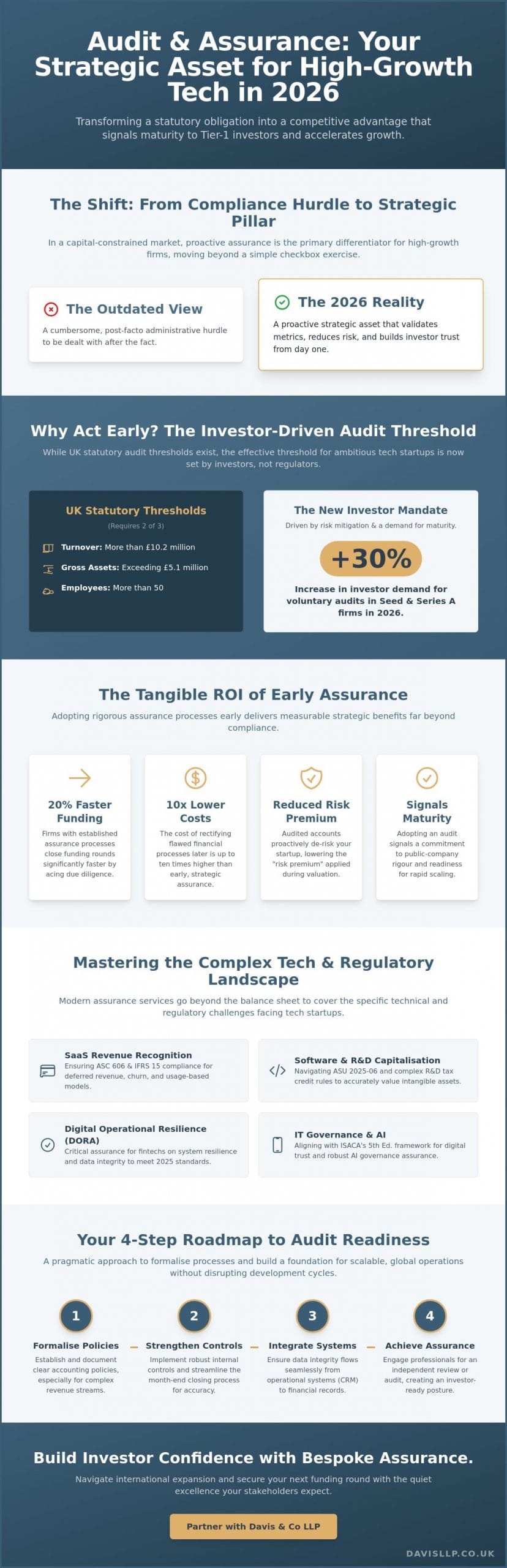
Independent verification provides a level of comfort that internal reports simply cannot match. It validates your growth metrics and ensures that your burn rate and runway are calculated with precision. This proactive approach allows the board to identify operational inefficiencies or control gaps before they become systemic risks. By the time a startup reaches international scale, the cost of rectifying a flawed revenue recognition process is often ten times higher than the cost of early, strategic assurance. We’ve found that firms with established assurance processes often close funding rounds 20% faster than those scrambling to reconcile accounts during a data room review.
Statutory vs. Voluntary Audits: When to Act
In the UK, the statutory threshold for an audit usually applies to companies meeting two of three criteria: a turnover of more than £10.2 million, gross assets exceeding £5.1 million, or more than 50 employees. However, the effective threshold for tech companies is often much lower. We’ve seen a 30% increase in investors demanding voluntary audits for Seed and Series A firms in early 2026. Early adoption sets a professional tone, signalling to your board a commitment to public-company rigour and ensuring your finance function is prepared for the rapid scaling ahead.
The Evolution of Assurance in the Tech Sector
Assurance isn’t confined to the balance sheet anymore. Following ISACA’s 5th edition of the IT Audit Framework in February 2026, the focus has moved to digital trust and AI governance. Modern audit and assurance services for tech startups now include “negative assurance” on non-financial data, such as system resilience and data integrity. This is critical for fintechs meeting Digital Operational Resilience Act (DORA) standards, which became fully enforceable in early 2025. We ensure your reporting reflects your technical sophistication and aligns with the board’s long-term strategic vision.
Navigating Complex Financial Reporting: SaaS, AI, and R&D
For the modern tech founder, financial statements are more than just a historical record; they’re a technical blueprint of the company’s value. In 2026, a startup’s worth is frequently tied to intangible assets such as proprietary AI models and custom software architectures. Standard bookkeeping often fails to capture this value accurately, which is where professional audit and assurance services for tech startups become indispensable. These services provide the intellectual rigour needed to value patents and software while ensuring that cross-border sales comply with the latest international accounting standards.
Research indicates that rigorous early-stage startup performance is closely correlated with the clarity of financial metrics provided to potential backers. When your reporting is transparent, it removes the friction that often stalls late-stage funding rounds. We help you move beyond surface-level metrics to a state of “audit readiness” that satisfies both the FRC and sophisticated global investors.
Revenue Recognition and SaaS Metrics
Moving from “bookings” to “recognised revenue” under IFRS 15 and ASC 606 is a common stumbling block for SaaS platforms. The complexity increases significantly with usage-based pricing models and tiered subscriptions that were prevalent throughout 2025. Our assurance process involves a detailed verification of:
- Deferred Revenue: Ensuring that multi-year contracts are amortised correctly over the performance period.
- Churn and CAC: Verifying that customer acquisition costs and churn rates are calculated using consistent, defensible methodologies.
- Contract Modifications: Addressing how mid-cycle upgrades or “freemium” conversions impact your top-line reporting.
R&D Tax Credits and Grant Assurance
The FRC and HMRC have significantly increased their scrutiny of R&D claims in 2026. It’s no longer enough to provide a high-level summary of innovation; you need robust documentation that distinguishes between pure R&D activities and standard operational maintenance under ASC 730. For those receiving Innovate UK funding, the reporting requirements are even more stringent, often requiring independent accountant’s reports to release subsequent grant tranches.
Under the 2026 regulatory framework, software startups must distinguish between Research and Development costs under ASC 730 while having the option to early-adopt ASU 2025-06 for capitalising internal-use software costs. If you’re preparing for a capital event, our team can provide a bespoke advisory session to review your current reporting framework and ensure your R&D documentation is beyond reproach.
Building Investor Confidence through Robust Assurance
In the capital-constrained environment of 2026, investors aren’t just buying into your code or your growth trajectory; they’re buying into the reliability of your financial reporting. A robust set of accounts serves as a strategic asset that effectively reduces the “risk premium” applied during valuation. When potential backers see you’ve engaged professional audit and assurance services for tech startups, they view it as a signal of board-level maturity and sophisticated corporate governance. This “trust architecture” is often what separates firms that secure Tier-1 funding from those that stall during final negotiations.
Beyond the balance sheet, assurance plays a pivotal role in building enterprise-level B2B trust. For startups targeting global contracts, SOC 1 and SOC 2 readiness has become a non-negotiable requirement. These reports verify that your internal controls and data security protocols meet international standards, providing the transparency that large-scale corporate partners demand. By addressing these requirements proactively, you position your startup as a dependable partner rather than a compliance risk.
Due Diligence Readiness
The due diligence process is frequently where deals go to die, often due to avoidable financial “red flags.” Auditors frequently catch unreconciled intercompany balances or inconsistent revenue recognition before they reach a potential investor’s desk. Pre-verified financial statements streamline the data room process, allowing your team to focus on growth rather than answering historical accounting queries. Additionally, a clean audit opinion significantly improves terms for venture debt and traditional lending, as banks in 2026 increasingly prioritise firms with established statutory rigour.
Governance and Internal Controls
Implementing a segregation of duties in a lean startup environment is a common challenge. We focus on pragmatic solutions that provide oversight without stifling your operational speed. As AI-led bookkeeping becomes the norm, our assurance process verifies the integrity of these automated systems, ensuring that your algorithms aren’t compounding errors. We also place a high priority on the accurate accounting of share options and EMI schemes. Protecting founder equity requires precise reporting, as errors in cap table management can lead to significant tax liabilities or disputes during an exit event. Our bespoke approach ensures your internal controls are both robust and scalable.
A Roadmap to Audit Readiness: Preparing for the First Audit
Transitioning from founder-led accounting to a formal statutory framework requires a deliberate, phased approach. It’s a common misconception that audit preparation begins at year-end; in reality, the most successful 2026 audits are the result of year-round discipline. By the time the auditor arrives, your finance function should already operate with the rigour of a public company. Adopting professional audit and assurance services for tech startups early allows you to build this maturity incrementally, ensuring that the first formal opinion is a milestone of success rather than a source of operational friction.
We recommend a five-phase roadmap to ensure your team is prepared for the scrutiny of an external review:
- Phase 1: Establish a robust month-end close process and a comprehensive reconciliation schedule to ensure all ledger entries are supported by primary evidence.
- Phase 2: Formalise your accounting policies, particularly those regarding revenue recognition, R&D capitalisation, and stock valuation, ensuring they align with 2026 regulatory updates.
- Phase 3: Centralise all documentation, including board minutes, cap tables, and material contracts, within a secure, accessible digital environment.
- Phase 4: Engage with your auditors early in the financial year to discuss complex or unusual transactions before they’re finalised.
- Phase 5: Conduct a “dry run” or internal review of controls to identify potential weaknesses in your financial reporting architecture.
The Documentation Trail
Modern audit readiness has moved beyond the era of static spreadsheets. Cloud-based accounting systems are now the baseline for any audit and assurance services for tech startups, providing the real-time data integrity that auditors require. This digital trail is especially critical when interpreting “substance over form” in complex licensing agreements. Auditors look past the label of a contract to its economic reality, and having a clear trail of correspondence and delivery milestones is vital. Maintaining a comprehensive fixed asset register is essential for hardware-tech startups to track the depreciation and physical location of specialised equipment throughout its lifecycle.
Engaging the Right Partner
Selecting an auditor is a strategic decision that shouldn’t be based on fee alone. A generalist firm may lack the technical depth to understand the nuances of SaaS churn or the specificities of Innovate UK grant reporting. A partner with a dedicated tech sector focus brings a “chartered” perspective that can navigate the statutory complexities of 2026, such as the PCAOB’s QC 1000 standards. Understanding how to find a chartered accountant who understands your specific vertical is the first step toward a successful partnership.
If you’re preparing for your first statutory filing, our team can provide a pre-audit diagnostic review to identify and resolve potential issues before they reach the auditor’s desk.
Bespoke Assurance: The Davis & Co LLP Approach
Davis & Co LLP provides a level of assurance that transcends simple statutory compliance. Our approach is rooted in the philosophy of “Quiet Excellence,” where we deliver deep technical rigour without disrupting the creative momentum of your development cycles. By selecting our audit and assurance services for tech startups, you gain a partner that understands the specific trajectory of high-growth firms. We integrate our findings with strategic international tax planning to ensure your corporate structure is as efficient as it is compliant as you move into global markets. This integration is vital; an audit should never exist in a vacuum, but should instead inform your broader commercial objectives.
We recognise that a tech startup’s needs evolve rapidly. Whether you’re navigating the complexities of the PCAOB’s QC 1000 standards effective from December 2026 or adjusting to the latest R&D capitalisation rules, our solutions are tailored to your current stage. We provide the institutional gravitas required to satisfy a board of directors while maintaining the agility necessary to support a fast-moving tech enterprise. This balance allows us to act as a strategic partner from your initial seed rounds through to a successful international exit.
A Strategic Partnership for Growth
Our work doesn’t end with the issuance of an audit report. We provide management letters and insights that help you refine your internal controls and financial architecture. Many founders start their journey by leveraging our small business accountant expertise, which allows us to build a foundational understanding of your business before the first statutory audit is even required. This continuity ensures that your transition is managed by a multi-disciplinary team with deep expertise in Tax, VAT, and Company Secretarial matters. We focus on the human and business impact of financial data, ensuring your board remains well-advised at every turn.
Confidence in a Volatile Market
In a volatile 2026 market where 80% of accounting firms have increased their fees, the composed and professional presence of a trusted advisor provides the security that sophisticated investors demand. Our national presence, combined with a worldwide perspective on compliance, ensures that your startup is prepared for any regulatory environment, including the nuances of the Digital Operational Resilience Act (DORA). We act as a dependable constant, providing the intellectual rigour and discretion your commercial matters require. To discuss how we can support your scaling objectives with a tailored approach, please contact our Audit and Assurance team for a bespoke consultation.
Securing Your Startup’s Strategic Future
Scaling a high-growth tech venture requires more than technical innovation; it demands a foundation of financial integrity that withstands global scrutiny. We’ve explored how establishing professional audit and assurance services for tech startups early in your lifecycle transforms a statutory obligation into a strategic advantage. By aligning your SaaS revenue recognition and R&D documentation with 2026 standards, you provide the transparency that Tier-1 investors and international regulators now expect as a baseline.
As Chartered Certified Accountants since 1901, Davis & Co LLP brings a history of reliability to the fast-paced tech and dental sectors. Our specialist partners focus on growth acceleration and international tax planning, ensuring your financial architecture is as scalable as your software. We provide the intellectual rigour and quiet excellence necessary to navigate a volatile market with absolute confidence. Please discuss your audit and assurance requirements with our specialist partners to begin your journey toward a secure, investor-ready future. Your commitment to financial maturity today is the catalyst for your global expansion tomorrow.
Frequently Asked Questions
What is the difference between an audit and an assurance engagement for a startup?
An audit is a formal, statutory process that provides a high level of “reasonable assurance” that your financial statements are free from material misstatement. Assurance is a broader term that encompasses various levels of review, including limited assurance on specific metrics or systems like SOC 2. While every audit is an assurance engagement, not all assurance engagements reach the comprehensive depth of a full statutory audit.
At what point does a UK tech startup legally require a statutory audit?
A UK company typically requires a statutory audit if it meets at least two of the following criteria: an annual turnover exceeding £10.2 million, gross assets worth more than £5.1 million, or an average of more than 50 employees. These thresholds remain the standard in 2026. You might also require an audit if your company’s articles of association demand it or if a shareholder owning at least 10% of shares requests one.
Can a voluntary audit help my startup secure venture capital funding?
A voluntary audit acts as a powerful signal of corporate maturity and financial transparency to potential backers. In a cautious 2026 capital market, roughly 30% of early-stage firms choose voluntary audit and assurance services for tech startups to reduce the “risk premium” during valuation. It proactively resolves accounting issues, ensuring that your due diligence process doesn’t stall when you’re close to signing a term sheet.
How long does the first-year audit process typically take for a tech firm?
The first-year audit process usually spans between six and twelve weeks from the initial planning phase to the final signing of the auditor’s report. This timeline depends heavily on the complexity of your revenue models and the readiness of your documentation. Firms with well-maintained cloud accounting systems often experience shorter timelines, as the digital trail allows for more efficient evidence gathering and testing.
What are the specific accounting challenges for SaaS companies during an audit?
SaaS companies face significant scrutiny regarding revenue recognition under IFRS 15, particularly concerning multi-year contracts and usage-based pricing. Auditors also focus on the correct capitalisation of R&D costs and the distinction between research and development activities. Ensuring that deferred revenue is accurately tracked and that churn rates are supported by verifiable data are critical hurdles that require technical rigour during the engagement.
How much does an audit for a tech startup typically cost?
Fees for audit services are bespoke and depend on the scale and complexity of your operations. However, industry data from late 2025 shows that 80% of accounting firms planned to increase their fees in 2026 due to rising business costs. While a full statutory audit is a significant investment, it’s distinct from monthly CFO or controller services, which frequently exceed $2,500 per month for high-growth firms.
Can my current bookkeeper also perform our statutory audit?
Ethical standards and statutory regulations strictly prohibit your bookkeeper from performing your audit. This independence is essential to ensure the audit remains an objective, third-party verification of your financial position. Professional audit and assurance services for tech startups must be delivered by a registered auditor who has not been involved in the day-to-day preparation of the accounts they’re examining.
What happens if our startup receives a “qualified” audit opinion?
A qualified opinion indicates that the auditor has found specific areas where your accounts don’t fully comply with accounting standards, even if the rest of the statements are fair. This can be a significant red flag for investors and may impact your ability to secure debt or equity. It usually necessitates an immediate review of your internal controls to rectify the underlying issues before your next reporting period.