For many UK businesses, the boundary between a mandatory statutory audit and a voluntary financial review will be defined by a single pound sterling as the new thresholds take effect in 2026. We recognise the apprehension that comes with evolving regulations. It’s understandable to worry about the risk of Companies House penalties or the high costs of commissioning an audit that your business doesn’t strictly require. Identifying exactly what is an audit exemption uk means for your specific circumstances is a vital step in protecting your firm’s bottom line.
This guide provides the clarity you need to confirm your eligibility under the revised 2025 and 2026 criteria, helping you optimise your financial operations while remaining fully compliant. We’ll detail the specific legal thresholds, the strategic implications of your choice, and a clear plan for your next statutory filing. By aligning your reporting with these updated standards, we can ensure your business maintains its professional standing without incurring unnecessary overheads.
Key Takeaways
- Understand what is an audit exemption uk and how this statutory provision under the Companies Act 2006 can alleviate the administrative and financial weight on your business.
- Identify the updated 2026 qualifying thresholds, including the £15 million turnover limit, to determine your eligibility under the “two out of three” rule.
- Explore specialised exemptions for dormant companies and subsidiaries to ensure your corporate structure remains both compliant and operationally efficient.
- Evaluate the strategic merits of pursuing a voluntary audit to enhance your firm’s credibility with lenders and secure more favourable commercial terms.
- Navigate the nuances of your compliance obligations, including the 10% shareholder rule and the correct procedure for claiming exemptions on your 2026 financial statements.
Understanding Audit Exemptions in the UK: A Statutory Overview
In the UK’s corporate framework, an audit exemption represents a vital statutory relief for qualifying entities. It’s a provision defined primarily within the Companies Act 2006 that allows smaller companies to forgo the annual external examination of their financial statements. We view this not merely as a reduction in paperwork, but as a strategic advantage that permits directors to reallocate capital toward growth rather than compliance overheads. Understanding what is an audit exemption uk requires distinguishing it from other financial assessments. While a statutory audit provides high-level assurance to shareholders, it’s often a disproportionate requirement for owner-managed firms.
The primary purpose of this exemption is to alleviate the administrative and financial burden on the UK’s Small and Medium-sized Enterprises (SMEs). For a typical small business, an audit can cost several thousand pounds and consume significant internal resources. By opting for an exemption, firms can instead focus on bespoke financial strategies. It’s essential to recognise that an audit differs from an independent financial review; the latter is a less rigorous check often requested by lenders or investors. Companies House acts as the central monitor for this process. They ensure that firms claiming this status meet strict eligibility criteria and file their accounts within the prescribed timelines. Failure to comply with these filing requirements can lead to late filing penalties or even the striking off of the company from the register.
The Legal Basis: Section 477 of the Companies Act 2006
Section 477 grants the specific right to exemption for companies meeting the small business criteria. It isn’t an automatic right. Directors must include a mandatory statement on the balance sheet above their signature. This statement confirms that members haven’t required an audit and that directors acknowledge their legal responsibilities. We remind our clients that even without an audit, the duty to maintain accurate accounting records remains absolute. Accuracy is a statutory requirement, not an optional extra.
Why the UK Government Provides Audit Exemptions
The government’s approach balances necessary oversight with the commercial reality of SME operations. By facilitating a simplified reporting regime, the state encourages entrepreneurship and domestic growth. Thresholds have evolved significantly since the 2016 reforms. As we move into 2026, these standards continue to align with the “small companies regime.” This ensures that approximately 90% of UK businesses remain eligible for these administrative savings, fostering a more competitive and pragmatic business environment. Correctly identifying what is an audit exemption uk for your specific entity is the first step in long-term fiscal planning.
Qualifying for Audit Exemption: The 2026 Thresholds and Criteria
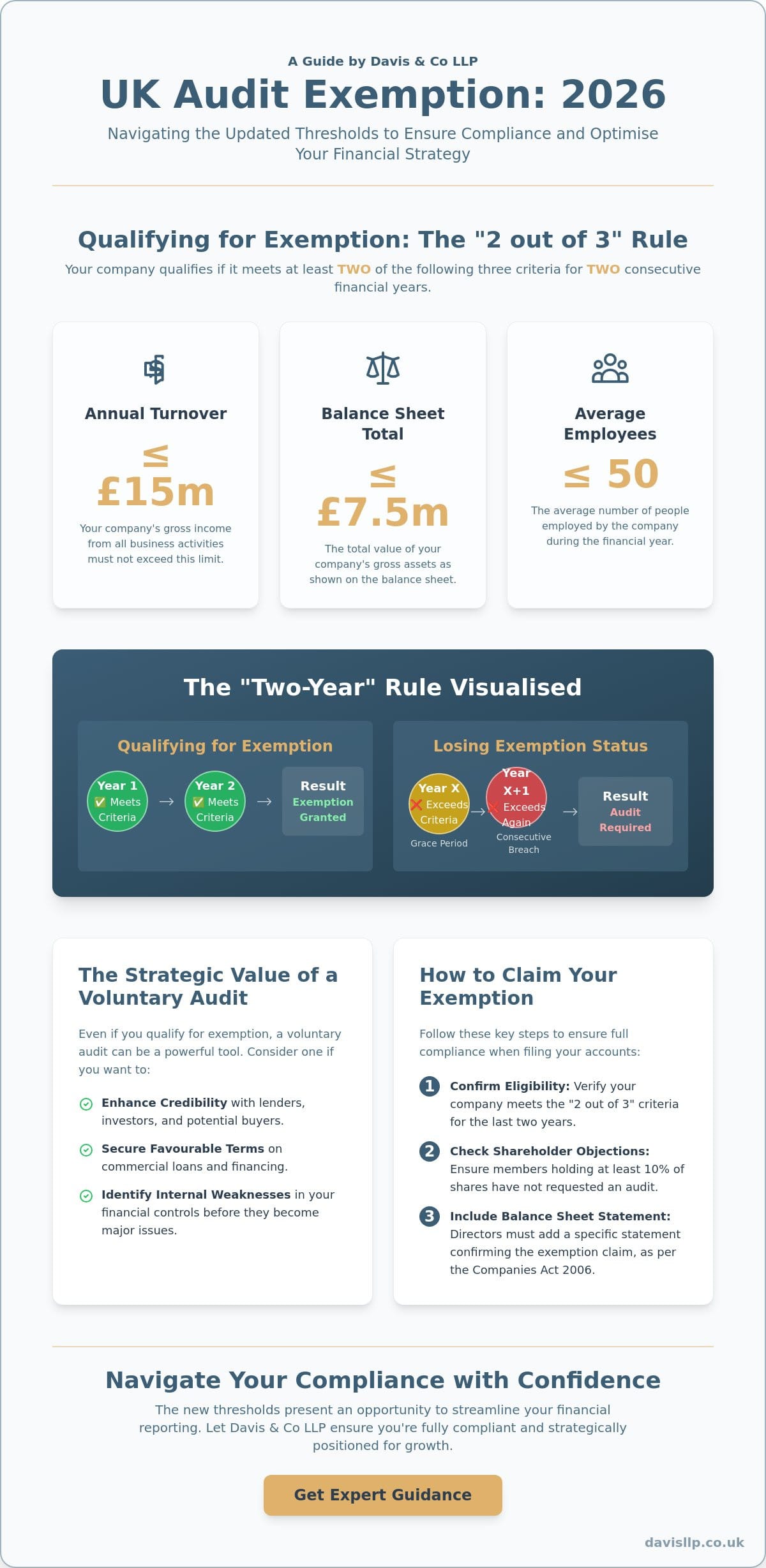
The statutory framework governing what is an audit exemption uk relies on a precise “two out of three” assessment. To qualify for an exemption in the 2026 financial year, a company must satisfy at least two of the following criteria for two consecutive years. These thresholds were updated to reflect the current economic climate and reduce the regulatory burden on growing enterprises.
- Annual Turnover: The company’s gross income must not exceed £15 million.
- Balance Sheet Total: The value of the company’s gross assets must be no more than £7.5 million.
- Average Employee Headcount: The business must employ 50 people or fewer on average throughout the year.
Determining what is an audit exemption uk requires a careful review of these figures at the end of each financial period. While the turnover limit is often the most visible metric, the balance sheet total can frequently be the deciding factor for asset-heavy businesses with lower revenue. We recommend that directors maintain rigorous internal reporting to track these metrics against the 2026 limits.
The “Two-Year” Rule and Grace Periods
The application of these thresholds depends on the company’s history. For a newly incorporated entity, the exemption applies in its first financial year if it meets the criteria. Established companies benefit from a grace period. A business only loses its small company status if it exceeds the limits for two consecutive financial years. This provides a transition year, allowing the board to prepare for the increased scrutiny of a statutory audit. Strategic planning during this window is vital. Our team provides bespoke legal and corporate advice to help firms manage this transition without disrupting their commercial operations.
Ineligible Companies: When an Audit is Always Mandatory
Size is not the only factor in this assessment. Certain entities are legally barred from claiming an exemption, regardless of their turnover or asset value. Public limited companies (PLCs) are a primary example; they must always undergo an annual audit to protect shareholder interests. This requirement also extends to specialist sectors, including banking, insurance, and e-money institutions, where the public interest necessitates higher transparency.
Group structures present another layer of complexity. If a company is part of an “ineligible group,” it cannot claim an exemption. This occurs if any member of the group is a PLC or a regulated financial body. The ICAEW guidance on eligibility provides a comprehensive overview of how these group exclusions apply to subsidiaries and parent companies. Directors must assess the status of every entity within their corporate structure to ensure compliance with the Companies Act 2006. Failure to identify an ineligible status can lead to significant late-filing penalties and legal complications.
Specialised Exemptions: Subsidiaries and Dormant Companies
Understanding what is an audit exemption uk requires looking beyond standard turnover thresholds. For complex group structures and non-trading entities, specific provisions in the Companies Act 2006 offer alternative pathways to relief. These specialised exemptions aren’t merely administrative shortcuts; they’re strategic tools that require a nuanced understanding of group liability and statutory definitions.
Audit Exemptions for Subsidiary Companies
Under Section 479A of the Companies Act, a UK subsidiary can bypass a statutory audit if its parent company provides a formal guarantee. This parent must be established under the law of an EEA state or within the UK. The primary mechanism involves filing Form AA06 with Companies House, which confirms the parent company’s irrevocable guarantee of all outstanding liabilities at the end of the financial year. When considering what is an audit exemption uk for a subsidiary, the board must weigh the immediate saving of audit fees against the permanent legal link created by this guarantee. We often find that for groups involved in International Tax Planning, this guarantee needs careful calibration. It can inadvertently complicate the group’s global risk profile or affect transfer pricing arrangements if the parent’s exposure isn’t managed with precision.
Dormant Company Status and Filing
Section 480 provides a specific audit exemption for companies that have had no significant accounting transactions during the financial year. It’s a common misconception that a company is dormant simply because it isn’t actively trading. Companies House defines a transaction as “significant” if it must be entered into the company’s accounting records. Even a single bank charge or a professional fee payment can disqualify a firm from dormant status.
- HMRC vs. Companies House: HMRC may consider a company dormant for Corporation Tax if it isn’t trading, but Companies House requires absolute transactional silence.
- The Transaction Trap: Payment for shares, late filing penalties, or even certain bank interest can trigger a loss of dormant status.
- Filing Benefits: Truly dormant entities benefit from simplified “dormant accounts,” significantly reducing the burden of the annual return process.
For entities held purely for asset protection or intellectual property holding, maintaining this status ensures the entity remains compliant without the £5,000 to £12,000 expense typically associated with a mid-market audit in the UK. We provide bespoke advice to ensure that holding companies don’t accidentally breach these rules through minor administrative oversights. The transition from dormant to active status must be timed perfectly to maintain regulatory integrity while pursuing commercial objectives.
The Strategic Value of a Voluntary Audit
Directors often ask why they should incur the professional fees of a voluntary audit when their company technically meets the criteria for exemption. While understanding what is an audit exemption uk allows you to legally bypass the process, choosing to forgo it can sometimes be a missed commercial opportunity. We view the audit not as a burdensome compliance exercise, but as a rigorous validation of your financial integrity that carries significant weight in the City and beyond.
An independent review provides a layer of security that internal reporting cannot replicate. It isn’t just about catching errors; it’s about verifying that your business’s financial narrative is accurate and robust. For companies planning a transition or seeking to strengthen their market position by 2026, the voluntary audit serves as a badge of transparency that distinguishes a growing enterprise from its less disciplined peers.
Building Trust with Stakeholders
Credibility is the primary currency of business growth. When you present audited accounts to a high-street lender or a private equity firm, you’re providing a level of assurance that simplifies their due diligence process. Many small business accountants recognise that audited figures can lead to more competitive interest rates and higher credit limits, as credit insurers are 30% more likely to offer favourable terms to transparent organisations.
This transparency is equally vital for internal harmony. Under Section 476 of the Companies Act 2006, minority shareholders holding just 10% of any class of shares can demand an audit. By proactively choosing a voluntary audit, you reassure these stakeholders and prevent potential disputes before they arise. It demonstrates a commitment to “quiet excellence” and fiscal responsibility that protects the interests of all parties involved.
Audit as a Growth Accelerator
Moving from a compliance mindset to a strategic one allows the audit process to uncover hidden value. During the review, we often identify tax efficiencies or unclaimed R&D opportunities that might have been overlooked in standard bookkeeping. With HMRC’s 2024 crackdown on R&D tax credit fraud, having an audited trail ensures your claims are technically sound and defensible.
A voluntary audit functions as a diagnostic tool that identifies structural vulnerabilities and operational waste before they escalate into systemic failures. Beyond the balance sheet, the process evaluates your internal controls. The Association of Certified Fraud Examiners reports that organisations with robust audit controls reduce fraud losses by up to 50%. This independent oversight ensures that waste is minimised and your capital is deployed effectively.
If you’re evaluating whether your current financial reporting meets the needs of your 2026 growth strategy, our team can provide a bespoke assessment of your requirements. Knowing what is an audit exemption uk is only the first step; deciding when to waive that exemption is where true strategic advantage is found.
Navigating Your Compliance Obligations with Davis & Co LLP
Correctly claiming an exemption on your 2026 financial statements requires more than a simple omission of an auditor’s report. It demands a precise statutory declaration on the balance sheet. Directors must state that the company is entitled to exemption under section 477 of the Companies Act 2006 for the year in question. This statement is a legal requirement. It confirms that the members haven’t required an audit and that the directors acknowledge their responsibilities for maintaining accurate accounting records. For many directors, understanding what is an audit exemption uk involves recognising these administrative nuances to avoid unnecessary queries from Companies House.
Filing timelines remain rigid. For a private company, you’ve got nine months after the financial year-end to submit your accounts. If your 2026 year-end is 31 December, your deadline is 30 September 2027. We manage these schedules with a deliberate, measured approach to ensure every filing is both punctual and compliant. This level of oversight prevents the automatic civil penalties that accrue the moment a deadline is missed; these can escalate quickly from £150 to £1,500 for private companies depending on the duration of the delay.
The Shareholder Request: Section 476
The right of shareholders to demand an audit is a critical check on corporate governance. Under Section 476 of the Companies Act 2006, any member or group of members representing at least 10% of the nominal value of the company’s issued share capital can force an audit. This holds true even if the company otherwise meets the criteria for what is an audit exemption uk. The request must be made in writing and delivered to the company’s registered office at least one month before the end of the financial year. For companies with a year-end of 31 December 2026, the cut-off is 30 November 2026.
When disputes arise between directors and minority shareholders regarding the need for an audit, the situation requires a calm, professional resolution. We provide the intellectual rigour needed to navigate these tensions. Our role is to ensure that all parties understand their statutory rights while protecting the company’s commercial interests. It’s often about balancing the costs of an audit against the transparency required to maintain shareholder confidence and internal harmony.
Choosing the Right Partner for Your Accounts
Deciding to claim an exemption shouldn’t be a decision made in isolation. It’s a strategic move that benefits from professional tax advice in the UK. We don’t just process numbers; we offer a composed partnership that looks at the wider impact on your business’s reputation and its standing with financial institutions. Lenders sometimes insist on audited accounts regardless of statutory exemptions. We help you evaluate these external pressures to ensure your business remains secure and well-advised through every growth phase.
Our bespoke approach ensures your statutory accounts are prepared with the same precision as if they were being audited. This provides a sense of order and reliability that reinforces your firm’s credibility. Whether you’re a small start-up or a growing commercial entity, we act as a dependable constant in a volatile regulatory environment. Contact Davis & Co LLP for a bespoke review of your audit requirements.
Securing Your Statutory Strategy for 2026
Grasping what is an audit exemption uk requires a clear view of the 2026 thresholds, which remain pivotal for SMEs managing their regulatory burden. While meeting two of the three criteria, such as a turnover under £10.2 million, total assets below £5.1 million, or fewer than 50 employees, grants relief, the decision shouldn’t be purely administrative. A voluntary audit often serves as a catalyst for SME growth acceleration and provides the robust assurance required by international stakeholders and lenders.
As Chartered Certified Accountants with over 100 years of expertise, we recognise that compliance is a strategic tool rather than a mere formality. We act as trusted advisors for complex statutory compliance, ensuring your business remains resilient amidst evolving UK regulations. We’ll help you determine if a bespoke assurance review aligns with your commercial objectives or if your subsidiary qualifies for specialised exemptions. Our specialists in international tax and corporate growth are ready to provide the intellectual rigour your business deserves.
Consult our specialists for a bespoke audit and assurance review to secure your firm’s financial integrity for the years ahead. We look forward to helping you navigate these requirements with confidence and precision.
Frequently Asked Questions
Can a company be audit exempt but still need to file full accounts?
Yes, audit exemption and the format of accounts filed at Companies House are separate statutory requirements. While you may qualify for an audit exemption in the UK, you might still choose or be required by shareholders to file full accounts rather than filleted versions. Under the Companies Act 2006, qualifying small companies can omit the directors’ report from their public filing, but this is a distinct choice from the audit itself.
What happens if I miss the deadline for claiming an audit exemption?
Missing the filing deadline results in automatic late filing penalties, but it doesn’t revoke your right to an audit exemption for that period. Penalties for private companies range from £150 for being one month late to £1,500 for delays exceeding six months. If your articles of association or a 10% shareholder group request an audit by the statutory deadline, you must comply regardless of your small company status.
Is a subsidiary of a US company eligible for a UK audit exemption?
A UK subsidiary of a US parent can qualify for an audit exemption under Section 479A of the Companies Act 2006 if the parent company provides a statutory guarantee. The US parent must guarantee all outstanding liabilities of the UK subsidiary at the balance sheet date. This process involves filing Form AA06 and the parent’s consolidated accounts, translated into English, to satisfy the what is an audit exemption uk regulatory framework.
Can my bank demand an audit even if I meet the small company criteria?
Yes, banks and other lenders frequently include a requirement for audited financial statements as a condition of a loan agreement or credit facility. While you may satisfy the government’s thresholds for a small company, these are private contractual obligations. We often see commercial lenders insist on this level of assurance to mitigate risk, especially for facilities exceeding £250,000 or those involving complex asset-backed lending structures.
How much does a voluntary audit typically cost for a UK SME?
Fees for a voluntary audit typically start at approximately £5,000 for a micro-entity and can exceed £20,000 for larger SMEs with complex operations. According to 2023 industry benchmarks, the average cost for a standard UK small business audit sits between £8,000 and £12,000. These costs reflect the rigorous testing and professional liability the auditor assumes to provide an independent opinion on your firm’s financial health.
What is the difference between a dormant company and a small company for audit purposes?
A dormant company has had no significant accounting transactions during the financial year, whereas a small company is active but falls below specific financial thresholds. Both may qualify for an audit exemption, but the criteria differ. A company is dormant under Section 1169 of the Companies Act 2006 if it only processes filing fees. Small companies must meet two of three criteria: turnover under £10.2 million, assets under £5.1 million, or fewer than 50 employees.
Does an audit exemption also exempt me from paying Corporation Tax?
No, an audit exemption has no impact on your liability for Corporation Tax or your obligation to file a CT600 return with HMRC. The exemption only relates to the independent verification of your financial statements. You must still calculate your taxable profits accurately and pay the current main rate of 25%, or the small profits rate of 19% if your annual profits remain below £50,000.
Can I change from an audited to an audit-exempt status mid-year?
You can decide to claim an audit exemption at any point before your accounts are formally approved by the board of directors. The decision is made annually based on the financial figures for the entire period. If your business fell below the thresholds in the 2024 financial year and continues to do so in 2025, you can transition to an exempt status when preparing your next bespoke year-end filing.