Could a single overlooked ledger entry jeopardize your entire litigation strategy? In 2024, the UK Fraud Indicator estimated that fraud costs the national economy over £190 billion annually, yet many directors remain unaware of quiet vulnerabilities within their own accounts. We recognize that when you’re facing a high-stakes commercial dispute or the intricate valuation of assets during a partnership split, the weight of financial uncertainty is significant. It’s a burden that requires more than standard bookkeeping. It demands the surgical precision of specialized forensic accounting services uk to uncover the definitive financial truth.
In this guide, we’ll demonstrate how professional forensic analysis protects your assets and transforms opaque financial data into robust, court-admissible evidence. You’ll learn how we quantify losses with absolute clarity and resolve the most complex commercial disputes through bespoke investigation. We’ll explore the strategic methodologies that will define the financial landscape in 2026, ensuring your interests remain secure and your decisions are backed by intellectual rigour.
Key Takeaways
- Understand why professional forensic accounting services uk are increasingly vital for safeguarding assets and navigating the complex financial landscape of 2026.
- Distinguish between standard statutory audits and forensic investigations to ensure your business identifies hidden risks that traditional reporting might overlook.
- Explore the diverse applications of forensic expertise, ranging from high-stakes corporate fraud investigations to nuanced litigation support for private clients.
- Demystify the investigative journey to learn how a structured, partner-led approach provides the clarity and evidence necessary for successful dispute resolution.
- Learn how bespoke, discreet strategies allow for the resolution of complex international and domestic financial matters with professional precision and “quiet excellence.”
The Role of Forensic Accounting Services in the UK
Forensic accounting represents a specialised discipline where financial expertise meets the rigour of legal investigation. It’s more than just auditing; it’s the meticulous reconstruction of financial events to meet a standard of proof required in a court of law. As we move through 2026, the demand for Forensic Accounting has intensified. This is largely due to the increasing sophistication of corporate structures and the rise of complex digital transactions that traditional audit methods might overlook.
The 2026 UK economic climate has seen businesses facing heightened scrutiny from both regulators and shareholders. Recent data indicates a 12% rise in reported commercial disputes involving asset misappropriation since 2024. Forensic accountants serve as the critical bridge, translating opaque ledger entries into clear, evidence-based narratives for legal proceedings. They provide the clarity required to resolve complex disputes with intellectual rigour.
At Davis LLP, we provide bespoke solutions that distinguish between reactive investigation and proactive risk mitigation. Reactive services address existing crises like fraud, embezzlement, or shareholder disputes. Conversely, proactive strategies focus on strengthening internal controls to prevent such issues from arising. This dual approach ensures that commercial objectives remain protected against both internal and external threats, offering a sense of security in a volatile market.
When Should You Engage a Forensic Accountant?
Engaging forensic accounting services uk providers often happens when “red flags” appear. These might include unexplained gaps in financial reporting, sudden changes in a partner’s lifestyle, or anomalies in supplier payments. Early intervention often facilitates dispute resolution without the need for a full court hearing. Solicitors rely on independent financial experts to build robust cases that stand up to intense cross-examination. We act as a steady partner in these high-stakes environments, ensuring that every financial detail is accounted for.
The Legal and Regulatory Framework in 2026
The regulatory landscape in 2026 is defined by stricter adherence to the Civil Procedure Rules regarding expert witnesses. HMRC’s recent shift towards AI-led tax audits has also increased the need for forensic tax investigations to ensure statutory compliance. Maintaining professional scepticism and total independence is non-negotiable for any credible expert. This ensures that the evidence remains admissible and credible under the highest levels of judicial scrutiny. We provide a reliable constant, ensuring our clients are well-advised and their evidence is beyond reproach.
Core Disciplines: From Fraud Investigation to Litigation Support
The landscape of forensic accounting services uk has transitioned from reactive auditing to a sophisticated blend of data science and legal strategy. In 2026, the complexity of global supply chains and digital asset structures requires a multi-disciplinary approach that prioritises precision over simple calculation. We apply a rigorous methodology to unravel financial webs, ensuring that every finding is both legally sound and commercially relevant. The Role of a Forensic Accountant now involves leveraging AI-driven pattern recognition to identify anomalies that traditional sampling might miss, providing a level of depth that’s essential for modern courtroom testimony.
Commercial Dispute Resolution and Valuations
Disputes often hinge on the precision of loss quantification. Whether we’re addressing a breach of contract or professional negligence, we provide objective assessments that withstand the pressure of the witness box. In shareholder disputes, our valuations reflect the nuanced reality of market conditions in 2026, moving beyond static balance sheets to include intellectual property and future earnings potential. We ensure that our clients enter negotiations with a clear, defensible understanding of their financial position. High-quality forensic accounting services uk turn speculative claims into evidence-based arguments, which often facilitates earlier settlements before costs escalate.
Financial Crime and Fraud Investigations
The implementation of the “Failure to Prevent Fraud” offence under the Economic Crime and Corporate Transparency Act 2023 has fundamentally altered corporate liability. By 2026, businesses that lack “reasonable procedures” face significant regulatory risk and potential prosecution. Our investigations cover asset misappropriation, bribery, and sophisticated white-collar crime, using trace-and-recovery techniques to follow diverted funds across multiple jurisdictions. We help boards establish the robust frameworks required to meet these statutory demands. It’s no longer enough to react to fraud; organisations must demonstrate a proactive, documented effort to identify vulnerabilities before they’re exploited.
Matrimonial and Private Client Services
In high-net-worth divorce proceedings, the “true” financial position is often obscured by complex trust structures or offshore holdings. We specialise in identifying non-disclosure with absolute discretion, ensuring that the matrimonial pot is accurately represented. Our approach is balanced and intellectual, focusing on the equitable distribution of family wealth while maintaining the necessary professional distance. We understand the emotional weight of these matters and provide a steady, expert hand to secure a fair outcome for our clients. If you require a discreet review of your financial standing, our private client team is available for a confidential consultation to discuss your specific requirements.
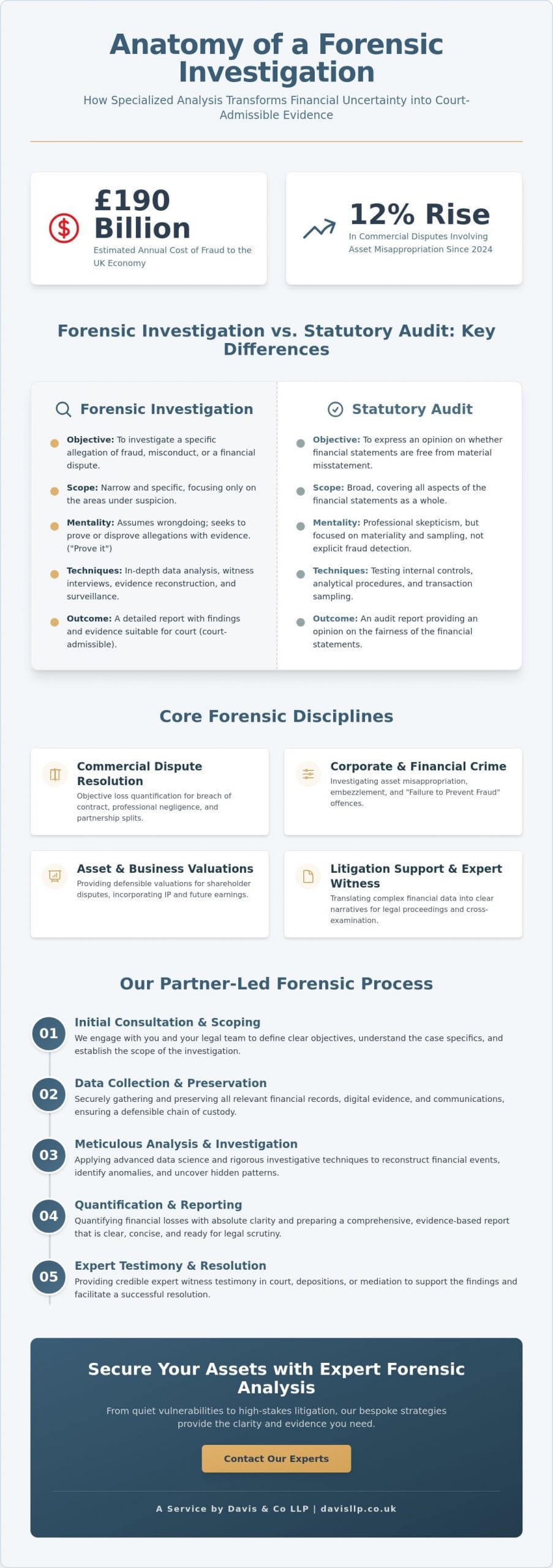
Forensic Accounting vs. Statutory Audit: Key Differences
A common misconception within UK boardrooms is that a clean statutory audit report serves as a guarantee against internal fraud. This is rarely the case. The Financial Reporting Council (FRC) revised ISA (UK) 240 in 2021 to clarify that while auditors must identify risks of material misstatement, their primary duty is to provide “reasonable assurance” that financial statements are fair. They don’t typically hunt for the sophisticated, small-scale deceptions that forensic accounting services uk are designed to catch.
Scope and Objective Comparison
The fundamental divide lies in the depth of the inquiry. Statutory audits rely heavily on sampling. An auditor might examine 5% of transactions to conclude that the accounts are broadly accurate. Conversely, a forensic investigation is exhaustive. It involves a granular analysis of every relevant ledger entry, email, and bank statement to establish the absolute truth of a specific financial event. This requires mastery of the Core Disciplines in Forensic Accounting, which blend technical proficiency with investigative intuition. The forensic mindset is defined by a shift from the auditor’s goal of verifying compliance to an investigator’s objective of identifying intentional deception.
Materiality thresholds also separate the two fields. An auditor might overlook a £15,000 discrepancy if the company’s turnover is £50 million, as it doesn’t skew the “true and fair” view. However, that £15,000 could be the first thread of a larger embezzlement scheme. Forensic accountants ignore these thresholds, knowing that fraud often starts small and stays beneath the auditor’s radar for years.
Reporting and Admissibility
The output of these two disciplines serves entirely different audiences. Audit reports follow a rigid, standardised format intended for shareholders and the public. Forensic reports are bespoke documents drafted for legal counsel, insurance loss adjusters, or the courts. When a dispute reaches the High Court, the forensic accountant often acts as an Expert Witness. This role is governed by Part 35 of the Civil Procedure Rules (CPR), which dictates that the expert’s primary duty is to the court, not the party paying their fees. This level of professional gravitas ensures the findings hold weight during cross-examination.
These investigations frequently intersect with complex tax matters. For instance, discovering diverted funds often triggers immediate liabilities or penalties from HMRC. In such cases, integrating expert tax advice in the UK ensures that the forensic findings are used to mitigate tax-related fallout while maintaining compliance. By combining these specialisms, an organisation can move from a state of vulnerability to one of informed financial integrity.
- Audits: Focus on historical accuracy and general compliance.
- Forensic Services: Focus on specific allegations, asset recovery, and legal proof.
- Collaboration: Using forensic insights to strengthen internal controls identified as weak during an audit.
The Forensic Process: What to Expect During an Investigation
Engaging a specialist for forensic accounting services uk often follows a period of significant corporate or personal stress. We understand this. Our approach is designed to replace uncertainty with a methodical, evidence-led framework. The journey begins with a private consultation where we define the specific objectives of the instruction. This initial step is vital. It prevents “scope creep” and ensures every hour spent contributes directly to the final resolution. We demystify the investigative process by providing a clear roadmap from the outset, allowing clients to regain a sense of control.
Phase 1: Planning and Data Acquisition
We identify key sources of evidence, which frequently include “off-book” records and digital footprints. In the UK, digital evidence now features in approximately 90% of commercial disputes according to recent judicial reviews. We establish a secure chain of custody for every document. This ensures that the integrity of the evidence remains unassailable if it’s presented in court. We collaborate closely with legal teams during this phase. This alignment ensures the investigation supports the broader litigation strategy without compromising our independence as experts.
Phase 2: Analysis and Quantification
Our team uses sophisticated forensic technology to identify patterns that manual reviews might miss. We’ve handled datasets involving over 250,000 transactions to isolate a single point of failure or an instance of asset misappropriation. Interviews with personnel are conducted with professional distance and gravitas. These conversations are handled sensitively to gather facts while maintaining the necessary professional scepticism. We quantify the financial impact with absolute precision. We don’t use speculation; we use verified data to build a resilient financial model of the loss or discrepancy.
Phase 3: Reporting and Testimony
The final report moves from complex data to a clear, persuasive narrative. This is where we demonstrate quiet excellence. We ensure the document complies with Civil Procedure Rules (CPR) Part 35, making it suitable for use in UK courts. The report is structured to be accessible to a layperson while remaining rigorous enough for a High Court judge. If the matter proceeds to mediation, arbitration, or trial, our experts provide oral evidence. We respond to cross-examination with composure and intellectual rigour, ensuring our findings are communicated clearly under pressure.
If you require a discreet and methodical investigation into a complex financial matter, we invite you to discuss your requirements with our team. Learn more about our bespoke forensic accounting services uk and how we can provide the clarity you need.
Choosing a Forensic Partner: The Davis & Co LLP Approach
Selecting the right firm for forensic accounting services uk requires looking beyond technical proficiency. At Davis & Co LLP, we define our practice through quiet excellence. We understand that in sensitive commercial disputes or private matrimonial matters, discretion is as valuable as the evidence we uncover. Our partners lead every engagement personally. This ensures that complex international cases benefit from decades of experience rather than being delegated to junior staff. It’s this senior-level oversight that allows us to spot nuances in financial data that others might overlook.
Our work doesn’t exist in a vacuum. We integrate our forensic findings with our established international tax planning capabilities. This provides a holistic view of your financial position, ensuring that any recovery or settlement is structured with long-term fiscal stability in mind. We provide the clarity you need to make informed decisions, transforming chaotic financial records into a clear, evidence-based narrative that stands up to the highest levels of scrutiny.
A Bespoke and Strategic Partnership
We don’t believe in templated investigations. Every business operates within unique commercial realities, and our scope reflects that. Our methodology draws on a deep history of success in audit and assurance. This background provides the investigative rigour needed to withstand the scrutiny of the High Court or HMRC. We communicate clearly and consistently. You’ll always know the status of the investigation, the strength of the evidence, and the likely impact on your commercial objectives. Our goal is to make you feel secure and well-advised throughout what is often a stressful process.
Next Steps for Your Business or Private Matter
Timing is critical in financial investigations. The Association of Certified Fraud Examiners (ACFE) 2024 Report indicates that organizations that implement early intervention measures reduce their median losses by 50 percent. Delaying an investigation often allows digital or financial trails to grow cold, making recovery more difficult. Whether you’re facing a shareholder dispute, a suspected internal fraud, or a complex valuation issue, early professional advice is your best defence.
If you suspect financial irregularities or require a valuation for a legal dispute, we encourage you to arrange a confidential consultation. We’ll discuss your specific challenges and outline a strategic path forward without the need for aggressive marketing or empty promises. Our reputation is built on the results we deliver for our clients in the most challenging circumstances.
Securing Financial Integrity in a Complex Regulatory Environment
The financial landscape of 2026 demands a level of precision that moves far beyond traditional auditing. Since 1901, Davis & Co LLP has served as Chartered Certified Accountants, providing the intellectual rigour and discretion required to navigate high-stakes international and domestic disputes. We recognise that the core of effective forensic accounting services uk lies in the ability to distinguish subtle irregularities from systemic fraud, ensuring that every investigation yields robust evidence for litigation or internal resolution.
Our partner-led service model prioritises a bespoke strategy for every client, whether you’re managing a commercial conflict or a sensitive private matter. We don’t rely on generic templates; instead, we apply a measured, analytical process that transforms complex data into clarity. This commitment to quiet excellence ensures your interests are protected by a firm with over a century of professional history and success. We invite you to discuss your requirements with our forensic experts to see how our expertise can support your strategic objectives. It’s a partnership built on stability, precision, and a deep understanding of the UK’s legal and financial frameworks.
Frequently Asked Questions
What is the average cost of forensic accounting services in the UK?
Hourly rates for senior forensic accountants in London typically range from £250 to £600 according to 2024 industry benchmarks. A preliminary assessment might start at £3,000, while complex litigation support for multi-year cases can exceed £50,000. We provide a bespoke fee structure for each engagement to ensure our services align with your specific commercial objectives and the technical complexity of the matter.
How long does a typical forensic financial investigation take?
A standard forensic financial investigation usually spans between four and twelve weeks. Simple asset traces might conclude within 20 working days, but complex corporate fraud cases involving international jurisdictions often require six months or longer to resolve. The timeline depends on the volume of digital records and the cooperation of third parties. We establish a clear project roadmap at the outset to keep your legal strategy on schedule.
Can forensic accounting evidence be used in a UK court?
Yes, forensic accounting evidence is a fundamental component of UK civil and criminal proceedings. Experts prepare reports in accordance with Part 35 of the Civil Procedure Rules (CPR), ensuring they meet the strict standards required for expert witness testimony. Our practitioners often provide oral evidence in the High Court, where their findings help clarify complex financial data for the judiciary during dispute resolution.
What is the difference between a forensic accountant and a private investigator?
A forensic accountant focuses on the technical analysis of financial records and statutory compliance, while a private investigator typically handles physical surveillance and background checks. While an investigator might track a person’s movements, a forensic accountant traces the digital and physical trail of transactions through ledgers and bank statements. In the context of forensic accounting services uk, our role is to provide the empirical financial evidence needed for legal resolution.
Do I need a forensic accountant for a small business dispute?
Engaging a forensic accountant is often essential for small business disputes, particularly those involving shareholder disagreements or partnership dissolutions. Data from the Federation of Small Businesses suggests that financial transparency is the primary hurdle in 40% of small firm legal conflicts. We help quantify the exact value of a claim, which often leads to a faster settlement and avoids the high costs of prolonged litigation.
Will my business operations be disrupted during a forensic investigation?
We design our investigative processes to minimize the impact on your daily business operations. By utilizing remote data extraction and off-site analysis, we often complete a significant portion of the work without a physical presence in your office. Our team works discreetly to protect your professional reputation. This approach ensures that your staff remains focused on their primary responsibilities while we secure the necessary evidence.
Can a forensic accountant help with HMRC tax investigations?
Forensic accountants play a critical role in HMRC tax investigations by providing a robust defence against allegations of underpayment or fraud. We review historical records to identify errors and ensure that your disclosures are accurate and comprehensive. This proactive approach can lead to a reduction in penalties under the Finance Act 2007, as it demonstrates a commitment to statutory compliance and transparency.
What qualifications should a UK forensic accountant hold?
A qualified UK forensic accountant should be a member of the Institute of Chartered Accountants in England and Wales (ICAEW) or the Association of Chartered Certified Accountants (ACCA). Many also hold the Specialist Forensic Accounting accreditation. These credentials ensure the practitioner adheres to strict ethical standards and possesses the technical rigour required for high-stakes litigation and complex forensic accounting services uk.