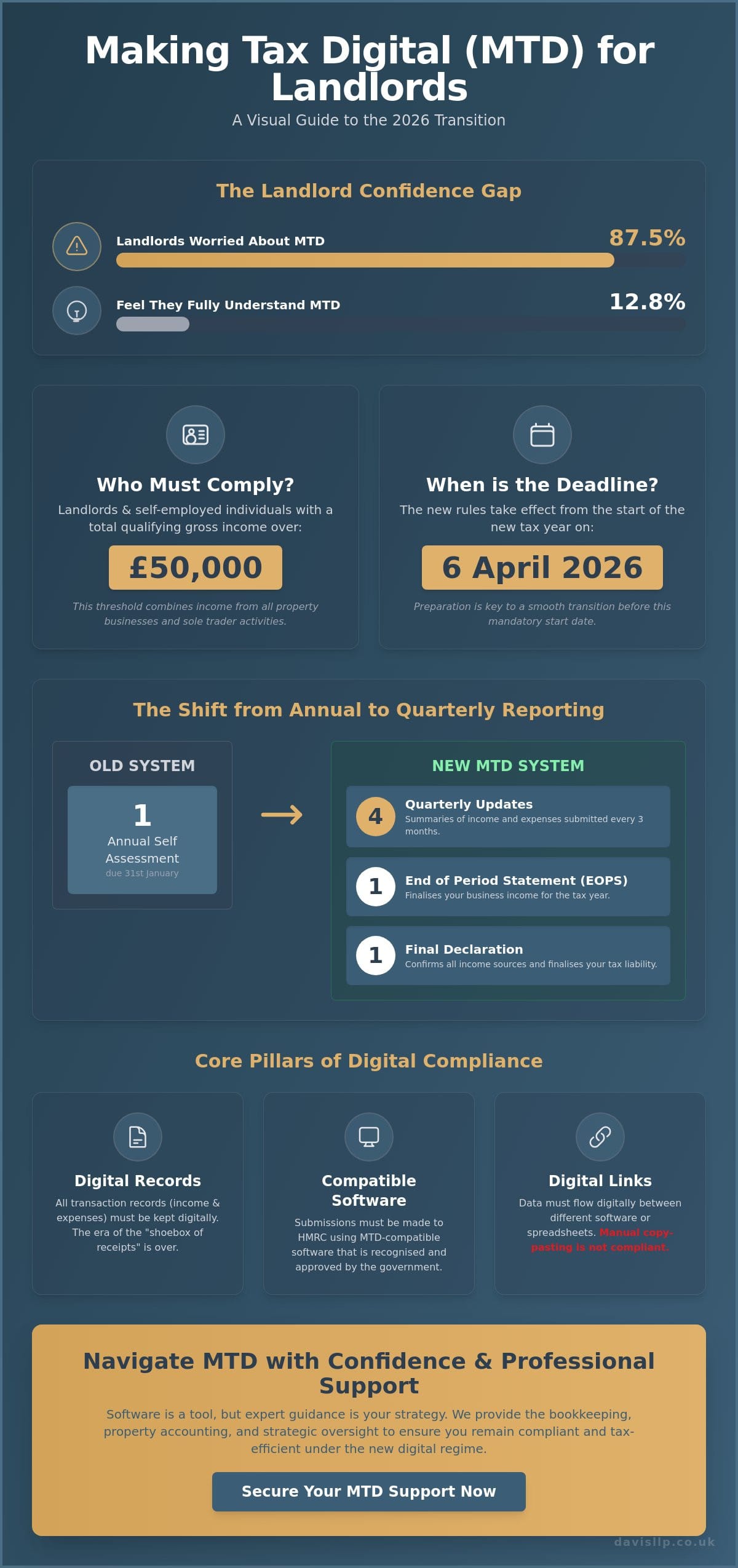
A January 2026 survey revealed that 87.5% of landlords are worried about the shift to the new digital tax regime, yet only 12.8% feel they truly understand what the mandate entails. This significant gap in confidence highlights the pressure facing the 864,000 individuals expected to enter the first wave of compliance on 6 April 2026. If you’re feeling a sense of technical anxiety regarding the move from annual filings to a quarterly cycle, your concerns are well-founded. Managing this transition requires more than just new software; it requires a disciplined approach to real-time record-keeping. Securing professional making tax digital for landlords support is a vital step for those who wish to maintain their tax efficiency while ensuring absolute compliance with HMRC’s new standards.
We recognize that your priority is to protect your property interests from the risks of a new points-based penalty system without becoming overwhelmed by administrative tasks. This guide provides a clear, professional overview of the MTD for Income Tax requirements and the expert advisory services necessary for a seamless transition. We’ll examine the specific income thresholds, the mandatory shift to digital record-keeping, and how our property accounting and bookkeeping expertise can help you remain secure and well-advised as the 2026 deadline approaches.
Key Takeaways
- Understand the mandatory transition from annual Self Assessment to the quarterly reporting model that takes effect for qualifying landlords on 6 April 2026.
- Clarify the technical requirements for digital record-keeping and the necessity of digital links to maintain a compliant audit trail for HMRC.
- Recognize why software is merely a tool and how professional making tax digital for landlords support provides the strategic oversight needed to manage complex property tax matters.
- Establish a clear preparation framework, beginning with a comprehensive portfolio audit to determine your specific reporting obligations and timeline.
- Learn how integrating property accounting and professional bookkeeping services can mitigate the risk of penalty points while preserving your long-term tax efficiency.
Understanding the Mandate: MTD for Income Tax in 2026
The introduction of Making Tax Digital (MTD) for Income Tax Self Assessment (ITSA) represents the most significant overhaul of the UK tax system in a generation. It moves the goalposts from a single, retrospective annual filing to a regime of continuous, digital engagement. This initiative is part of a broader government strategy to modernise tax administration. HMRC aims to reduce the “tax gap,” which is the difference between tax owed and tax collected. Much of this gap stems from avoidable errors in manual record-keeping. For property investors, the era of the annual “shoebox of receipts” is ending.
The first major milestone arrives on 6 April 2026. At this stage, the mandate applies to any individual landlord or self-employed person with a total qualifying income exceeding £50,000. It’s vital to understand that this threshold is based on gross turnover, not net profit. Even if your portfolio’s expenses significantly reduce your taxable income, you must join the digital regime if your gross receipts hit the mark. Securing professional making tax digital for landlords support early is essential. It ensures your systems are robust enough to handle this increased frequency of reporting without disrupting your daily operations.
The Scope of Qualifying Income
Determining whether you fall within the scope of MTD for ITSA requires a holistic view of your revenue streams. HMRC aggregates income from all your property businesses. This includes traditional buy-to-let portfolios, commercial premises, and furnished holiday lets. If you also operate as a sole trader, your business turnover is added to your rental income to determine if you exceed the £50,000 threshold. This cumulative approach means many landlords who previously viewed their property income as a secondary concern may find themselves mandated to comply sooner than expected.
The New Reporting Calendar
The transition replaces the traditional 31st January deadline with a cycle of four quarterly updates. These updates are due by the 7th of August, November, February, and May. Following these submissions, landlords must complete an End of Period Statement (EOPS) for each source of income and a Final Declaration by 31st January of the following year. This new rhythm demands administrative discipline. It requires a strategic partnership to ensure every update is accurate. These submissions form the basis of your ongoing tax liabilities and financial standing with HMRC.
The Mechanics of Digital Compliance: Records and Submissions
Compliance under the new regime is defined by the integrity of your digital trail. It’s no longer sufficient to maintain a ledger that is updated once a year. HMRC now requires landlords to keep digital records of every transaction. These records must include the date of the transaction, the amount, and the specific category of income or expense. According to the official government guidance on MTD, this data must be stored in a digital format that can be shared with HMRC through compatible software. For those with complex portfolios involving both residential and commercial assets, the precision of these records is paramount.
A critical component of this framework is the concept of “digital links.” HMRC defines a digital link as a transfer or exchange of data between software programs, products, or applications. Crucially, this transfer must occur without manual intervention. If you use a spreadsheet to track expenses and software to file your returns, the data must flow between them electronically. Manual copy-pasting is not permitted. This technical requirement often necessitates professional making tax digital for landlords support to ensure that your existing systems are correctly integrated and compliant with the “no manual intervention” rule.
Maintaining Accurate Digital Records
Accurate record-keeping is the foundation of tax efficiency. While software can automate bank feeds, it cannot always distinguish between a revenue expense, such as a minor repair, and a capital improvement. Misclassifying these can lead to significant discrepancies in your tax liability. We recommend maintaining digital evidence, such as scanned receipts or electronic invoices, alongside your transaction data. This discipline simplifies the quarterly submission process and provides a robust defence in the event of an HMRC enquiry. Our property accounting experts help clients establish these workflows to ensure every deduction is captured accurately.
The Final Declaration and Tax Payment
The move to quarterly updates does not change the fundamental timeline for tax payments. You’ll still typically pay your tax by 31st January and 31st July. However, the reporting process culminates in a Final Declaration. This step replaces the old Self Assessment return. It involves reconciling your four quarterly updates and accounting for any adjustments, such as personal allowances or relief for finance costs. Professional oversight during this phase is vital. It prevents the accumulation of errors that might otherwise trigger the new points-based penalty system. By aligning your quarterly data with a comprehensive end-of-year review, you maintain a clear view of your cash flow and liabilities.
Beyond Software: Why Professional MTD Support is Essential
Technology is the engine of the new regime, yet software alone cannot navigate the intricacies of UK property tax law. Many providers market “one-click” solutions that promise simplicity, but this automation often masks underlying complexities. Relying solely on a digital tool for making tax digital for landlords support leaves a significant gap between data entry and strategic compliance. Software records what has happened; a professional advisor explains why it happened and how it affects your long-term position. We believe that true compliance is found at the intersection of robust technology and expert interpretation.
The question of whether a landlord can manage MTD independently often overlooks the increased “surface area” of risk. With four annual updates and a final declaration, there are five distinct opportunities for errors to enter the official record every year. Unlike the previous annual system, where mistakes might be caught during a comprehensive year-end review, the new model requires accuracy in real-time. We position ourselves as a strategic partner, ensuring that your Property Accounting remains precise and that your submissions reflect the true nature of your commercial activities. This professional distance allows us to identify anomalies that an automated system would simply overlook.
Mitigating the Risk of Real-Time Errors
Automated bank feeds are efficient, but they lack the nuance required for property expenses. A software algorithm might categorize a significant roof replacement as a simple repair, when it might actually be a capital improvement. These distinctions are critical. If HMRC observes inconsistent reporting across your quarterly updates, it may increase the likelihood of a formal enquiry. A professional pre-submission review acts as a vital safeguard. We catch miscategorisations before they become part of your permanent tax record, protecting you from the new points-based penalty system.
Strategic Tax Planning in a Digital Framework
The shift to digital reporting offers a unique advantage: access to real-time financial data. Instead of waiting until the end of the tax year to understand your liabilities, we use this quarterly visibility to provide proactive expert tax advice in the UK. This is particularly relevant when managing the impact of Section 24 and finance cost restrictions. By monitoring your portfolio’s performance every three months, we can adjust your strategy to account for changing interest rates or shifting thresholds. This ensures your Personal Tax Services are optimized for maximum efficiency throughout the year, rather than as a retrospective calculation.
Strategic Preparation: A Framework for Landlord Compliance
Preparation is a structured progression rather than a single event. To ensure your operations are optimized before 6 April 2026, we’ve developed a framework designed to facilitate a smooth transition. This approach moves beyond mere awareness, focusing on the practical steps required to secure robust making tax digital for landlords support. By breaking the transition into manageable stages, you can mitigate administrative stress and maintain focus on your portfolio’s performance. Comprehensive support often begins with a rigorous assessment of current data quality and reporting habits.
- Phase 1: Portfolio Audit. Accurately calculating gross income across all property types to determine mandate dates.
- Phase 2: Digital Infrastructure. Selecting and implementing HMRC-compatible software that fits your specific needs.
- Phase 3: Process Integration. Establishing a routine for capturing digital receipts and invoices to maintain real-time records.
- Phase 4: Professional Alignment. Ensuring your advisor has the necessary HMRC authorisations to manage your submissions.
- Phase 5: Ongoing Monitoring. Leveraging quarterly data to inform strategic investment and cash flow decisions.
Auditing Your Property Portfolio
Determining your exact status requires aggregating gross rental income from all sources. This includes residential buy-to-lets, commercial premises, and furnished holiday lets. If you own properties jointly, you must understand how this impacts your individual £50,000 threshold. In most cases, each individual’s share of the gross income is what counts toward their specific MTD mandate. This is a critical time to review any legacy paper-based systems. If your records aren’t already in a digital format, the “clean up” phase must begin now to avoid a frantic transition in early 2026.
Selecting the Right Professional Partner
The complexity of this transition means that choosing an advisor is a strategic decision. You need a firm that offers both technical software proficiency and deep advisory expertise. Some landlords prefer to maintain traditional record-keeping methods using spreadsheets; in these instances, “bridging software” can provide the necessary digital link to HMRC. However, the most effective solutions often involve a full transition to cloud-based Bookkeeping Services. This ensures that every transaction is captured in a format that satisfies HMRC’s “digital link” requirements without manual intervention.
When evaluating potential partners, prioritize those who demonstrate a clear understanding of property-specific tax nuances. You can review our guide on how to find a chartered accountant to better understand the selection criteria for a modern, digital-first practice. Effective making tax digital for landlords support is as much about the quality of the partnership as it is about the software itself. To begin your transition with a partner who understands the high-rent landscape, explore our Property Accounting services today.
Bespoke MTD Support from Davis & Co LLP
At Davis & Co LLP, we recognize that the transition to digital reporting is a significant milestone for any property investor. It requires a move away from traditional retrospective accounting toward a model of continuous, real-time engagement. Our making tax digital for landlords support is designed to bridge this gap, providing a sophisticated framework that balances technical compliance with commercial insight. We don’t simply offer software; we provide a managed environment where your financial data is handled with the discretion and professional gravitas that a high-calibre portfolio demands. Our goal is to ensure that you feel secure and well-advised throughout every stage of the 2026 implementation.
Managed Transition and Implementation
The initial phase of digital adoption is often the most technical. We take a hands-on approach to this transition, ensuring that your digital record-keeping systems are correctly configured from the outset. This includes the technical liaison with HMRC on your behalf, removing the administrative burden from your daily schedule. Our deep-seated expertise in property accounting allows us to tailor these systems to the specific needs of complex portfolios, ensuring that data flows seamlessly and accurately between your operations and the tax authorities. We manage the migration of your legacy data, ensuring that your first quarterly update is as precise as your final declaration.
A Partnership for Long-Term Compliance
Our commitment extends far beyond the initial setup. We provide an ongoing quarterly review and submission service that acts as a continuous audit of your financial health. This regular engagement allows us to identify tax-saving opportunities that automated software alone might overlook. By monitoring your portfolio in real-time, we can offer proactive advice on capital allowances, finance cost restrictions, and cash flow management. This rhythmic consistency helps build a sense of stability, ensuring that you remain secure in an evolving regulatory environment. We understand the nuances of the new points-based penalty system and work diligently to ensure your record remains impeccable.
Navigating the 2026 landscape requires more than just compliance; it requires a strategic partner who understands the human and organizational impact of these changes. Our Bookkeeping Services and Personal Tax Services are integrated into a single, cohesive strategy designed for the modern landlord. We invite you to experience the quiet excellence of our advisory services. Contact Davis & Co LLP for bespoke MTD support and ensure your property interests are protected by a practice that values precision and reliability above all else. By choosing a partner with a history of success, you’re investing in the long-term stability of your property business.
Securing Your Portfolio for the Digital Future
The transition to MTD for ITSA is more than a technical update; it’s a fundamental shift in how property income is managed and reported. Success in the 2026 landscape requires early adoption of digital record-keeping and a disciplined approach to quarterly submissions. By establishing these frameworks now, you protect your portfolio from the risks of the new points-based penalty regime and gain real-time visibility into your tax liabilities. Professional making tax digital for landlords support ensures that these technical requirements are met without sacrificing the strategic oversight necessary for long-term tax efficiency.
As Chartered Certified Accountants since 1901, Davis & Co LLP brings over a century of expertise to your digital transition. We specialize in complex property accounting and international tax, positioning us as the ideal partner for landlords navigating this regulatory shift. Our experts manage the entire implementation process, ensuring your systems are HMRC-compliant and your interests are protected. Secure professional MTD support for your property portfolio with Davis & Co LLP. We look forward to helping you achieve a seamless transition and continued financial stability.
Frequently Asked Questions
What is the qualifying income threshold for MTD for landlords in 2026?
Starting 6 April 2026, the mandate applies to landlords with a gross annual income of over £50,000 from property and self-employment. This threshold is calculated based on your total turnover rather than your net profit. For those seeking making tax digital for landlords support, it’s vital to assess these figures accurately across all income streams. If your combined income stays below this figure, you aren’t required to join in the first phase.
Can I still use spreadsheets for my property records under MTD?
You may continue using spreadsheets, provided they are connected to HMRC via bridging software to ensure a mandatory digital link. Manual data entry or copy-pasting between your records and the submission portal is strictly prohibited under the new regulations. We assist our clients in implementing these digital links to maintain their preferred workflows while ensuring every transaction remains compliant with the required technical standards.
Does MTD for Income Tax apply to jointly owned properties?
Jointly owned properties are included in the mandate, but the threshold applies to each individual owner separately. You must calculate your specific share of the gross rental income based on your ownership percentage. If your portion, combined with any other qualifying self-employment income, exceeds the £50,000 limit, you’ll need to register for MTD. We help clients accurately aggregate these income streams to determine their specific compliance obligations.
Will I have to pay my tax quarterly under the new MTD rules?
Tax payment deadlines remain unchanged under the current MTD for ITSA framework. Although you’ll submit digital updates every three months, you’ll continue to make payments on account by 31 January and 31 July as usual. These quarterly updates are designed to provide HMRC with real-time data and improve accuracy; they don’t accelerate the collection of the tax itself. Your final liability is still settled following the year-end declaration.
What happens if I fail to sign up for Making Tax Digital by the deadline?
Failing to comply triggers a new points-based penalty system designed to encourage timely reporting. Each late submission results in a single point; once you reach a specific threshold of four points, HMRC will issue a financial penalty of £200. While there’s a grace period for the first year of the mandate, digital records must still be maintained to avoid the accumulation of points and potential late payment charges in the future.
How does MTD affect my year-end tax return process?
The traditional annual Self Assessment return is replaced by a more continuous reporting cycle. This process involves four quarterly updates followed by an End of Period Statement for each source of income. Finally, you’ll complete a Final Declaration by 31 January. This new structure replaces the single year-end filing with a series of smaller, digital submissions that culminate in a final reconciliation of your annual tax position.
Can my accountant submit my quarterly updates for me?
Yes, we can manage the entire submission process on your behalf once you’ve granted us the necessary HMRC agent authorisation. Providing comprehensive making tax digital for landlords support is a core element of our collaborative partnership. We ensure that your quarterly data is thoroughly reviewed for accuracy and tax efficiency before it reaches HMRC, significantly reducing the risk of administrative errors or formal investigations.
Do I need to register for MTD if my rental income is below £50,000?
You aren’t required to register in April 2026 if your qualifying income is below the £50,000 threshold. You should, however, remain mindful of the subsequent phases of the digital rollout. The threshold is confirmed to drop to £30,000 in April 2027, and it’s expected to expand further to include those earning over £20,000 by April 2028. Early preparation ensures a smoother transition when your portfolio becomes mandated.