Could a single administrative oversight truly put your personal assets at risk? For those stepping into the role, the duties and responsibilities of a trustee in the UK often feel like a delicate balancing act between honouring a legacy and navigating an increasingly dense thicket of HMRC regulations. It’s understandable to feel a sense of trepidation when faced with the 2026 tax landscape, particularly with the recent expansion of the Trust Registration Service and the complexities of shifting Inheritance Tax thresholds.
We recognise that you’re looking for more than just a checklist; you require the peace of mind that comes from robust fiduciary management and a clear understanding of your legal standing. This guide provides a strategic framework for your tenure, detailing the six core duties every trustee must master to remain compliant. We’ll explore how to manage trust assets effectively while insulating yourself from personal liability through disciplined risk management and precise tax reporting, ensuring you act with the confidence of a well-advised professional.
Key Takeaways
- Understand the fundamental legal and fiduciary framework that defines the duties and responsibilities of a trustee uk, ensuring you maintain full alignment with the trust deed.
- Navigate the latest 2026 HMRC requirements, including the expanded Trust Registration Service (TRS) mandates and the management of 10-year anniversary charges.
- Learn to distinguish between standard investment fluctuations and a “Breach of Trust” to effectively mitigate the risk of personal financial liability.
- Gain a clear framework for balancing the interests of multiple beneficiaries while upholding your statutory duty of care and skill.
- Identify when professional oversight is required to manage trust-owned business entities and maintain long-term tax compliance.
Understanding the Role of a Trustee in the UK for 2026
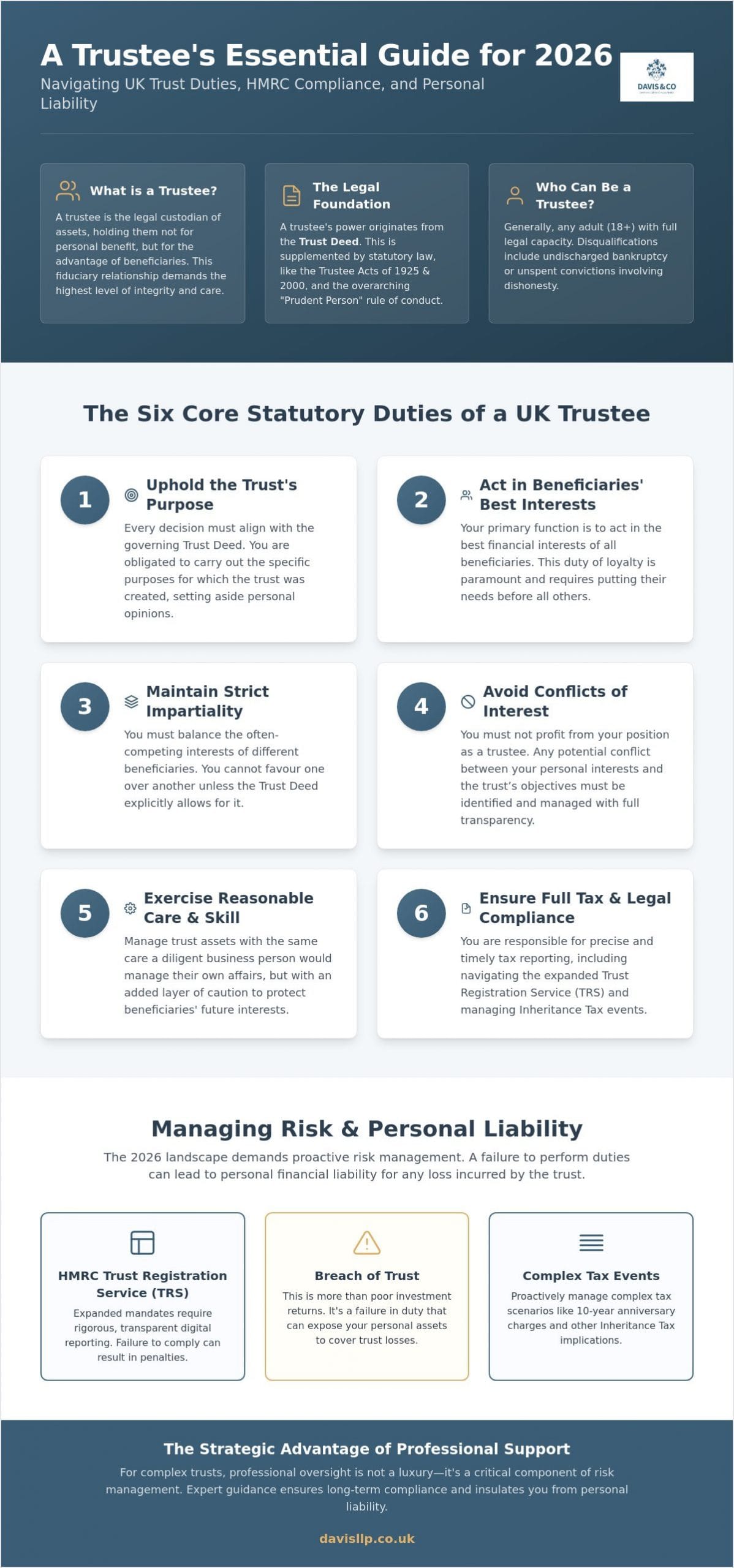
A trustee acts as the legal custodian of assets, holding them not for their own benefit, but for the advantage of others. This fiduciary relationship is the cornerstone of the duties and responsibilities of a trustee uk, requiring a level of integrity and care that exceeds standard commercial dealings. While public discourse often focuses on charity trustees, the role is equally critical in private family trusts, such as discretionary or life-interest structures, and within corporate environments. Each role carries distinct legal weight, yet they all share the fundamental requirement of putting the beneficiaries’ interests first.
The legal framework governing this role has evolved significantly. While the Trustee Act 2000 introduced modern standards for investment and delegation, it remains anchored by historical precedents established in the Trustee Act 1925. In 2026, the role has transitioned from a largely private affair into a position of high visibility. Increased transparency requirements, particularly through the expansion of HMRC’s Trust Registration Service (TRS), mean that trustees are now subject to rigorous reporting standards that were non-existent a decade ago. Managing these duties and responsibilities of a trustee uk now requires a blend of traditional stewardship and modern digital compliance.
The Legal Basis of Trusteeship
Every trustee’s power originates from the trust deed. This governing document acts as the primary rulebook, dictating how assets should be managed and distributed. However, the law imposes an overarching “Prudent Person” rule. This requires you to manage trust assets with the same care and diligence as a person of business would manage their own affairs, but with an added layer of caution to protect the beneficiaries’ future interests. It’s a duty of loyalty that strictly prevents any conflict of interest between your personal gains and the trust’s objectives.
Who Can Serve as a Trustee?
Generally, any adult with full legal capacity can serve. For private trusts, the individual must be at least 18 years old, whereas charity trustees may sometimes be 16 depending on the specific legal structure. Certain factors lead to automatic disqualification. These include undischarged bankruptcy or unspent criminal convictions involving dishonesty. While many families appoint a “lay trustee,” such as a relative, the technical demands of 2026 compliance often make a professional trustee a strategic choice. Professional trustees bring a level of expertise in tax and accounting that mitigates the risk of costly administrative errors.
The Six Core Statutory Duties of a UK Trustee
Statutory duties represent the mandatory minimum standards for anyone holding trust assets. They aren’t merely guidelines; they are legal obligations that, if ignored, can lead to personal liability. The duties and responsibilities of a trustee uk are designed to create a protective barrier around the trust’s capital while ensuring the settlor’s original intentions are realised. While the trust deed provides the specific instructions, the law provides the overarching framework for how those instructions must be executed.
A trustee’s primary function is to ensure the trust carries out its specific purposes. For a private family trust, this might involve providing for a beneficiary’s education or housing. For a charity, it involves adhering to the “public benefit” requirement. Every decision must align with the governing document. If the deed is silent on a particular matter, general trust law prevails. This requires a disciplined approach to administration where personal opinions are set aside in favour of the trust’s objectives.
Duty 1 to 3: Purpose, Compliance, and Best Interests
The first three duties focus on the direction and integrity of the trust. You must act in the best interests of the beneficiaries at all times. This often requires a delicate balancing act, especially when beneficiaries have competing needs. Impartiality is essential. You cannot favour one beneficiary over another unless the trust deed specifically grants that power.
Conflicts of interest must be identified and managed with absolute transparency. You shouldn’t profit from your position unless the deed explicitly allows for professional fees. Adhering to the essential trustee guidance provided by the Charity Commission is a vital practice for those in the third sector, but the principles of loyalty and disclosure apply across all trust types. Beneficiaries have a right to know the status of the trust and how it’s being managed; withholding information can often be the first step toward a formal dispute.
Duty 4 to 6: Resource Management, Care, and Accountability
The remaining duties involve the practical stewardship of assets. Under Section 1 of the Trustee Act 2000, you’re required to exercise “reasonable care and skill.” It’s vital to recognise that the law holds professional trustees to a higher standard than laypeople. If you possess specialist knowledge, you’re expected to use it. Managing resources responsibly means avoiding undue risk. While you aren’t expected to be a prophet of the markets, you must ensure that investments are diversified and suitable for the trust’s specific needs.
Accountability is maintained through meticulous record-keeping. You must be able to produce an accurate set of accounts at any time. This includes tracking every penny of income and expenditure. Implementing robust internal controls prevents the misappropriation of assets and ensures the trust remains compliant with HMRC. Many trustees find that engaging professional Trust Tax Services helps maintain this level of precision, providing a clear audit trail that satisfies both beneficiaries and regulators. By treating the trust’s resources with more care than your own, you fulfil the core of your fiduciary promise.
Financial Stewardship and Trust Tax Compliance
Financial stewardship is often where the theoretical weight of trusteeship meets the reality of administrative precision. The duties and responsibilities of a trustee uk extend far beyond merely safeguarding capital; they require an active engagement with the UK’s evolving tax architecture. In 2026, the margin for error has narrowed. Trustees must now manage complex income tax rates, such as the 45% charge on non-dividend income for discretionary trusts exceeding the £500 exemption, while ensuring every distribution is documented with forensic accuracy. This isn’t a role for the passive observer; it’s a commitment to rigorous financial discipline.
Effective management involves balancing the immediate needs of beneficiaries with the long-term sustainability of the trust’s tax position. This requires more than just filing returns. It demands a forward-looking strategy that accounts for the 10-year anniversary charges and potential exit charges inherent in the relevant property regime. By maintaining a composed partnership with professional advisors, you can ensure that the trust remains a vehicle for wealth preservation rather than a source of regulatory friction. Seeking expert tax advice in the UK allows you to align your fiduciary actions with the latest legislative standards, protecting both the assets and your reputation.
HMRC Reporting and the Trust Registration Service
The Trust Registration Service (TRS) has become the primary mechanism for HMRC to enforce transparency. Following the regulations (SI 2026/621) that came into force on 30 June 2026, the reporting landscape has shifted. Most new express trusts must register within 90 days of creation. However, a new exemption now exists for low-value trusts with assets of £10,000 or less and annual income of £5,000 or less, provided they hold no UK land. For non-UK trusts that acquired UK property before 6 October 2020, the deadline to register is 1 September 2027. Failure to meet these windows can lead to significant penalties, making calendar management a critical trustee skill. Adhering to The Essential Trustee Guidance ensures you remain on the right side of these digital filing requirements.
Inheritance Tax (IHT) and Capital Gains Management
Managing the “relevant property” regime is perhaps the most technical aspect of modern trusteeship. With the Inheritance Tax nil-rate band frozen at £325,000 until 2031, fiscal drag is bringing more trusts into the scope of periodic charges. Furthermore, from 6 April 2026, changes to Business Property Relief (BPR) and Agricultural Property Relief (APR) introduce a £2.5 million cap on 100% relief, which may necessitate a total restructuring of how certain trust-held assets are valued. When transferring assets to beneficiaries, you must also navigate Capital Gains Tax (CGT). Strategic use of hold-over relief can preserve trust value by deferring the tax charge until the beneficiary eventually disposes of the asset. It’s a complex environment where every transaction must be weighed against its long-term tax impact.
Managing Risk and Avoiding Personal Liability
The burden of personal financial liability often weighs heavily on those undertaking the duties and responsibilities of a trustee uk. It is a legitimate concern; unlike directors of a limited company, trustees don’t always enjoy a corporate veil to shield their personal assets. Legal exposure typically arises when a trustee fails to act in accordance with the trust deed or the general law, leading to a financial loss for the beneficiaries. However, it’s vital to distinguish between a “Breach of Trust” and a simple investment loss. A market fluctuation that reduces the trust’s value isn’t a breach, provided the trustee followed a prudent investment strategy. Conversely, failing to diversify assets or making unauthorised payments constitutes a clear breach that can lead to personal restitution.
Exoneration clauses within a trust deed can offer a layer of protection, but they aren’t absolute. Most clauses shield trustees from liability for “honest mistakes” or simple negligence. They cannot, however, protect against gross negligence, fraud, or wilful misconduct. In the regulatory climate of 2026, relying solely on a deed’s wording is insufficient. Professional governance now dictates the use of Trustee Indemnity Insurance. This cover provides a critical safety net, ensuring that the costs of defending a claim or settling a loss don’t fall directly on the individual trustee.
Identifying and Mitigating Breaches of Trust
Common pitfalls often stem from a lack of procedural rigour rather than malice. Self-dealing, where a trustee personally profits from a trust transaction, is a strict liability offence in most scenarios. Negligent investment choices, particularly those made without documented professional advice, also create significant exposure. To satisfy the statutory “Duty of Care,” you must demonstrate that you sought expert counsel when the matter exceeded your own expertise. If a breach is discovered, immediate disclosure to beneficiaries and seeking a court’s relief can sometimes mitigate the personal fallout. Taking proactive steps to rectify an error is always looked upon more favourably than concealment.
Governance Best Practices for Risk Reduction
A disciplined governance framework is your strongest defence. This begins with a formal Investment Policy Statement (IPS) that outlines the trust’s risk appetite and objectives. Regularly reviewing the performance of delegated managers ensures you’re meeting your ongoing duty of supervision. Perhaps most importantly, maintaining comprehensive minutes of all meetings provides a contemporaneous record of your decision-making process. This documentation proves that you acted with reasonable care and skill, even if the eventual outcome was unfavourable. For those seeking to formalise their oversight and ensure full compliance, engaging with Audit and Assurance services provides the objective verification necessary to protect all parties involved.
The Strategic Advantage of Professional Support
Accepting a trusteeship is often an act of familial duty or charitable commitment. However, the practical execution of the duties and responsibilities of a trustee uk in 2026 requires more than good intentions. The modern regulatory environment, characterised by digital-first HMRC reporting and complex anti-avoidance legislation, often exceeds the administrative capacity of a lay trustee. Engaging professional support isn’t an admission of inadequacy; it’s a strategic fulfilment of the statutory duty of care. By delegating technical tasks to specialists, you create a robust audit trail that serves as your primary defence against claims of negligence or mismanagement.
The complexity increases significantly when the trust holds interests in commercial ventures. In these instances, the role of a small business accountant is indispensable. They help bridge the gap between trust law and commercial reality, ensuring that the trust-owned business remains tax-efficient while adhering to the specific restrictive covenants found in trust deeds. For families with a global footprint, this oversight should be part of a cohesive international tax planning strategy. Coordination between jurisdictions prevents double taxation and ensures that distributions to beneficiaries remain compliant with both UK and local laws.
When to Appoint a Professional Advisor
Certain scenarios demand immediate professional intervention to protect the trust’s capital. If the portfolio includes complex asset classes like private equity, commercial property, or international holdings, the valuation and reporting requirements become highly specialised. Professional advice is also vital during periods of high family conflict. An impartial third party provides objective guidance that de-escalates tension and ensures decisions are made solely in the best interests of the beneficiaries. Significant tax events, such as a trust winding up or a large capital distribution, also require precise calculation to avoid unnecessary HMRC scrutiny.
How Davis & Co LLP Supports Trustees
Our approach is rooted in the principle of composed partnership. We provide comprehensive Trust Tax Services that manage every aspect of compliance, from initial registration on the TRS to the filing of complex annual returns. For larger private trusts and charitable organisations, our audit and assurance expertise offers the independent verification necessary to satisfy both regulators and stakeholders. We don’t merely act as service providers; we position ourselves as strategic partners dedicated to the long-term viability of your mission. By assuming the technical burden, we allow you to focus on the human impact of your stewardship, secure in the knowledge that your legal and financial obligations are being met with precision.
Securing the Future of Your Trust Through Proactive Stewardship
The landscape for trustees in 2026 is defined by transparency and technical precision. Successfully managing the duties and responsibilities of a trustee uk requires you to move beyond basic oversight and embrace a strategy that balances beneficiary interests with rigorous HMRC reporting. By mastering the core statutory duties and implementing a robust risk management framework, you can protect trust assets while insulating yourself from personal liability. This shift from passive administration to active fiduciary management is essential for long-term stability.
Navigating these complexities doesn’t have to be a solitary endeavour. At Davis & Co LLP, our team of Chartered Certified Accountants has provided professional gravitas and reliable counsel since 1901. We specialise in international and trust tax planning, offering bespoke advisory services tailored specifically for high-net-worth family offices. Whether you require assistance with TRS registration or strategic audit and assurance, we’re here to act as your composed partner in fiduciary excellence. Contact Davis & Co LLP for expert Trust Tax and Compliance support and ensure your stewardship meets the highest modern standards. With the right professional support, you can transform your trusteeship from a source of concern into a legacy of lasting value.
Frequently Asked Questions
Can a trustee be held personally liable for financial losses in the UK?
Yes, trustees can be held personally liable if they commit a breach of trust that results in a financial loss. This liability typically arises from negligence, unauthorised payments, or failing to follow the instructions in the trust deed. While exoneration clauses and indemnity insurance provide some protection, they don’t cover gross negligence or fraud. Maintaining a clear audit trail and seeking professional advice are the most effective ways to mitigate this risk.
Do trustees get paid for their work in the UK?
Lay trustees are generally not entitled to payment for their time unless the trust deed specifically permits it. They are, however, entitled to be reimbursed from the trust assets for all reasonable expenses incurred during their duties. Professional trustees, such as accountants or solicitors, are usually paid for their services as outlined in the governing document. It’s essential to check the specific charging clause within the deed to understand what remuneration is permitted.
What is the difference between a trustee and a beneficiary?
A trustee holds legal title to the assets and manages them, whereas a beneficiary is the person entitled to benefit from those assets. The trustee has a fiduciary duty to act in the best interests of the beneficiaries at all times. While the trustee makes the management decisions, the beneficiary holds the equitable interest in the trust property. This distinction is fundamental to the duties and responsibilities of a trustee uk, ensuring management is separated from personal gain.
How often should trustees meet to discuss trust business?
There is no statutory requirement for meeting frequency, but trustees should meet at least once or twice annually to review performance and tax positions. More complex trusts, particularly those holding business interests or active property portfolios, may require quarterly reviews. These meetings are vital for reviewing investment performance and ensuring compliance with the Trust Registration Service. Every meeting must be formally minuted to provide a contemporary record of the decision-making process.
Can a trustee also be a beneficiary of the same trust?
Yes, a trustee can also be a beneficiary of the same trust, provided the trust deed allows it. This is common in family trusts where a parent might be both a trustee and a potential beneficiary. However, this dual role requires careful management to avoid conflicts of interest. When making distribution decisions that benefit themselves, trustees must be particularly diligent in documenting that they’re acting fairly and in accordance with the settlor’s intentions.
What happens if a trustee dies or wants to resign?
If a trustee dies or wishes to resign, the remaining trustees must follow the procedures for replacement outlined in the trust deed or the Trustee Act 1925. A resignation is usually only valid if at least two trustees remain to continue the administration. New trustees are typically appointed through a Deed of Appointment, and legal title to the trust assets must be formally transferred to the new group of trustees to ensure continuity.
Are trustees responsible for paying tax on trust income?
Trustees are legally responsible for ensuring that all relevant taxes on trust income and capital gains are paid to HMRC. This includes filing an annual Self-Assessment tax return and adhering to the 31 January payment deadlines. For discretionary trusts in 2026, income over £500 is subject to the trust rate of tax, which is 45% for non-dividend income. Trustees must also manage 10-year anniversary and exit charges under the relevant property regime.
What records must a trustee keep by law?
Trustees must by law keep accurate and up-to-date financial records, including a full history of income, expenditure, and distributions. They’re also required to maintain records of all trustee decisions, meeting minutes, and professional advice received. Under the Trust Registration Service requirements, trustees must keep details of all beneficial owners, including settlors and beneficiaries. These records must be retained for at least six years after the trust is wound up to satisfy HMRC audit requirements.