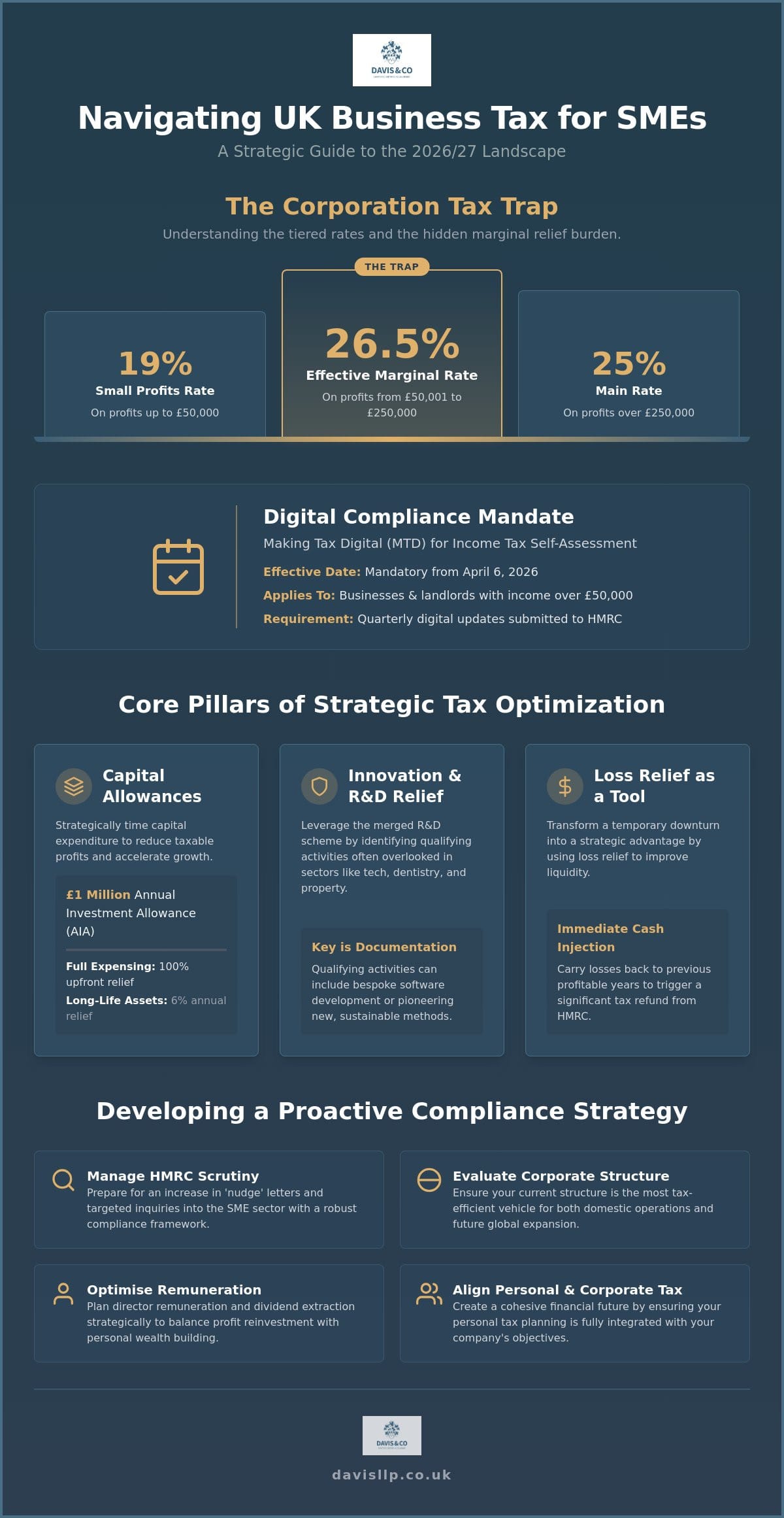
For many UK business owners, the most expensive tax rate isn’t the 25% main rate, but the 26.5% effective rate that quietly erodes profits between £50,000 and £250,000. As we move through 2026, staying ahead of these nuances requires more than just basic bookkeeping; it demands sophisticated business tax advice for uk smes that prioritises long-term stability over short-term fixes.
We understand that the constant evolution of UK tax legislation, particularly the mandatory transition to Making Tax Digital for Income Tax Self-Assessment this April, can feel like a relentless weight on your operational focus. You’re right to be concerned about the complexity of associated company rules or the risk of an HMRC inquiry. Our goal is to replace that uncertainty with a clear, actionable roadmap for tax efficiency that protects your firm’s interests.
This article explores how to optimise your corporate tax position and leverage strategic reliefs to accelerate your growth in the current 2026/27 landscape. We’ll examine the practical application of the £1 million Annual Investment Allowance, the implications of current dividend thresholds, and how to structure your operations to maximise reinvestment capital while maintaining absolute compliance.
Key Takeaways
- Understand how to navigate the 2026/27 Corporation Tax thresholds to protect your bottom line from the 26.5% marginal relief trap.
- Uncover specific, often overlooked tax reliefs that allow you to reinvest more capital into your core business operations and growth.
- Secure bespoke business tax advice for uk smes to evaluate if your current corporate structure remains the most efficient vehicle for global expansion.
- Develop a proactive compliance strategy to manage HMRC’s increasing use of ‘nudge’ letters and targeted inquiries into the SME sector.
- Align your personal tax planning with your corporate objectives to ensure a cohesive and secure financial future for both you and your firm.
The 2026 UK Tax Landscape: What SMEs Must Prioritise
The 2026/27 financial year presents a landscape defined by relative stability in headline rates but increasing complexity in their application. While the main rate of Corporation Tax remains at 25%, the actual tax burden for many smaller firms is far more nuanced. Relying on retrospective filing is a strategy of the past. Modern growth requires a forward-looking approach that anticipates liabilities long before the year-end deadline. Recent fiscal updates, including the latest Autumn Statement, have reinforced the government’s focus on targeted investment incentives rather than broad rate cuts.
We’ve seen that the most successful enterprises are those that treat tax as a central pillar of their commercial strategy rather than an administrative afterthought. Providing effective business tax advice for uk smes involves more than just ensuring accuracy; it requires a deep understanding of how specific reliefs can be leveraged to protect your margins. As HMRC increases its focus on the SME sector, having a robust framework for your tax affairs provides both peace of mind and a competitive edge. This proactive stance is the only way to ensure that your cash flow remains robust enough to support your long-term ambitions. By understanding the underlying mechanics of current legislation, you can transform tax from a static cost into a dynamic tool for business acceleration.
Evolving Corporation Tax Dynamics
The UK corporation tax system uses a tiered structure where the 19% Small Profits Rate applies below £50,000, while profits over £250,000 face the 25% main rate. The marginal relief band effectively taxes profits between these figures at 26.5%. This burden can increase if associated company rules divide your thresholds. To mitigate this, we recommend strategic timing of capital expenditure to utilise the £1 million Annual Investment Allowance (AIA).
The Digital Compliance Mandate
The shift toward real-time reporting is a significant transition. Cloud-based platforms allow us to provide precise business tax advice for uk smes by moving from historical data to live insights. This ensures you’re prepared for HMRC scrutiny while identifying efficiencies early. From April 6, 2026, Making Tax Digital for Income Tax Self-Assessment becomes mandatory for businesses and landlords with a qualifying income over £50,000, requiring quarterly digital updates to HMRC.
Core Pillars of Strategic Business Tax Optimization
Strategic tax planning isn’t just about filing on time; it’s about sophisticated capital allocation. Many firms overlook the power of loss relief as a cash flow tool. If your firm faces a temporary downturn, carrying losses back to previous profitable years can trigger a significant tax refund, providing an immediate injection of liquidity. This level of foresight is a hallmark of Expert Tax Advice in the UK. It transforms tax from a sunk cost into a strategic reserve. Effective tax risk management ensures these claims are robust enough to withstand HMRC scrutiny while maximising your available working capital.
Securing high-calibre business tax advice for uk smes means looking beyond the current tax year to anticipate how profit retention affects future valuation. By carefully balancing the reinvestment of profits with strategic wealth extraction, you create a resilient foundation for both the business and its shareholders. We focus on identifying these intersections where corporate efficiency meets personal financial security, ensuring no relief goes unclaimed.
Maximising R&D and Capital Allowances
The 2026 R&D regime has evolved into a merged scheme, simplifying the process but heightening the need for precise documentation. We often find that businesses in sectors like dentistry or property development miss out because they don’t view their operational improvements as innovation. Whether it’s developing bespoke clinical software or pioneering sustainable building methods, these activities likely qualify. For physical assets, the choice between full expensing and long-life asset treatment is critical. While full expensing offers 100% relief upfront, long-life assets require a different rate of 6% per annum. Choosing the right path depends entirely on your five-year growth trajectory.
Director Remuneration and Dividend Planning
Balancing corporate retention with personal wealth requires a surgical touch. With the 2026/27 dividend allowance remaining at £500, the low-salary, high-dividend model is no longer a default choice. We must account for the 6% National Insurance rate for class 4 contributions and the various income tax bands. Employer pension contributions often remain the most tax-efficient way to extract value, as they’re typically a deductible business expense and free from NI. Engaging a Strategic Small Business Accountant allows you to manage director loan accounts effectively, avoiding the pitfalls of Section 455 tax while ensuring your personal income is optimised.
If you’re looking to refine your current structure, our team can help you identify the most beneficial cash flow management strategies for the year ahead.
Strategic Structuring: Domestic vs. International Expansion
Choosing between a Limited Company and a Limited Liability Partnership (LLP) isn’t merely a legal formality; it’s a strategic tax decision. A Limited Company offers a distinct legal personality and access to the tiered Corporation Tax system, whereas an LLP provides transparency, with profits taxed directly in the hands of the members. As your firm scales, the simplicity of a domestic structure often gives way to the complexities of global operations. Providing comprehensive business tax advice for uk smes involves more than just domestic filing; it requires a vision that spans multiple jurisdictions.
While the official HMRC Corporation Tax guidance outlines the standard requirements for UK entities, international expansion demands a more nuanced approach. This is where International Tax Planning becomes a critical component of your growth strategy. We’ve seen businesses inadvertently create a Permanent Establishment (PE) simply by hiring a remote developer in Europe or North America, leading to unexpected foreign tax liabilities. Effective business tax advice for uk smes must also address the complexities of post-BEPS transfer pricing, ensuring that any inter-company transactions are conducted at ‘arm’s length’ to satisfy both HMRC and foreign tax authorities.
Cross-Border Tax Efficiency
Managing cross-border efficiency requires a firm grasp of Double Taxation Treaties. These agreements are vital for reducing or eliminating withholding taxes on dividends, interest, and royalties. For those exporting digital services in 2026, VAT compliance across multiple jurisdictions remains a significant administrative hurdle that shouldn’t be underestimated. Deciding whether to operate via an overseas branch or a full subsidiary is equally pivotal. A branch is often easier to set up, but a subsidiary can provide a cleaner tax break and better protection for the parent company’s assets.
Group Structures and Holding Companies
A well-designed group structure can act as a powerful shield. By using a holding company, you can ring-fence valuable assets like intellectual property or property away from the trading risks of a subsidiary. This structure also facilitates the Substantial Shareholdings Exemption (SSE). This exemption can make the future sale of a trading subsidiary entirely tax-free for the group, provided certain conditions are met. We also help clients manage group-wide tax losses, allowing the profits of one entity to be offset by the losses of another, which significantly improves the group’s overall cash position.
HMRC Compliance and Risk Mitigation Strategies
HMRC’s approach to the SME sector has evolved into a sophisticated “nudge” culture. Rather than launching immediate, resource-heavy audits, the revenue now uses targeted correspondence to prompt voluntary corrections. These letters often signal that your data has triggered an automated alert within their systems. High-calibre business tax advice for uk smes prioritises the resolution of these flags before they escalate into formal inquiries. By mirroring the Senior Accounting Officer standards typically reserved for the UK’s largest corporations, smaller firms can demonstrate a commitment to fiscal integrity that often discourages more intrusive scrutiny. It’s a psychological and operational shield that protects your time and reputation.
Maintaining this level of readiness requires a deep understanding of current regulatory priorities. Our HMRC Tax Warning 2026 provides the necessary context for navigating these compliance hurdles. We also recommend that clients maintain robust fee protection insurance. While it doesn’t prevent an inquiry, it ensures that the professional costs of defending your position don’t drain your cash reserves. This allows us to focus on the technical merits of your case without the pressure of mounting hourly fees.
Common Triggers for HMRC Investigations
HMRC’s algorithms are increasingly adept at spotting discrepancies between VAT returns and annual accounts. If your reported turnover doesn’t align with your VAT filings, a red flag is raised automatically. Similarly, unusual fluctuations in gross profit margins often invite sector-wide benchmarking to identify potential under-reporting. HMRC’s Connect AI system cross-references SME bank data with reported income in 2026 to identify undisclosed revenue streams and lifestyle discrepancies instantly. These automated checks mean that even small errors can lead to significant administrative burdens.
Managing VAT and Payroll Compliance
For rapidly growing firms, the £90,000 VAT registration threshold can become a trap if not monitored monthly. Crossing this line without registration leads to backdated liabilities and heavy penalties. Payroll compliance is equally fraught, particularly regarding IR35 and off-payroll working rules. Ensuring your contractor base doesn’t inadvertently create a corporate tax liability is essential for long-term stability. If errors are found, making a voluntary disclosure is often the most strategic move. It usually results in significantly lower penalties than if HMRC discovers the discrepancy first.
If you are concerned about your current risk profile, our Audit and Assurance team can provide a comprehensive review of your internal controls to ensure you remain fully compliant.
The Davis & Co LLP Approach to Strategic Tax Partnership
We view tax not as a static obligation but as a fluid element of your commercial success. While many firms stop at the point of filing, our commitment begins with the deeper analysis of your long-term goals. Providing business tax advice for uk smes requires an understanding that your personal wealth and corporate performance are inextricably linked. We don’t believe in siloed thinking. Instead, we offer a composed partnership that prioritises discretion and precision in every calculation. It’s about creating a sense of order and intellectual rigour that reinforces your firm’s credibility with both stakeholders and HMRC.
Our dual focus ensures that while the company remains tax-efficient, the directors’ personal positions are equally protected. This is particularly vital for high-growth firms where the lines between organizational and individual financial security can often blur. Working with Chartered Accountants who possess deep-seated expertise in niche sectors like dentistry and property allows us to identify specific reliefs and structures that generalist firms often overlook. We bring a level of technical excellence that suggests a history of success and a reliable future for your operations.
Tailored Solutions for Complex Needs
We integrate international tax planning seamlessly with your domestic growth strategies. This ensures that as you expand, your structure remains robust and compliant across all jurisdictions. Our audit and assurance services are designed to provide genuine confidence to your investors and lenders. By leveraging management accounting, we help you make real-time decisions based on live data rather than historical records. This proactive stance is what distinguishes a strategic partner from a mere service provider, as it allows for a steady and measured response to any legislative changes.
Next Steps for Your SME
The 2026 tax landscape is far too volatile for a reactive approach. A comprehensive tax health check is the first step toward securing your firm’s future. It’s about more than just checking numbers; it’s about evaluating whether your current path aligns with the evolving regulatory environment. Transitioning to a firm that offers technical excellence and strategic gravitas provides the stability your business needs to thrive. You can reach out to our specialists in London or Harpenden for a confidential consultation to discuss how we can support your growth. Our business tax advice for uk smes is built on the foundation of highly individualized service delivery, ensuring that your specific needs are always the priority.
Securing Your SME’s Long-Term Fiscal Resilience
The 2026/27 financial year rewards those who view tax as a strategic asset rather than a compliance burden. By understanding the nuances of marginal relief and the final transition toward digital transparency, your firm can maintain the liquidity needed for sustained growth. Whether you’re expanding across borders or refining your domestic structure, securing professional business tax advice for uk smes ensures your operations remain robust against both HMRC scrutiny and global market shifts. We’ve explored how proactive structuring and a deep understanding of specific reliefs can transform your balance sheet.
At Davis & Co LLP, we combine over a century of heritage as Chartered Certified Accountants since 1901 with modern, specialist expertise in international and dental tax. We offer a discreet and professional strategic partnership that aligns your corporate objectives with long-term financial security. Our approach is steady and measured, providing the stability your business requires in an often volatile regulatory environment. It’s this commitment to quiet excellence that allows our clients to focus on their core operations while we manage the complexities of the tax landscape.
Secure your SME’s financial future with a strategic tax consultation from Davis & Co LLP. We look forward to helping you navigate the complexities of the years ahead with clarity and confidence.
Frequently Asked Questions
What are the primary business tax changes for UK SMEs in 2026?
The most significant operational shift is the commencement of Making Tax Digital for Income Tax Self-Assessment on April 6, 2026, for those with qualifying income over £50,000. While Corporation Tax rates remain steady at 19% and 25%, the marginal relief band effectively taxes profits between £50,000 and £250,000 at 26.5%. This creates a landscape where digital compliance and threshold management are the primary priorities for directors.
How can an SME legitimately reduce its Corporation Tax liability?
Legitimate reduction of your tax liability is achieved through the strategic application of statutory reliefs and allowances. Utilising the £1 million Annual Investment Allowance for qualifying plant and machinery remains a powerful tool for immediate relief. Additionally, employer pension contributions and the effective use of carry-back loss relief can significantly improve your cash position. We focus on identifying these opportunities as part of our bespoke business tax advice for uk smes.
What is the difference between tax evasion and strategic tax planning?
The distinction lies in legality and transparency. Tax evasion involves the deliberate non-payment or illegal concealment of liabilities, which carries severe criminal penalties. Conversely, strategic tax planning is the legitimate arrangement of your financial affairs within the framework of UK law. It ensures you don’t pay more than is legally required by utilizing available reliefs, such as the Substantial Shareholdings Exemption or R&D credits, in a fully disclosed manner.
Does my SME need an international tax specialist if we only have a few overseas clients?
Even a small number of international transactions can trigger complex obligations, such as Permanent Establishment risks or withholding tax requirements under double taxation treaties. Engaging a specialist ensures you don’t inadvertently create a foreign tax liability or face double taxation on your global income. We help firms navigate these cross-border complexities to ensure that international growth doesn’t lead to unforeseen administrative burdens or financial penalties.
How does HMRC’s Making Tax Digital affect my business in 2026?
From April 2026, businesses and landlords with a qualifying income exceeding £50,000 must comply with Making Tax Digital for Income Tax Self-Assessment. This requires you to maintain digital records and provide quarterly updates to HMRC using compatible software. This shift moves tax from an annual retrospective task to a real-time reporting requirement. It’s a fundamental change that demands robust cloud accounting systems to ensure ongoing compliance and data accuracy.
What should I do if my SME receives an HMRC investigation notice?
Your first step should be to contact your professional advisor before responding to HMRC or providing any documentation. We recommend a calm, measured approach that prioritises a thorough review of the records in question. It’s essential to understand the specific scope of the inquiry, whether it’s a routine check or a targeted investigation. Having fee protection insurance in place allows us to manage the defense of your position without mounting costs.
Can R&D tax credits still be claimed by small businesses in 2026?
Yes, R&D tax credits remain a vital incentive, though they now operate under a merged scheme designed to simplify the process while maintaining rigorous compliance standards. Small businesses can still claim for qualifying activities that seek to achieve an advance in science or technology. We often find that innovative SMEs in sectors such as dentistry and property development fail to recognise that their technical problem-solving qualifies for these significant corporate tax savings.
How often should an SME review its corporate tax structure?
We advise a formal review of your corporate structure at least once a year, ideally ahead of your financial year-end. However, significant milestones such as international expansion, changes in ownership, or reaching new profit thresholds should trigger an immediate assessment. Regular reviews ensure your structure remains the most efficient vehicle for your current operations. This proactive habit is a core element of effective business tax advice for uk smes, protecting your long-term interests.