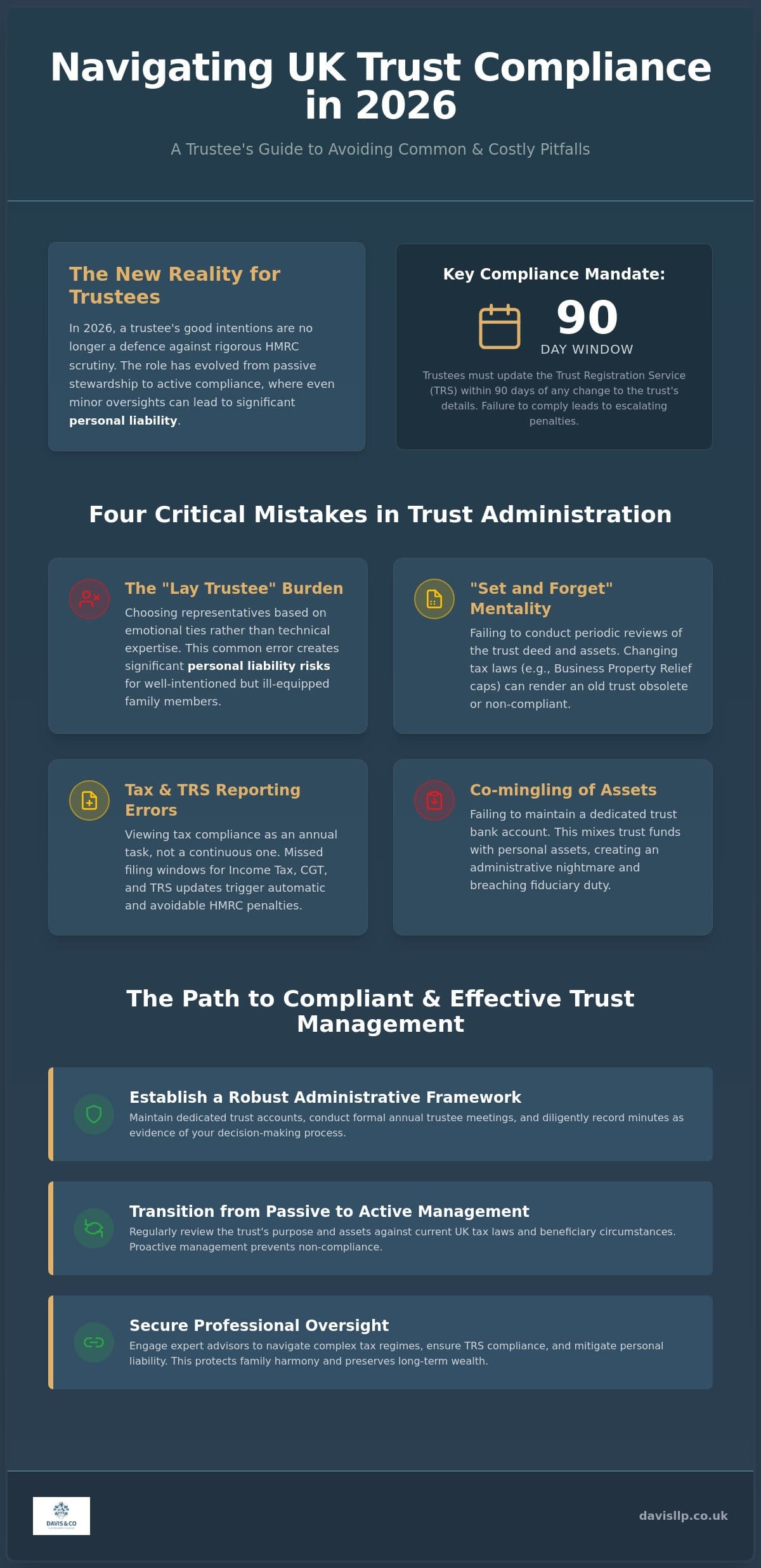
In 2026, a trustee’s good intentions are no longer a valid defence against rigorous HMRC scrutiny. While many take on this role out of a sense of family duty, the reality of modern UK compliance is that even minor oversights can lead to significant personal liability. We recognize that managing the latest Trust Registration Service updates and the recent caps on Business Property Relief creates a high-pressure environment where it’s easy to stumble. Identifying the common mistakes in trust administration is the first step toward moving from a position of uncertainty to one of composed, professional authority. It’s a common concern that administrative errors might not only attract HMRC penalties but also cause irreparable friction among the very beneficiaries you intend to support.
This guide serves as a steady hand for those facing these challenges, offering a clear path to safeguard your assets through rigorous administrative standards. By understanding the critical tax and legal pitfalls currently facing UK trusts, you can ensure your management remains both compliant and transparent. We will explore the essential 2026 compliance requirements, from the 90-day TRS reporting windows to the strategic management of Inheritance Tax thresholds, ensuring you remain a well-advised and reliable partner to your beneficiaries.
Key Takeaways
- Understand the updated Trust Registration Service (TRS) deadlines and reporting requirements to avoid escalating HMRC penalties and administrative scrutiny.
- Learn how to identify and rectify common mistakes in trust administration, particularly regarding the complexities of the relevant property regime and periodic tax charges.
- Recognise the risks of the “lay trustee” burden and why choosing representatives based on emotional ties rather than technical capability can create significant personal liability.
- Discover the essential steps for maintaining a robust administrative framework, including the necessity of dedicated trust accounts to prevent the co-mingling of assets.
- Explore how professional oversight can transform trust management into a disciplined, compliant operation that preserves family harmony and protects long-term wealth.
The Evolution of Trust Administration: Why Compliance is More Complex in 2026
Trust administration is the disciplined, ongoing stewardship of assets in strict accordance with both the specific trust deed and the broader requirements of the UK legal system. Historically, some trustees might’ve viewed their role as a passive one, perhaps limited to occasional asset reviews. In 2026, this perspective is increasingly dangerous. HMRC’s heightened focus on transparency and stringent anti-money laundering (AML) regulations has transformed the role into a rigorous exercise in active compliance. Trustees now face significant personal liability for negligence, as the “good intentions” of a family friend no longer provide a shield against administrative failures.
The Legal Framework: The Trustee Act 2000
The Trustee Act 2000 provides the statutory foundation for how trusts are managed in England and Wales. It imposes a clear duty of care, requiring trustees to exercise such care and skill as is “reasonable in the circumstances.” Crucially, the law distinguishes between the expectations placed on a lay trustee and a professional advisor. A professional is held to a far higher standard, reflecting their specialised expertise and the fee-earning nature of their work. This legal framework is rooted in the long history of English trust law, which prioritises the protection of the beneficiary’s interests above all else. Within this context, fiduciary duty is the unwavering legal obligation to act in the absolute best interests of the beneficiaries while strictly avoiding any personal conflict of interest.
Why “Setting and Forgetting” a Trust is a Critical Error
Perhaps the most frequent of the common mistakes in trust administration is the failure to review the trust deed and its assets periodically. A trust established a decade ago may no longer serve its intended purpose if family circumstances change or if UK tax laws undergo significant shifts, such as the 2026 changes to Business Property Relief. Neglecting regular reviews can render a trust obsolete or, worse, non-compliant. We advocate for a disciplined approach that includes annual trustee meetings and the formal recording of minutes. These documents aren’t merely bureaucratic exercises; they’re essential evidence of a trustee’s diligent decision-making process. Avoiding common mistakes in trust administration requires this transition from informal family arrangements to a professionalised framework of governance that mirrors the precision of a commercial operation.
The “Silent” Tax Errors: Failing to Navigate HMRC Reporting and TRS Requirements
HMRC’s expectations for trustees have sharpened considerably. While the legal framework provides the structure, the tax regime provides the risk. One of the most frequent common mistakes in trust administration is viewing tax compliance as an annual event rather than a continuous obligation. This oversight is particularly evident with the Trust Registration Service (TRS), which has become the primary area for administrative failure in recent years. Beyond simple registration, trustees must navigate the complexities of the relevant property regime, which governs how discretionary trusts are taxed. Failing to secure expert tax advice in the UK often leads to missed filing windows for Income Tax and Capital Gains Tax (CGT). These technical lapses are among the most expensive common mistakes in trust administration, triggering automatic penalties that could’ve been easily avoided with professional foresight.
The Trust Registration Service (TRS) Pitfalls
The TRS is no longer a “one-and-done” requirement. Since the Money Laundering and Terrorist Financing (Amendment) Regulations 2026 came into effect on June 30, 2026, the scope for non-UK trusts holding UK property has expanded. Trustees are legally required to update the TRS within 90 days of any change to the trust’s details, such as a change in beneficiary address or the appointment of a new trustee. HMRC now uses automated flags to identify inconsistencies, and the penalties for non-compliance are strictly enforced. An initial £100 penalty can escalate to £5,000 for deliberate failure to register or update records. While some low-risk, low-value trusts remain exempt, determining “registrability” is a nuanced process that requires a thorough understanding of current trustee tax responsibilities.
The 10-Year Anniversary and Exit Charges
Discretionary trusts are subject to the periodic charge, often called the 10-year charge, which many lay trustees inadvertently overlook. This charge is calculated on the value of the “relevant property” held within the trust at each tenth anniversary of its creation. Similarly, exit charges may apply when assets are distributed to beneficiaries between these anniversaries. It’s a common misconception that these charges only trigger when cash is involved; in reality, these charges apply even if no cash is physically leaving the trust. Missing the SA900 filing deadlines, October 31 for paper or January 31 for online, results in an immediate £100 penalty, with daily charges accruing if the delay exceeds three months. To maintain the integrity of the trust’s capital, we recommend a proactive review of your current reporting status. Our team at Davis & Co LLP focuses on providing the precise technical oversight needed to manage these complex tax cycles effectively.
Selection and Succession: Avoiding the “Wrong Trustee” and Lay Person Pitfalls
Selecting a trustee is frequently treated as an emotional gesture, yet it remains one of the most critical decisions in the lifecycle of a trust. A common mistake is appointing a family member based on kinship rather than technical aptitude. While a spouse or sibling may have the best intentions, they often lack the forensic attention to detail required to meet HMRC’s stringent standards. This “lay trustee” burden creates a significant gap between an individual’s ability and the professional administrative standards expected by the state. In 2026, where missing the online filing deadline for an SA900 return results in an immediate £100 penalty and potentially £900 in daily fines, the margin for error is non-existent.
We often observe conflict of interest when a trustee is also a primary beneficiary. This dual role can cloud judgment and lead to accusations of bias, particularly in discretionary trusts where distributions are subjective. Similarly, relying on a sole trustee is a precarious strategy; it ignores the necessity of succession planning. If that individual becomes incapacitated, the trust can enter a state of administrative paralysis. Avoiding these common mistakes in trust administration requires a shift toward a more balanced board of trustees, perhaps pairing a family member’s personal knowledge with a professional’s technical rigour.
The Technical Capability Gap
Record-keeping is the backbone of compliance. A professional firm maintains a rigorous trust administration practice note for every client, ensuring that every decision is documented and every deadline met. This is especially vital when assets involve international tax planning, where cross-border compliance makes lay trusteeship nearly impossible to navigate safely. Individual trustees also lack the professional indemnity insurance that protects the trust’s capital against administrative errors, leaving their personal assets at risk if they’re found negligent in their duties.
Managing Beneficiary Relationships and Conflicts
Neutrality is the best defence against litigation. When a trustee lacks the distance of a professional expert, beneficiary relationships can quickly strain. While a “Letter of Wishes” provides helpful guidance on the settlor’s intent, it isn’t legally binding. A trustee must still exercise independent judgment and act in the best interests of all beneficiaries, not just the most vocal ones. If you’re asked to serve but feel the technical burden is too great, it’s often more professional to decline the appointment or suggest a joint appointment with a qualified firm. This preserves family harmony while ensuring the trust’s long-term stability and compliance with UK law.
Establishing a Robust Administrative Framework: Records, Accounts, and Transparency
A trust is more than a legal arrangement; it’s a functioning entity that requires the same administrative rigour as a commercial enterprise. One of the most avoidable common mistakes in trust administration is failing to maintain a clear, chronological record of the trust’s life. Without a structured framework, trustees often find themselves unable to justify their decisions during an HMRC enquiry or a beneficiary dispute. We recommend establishing a professionalised system that moves beyond informal notes and focuses on five essential pillars of governance.
- Step 1: The Permanent File. Every trust should have a master file containing the original deed, any subsequent deeds of appointment or retirement, and the latest TRS registration confirmation.
- Step 2: Dedicated Financial Channels. You must implement a dedicated trust bank account to prevent the co-mingling of trust capital with personal funds, which is a fundamental breach of fiduciary duty.
- Step 3: Professional Accounting Standards. Producing annual trust accounts isn’t just best practice; it’s necessary for accurate tax reporting and provides a clear audit trail of asset performance.
- Step 4: The Decision Log. Maintain a formal record of all trustee meetings, noting the specific rationale behind distributions or investment changes to protect against future claims of negligence.
- Step 5: Proactive Disclosure. Establish a rhythm of regular communication with beneficiaries to fulfill your legal duty to keep them informed of the trust’s status.
Adopting these steps ensures that the trust remains a stable vehicle for wealth preservation. To maintain this level of technical rigour, many trustees find it beneficial to engage our Trust Tax Services to manage their ongoing compliance and accounting requirements.
Financial Transparency and the Duty to Inform
Beneficiaries have a legitimate legal interest in how trust assets are managed, and a lack of transparency is often the primary catalyst for litigation. The mistake of “secrecy” often stems from a desire to avoid family friction, yet it typically has the opposite effect by triggering distrust. Clear communication prevents the common mistakes in trust administration that arise when beneficiaries feel excluded or uninformed. Specifically, beneficiaries maintain a legal right to inspect the trust deed, the formal annual accounts, and the tax returns submitted to HMRC.
Investment Policy Statements (IPS)
For many trusts, failing to have a written Investment Policy Statement is a direct breach of the Trustee Act 2000. This document outlines the trust’s objectives, risk appetite, and liquidity requirements, providing a benchmark for performance. The Act also requires trustees to seek professional investment advice unless it’s clearly unnecessary in the circumstances. Regular reviews of this policy ensure that the investment strategy remains aligned with the trust’s long-term goals, particularly as market conditions and the needs of beneficiaries evolve over time.
Professional Oversight: How Davis & Co LLP Mitigates Risks in Trust Management
The complexities of 2026 compliance require more than just clerical diligence; they demand a strategic partnership that anticipates regulatory shifts before they become liabilities. At Davis & Co LLP, we position ourselves as a dependable constant for trustees who seek to move beyond the anxieties of personal liability. Our approach to Trust Tax Services is designed to provide the intellectual rigour and administrative stability necessary to uphold your fiduciary duties with absolute confidence. By systematically addressing the common mistakes in trust administration, we ensure that the settlor’s original intentions are preserved and that the trust’s capital isn’t eroded by avoidable HMRC penalties or administrative friction.
We provide a polished, integrated service where tax expertise, accounting precision, and strategic planning converge. This holistic perspective is essential for maintaining the delicate balance between tax efficiency and legal transparency. Our role is to act as your technical shield, allowing you to focus on the human impact of the trust while we manage the granular requirements of UK law. Professional administration isn’t merely a compliance exercise; it’s a commitment to protecting the legacy that the trust was established to create, ensuring it remains a robust vehicle for future generations.
Our Comprehensive Trust Tax Services
Our team provides meticulous support for the preparation and submission of SA900 Trust and Estate Tax Returns. We ensure that every calculation, from income distributions to capital gains, is technically accurate and filed well in advance of the January 31 online deadline. For those managing cross-border assets, we offer specialised guidance on international tax planning to navigate the reporting requirements of multiple jurisdictions. We recognize the heavy administrative burden placed on lay trustees, and we provide the necessary infrastructure to manage TRS registrations and ongoing updates, ensuring you never miss the critical 90-day reporting windows.
Securing the Future of Your Trust
For existing trusts, we offer a professional “health check” to identify latent issues before they escalate into formal enquiries or beneficiary disputes. This proactive review examines the trust’s current compliance status, investment policy alignment, and tax efficiency under the latest 2026 regulations. When the time comes to distribute assets or close the trust, we assist with the complex process of winding up and obtaining final tax clearances from HMRC. This ensures a clean break and protects trustees from future claims. If you’re ready to transition to a more secure administrative framework, you can contact Davis & Co LLP for professional trust administration and tax support to discuss your specific requirements.
Securing Your Legacy Through Professional Governance
Managing a trust in 2026 requires a transition from informal family arrangements to a disciplined, compliant framework. We’ve explored how identifying the common mistakes in trust administration, such as neglecting TRS updates or failing to maintain a robust decision log, can protect you from significant HMRC penalties and personal liability. By implementing rigorous administrative standards and maintaining financial transparency, you fulfill your fiduciary duties while preserving the harmony of the families you serve. A trust isn’t just a legal vehicle; it’s a living legacy that demands continuous, expert stewardship.
As Chartered Certified Accountants with over 120 years of heritage, we specialize in complex international and trust tax planning. We provide a discreet and professional advisory service for family offices, ensuring that every technical detail is handled with the precision your legacy deserves. Secure your trust’s compliance with Davis & Co LLP’s expert tax services and move forward with the assurance that your assets are well-protected. With the right strategic partner, the complexities of modern trust management become a manageable path toward long-term stability and success.
Frequently Asked Questions
What is the most common mistake trustees make in the UK?
One of the most frequent common mistakes in trust administration is failing to comply with the Trust Registration Service (TRS) requirements. Many trustees incorrectly assume that registration is a one-off event. In reality, you must update the register within 90 days of any change to the trust’s details, such as a change of address for a beneficiary or the appointment of a new trustee. Neglecting these updates can lead to escalating HMRC penalties and increased administrative scrutiny.
Can I be personally sued for making a mistake as a trustee?
Yes, trustees face personal liability for any financial loss to the trust caused by a breach of fiduciary duty or negligence. Unlike directors of a limited company, trustees don’t enjoy the protection of limited liability. If a mistake leads to a tax penalty or an avoidable loss in asset value, beneficiaries have the legal right to sue the trustee to recover those funds from their personal assets. This risk is why professional oversight and indemnity are so critical.
How often do I need to update the Trust Registration Service (TRS)?
You’re required to update the TRS within 90 days of any reportable change to the trust’s information. This includes changes to the settlor, trustees, or beneficiaries. Furthermore, for trusts that are liable for UK tax, you must also perform an annual declaration by January 31 each year to confirm that the records remain accurate. Failing to maintain these records is a primary trigger for HMRC compliance interventions.
What happens if I forget to pay the 10-year anniversary charge?
Forgetting the 10-year periodic charge results in immediate late-payment interest and potential penalties from HMRC. You’re legally required to submit an IHT100 form and pay any tax due within six months of the trust’s tenth anniversary. If this deadline is missed, the trust may be subject to a formal investigation. These oversights are common mistakes in trust administration that can significantly erode the trust’s capital over time.
Do I need a separate bank account for a trust?
Yes, it’s essential to maintain a dedicated bank account specifically for the trust’s assets to avoid the co-mingling of funds. Using a personal account for trust transactions is a fundamental breach of fiduciary duty and makes it nearly impossible to produce the accurate annual accounts required by law. A separate account provides the necessary transparency and a clear audit trail for both beneficiaries and tax authorities.
Can a trustee also be a beneficiary in a UK trust?
A trustee can also be a beneficiary, but this dual role often creates complex conflicts of interest. The trustee must remain neutral and act in the best interests of all beneficiaries, not just their own. If a trustee-beneficiary is perceived to be favouring themselves, it frequently leads to distrust and litigation. We often suggest appointing an independent professional to act alongside family trustees to ensure impartial decision-making.
How much does it cost to have a professional manage trust tax compliance?
The cost of professional management depends on the complexity of the trust’s assets and the frequency of distributions. While fees vary, the investment in professional Trust Tax Services is generally far lower than the cost of HMRC penalties or the legal fees associated with defending a negligence claim. Engaging an expert ensures that your compliance is handled with the precision required to protect the trust’s long-term value.
What records is a trustee legally required to keep in the UK?
Trustees must maintain the original trust deed, any subsequent deeds of appointment or retirement, and comprehensive financial records including bank statements and investment reports. You’re also required to keep copies of all tax returns, TRS confirmation certificates, and a formal log of trustee decisions and meeting minutes. These records should be retained for at least six years after the trust has been wound up to satisfy HMRC requirements.