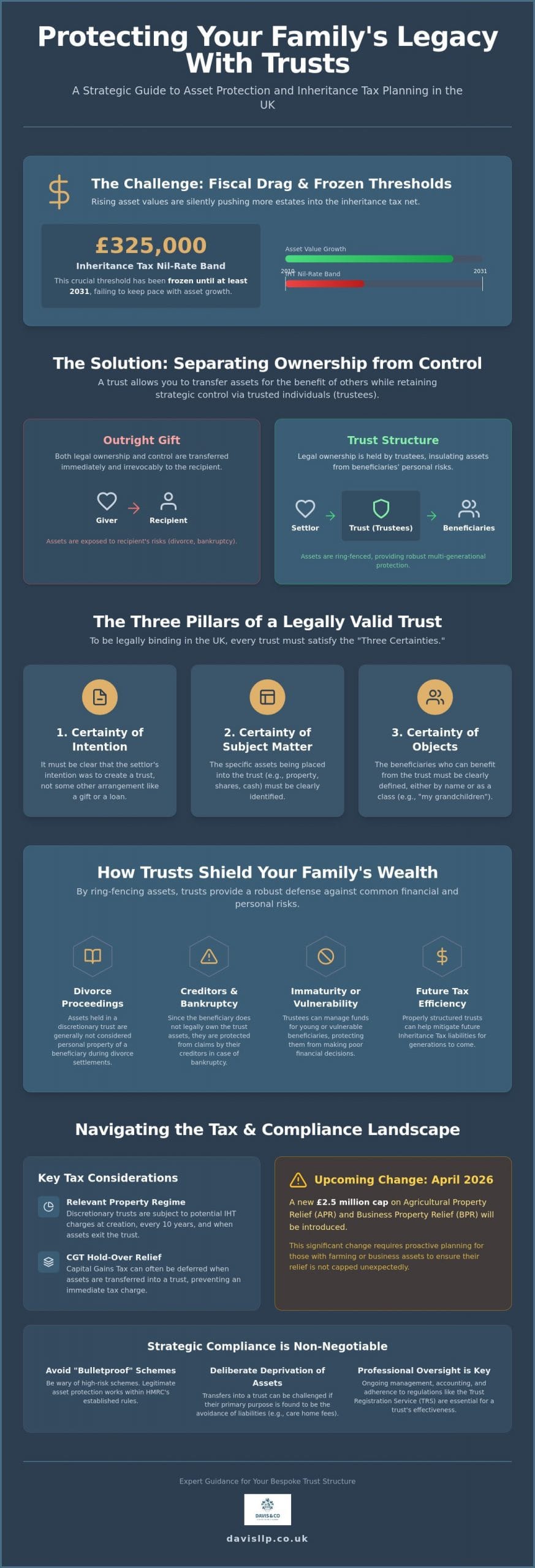
If you believe that your existing estate plan remains effective simply because the headline tax rates haven’t changed, you may be overlooking the silent impact of fiscal drag. With the standard inheritance tax nil-rate band frozen at £325,000 until at least 2031, protecting family assets with a trust has become an essential strategy for those seeking to prevent their legacy from being eroded by rising asset values. We understand the profound sense of responsibility you feel toward your children and grandchildren, as well as the valid concerns regarding how divorce, bankruptcy, or complex HMRC reporting might threaten your hard-earned wealth.
In this guide, we provide the clarity you need to safeguard your family’s financial future using professional trust structures that remain fully compliant with the latest UK tax laws. We’ll examine the strategic advantages of different trust types, the implications of the new £2.5 million cap on agricultural and business property relief effective from April 2026, and the practical steps required to ensure your assets are securely ring-fenced. Our goal is to provide you with a clear framework for reducing your inheritance tax exposure and the confidence that your estate is managed with the precision it deserves.
Key Takeaways
- Discover how discretionary trust structures act as a robust shield, ring-fencing family capital against the risks of beneficiary bankruptcy or divorce proceedings.
- Gain a clear understanding of the tax implications involved in protecting family assets with a trust, including the complexities of the Relevant Property Regime and CGT hold-over relief.
- Learn to distinguish between legitimate asset protection and high-risk schemes that could fall foul of HMRC’s deliberate deprivation of assets rules.
- Identify the “three certainties” required to establish a legally valid trust that provides long-term security for future generations.
- Understand why ongoing professional oversight and rigorous management accounting are essential for maintaining a trust’s strategic effectiveness in a volatile tax environment.
Understanding Trusts as a Vehicle for Multi-Generational Wealth
A trust is far more than a mere legal instrument; it’s a sophisticated fiduciary arrangement designed to bridge the gap between current wealth and future legacy. In its simplest form, a trust exists when assets are held by one party, the trustees, for the benefit of another, the beneficiaries. For those focused on protecting family assets with a trust, this arrangement offers a level of governance that outright gifting simply cannot match. While a gift transfers both ownership and control immediately, a trust allows you to separate the two. This ensures that wealth is preserved and managed according to your specific long-term vision rather than being subject to the immediate whims or misfortunes of a recipient.
To be legally valid in the UK, every trust must satisfy the “three certainties.” First, there must be certainty of intention, meaning it’s clear the settlor intended to create a trust rather than a different type of legal arrangement. Second, there must be certainty of subject matter, which involves identifying exactly which assets are being placed into the structure. Finally, there must be certainty of objects, which defines who the beneficiaries are. Without these three pillars, the structure risks being declared void. This could lead to unintended consequences, including exposing the estate to unnecessary tax liabilities or legal disputes.
The Core Roles: Settlor, Trustee, and Beneficiary
The settlor is the individual who establishes the trust and provides the initial assets. While the trust deed sets the legal boundaries, we often advise clients to draft a “Letter of Wishes.” This document provides non-binding but essential guidance to trustees on how they should exercise their discretion in the years to come. Choosing the right trustees is a critical decision. While family members are often included, appointing professional trustees ensures a level of objective compliance and technical expertise that helps to mitigate potential family friction. Beneficiaries can be specifically named individuals or broader discretionary groups, such as “all future grandchildren,” providing the flexibility needed for truly multi-generational planning.
Common Assets Held in UK Family Trusts
Family trusts frequently hold a diverse range of assets, from the primary residence to complex investment portfolios. When managing private company shares, a trust can be an invaluable tool for business succession. It allows for the transfer of economic value while retaining voting control in the hands of experienced trustees. This prevents the dilution of company interests and ensures the business remains a stable engine for family wealth.
Families with global footprints often face unique challenges. An Asset-protection trust must be structured with an acute awareness of how different jurisdictions treat tax and residency. We specialise in integrating these international elements into a cohesive strategy, ensuring that UK reporting requirements, such as the Trust Registration Service (TRS), are met without compromising the efficiency of the broader estate. This meticulous approach to protecting family assets with a trust ensures that your legacy remains secure, regardless of geographical complexity.
The Mechanics of Asset Protection: Control, Divorce, and Creditors
Establishing a trust is a proactive step toward insulating your legacy from the unpredictable nature of external risks. While tax efficiency is a vital consideration, the strategic value of protecting family assets with a trust lies in its ability to separate legal ownership from beneficial enjoyment. This separation is the cornerstone of effective asset protection. It ensures that family capital remains intact even when individual beneficiaries face personal or professional challenges, such as the eroding effects of a “spendthrift” lifestyle or unforeseen insolvency. As highlighted by Forbes on Asset Protection Trusts, the resilience of these arrangements depends on the precise legal structure and the independence of the governing trustees.
One of the most practical applications of this structure is managing the “Bank of Mum and Dad.” Many parents wish to help their children enter the property market but fear the loss of that capital if the child’s future relationship fails. By providing funds as a loan from the trust rather than an outright gift, the principal remains a debt owed back to the trust. This simple yet effective mechanism ensures the money stays within the family bloodline, protected from being treated as a personal asset of the child or their spouse.
Safeguarding Against Divorce and Relationship Breakdown
The vulnerability of family wealth during a divorce is a significant concern for many settlors. In the UK, the Family Court views assets with a critical eye, often looking through structures to determine the true nature of a “nuptial settlement.” However, a discretionary trust that is managed with professional rigour offers a layer of protection that an outright gift cannot. By maintaining clear records and ensuring that trustees act independently, you reinforce the trust’s integrity. This makes it much harder for trust capital to be classified as a marital asset available for division. This level of professional management is particularly vital when you wish to preserve assets for children from previous relationships or ensure that wealth isn’t diluted by a beneficiary’s relationship breakdown.
Creditor Protection and Business Continuity
For business owners and global entrepreneurs, the line between professional liability and personal wealth can sometimes blur. Integrating trust structures with international tax planning provides a robust framework for shielding your family’s core assets from potential business insolvency or professional litigation. This is not about evading legitimate obligations; it’s about prudent risk management. Beyond creditor protection, trusts facilitate seamless business continuity. By holding voting shares within a trust, you ensure that the governance of a family enterprise remains stable during a transition of power. We often find that a trust’s strength depends on the quality of its ongoing administration. Our trust tax services are designed to help you evaluate these risks and ensure your structure remains a dependable shield for your family’s interests.
Navigating the Tax Implications of UK Family Trusts in 2026
While a trust provides a robust legal shield, its financial efficiency is dictated by the “Relevant Property Regime.” This tax framework governs how most discretionary trusts are treated for Inheritance Tax (IHT) purposes. Protecting family assets with a trust requires a precise understanding of three distinct potential charges: the entry charge, the ten-year anniversary charge, and the exit charge. When you transfer assets into a trust during your lifetime, any value exceeding your available nil-rate band is subject to an immediate 20% entry charge. However, many settlors utilise Capital Gains Tax (CGT) hold-over relief under Section 260 of the Taxation of Chargeable Gains Act 1992. This allows the CGT liability to be deferred and attached to the asset itself, rather than being triggered upon the initial transfer into the trust structure.
Effective management also involves addressing the ongoing income generated by trust assets. For the 2026-2027 tax year, discretionary trustees face a 45% tax rate on most income and 39.35% on dividend income once the initial £500 tax-free amount is exceeded. We work closely with our clients to manage these liabilities through the “tax pool,” ensuring that when income is distributed to beneficiaries, they receive credit for the tax already paid by the trustees. This level of accounting precision is essential to avoid the double taxation of family wealth.
Inheritance Tax (IHT) and the 10-Year Anniversary Charge
The standard nil-rate band is frozen at £325,000 per person until at least 5 April 2031, and this threshold serves as the primary benchmark for the 20% lifetime inheritance tax charge applied to assets entering most discretionary trusts. Beyond the entry point, trustees must prepare for the periodic charge, which occurs every ten years. This charge is calculated at a maximum of 6% of the trust’s value above the nil-rate band. Pro-rata exit charges may also apply when capital is distributed between these ten-year milestones. Securing professional tax advice in the UK ensures that these charges are calculated accurately and that the trust maintains sufficient liquidity to meet its obligations without being forced to liquidate core assets.
Income Tax and Capital Gains within the Trust Structure
Trustees must also navigate the 2026-2027 CGT environment, where the trustee rate for most assets stands at 24%. The annual exempt amount for most trusts is restricted to £1,500, making the timing of asset disposals a critical factor in tax planning. For families with international interests, compliance extends beyond mere tax payments. Most UK trusts must be registered with HMRC’s Trust Registration Service (TRS) within 90 days of creation. This transparency requirement also applies to non-UK trusts that acquire UK land or have at least one UK resident trustee. We believe that protecting family assets with a trust is a long-term commitment that demands rigorous reporting and strategic oversight to remain both compliant and efficient.
Strategic Compliance: Avoiding the ‘Bulletproof’ Marketing Trap
The marketplace is currently saturated with unregulated providers offering “Asset Protection Trusts” marketed as a “bulletproof” solution to avoid care home fees. We urge a high degree of caution regarding these claims. While the concept of protecting family assets with a trust is fundamentally sound, its legal and tax validity depends entirely on the legitimacy of the settlor’s intentions and the precision of the trust deed. Using boilerplate documents or aggressive marketing schemes often leads to structures that fail under the slightest professional scrutiny. A trust should never be viewed as a “set and forget” product; it is a dynamic governance framework that requires ongoing management to remain effective.
True security comes from bespoke planning that prioritises multi-generational wealth preservation and family governance over high-risk tax avoidance. When a trust is established with a clear, documented purpose, such as providing for a vulnerable beneficiary or managing a complex business succession, it stands on much firmer ground. This strategic approach ensures that the structure can withstand challenges from creditors or authorities because it’s built on a foundation of genuine fiduciary responsibility rather than a desire to circumvent social care obligations.
HMRC Scrutiny and the Trust Registration Service (TRS)
Compliance is no longer optional or an afterthought. Since the expansion of the Trust Registration Service (TRS), almost all UK express trusts, including many non-taxable ones, must be registered with HMRC. Most new trusts are required to be registered within 90 days of their creation. From June 2026, these rules have tightened further for non-UK trusts holding UK property. Non-compliance or inaccurate reporting can lead to significant financial penalties and heightened scrutiny of the settlor’s broader financial affairs. To complete a TRS submission, you must provide specific details, including the identities of the settlor, trustees, and beneficiaries, along with a description of the trust assets and their current valuation. We ensure our clients remain ahead of these deadlines, maintaining a transparent and compliant record that protects the trust’s long-term integrity.
The Reality of Long-Term Care Planning
Local authorities are increasingly rigorous in applying the “Deliberate Deprivation of Assets” rules. If a council believes that a trust was created with the primary purpose of avoiding means-testing for care home fees, they have the power to treat the transferred assets as if they still belong to you. The timing of the transfer and the foreseeability of the need for care are the two most critical factors in these assessments. If you’re already in poor health or the need for care is imminent, the local authority is likely to challenge the trust. We recommend consulting a chartered accountant to ensure your trust serves legitimate financial goals, such as IHT planning or protecting assets for future generations. If you’re concerned about the resilience of your current arrangements, our trust tax services can provide a comprehensive review of your compliance status.
Establishing a Bespoke Trust Structure with Davis & Co LLP
Protecting family assets with a trust is a commitment that extends far beyond the initial drafting of a legal deed. At Davis & Co LLP, we view our role as a strategic partnership designed to provide the intellectual rigour and administrative precision necessary for long-term wealth preservation. A trust’s success isn’t defined at its creation, but through decades of meticulous oversight and adaptation to a shifting regulatory environment. Our methodology integrates high-level tax planning with robust management accounting, ensuring your trust remains a resilient vehicle for your family’s future. We believe that professional accounting is the true backbone of any trust structure, providing the transparency and accuracy required to satisfy both beneficiaries and HMRC.
Our approach is rooted in a deep understanding of the practical realities our clients face. We don’t offer generic solutions. Instead, we begin with an intensive diagnostic phase that assesses your unique family goals, the nature of your asset portfolio, and any jurisdictional complexities that may arise from international interests. This thorough preparation allows us to build a framework that is both legally sound and tax-efficient, providing you with the peace of mind that your legacy is in capable hands.
The Davis & Co Trust Advisory Process
We follow a disciplined three-step process to ensure every trust we manage is positioned for multi-generational success. First, we conduct a comprehensive strategic review of your personal and international tax positions, identifying potential vulnerabilities and opportunities for optimisation. Second, we coordinate closely with legal specialists to ensure the bespoke deeds reflect your specific intentions while remaining flexible enough to handle future changes. Finally, we implement robust accounting and HMRC reporting systems. This includes managing the Trust Registration Service (TRS) requirements and maintaining the detailed records necessary for calculating periodic and exit charges. This systematic approach eliminates the risk of administrative oversight and ensures your trust operates with clinical precision.
Why Discretion and Expertise Matter
Since 1901, we’ve acted as a trusted advisor to families with complex financial interests. We understand that matters of wealth and succession are deeply personal. Discretion is not merely a policy for us; it’s a fundamental value that defines how we operate. Our history provides a unique perspective on long-term stability, allowing us to offer advice that is both traditional in its principles and contemporary in its application. We focus on the human impact of these structures, aiming to make you feel secure and well-advised without the need for aggressive marketing or loud claims. If you’re ready to explore a more refined approach to protecting family assets with a trust, we invite you to schedule a confidential consultation. Together, we can develop a strategy that reflects your values and secures your family’s financial standing for the years to come.
Securing Your Multi-Generational Legacy
The complexities of 2026 require more than just standard legal documents; they demand a proactive approach to governance and rigorous tax precision. We’ve explored how a well-structured trust serves as a robust shield against relationship breakdowns, creditor risks, and the eroding effects of fiscal drag. However, the true strength of these arrangements lies in their ongoing administration and unwavering adherence to evolving HMRC reporting standards. Without professional oversight, even the most carefully drafted deed can become a liability rather than a protection.
Since 1901, Davis & Co LLP has served as a discrete partner for families navigating sensitive financial matters. As specialists in international and trust tax, we provide the professional gravitas required to manage complex cross-border interests with absolute reliability. Protecting family assets with a trust is a strategic journey that requires a partner who understands both the technical nuances and the human impact of wealth preservation. We invite you to secure your family’s future with bespoke trust tax services from Davis & Co LLP. By integrating professional accounting with a deep respect for your family’s unique goals, we’ll help ensure your legacy remains intact for generations to come.
Frequently Asked Questions
Can a trust protect my home from being sold to pay for care fees?
A trust can only protect your home if its primary purpose isn’t the avoidance of care fees and the transfer occurs well before the need for care is foreseeable. Local authorities apply the “deliberate deprivation of assets” test; they have the power to challenge trusts they believe were created to circumvent means-testing. A trust established while in good health for inheritance tax planning or succession is generally more resilient than one created as an emergency measure.
What is the difference between a lifetime trust and a will trust?
A lifetime trust is established and funded while you’re alive, whereas a will trust only comes into existence upon your death. Lifetime structures are often preferred for protecting family assets with a trust because they allow for immediate ring-fencing against risks like divorce or bankruptcy. This proactive approach ensures that assets are already under professional management and legally separated from your personal estate long before they’re needed by future generations.
How much does it cost to maintain a family trust annually in the UK?
Annual maintenance costs typically involve professional fees for tax return preparation, management accounting, and Trust Registration Service (TRS) updates. These costs vary based on the complexity of the asset portfolio and the frequency of distributions to beneficiaries. Trustees should budget for the administrative rigour required to ensure the trust remains compliant with HMRC’s 2026 reporting standards; failing to do so can lead to much higher costs in penalties and remedial work.
Do I lose control of my assets if I put them in a trust?
You don’t necessarily lose all influence, but you must transfer legal ownership to the trustees. By acting as a trustee yourself and drafting a detailed Letter of Wishes, you maintain a level of strategic oversight while ensuring the assets are legally separated from your personal estate. This balance allows you to guide how the wealth is used while enjoying the protection that comes from no longer owning the assets in your individual capacity.
What is the 10-year anniversary charge for UK trusts?
The 10-year anniversary charge is a periodic inheritance tax payment of up to 6% on the value of the trust’s assets that exceeds the available nil-rate band. For 2026, the standard nil-rate band remains frozen at £325,000; this means trustees must conduct a formal valuation every decade. We ensure our clients have sufficient liquidity within the trust to meet this liability without being forced to sell core family assets like property or business shares.
Can I be both a trustee and a beneficiary of my own family trust?
You can legally be both a trustee and a beneficiary, but this often classifies the arrangement as a “settlor-interested trust” for tax purposes. Under these rules, the trust’s income and gains are generally taxed as your own, which can simplify some aspects of reporting. However, while protecting family assets with a trust in this way is possible, it requires careful structuring to ensure the asset protection benefits aren’t compromised by your ongoing access to the funds.
How does HMRC track trusts that aren’t paying tax?
HMRC tracks trusts primarily through the Trust Registration Service (TRS), which now requires almost all UK express trusts to register regardless of their tax liability. Most new trusts must be registered within 90 days of their creation. Furthermore, financial institutions are required to report data to HMRC under international transparency agreements, making it nearly impossible for significant trust arrangements to remain invisible to the authorities in 2026.
Can a UK trust hold international property or foreign shares?
A UK trust can certainly hold foreign shares and international property, though this introduces significant cross-border tax complexities. Trustees must navigate the specific tax laws of the country where the asset is located along with UK reporting requirements. This often involves managing double taxation treaties and ensuring that the trust deed is recognised in the foreign jurisdiction, making specialist international tax planning an essential component of the trust’s ongoing management.