Maintaining a £90,000 turnover threshold may appear to offer a comfortable margin for growth, yet for firms exporting professional expertise, the intricate “place of supply” rules regarding vat on international services uk can swiftly transform domestic expansion into a complex cross-border compliance challenge. We understand that the administrative weight of the reverse charge mechanism, coupled with the persistent threat of HMRC penalties, creates a significant sense of uncertainty for even the most established enterprises. It’s a common concern that often hinders strategic international scaling and complicates your operational focus.
This guide provides the necessary clarity to ensure your cross-border operations remain both compliant and tax-efficient. We’ll examine the nuances of the dual-test registration threshold, clarify the vital distinctions between B2B and B2C invoicing, and establish a robust framework for protecting your cash flow. By the end of this article, you’ll have a clear, actionable strategy to navigate the 2026 regulations with the confidence of a well-advised partner. Our aim is to replace administrative confusion with a structured approach that supports your long-term commercial objectives.
Key Takeaways
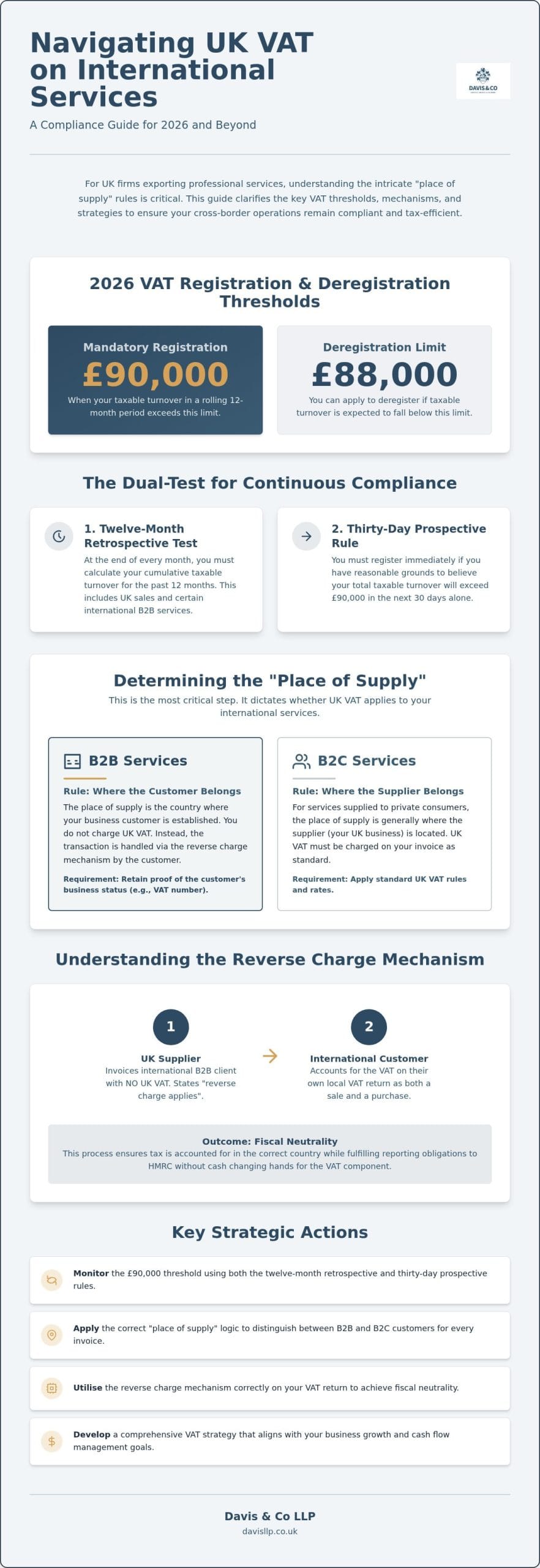
- Monitor the £90,000 registration threshold using both the twelve-month retrospective assessment and the thirty-day prospective rule to maintain continuous compliance.
- Apply the correct “place of supply” logic to your transactions to distinguish between business customers and private consumers, ensuring the appropriate tax treatment for every invoice.
- Utilise the reverse charge mechanism correctly on your VAT return to achieve fiscal neutrality while fulfilling your reporting obligations to HMRC.
- Develop a comprehensive strategy for vat on international services uk that aligns with your wider objectives for business growth acceleration and cash flow management.
- Identify how specific sector requirements, such as those for dental practices and healthcare providers, influence your VAT recovery and partial exemption calculations.
UK VAT on International Services: The 2026 Regulatory Framework
The 2026 landscape for vat on international services uk is anchored by a registration threshold of £90,000. While this figure provides a clear benchmark, the calculation of “taxable turnover” for businesses operating across borders is often more nuanced than it first appears. It’s vital to understand that the UK Value-Added Tax (VAT) system requires businesses to include not just their domestic sales, but also certain international supplies when determining if they’ve breached this limit. Specifically, if you provide services to international business clients that would be taxable if delivered within the UK, these “outside the scope” supplies generally count toward your cumulative turnover. This is a critical detail often overlooked by growing firms.
Distinguishing between zero-rated, exempt, and “outside the scope” supplies is a cornerstone of effective tax planning. Exempt supplies, such as specific insurance or financial services, don’t contribute to your taxable turnover. Conversely, zero-rated supplies do. The complexity arises with international B2B services; while they’re technically outside the scope of UK VAT, their value must still be monitored against the £90,000 threshold to ensure you don’t inadvertently trigger a mandatory registration. This dual nature of international sales demands a rigorous approach to management accounts.
The Rolling 12-Month Period vs Fixed Tax Years
HMRC assesses the registration requirement on a rolling twelve-month basis rather than a fixed financial or calendar year. You must calculate your cumulative turnover at the end of every month. A common oversight involves foreign currency invoices. You must convert these into GBP using the appropriate HMRC exchange rates at the time of the supply to maintain an accurate threshold count. Accessing expert tax advice in the UK ensures these conversions and rolling assessments are handled with the precision required to avoid late registration penalties.
Registration and Deregistration Limits for 2026
For businesses that have already registered, the 2026 deregistration threshold stands at £88,000. You can only apply to cancel your registration if you expect your taxable turnover to fall below this limit in the next twelve months. However, voluntary registration remains a strategic option even for those below the £90,000 mark. If your international service delivery involves significant UK-based costs, registering voluntarily allows you to recover input tax that would otherwise be lost. This directly supports your cash flow management and broader business growth acceleration.
Determining the Place of Supply for Cross-Border Services
Identifying where a service is legally “supplied” is the most critical step in managing vat on international services uk. This determination dictates whether you must apply UK VAT or if the transaction falls under the jurisdiction of the recipient’s country. Central to this is the “Place of Belonging” concept. This isn’t merely where a client’s head office sits; it’s the location where the service is most directly used or where the business has a fixed establishment with the human and technical resources necessary to receive the supply. If a client has multiple offices, determining which one is the “recipient” requires a careful, fact-based analysis of the service’s delivery.
B2B Services: The Customer Belongs Rule
For the majority of business-to-business transactions, the general rule states that the place of supply is where the customer belongs. If your client is a company established in Germany, the supply is deemed to occur in Germany. Consequently, your invoice shouldn’t include UK VAT. However, the burden of proof rests entirely on the supplier. You must secure and retain evidence of the customer’s business status, such as a valid VAT registration number. This level of diligence is a vital component of robust international tax planning. HMRC provides comprehensive guidance on these specifics in their notice on the Place of supply of services, which outlines the necessary evidentiary standards for global trade.
B2C Services: The Supplier Belongs Rule
When dealing with private individuals (B2C), the regulatory logic typically reverses. The place of supply is usually where the supplier belongs. If a UK consultancy provides advice to a private individual in Spain, UK VAT is generally applicable at the standard 20% rate. Significant exceptions exist, particularly for electronic, telecommunications, and broadcasting services. In these instances, the place of supply is always where the consumer resides. This often necessitates a VAT registration in each country where you have private customers, or the use of specific simplified schemes. Accurate classification at the point of sale is essential to protect your profit margins.
High-growth startups must be particularly vigilant regarding the “Forward-Looking” test. If you expect your taxable turnover, including relevant international services, to exceed the £90,000 threshold in the next thirty days alone, you must register immediately. Many firms focus solely on historical data, but this prospective spike can trigger an unexpected liability and immediate penalties. If you’re scaling quickly and require a partner to monitor these thresholds through detailed management accounts, our team at Davis & Co LLP is here to provide the necessary oversight. We ensure your compliance framework evolves at the same pace as your international expansion.
The Reverse Charge Mechanism and Fiscal Neutrality
The reverse charge mechanism serves as a fundamental compliance tool for vat on international services uk, ensuring that tax is accounted for in the country where services are consumed. When a UK business procures services from an overseas supplier, the responsibility for reporting VAT shifts from the seller to the buyer. This process effectively requires the recipient to treat themselves as both the supplier and the customer on their VAT return. It’s a system designed to prevent overseas suppliers from gaining a competitive advantage over domestic providers by avoiding local tax obligations.
For most fully taxable businesses, this mechanism achieves fiscal neutrality. You record the VAT due as output tax in Box 1 and simultaneously reclaim the same amount as input tax in Box 4. While this results in a net-zero financial impact, the reporting obligation remains mandatory. Accuracy is essential. HMRC expects these figures to reflect the true value of imported services to maintain the integrity of the UK tax base. Neglecting this “paper exercise” can lead to administrative errors that complicate your VAT compliance profile during an inspection.
Importing Services: Compliance Obligations
Managing the reverse charge requires precise data entry, particularly when dealing with foreign currency invoices. You must convert the value of the imported service into British Pounds using the exchange rate applicable at the tax point, which is typically the invoice date or the date of payment. Failure to apply the correct rate can lead to discrepancies in your turnover calculations and potential under-reporting of your tax position.
Crucially, the value of services subject to the reverse charge contributes to your total taxable turnover. If your business isn’t yet registered, these imported services could push you over the £90,000 threshold. This triggers a mandatory registration even if your domestic sales remain well below the limit. Maintaining meticulous records through professional bookkeeping services is the most effective way to monitor these cumulative values and avoid the risk of backdated tax liabilities and interest charges.
Partial Exemption and the Reverse Charge
The principle of fiscal neutrality diminishes for businesses that make exempt supplies, such as those in the healthcare and dental sectors. These partially exempt entities cannot reclaim all the VAT they incur. When a dental practice imports specialist software or consultancy from abroad, they must still account for output VAT in Box 1. However, their ability to reclaim that same amount in Box 4 is restricted by their partial exemption recovery rate. This creates a genuine cash cost for the business.
It’s vital to refer to the official government guidance on the place of supply for services to confirm whether the reverse charge applies to your specific procurement. Calculating the non-recoverable portion requires a detailed understanding of your business’s input tax allocation. We work closely with our clients to integrate these calculations into their broader cash flow management. This ensures that international procurement remains a viable part of your growth strategy without leading to unforeseen tax leakages.
The Dual-Test Calculation: Managing Growth and Spikes
Compliance regarding vat on international services uk isn’t a static obligation. HMRC employs a dual-test methodology to determine when a business must join the VAT register. The first component is the “Backward Look,” which requires you to assess your cumulative taxable turnover at the end of every month for the previous twelve months. If this figure exceeds £90,000, you have thirty days to notify HMRC. Failure to do so often results in backdated tax liabilities and financial penalties that can disrupt your business growth acceleration plans.
While the rolling twelve-month check is standard, high-growth firms often overlook the “Forward Look” test. This requirement is particularly relevant when securing significant international contracts. If you anticipate that your taxable turnover will exceed the threshold in the next thirty days alone, the notification period begins immediately. We often see businesses focus so intently on historical data that they miss this prospective requirement, leading to avoidable compliance friction.
Navigating the 30-Day Forward-Looking Rule
Identifying “reasonable grounds” for a threshold breach requires a proactive analysis of your sales pipeline and signed agreements. The 30-day rule is a mandatory proactive compliance measure for high-growth firms. When your international expansion involves a single large-scale project or a sudden influx of global clients, your UK VAT obligations can trigger overnight. It’s not enough to wait for the money to land; the moment the expectation exists, the clock starts. We help our partners monitor these projections to ensure registration occurs exactly when required, neither too early nor too late.
Exemption from Registration for One-Off Breaches
In specific circumstances, a business might breach the £90,000 limit due to a temporary, non-recurring event. If you can prove to HMRC that your turnover will not exceed the £88,000 deregistration limit in the subsequent twelve months, you may apply for an “exception” from registration. This is a nuanced process that requires robust evidence, such as proof that a contract was a one-off or that a specific revenue stream has ceased. HMRC doesn’t grant these exceptions lightly; they require a clear and documented narrative of your financial trajectory.
The role of a small business accountant is pivotal in these negotiations. We provide the intellectual rigour and professional gravitas needed to present your case effectively to HMRC. By aligning your VAT strategy with your broader cash flow management, we ensure that a temporary spike in international sales doesn’t lead to a permanent and unnecessary administrative burden. If you’re concerned about a recent or upcoming turnover surge, our team at Davis & Co LLP can help you determine the most strategic path forward.
Strategic VAT Management with Davis & Co LLP
Davis & Co LLP has served as a trusted advisor to growing enterprises since 1901, providing the professional gravitas required to manage complex fiscal obligations. We believe that managing vat on international services uk should never be an isolated administrative exercise. Instead, we integrate VAT compliance into a comprehensive Business Growth Acceleration plan. This approach ensures that your tax strategy supports your commercial ambitions rather than hindering them through unforeseen liabilities or cash flow constraints.
Proactive threshold monitoring is the cornerstone of our service delivery. By utilizing detailed Management Accounts, we provide our clients with real-time visibility into their rolling twelve-month turnover. This level of oversight is particularly vital for firms scaling internationally, where a single contract or a change in “place of supply” rules can trigger immediate registration requirements. We act as a dependable constant in a volatile regulatory environment, allowing you to focus on your core operations with the security of expert guidance.
Bespoke Support for Dental and Specialist Sectors
Our firm provides specialized expertise for healthcare providers and dental practices, sectors that often face unique challenges regarding vat on international services uk and partial exemption. When your business generates a mix of taxable and exempt income, importing international services or equipment requires precise apportionment to avoid overpaying VAT. As a dedicated dental tax specialist, we understand the nuances of these income streams and work to optimize your VAT recovery on international software licenses and clinical equipment. We ensure that your cross-border procurement remains fiscally efficient while maintaining total transparency with HMRC.
A Partner-Led Approach to International Tax
We pride ourselves on a partner-led model that fosters deep, collaborative relationships. This composed partnership allows us to address sensitive commercial matters with the discretion and intellectual rigour they deserve. We don’t merely provide a service; we offer a strategic alliance designed to ensure long-term fiscal stability and resilience against regulatory shifts. We invite you to consult with our partners for a bespoke VAT evaluation of your international operations. Our goal is to provide you with the understated confidence that comes from knowing your global tax position is managed by specialists with a proven history of success.
Securing Your Global Growth Strategy
Mastering the intricacies of vat on international services uk is no longer just a matter of administrative hygiene; it’s a strategic pillar for any firm with global ambitions. By rigorously applying the dual-test calculation and maintaining clarity on “place of supply” rules, you protect your enterprise from the friction of late registration and the hidden costs of partial exemption. These frameworks ensure that your expansion remains fiscally sound and fully aligned with HMRC’s expectations. Consistency in your reporting and threshold monitoring serves as the foundation for sustainable international trade.
As Chartered Certified Accountants since 1901, we provide the steady guidance necessary to navigate these complexities. We act as specialist international and dental tax advisors, serving as strategic partners in business growth and HMRC compliance. We invite you to contact Davis & Co LLP for a strategic VAT and international tax consultation to evaluate your specific cross-border requirements. With a robust compliance structure in place, your international service delivery can become a seamless and confident driver of long-term success.
Frequently Asked Questions
Do international sales count towards the £90,000 VAT threshold?
International B2B sales generally count towards the £90,000 registration threshold if the services would be taxable if supplied within the UK. While these sales are technically “outside the scope” of UK VAT, their value remains a critical part of your taxable turnover calculation. You must monitor these figures monthly to ensure you don’t inadvertently breach the limit. It’s a common area of confusion that requires precise management accounts to track accurately.
What is the reverse charge and how does it affect my UK VAT return?
The reverse charge is a mechanism where the UK buyer accounts for the VAT on services imported from overseas. On your VAT return, you record the VAT amount in Box 1 as output tax and the same amount in Box 4 as input tax. This process ensures fiscal neutrality for most businesses. It’s an essential requirement for maintaining compliance when managing vat on international services uk, effectively making you both the supplier and the customer.
Do I need to charge VAT to a business customer based in the USA?
You generally don’t need to charge UK VAT to a business customer in the USA because the place of supply is where the customer belongs. However, you must obtain and retain commercial evidence that your client is a legitimate business entity. Without this documentation, HMRC may expect you to treat the transaction as a B2C supply and apply the standard 20% UK VAT rate. Keeping robust records is vital for your international tax planning.
What happens if I temporarily exceed the VAT threshold due to a large international order?
If a one-off international contract pushes your turnover over £90,000, you may apply for a registration “exception”. You must write to HMRC and provide evidence that your taxable turnover will not exceed the £88,000 deregistration threshold in the coming twelve months. If HMRC is satisfied that the breach is temporary, they may permit you to remain unregistered. This process requires a detailed narrative of your expected income and professional oversight to be successful.
Can I reclaim VAT on international services I have purchased for my business?
You can reclaim VAT on international services through the reverse charge mechanism on your UK return. When you account for the VAT due in Box 1, you simultaneously claim it back in Box 4. This is only possible if your business is fully taxable and the services are used for taxable supplies. If your firm is partially exempt, your ability to reclaim this input tax will be restricted by your specific recovery percentage.
How do the “place of supply” rules affect a UK dental practice?
For a UK dental practice, the place of supply rules often apply to imported clinical software or specialist consultancy. Because dental services are largely exempt, the practice must account for reverse charge VAT on these international inputs but cannot reclaim the full amount. This creates a non-recoverable tax cost. Navigating these nuances requires the expertise of a dental tax specialist to ensure your partial exemption calculations remain accurate and compliant with HMRC standards.
What are the penalties for late VAT registration when trading internationally?
HMRC applies “failure to notify” penalties if you register for VAT after the mandatory deadline. These penalties are calculated as a percentage of the “potential lost revenue,” which is the VAT due from the date you should have been registered until you notified HMRC. The percentage varies based on whether the delay was deliberate or concealed. Trading internationally doesn’t exempt you from these strict timelines, making proactive threshold monitoring through management accounts essential.
Is voluntary VAT registration beneficial for a business with high international costs?
Voluntary registration is often beneficial when your business incurs significant vat on international services uk through the reverse charge or pays UK VAT on domestic inputs. By registering before you reach the £90,000 threshold, you gain the ability to recover this input tax, which can significantly improve your cash flow. This is a strategic decision that should be evaluated as part of your broader business growth acceleration plan to ensure optimal fiscal efficiency.