While many directors assume their filings at Companies House serve as the definitive record of ownership, the legal reality is found only within your own private documents. If these internal records are neglected, your business faces significant risks during a HMRC audit or a potential sale. Maintaining statutory registers for a limited company is no longer just a matter of administrative hygiene; it’s a critical legal obligation that defines the very structure and legitimacy of your organisation.
We recognise that the shifting landscape introduced by the 2024 Economic Crime and Corporate Transparency Act has created a sense of uncertainty for many business leaders. It’s understandable to feel anxious about whether your current processes meet the rigorous standards expected in 2026. This article will help you master the evolving requirements of corporate record-keeping and ensure your company remains compliant with the latest UK legislative changes. We provide a clear distinction between mandatory and optional registers, offer a practical compliance checklist, and explain how professional oversight provides the quiet excellence needed to pass any due diligence process with absolute confidence.
Key Takeaways
- Understand why the Register of Members serves as the definitive legal proof of ownership, remaining a mandatory internal requirement that Companies House records merely mirror.
- Navigate the complexities of the Economic Crime and Corporate Transparency Act 2024 and its specific implications for your 2026 compliance obligations.
- Evaluate the strategic decision between maintaining statutory registers for a limited company internally versus electing to keep records on the central register.
- Follow a structured checklist to audit your existing records and confirm their correct location, whether at your Registered Office or a Single Alternative Inspection Location (SAIL).
- Recognise how proactive corporate governance and professional secretarial support can mitigate risks during audits and facilitate seamless business transactions.
The Evolution of Statutory Registers in 2026
Statutory registers represent the definitive legal record of a private limited company and its internal constitution. While digital filings are increasingly prevalent, these registers remain the primary evidence of a company’s legal standing and ownership structure. By 2026, the legislative landscape has shifted significantly following the full implementation of the Economic Crime and Corporate Transparency Act 2024. This Act has redefined the relationship between a company’s private records and the public record held by the Registrar.
Directors must distinguish between the “Central Register” maintained by Companies House and the “Internal Registers” that the company is legally obliged to keep. Maintaining statutory registers for a limited company involves ensuring these records are accessible at the registered office or a Single Alternative Inspection Location (SAIL). Neglecting this duty can lead to severe legal consequences, including daily default fines for the company and its directors. It’s a matter of legal necessity that requires constant, meticulous attention.
What Has Changed: The Move to Central Filing
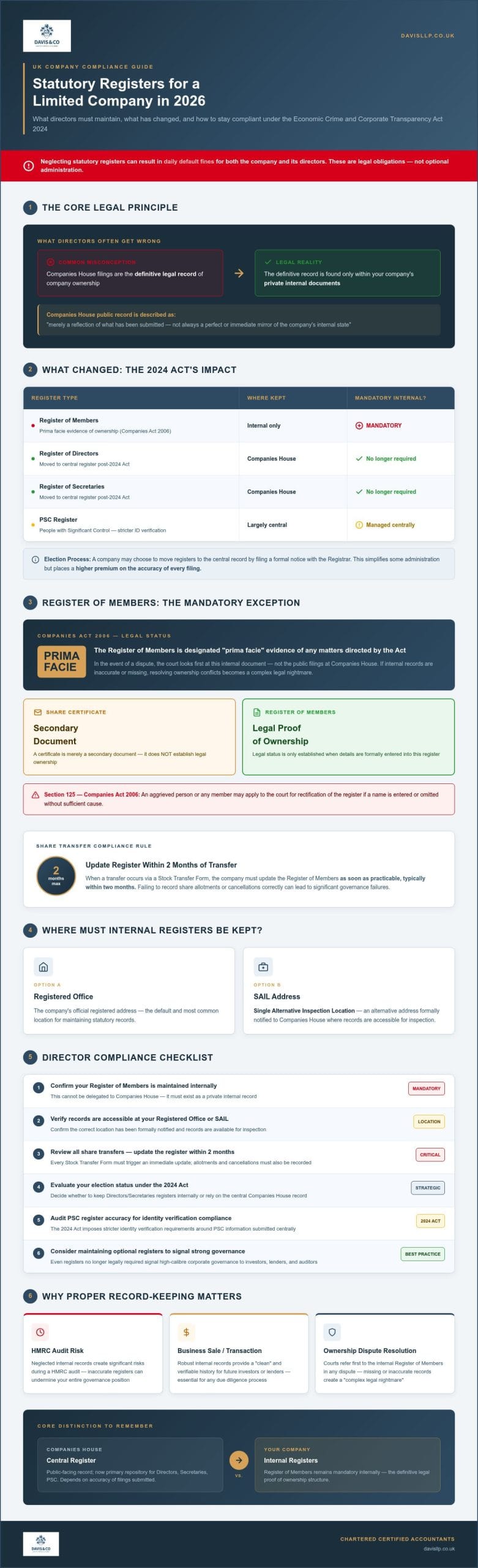
The modern regulatory framework has removed the mandatory requirement for companies to keep internal Registers of Directors and Secretaries. Instead, Companies House now serves as the primary repository for this information. Similarly, the Register of People with Significant Control (PSC) is now largely managed via the central record to facilitate stricter identity verification. A company may choose to use the “election” process to move its registers to the central record by filing a formal notice with the Registrar. This change simplifies some administrative burdens but places a higher premium on the accuracy of every filing.
Why Internal Records Still Matter for Governance
Relying exclusively on Companies House for your corporate history is a strategic mistake. The public record is merely a reflection of what has been submitted; it isn’t always a perfect or immediate mirror of the company’s internal state. Robust internal records provide a “clean” and verifiable history for future investors or lenders. We find that maintaining statutory registers for a limited company, even those no longer strictly required by law, signals a commitment to high-calibre corporate governance. It ensures your organisation is always prepared for the scrutiny of an audit or the complexities of a business sale. This disciplined approach to record-keeping acts as a prerequisite for sustained business growth and effective cash flow management.
The Register of Members: The Mandatory Exception
Unlike the registers for directors or secretaries, the Register of Members cannot be delegated entirely to the central record at Companies House. It must be maintained internally. This record isn’t just an administrative task; it’s the final legal word on who owns the company. Many directors mistakenly believe a share certificate is the ultimate proof of ownership. In reality, a certificate is merely a secondary document. The legal status of a shareholder is only established when their details are formally entered into the Register of Members.
Legal Primacy of the Register
The Companies Act 2006 designates the Register of Members as “prima facie” evidence of any matters directed by the Act. This means that in the event of a dispute, the court looks first at this internal document rather than the public filings at Companies House. If your internal records are inaccurate or missing, resolving ownership conflicts becomes a complex legal nightmare. Under Section 125, an aggrieved person or any member may apply to the court for the rectification of the register if a name is entered or omitted without sufficient cause. Maintaining statutory registers for a limited company with this level of precision ensures that your organisation’s ownership structure remains beyond reproach. It provides the intellectual rigour required for serious corporate governance.
Maintaining Accuracy During Share Transfers
Precision is required whenever shares change hands. When a transfer occurs via a Stock Transfer Form, the company must update the register as soon as practicable, typically within two months. Failing to record share allotments or cancellations correctly can lead to significant governance failures. Directors must ensure that every change is captured immediately to maintain the integrity of the corporate record. Maintaining statutory registers for a limited company requires a deep understanding of these timelines to avoid administrative penalties during future due diligence.
This accuracy is particularly vital when seeking expert tax advice in the UK regarding dividend distributions. Dividends must only be paid to those legally recognised on the register at the time of declaration. Properly documenting names, addresses, share classes, and the exact dates of entry is part of the broader annual compliance requirements for limited companies. For family offices or international structures, the complexity of these entries often requires the steady hand of a professional partner. Our team at Davis & Co LLP can ensure your registers are not only compliant but also structured to support your long-term commercial goals.
Internal vs. Central Registers: Deciding Your Strategy
Deciding whether to maintain records internally or elect to use the central register at Companies House is a pivotal choice for directors. This decision impacts not only administrative efficiency but also the company’s privacy profile and its readiness for future investment. While the central register offers a degree of convenience, it requires rigorous adherence to identity verification standards that became mandatory by 2026. Choosing the right path is a balance between public transparency and private control.
Pros and Cons of Central Election
Choosing the central election simplifies the filing process by consolidating records with the Registrar, but it often leads to a loss of control over how historical data is presented. For companies involved in international tax planning, relying solely on the UK’s central record may not suffice. Many international jurisdictions and family offices require highly specific, localised documentation that goes beyond the UK’s baseline requirements. Central records are public by nature. While directors’ residential addresses are generally protected from the public, the risk of “public record” errors becoming legally binding if left unchallenged is a significant concern for high-growth firms. Maintaining statutory registers for a limited company internally allows for a more nuanced and secure historical record.
The Role of the SAIL Address
For those who prefer internal control but cannot host records at their primary office, the Single Alternative Inspection Location (SAIL) provides a sophisticated solution. This designated address, which must be notified to the Registrar, allows a company to centralise its Companies Act 2006 statutory register requirements in a professional environment. Using a SAIL address is particularly effective for managing public inspection rights. Any member of the public can request to see your registers, provided they state their purpose and pay a prescribed fee. Having a professional firm manage this process ensures that such requests are handled with the necessary discretion and legal compliance.
Ultimately, maintaining statutory registers for a limited company through an internal or SAIL-based system often yields better results during business valuations. Investors and lenders look for “clean” records that demonstrate a history of diligent governance. A well-maintained internal register acts as a repository of corporate truth, providing a level of detail that Companies House cannot always replicate. This strategic approach ensures that your corporate governance remains an asset rather than a liability during due diligence, providing a sense of stability in a volatile commercial environment.
A Comprehensive Compliance Checklist for Directors
Maintaining statutory registers for a limited company requires a disciplined approach to administrative oversight. It’s not enough to set up these records at incorporation; they must be living documents that reflect every structural change within your organisation. To ensure your company remains on the right side of the law in 2026, we recommend following a structured audit process. This ensures that your corporate governance remains robust and ready for any external scrutiny.
- Step 1: Audit existing registers. Ensure all entries are accurate as of 2026, reflecting any changes necessitated by the Economic Crime and Corporate Transparency Act.
- Step 2: Confirm record location. Verify whether your records are held at the Registered Office or a Single Alternative Inspection Location (SAIL), and ensure this matches your filings at Companies House.
- Step 3: Review the Register of Members. Cross-reference current and past shareholder details against share certificates and stock transfer forms to ensure no discrepancies exist.
- Step 4: Check legacy charges. For companies established before 2013, ensure the Register of Charges and Debentures is complete, as these legacy records remain a legal requirement.
- Step 5: Synchronise with filings. Ensure your internal registers perfectly match your latest Confirmation Statement to avoid contradictions during an official inspection.
The Annual Review Process
A robust governance strategy integrates these checks into your broader financial calendar. We suggest aligning register audits with your annual management accounts review. This ensures that any share allotments or transfers discussed during the year are formally recorded. Certain trigger events, such as the death of a shareholder or a new share issue, require immediate action. You must notify Companies House of changes to your directors or secretaries within 14 days of the event occurring. Staying ahead of these deadlines prevents the accumulation of late filing penalties and protects the company’s reputation.
Preparing for Due Diligence
Missing or incomplete registers are one of the most common reasons for a business sale or investment round to stall. Reconstructing a lost register is a costly and time-consuming exercise that often requires legal intervention to verify historical ownership. Professional audit and assurance processes rely heavily on the integrity of these statutory records. Without them, auditors may be unable to verify the legal basis of your corporate structure. Maintaining statutory registers for a limited company is therefore an investment in the future liquidity of your business. If you’re concerned about the state of your corporate records, our Company Secretarial Services can provide a full health check to ensure you’re transaction-ready.
Strategic Governance with Davis & Co LLP
Effective corporate governance moves beyond the simple avoidance of penalties; it serves as a foundation for sustainable business growth and long-term stability. While the administrative burden of maintaining statutory registers for a limited company has increased with the implementation of the Economic Crime and Corporate Transparency Act, this complexity also offers an opportunity to refine your organisation’s internal controls. We view these duties not as isolated tasks, but as integral components of a broader financial and strategic framework. By ensuring your records are beyond reproach, we protect your company’s reputation and commercial value.
Our approach is defined by a sense of quiet excellence and discretion. For family offices and international SMEs, the sensitivity of ownership data requires a partner who understands the nuances of cross-border structures and complex share arrangements. We integrate our secretarial expertise with our core accounting and tax functions, ensuring that every entry in your register aligns with your wider financial objectives. This holistic perspective allows us to identify potential governance risks before they impact your operations or investment potential.
Our Company Secretarial Services
We provide a comprehensive suite of services designed to alleviate the pressure of regulatory compliance for national and international clients. Our dedicated department manages the provision of registered office and SAIL address services, ensuring your statutory records are held in a professional environment that meets all legal inspection requirements. We maintain both electronic and physical registers to the highest standards of precision, reflecting every change in your company’s constitution with absolute accuracy. As identity verification protocols under the Economic Crime Act become more rigorous, we handle all necessary Companies House filings, providing you with the assurance that your organisation remains fully compliant with the latest UK standards.
The Partnership Approach
Working with us means entering into a composed partnership where your corporate standing is managed with the same rigour as your financial accounts. We recognise that your primary focus should remain on driving business growth and acceleration rather than navigating the intricacies of legislative change. Our team specialises in managing intricate share structures and the specific requirements of international owners, offering a level of service that is both traditional in its values and modern in its application. This reliable oversight ensures that when the time comes for a sale, audit, or significant investment, your corporate history is a clear and verifiable asset. Secure your corporate standing-contact Davis & Co LLP for a governance review to ensure your registers are prepared for the challenges of 2026 and beyond.
Securing Your Corporate Legacy in 2026 and Beyond
Adopting a disciplined approach to corporate record-keeping is no longer an optional administrative task; it’s a fundamental pillar of modern business governance. We’ve explored how the Register of Members remains the definitive legal evidence of ownership, standing as a mandatory internal record that Companies House only mirrors. By following a structured audit process and understanding the nuances of the Economic Crime and Corporate Transparency Act, you ensure your organisation is prepared for any level of external scrutiny or due diligence.
Maintaining statutory registers for a limited company requires both precision and a deep understanding of evolving UK legislation. As Chartered Certified Accountants and strategic partners since 1901, we specialise in high-value corporate governance and provide the quiet excellence needed to navigate these complexities. We invite you to explore our professional Company Secretarial Services to discover how we can align your statutory duties with your broader commercial objectives. With the right professional support, you can focus on sustainable growth while we ensure your corporate foundations remain secure and compliant.
Frequently Asked Questions
Do I still need to keep a physical minute book in 2026?
You aren’t strictly required to maintain a physical leather-bound book, but you must keep a record of all minutes from directors’ and members’ meetings for at least 10 years. These records can be stored in a digital format provided they’re accessible and capable of being reproduced in hard copy. Many organisations prefer digital systems for better security and searchability. Regardless of the medium, the integrity of the record remains a key director responsibility.
What are the penalties for not maintaining a Register of Members?
Failing to maintain this specific register is a criminal offence that can result in a fine for both the company and its individual officers. In addition to initial penalties, directors may face daily default fines if the breach continues after a warning. Beyond financial costs, an inaccurate register can stall business sales or investment rounds. Maintaining statutory registers for a limited company correctly is essential to avoid these preventable legal and commercial risks.
Can I store my statutory registers electronically?
You can certainly store your statutory registers in an electronic format, provided the records are easily accessible for inspection and can be printed if required. Digital storage is often more efficient for modern organisations, as it allows for quicker updates and more robust version control. However, you must ensure your digital system is secure and backed up regularly. The law requires these records to be available at your registered office or a notified SAIL address.
What is the difference between a Register of Members and a PSC Register?
The Register of Members records the legal owners of the company’s shares, whereas the PSC Register identifies individuals who exert significant influence or control over the organisation. While a shareholder often appears on both, the PSC criteria include factors beyond mere share ownership, such as voting rights or the power to appoint directors. Under the latest regulations, the PSC register is increasingly managed via central filing, but the Register of Members must remain an internal company record.
How long must a company keep its statutory registers for?
Your statutory registers must be kept for the entire duration of the company’s existence. Even if a member leaves or a director resigns, their historical data must remain part of the corporate record. Specific documents, such as the Register of People with Significant Control, must be retained for 10 years after an individual ceases to be a PSC. Maintaining statutory registers for a limited company involves preserving this historical continuity to ensure a clear audit trail for future transactions.
Who is legally responsible for maintaining the registers if there is no Company Secretary?
If your company doesn’t have a formally appointed Company Secretary, the legal responsibility for record-keeping falls directly on the directors. Every director shares the duty to ensure the company complies with the Companies Act 2006. While you can delegate the administrative work to a professional firm like ours, the ultimate accountability remains with the board. This is why many directors opt for professional support to ensure their governance standards remain high and their legal obligations are met.
Do dormant companies need to maintain statutory registers?
Yes, dormant companies are not exempt from the requirement to maintain accurate statutory records. Even if your company isn’t currently trading, it remains a legal entity with a defined ownership structure that must be documented. You must still keep a Register of Members and a Register of Directors, and you’re required to file an annual Confirmation Statement. Maintaining these records ensures that the company is ready to be reactivated or sold without the need for complex historical reconstruction.
Can any member of the public inspect my statutory registers?
Any member of the public has a right to request an inspection of your statutory registers, provided they have a proper purpose for doing so. They must submit a formal request stating their name, address, and the reason for the inspection. You’re entitled to charge a small prescribed fee for this service. If the request is legitimate, you must provide access within a specific timeframe, typically five working days, or risk legal penalties for non-compliance.