Payroll is no longer a routine administrative exercise; it is one of the most rigorously scrutinised disciplines of corporate governance. For directors and finance leaders, mastering payroll compliance and legislation UK standards in 2026 demands relentless vigilance against shifting tax thresholds, overhauled Statutory Sick Pay rules, and automated HMRC scrutiny. If you feel that keeping pace with these regular rate adjustments and complex reporting rules drains valuable internal resources, you aren’t alone. The margin for error between a minor operational oversight and a severe HMRC penalty notice has never been narrower.
This guide delivers a clear, structured operational framework designed to help you eliminate compliance risk, secure absolute calculation precision, and integrate your payroll directly into wider corporate accounting. We examine the mandatory 2026 statutory rates and thresholds, clarify intricate rules regarding holiday pay and workplace pension duties, and provide practical clarity on whether retaining payroll in-house or engaging external chartered expertise best protects your organisation.
Key Takeaways
- Understand how current payroll compliance and legislation UK standards establish PAYE as a vital corporate governance discipline rather than a routine administrative task.
- Identify critical 2026 statutory updates, including revised National Living Wage bands and overhauled Statutory Sick Pay rules, to prevent systemic miscalculations.
- Recognise how automated Real Time Information monitoring triggers escalating HMRC penalties, and examine the record-keeping standards required to withstand statutory scrutiny.
- Evaluate the strategic trade-offs between internal processing and qualified chartered support to eliminate key-person dependencies and reduce overhead.
- Discover the practical stages required to build an integrated compliance framework that connects routine gross-to-net processing directly with your broader financial accounting.
The UK Payroll Compliance Landscape: Core Statutory Obligations in 2026
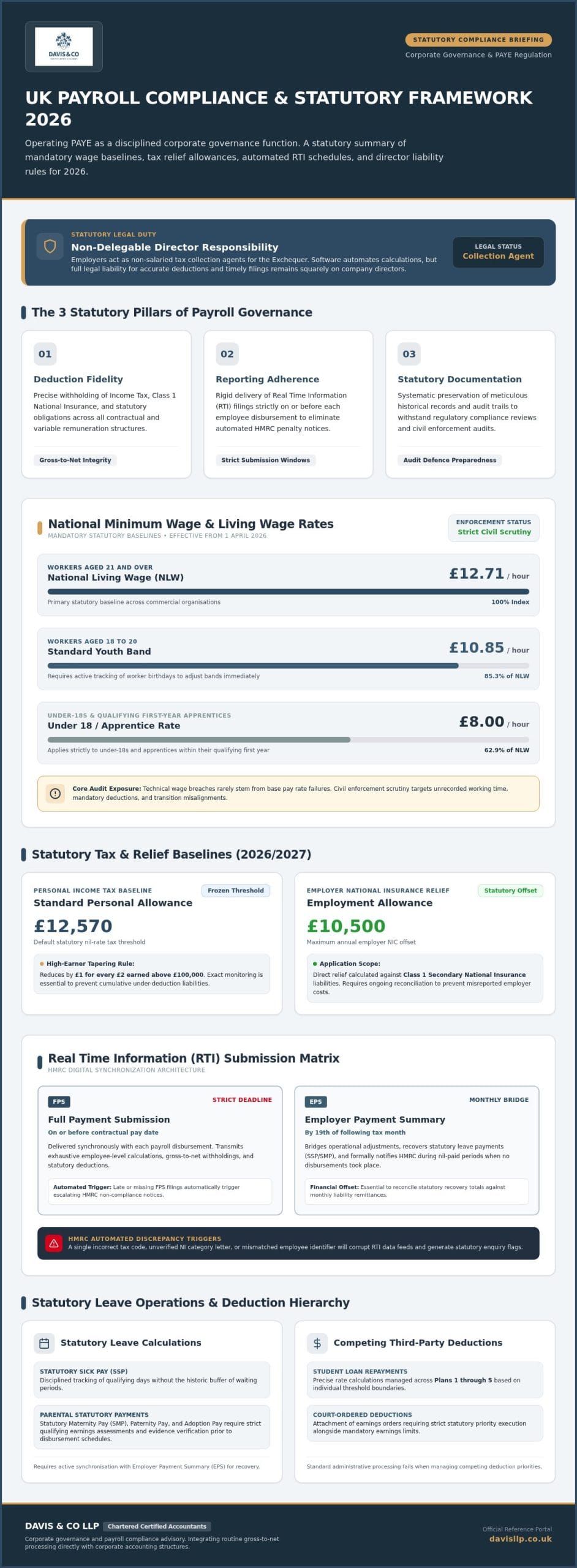
Many commercial organisations mistakenly treat remuneration as a back-office administrative process. In truth, operating within the boundaries of payroll compliance and legislation UK frameworks represents an exercise in statutory tax collection and legal risk governance. Employers serve as non-salaried collection agents for the Exchequer through the established Pay As You Earn (PAYE) system. This structure places the full legal liability for accurate deductions squarely upon company directors. Automated software may process calculations, but the operational duty to ensure statutory integrity remains non-delegable.
Fulfilling these obligations demands rigorous governance across three statutory pillars:
- Deduction fidelity: Ensuring precise withholding of Income Tax, Class 1 National Insurance, and third-party liabilities across variable pay structures.
- Reporting adherence: Delivering Real Time Information (RTI) filings strictly on or before each contractual disbursement.
- Statutory documentation: Maintaining meticulous historical records to withstand regulatory compliance reviews.
Directors who view payroll as mere data entry overlook how quickly minor reporting errors escalate into personal corporate liabilities during an HMRC enquiry.
The Mechanics of Real Time Information and HMRC Submissions
Real Time Information demands absolute synchronization between internal accounts and HMRC databases. Each payroll disbursement requires a Full Payment Submission (FPS) delivered on or before the contractual pay date, detailing exact gross-to-net calculations. When operational adjustments occur, such as recovering statutory payments or reporting zero disbursements during nil-paid periods, an Employer Payment Summary (EPS) must bridge the gap by the 19th of the following tax month. A single incorrect tax code, an unverified National Insurance category, or a mismatched employee identifier will corrupt RTI data feeds, prompting automated discrepancy notices from HMRC systems.
Statutory Leave and Deductions: Operational Realities
Operational complexity deepens when statutory leave entitlements intersect with contractual deductions. The administration of Statutory Sick Pay (SSP) requires disciplined tracking of qualifying days without the historic buffer of waiting periods. Concurrently, Statutory Maternity Pay (SMP), Paternity Pay, and Adoption Pay require strict qualifying earnings assessments and evidence verification before payment schedules are initiated.
These statutory payments must also balance against court-ordered attachment of earnings and student loan deductions across Plans 1 through 5. Managing these competing deduction priority orders is where standard administrative processing fails, demonstrating why resilient payroll compliance and legislation UK governance is an indispensable component of corporate financial management.
Critical Payroll Legislation and Rate Changes for 2026
Statutory updates for the 2026/2027 tax year impose stringent mechanical adjustments across domestic finance systems. Operating compliant payroll requires immediate alignment with frozen personal tax thresholds, revised National Living Wage bands, and altered National Insurance liabilities. The standard Personal Allowance remains frozen at £12,570, tapering by £1 for every £2 earned above £100,000, while Class 1 Secondary National Insurance thresholds demand exact calculation alongside the £10,500 Employment Allowance. Relying on default software automations without verifying these underlying statutory baselines regularly produces systemic gross-to-net discrepancies.
National Minimum Wage Governance and Common Breaches
From 1 April 2026, the National Living Wage for workers aged 21 and over stands at £12.71 per hour, while the rate for workers aged 18 to 20 is £10.85 per hour. Under-18s and apprentices in their qualifying first year must receive at least £8.00 per hour. Compliance teams must actively cross-reference internal pay schedules against our National Minimum Wage 2026 guide to avoid statutory exposure.
Civil enforcement bodies scrutinise pay records closely. Technical breaches rarely stem from base rate failures; they occur when unrecorded working time, mandatory uniform requirements, or tool deductions diminish effective pay. Most critically, salary sacrifice arrangements must never reduce an employee’s cash remuneration below the statutory hourly baseline, regardless of employee consent.
Pensions Automatic Enrolment and Ongoing Assessment
Workplace pension governance requires continuous administrative vigilance. While the earnings trigger remains £10,000 per annum, contributions apply to the qualifying earnings band between £6,240 and £50,270. Total minimum contributions remain fixed at 8%, with employers legally mandated to contribute at least 3%. Every pay cycle, finance teams must assess variable-hour workers and automatically enrol eligible jobholders without delay.
Every three years, employers must execute mandatory triennial re-enrolment, re-assessing eligible staff who previously opted out and filing a formal declaration of compliance with The Pensions Regulator. Aligning these internal operations with the official government payroll guide provides a clear baseline, yet maintaining continuous alignment with shifting payroll compliance and legislation UK standards often benefits from strategic oversight. If your internal finance team faces pressure managing these recurring obligations, engaging dedicated payroll services managed by qualified chartered accountants guarantees full regulatory protection.
The Cost of Non-Compliance: HMRC Penalties, Audits, and Exposure
Non-compliance is not a trivial operational delay; it is an immediate balance-sheet liability. Under current statutory mechanisms, HMRC applies automated penalties for late Full Payment Submissions without requiring an officer review. Monthly default surcharges range from £100 for small entities with under ten employees up to £400 for payrolls exceeding 250 staff, while unpaid liabilities accrue late payment interest at 7.75%. Compounding these charges are retrospective assessments for underpaid PAYE and National Insurance, where historic classification errors quickly multiply across open tax years. For wider strategic context regarding revenue enforcement patterns, review our HMRC tax warning guidance.
HMRC Compliance Audits and Investigation Triggers
Automated data matching allows the revenue authority to cross-reference Real Time Information filings against VAT returns, corporate tax computations, and commercial banking records. Significant variances elevate an organisation’s risk profile, prompting formal employer compliance reviews. During these audits, inspectors evaluate expense reimbursements, benefits in kind, and off-payroll contractor determinations under the off-payroll working (IR35) rules. Overlooking these technical boundaries compromises your broader payroll compliance and legislation UK governance, converting routine operational oversights into acute corporate inquiries.
Reputational Exposure and Fiduciary Director Liability
The ultimate consequences of non-compliance extend beyond ledger adjustments into public and legal standing. Breaches of the National Minimum Wage attract punitive 200% financial penalties alongside mandatory public naming by the Department for Business and Trade, damaging client goodwill and talent recruitment. Where a company demonstrates persistent neglect in remitting withheld PAYE or National Insurance deductions, HMRC holds statutory powers to issue Personal Liability Notices, holding company directors personally accountable for corporate tax debts. These severe interventions routinely imperil banking covenants, disrupt trade credit facilities, and complicate statutory audit sign-offs.
Robust payroll compliance and legislation UK management acts as an essential shield for directors, preserving corporate solvency and executive standing through demonstrable statutory discipline.
In-House vs Outsourced Payroll: A Strategic Comparison Matrix
Every executive leadership team faces a fundamental structural choice: retain payroll operations internally or transition the function to an accredited practice. This decision is not merely about administrative convenience; it dictates how your organisation manages regulatory exposure. Modern payroll software platforms market automated ease, yet an algorithm merely executes mathematical instructions based on data inputs. It cannot evaluate contractual nuance, detect subtle worker reclassifications, or assume statutory liability when submissions prove flawed.
Evaluating In-House Processing Overhead and Hidden Risks
Maintaining an internal payroll function demands substantial, ongoing capital investment. Beyond recurring enterprise software licences, internal staff require continuous professional education to keep pace with statutory changes. An in-house structure also introduces acute key-person dependencies. If a sole payroll administrator departs or falls ill during a processing window, the business faces immediate operational paralysis and late-filing exposure. Internal teams frequently lack the technical depth required to manage complex statutory calculations, such as pro-rata holiday accruals for irregular staff or termination packages, creating avoidable vulnerabilities under payroll compliance and legislation UK rules.
The Chartered Accounting Payroll Advantage
Entrusting payroll to chartered certified accountants transforms an administrative vulnerability into a robust governance discipline. Direct oversight by qualified practitioners ensures every gross-to-net computation and statutory deduction adheres strictly to current tax law. To understand how structured financial stewardship protects broader operations, review the strategic small business accountant guide.
Under an outsourced chartered model, payroll records feed seamlessly into management accounts and cash flow models, providing leadership with reconciled labour cost metrics. This holistic integration eliminates the reporting discrepancies that routinely attract revenue scrutiny, safeguarding both payroll compliance and legislation UK standards across the corporate structure. To insulate your operations from single-point failure and secure rigorous compliance, explore how to engage Davis & Co LLP for specialist payroll services designed around your commercial priorities.
Implementing a Robust Payroll Compliance Framework for Your Organisation
Historical payroll data often harbours latent calculation faults. Establishing enduring operational resilience begins with a disciplined review of past workflows, confirming that existing data collection protocols and record-keeping mechanisms satisfy statutory standards. Standardised intake schedules prevent mid-period calculation discrepancies, late submissions, and erratic deduction errors. When evaluating professional partners to oversee this transformation, consult our guide to finding a chartered accountant to identify practitioners equipped for complex statutory governance.
Conducting an Initial Payroll and Employment Tax Health Check
A structured health check provides the necessary empirical baseline for corporate governance. This exercise begins with an audit of historical worker categorisations, establishing whether individuals treated as off-payroll contractors withstand current status tests. Gross-to-net calculations, dynamic tax code updates, and workplace pension contribution reconciliations must be verified against historical RTI submissions.
The review also scrutinises business expense reimbursements, mileage claims, and non-cash benefits. Verifying historical P11D disclosures ensures Class 1A National Insurance liabilities are settled correctly. Uncovering systemic errors internally enables controlled, proactive remedial adjustments with HMRC, mitigating punitive penalties before regulatory enquiries begin.
Transitioning to a Managed Professional Solution
Transitioning to an outsourced chartered model introduces dependable procedural controls into monthly operations. Secure, encrypted digital channels protect sensitive employee records in strict compliance with UK data protection legislation. Defined monthly cut-off calendars, paired with multi-tiered approval workflows, ensure that timesheets, commission structures, and statutory leaves are fully reconciled before any submission occurs.
Sustaining payroll compliance and legislation UK standards demands seamless integration between routine payroll mechanics and corporate tax strategy. By aligning your gross-to-net data directly with management reporting, employer National Insurance reliefs and statutory recovery balances remain entirely accurate across financial statements. To insulate your enterprise against regulatory intervention and establish enduring operational certainty, partner with Davis & Co LLP for payroll governance and professional oversight.
Securing Operational Resilience and Statutory Payroll Precision
Achieving lasting statutory precision requires treating payroll as an essential pillar of corporate governance rather than a routine administrative process. Managing strict RTI submission deadlines, evolving minimum wage baselines, and workplace pension duties leaves zero room for operational error. Proactive oversight protects commercial reputations, shields company directors from personal liabilities, and ensures internal finance teams remain focused on core commercial growth.
Mastering payroll compliance and legislation UK standards becomes straightforward when supported by experienced professional stewardship. As an established partnership of Chartered Certified Accountants, Davis & Co LLP provides dedicated national payroll management, executing end-to-end RTI filings and pension assessments alongside comprehensive corporate accounting. Secure your payroll compliance with Davis & Co LLP to eliminate regulatory uncertainty and establish enduring financial integrity across your business.
Frequently Asked Questions
What are the essential legal responsibilities for a UK employer running payroll?
A UK employer is legally obligated to register for PAYE, calculate and deduct Income Tax and National Insurance, and disburse statutory payments such as sick or parental pay. Employers must report exact figures to HMRC under Real Time Information on or before each payday, issue itemised payslips, and retain records for up to six years. Operating within core payroll compliance and legislation UK frameworks protects company directors against personal and corporate tax liabilities.
How do Real Time Information (RTI) reporting deadlines operate with HMRC?
RTI regulations mandate that employers submit a Full Payment Submission (FPS) to HMRC on or before the contractual day employees receive payment. If no staff are paid or if statutory pay recoveries occur within a tax month, an Employer Payment Summary (EPS) must be submitted by the 19th of the following month. Late submissions trigger automatic monthly penalties ranging from £100 to £400, alongside interest charges on overdue PAYE settlements.
What are the common triggers for an HMRC employer compliance check?
HMRC compliance checks are typically triggered by discrepancies between RTI filings and statutory annual accounts, persistent late submissions, or irregular Nil-EPS notices. Employee whistleblowing regarding unpaid working hours or incorrect expense deductions will also prompt an inspection. Additionally, the revenue authority routinely targets specific commercial sectors through random sampling to audit off-payroll worker categorisations, statutory minimum wage adherence, and benefits-in-kind disclosures.
How often must employers complete automatic enrolment re-enrolment duties?
Employers must complete automatic enrolment re-enrolment duties every three years. This statutory process requires assessing all staff members who previously opted out or ceased active membership, re-enrolling those who satisfy eligible jobholder criteria, and writing formally to affected personnel. Following this assessment, the employer must submit a formal re-declaration of compliance to The Pensions Regulator within five calendar months of the third anniversary of their original staging or re-enrolment date.
Can payroll software fully protect my business against statutory non-compliance penalties?
No, payroll software doesn’t fully protect a business from non-compliance penalties because software only processes the specific data entered by users. HMRC holds the employer strictly liable for incorrect tax codes, erroneous working hour calculations, and improper worker status categorisations. While software executes mathematical formulas, it can’t interpret complex statutory nuances. Ensuring total compliance across payroll compliance and legislation UK requirements requires qualified professional oversight rather than unverified digital automation.
What penalties apply if an employer underpays the National Minimum Wage?
Employers that underpay the National Minimum Wage face mandatory financial penalties of up to 200% of the total arrears owed, capped at £20,000 per worker. In addition to repaying historical wage arrears at current statutory rates, non-compliant organisations are routinely named and shamed on public government enforcement registers. Serious or deliberate non-compliance can also result in formal criminal prosecution and the disqualification of company directors.
How does salary sacrifice affect statutory employee pay and benefits?
A salary sacrifice arrangement reduces an employee’s gross contractual pay, which consequently lowers their liability for Income Tax and National Insurance. However, the sacrificed salary must never reduce cash remuneration below the statutory National Minimum Wage rate. Crucially, a reduced contractual wage can also suppress statutory entitlements calculated on average weekly earnings, including Statutory Maternity Pay, paternity leave, and statutory redundancy payouts, requiring careful planning before implementation.