What if the smoothest way to change accountants is to plan the handover before ending your current arrangement? If you’re researching how to change accountants uk, the main concern is often keeping records, tax filings and day-to-day responsibilities in order while one firm hands over to another.
It’s reasonable to want clarity before making a move. You may be unsure how to notify your existing accountant, which information needs to transfer, or how professional clearance and HMRC authorisation fit into the process. A well-managed switch depends on agreeing who is responsible for each task and deadline, rather than assuming everything will move automatically.
This guide explains when a change may make sense, how to organise the handover and what to consider when assessing a new accountant’s suitability. It also covers practical steps for transferring records, arranging HMRC access and checking upcoming filing dates, so you can understand what each firm needs to do.
Key Takeaways
- Learn how to change accountants uk by following a clear sequence, from assessing your needs to confirming the new engagement.
- Set a realistic start date around upcoming filing and reporting deadlines, and agree who is handling each responsibility.
- Compare accountants by relevant expertise, service scope and communication arrangements, rather than firm size or broad claims alone.
- Use a shared schedule for tax returns, accounts, VAT and payroll where applicable to help maintain continuity during the transition.
- After the transfer, review priorities and responsibilities with your new accountant, and clarify any outstanding questions.
How to change accountants in the UK: when a switch makes sense
Changing accountants is a planned transfer of professional support and records, not simply a decision to end one relationship and begin another. If you’re researching how to change accountants uk, start by identifying what has changed and what you need from your next adviser. A clear reason helps you assess whether another firm can meet those needs and plan a suitable handover.
Common triggers include a growing business, changes to your personal tax affairs, or services that no longer match your circumstances. Communication may also be a concern: perhaps questions go unanswered, reports are difficult to understand, or you’re unsure what work is included. Dissatisfaction alone doesn’t establish misconduct. Note specific service gaps and unresolved questions so you can explain what needs to improve, whether you stay or move.
What are valid reasons to change accountants?
A switch can be reactive or proactive. A sole trader who incorporates may need support with company accounts, payroll or VAT, while an individual with new property or overseas tax affairs may need relevant specialist knowledge. The right fit depends on your circumstances, not the length of a firm’s service list. If you’re assessing professional credentials, this overview of Chartered Accountants provides background on the designation.
Before approaching a new firm, note recurring communication problems, outstanding queries and your expectations for updates, reporting and advice. This gives you a practical basis for comparing what each accountant agrees to do. Your needs may simply have evolved; a change can be sensible even if the existing relationship has been satisfactory.
Also distinguish personal tax work from business accounting. A personal tax return may be your main requirement, while a business could need bookkeeping, management accounts, payroll, VAT compliance or support with company reporting. List the services you use now and any you may need as your circumstances develop.
Is changing accountants difficult or risky?
A planned handover can reduce avoidable confusion, but no transfer should be assumed to be risk-free. Records may be incomplete, responsibility for a filing in progress may be unclear, or an upcoming deadline may be overlooked if you and both firms don’t agree what happens next. These risks are easier to manage when you identify active work and confirm who will handle it.
Agreeing ownership and timing before the handover helps keep records moving and deadlines visible. Check your engagement terms and discuss the proposed change with the new accountant, particularly if a tax return, accounts, VAT submission or payroll task is approaching. A realistic start date should give both firms time to understand their responsibilities and flag any information that still needs attention.
How to change accountants in the UK: a practical handover sequence
A clear sequence helps keep the change organised. If you’re considering how to change accountants uk, work through these steps and agree a realistic start date that accounts for upcoming tax and reporting deadlines:
- Shortlist firms whose expertise and services match your personal or business needs.
- Confirm the scope of the proposed work, including what’s excluded and how work in progress will be handled.
- Review engagement terms with the new firm, including responsibilities, communication arrangements and the proposed start date.
- Notify your current accountant in writing, after checking notice provisions and any outstanding work or invoices.
- Arrange the records transfer and confirm which documents each firm will provide or retain.
- Verify completion by checking that records, active tasks and relevant HMRC authorisations have been addressed.
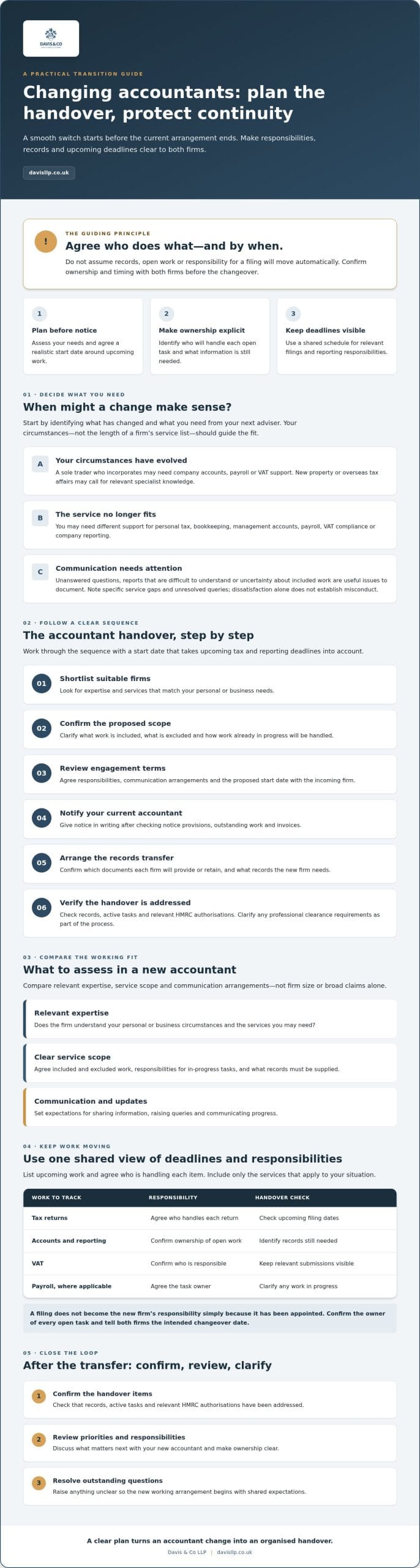
Don’t assume the new firm will take responsibility for a filing simply because it has been appointed. Confirm who is handling each open task, and make sure both firms know the intended changeover date.
What should you agree with the new accountant first?
Be specific about the support you need. This might include personal tax, or business services such as bookkeeping, VAT compliance, payroll, management accounts or company reporting, depending on your circumstances. Agree who will handle work already under way, how you’ll share information and how progress or queries will be communicated. Ask what records the new firm needs and whether it will contact your former accountant as part of the handover.
The incoming firm may use professional clearance to communicate with your current accountant and request relevant handover information. Practices can vary, so ask the new accountant to explain its process and what it needs from you. Treat this as coordination between firms, not a substitute for agreeing the scope and start date with your new adviser.
How do you notify your current accountant?
Send a clear, factual written notice stating your intended changeover date and, where appropriate, the name of your new adviser. Check your engagement terms for notice provisions, clarify outstanding work and invoices, and ask which records will be transferred. Keep copies of important correspondence so you can refer to agreed dates and responsibilities.
Which records and authorisations need attention?
Depending on your affairs, the handover may involve tax returns and calculations, accounts, bookkeeping records, VAT information, payroll records or company documents. Ask which records the former firm will transfer, what you should retain and whether anything remains incomplete. Keep your own copies of important records rather than relying on a transfer alone.
Appointing an accountant and authorising them to act for you with HMRC are separate matters. Check the current steps for the relevant tax services, including how to change or remove an agent, using HMRC’s guidance on agent authorisation. If you’re comparing firms for personal tax or business accounting support, you can also review Davis & Co LLP’s accounting and tax services against your requirements.
Choosing a new UK accountant: compare service fit, expertise and communication
A suitable accountant should match the work you need done and the way you expect to work together. As you consider how to change accountants uk, compare the proposed engagement in detail rather than relying on firm size or broad claims about expertise. This guide to finding a Chartered Accountant can help you think through selection criteria.
| What to compare | Questions to ask |
|---|---|
| Service scope | Which tasks are included, and what falls outside the engagement? |
| Relevant expertise | Who will handle work like yours, and what experience do they have with it? |
| Communication | Who is your main contact, and how should you raise questions? |
| Reporting | What information will you receive, how often, and in what format? |
What services should your new accountant provide?
For an individual, the right scope may centre on personal tax, with additional needs relating to property, trusts or overseas tax affairs. A business may need bookkeeping, accounts, VAT compliance, payroll or management information. Consider what you need now and what may change, then check that each relevant service is explicitly covered in the proposed engagement. If you run a smaller business, the strategic small business accountant guide offers further points to consider.
How can you assess expertise and working style?
Ask who will do the work, how queries are handled and what reporting you can expect. Check the professional credentials and relevant experience of the people responsible for your account, rather than assuming a firm’s general reputation establishes its suitability for every assignment. If considering an ICAEW-regulated firm, review ICAEW’s regulatory standards for information about its regulatory framework.
A good-fit accountant combines an agreed scope, relevant expertise and communication that works for your circumstances.
When might specialist tax advice matter?
Cross-border tax affairs, trusts, property and dental practice accounting are examples where relevant specialist knowledge may matter. Don’t assume every accountant or firm has expertise in each area; ask who would advise on your circumstances and what the engagement covers. For broader questions, consult the UK tax advice guide as you assess the support you need.
How to prevent missed deadlines and gaps during the accountant changeover
Changing accountants needn’t mean leaving filing responsibilities unattended. Use a shared schedule that names each task, deadline and responsible person. Don’t assume responsibility transfers automatically when you appoint a new firm. Agree explicitly who will complete work already under way and who will handle the next submission.
As part of planning how to change accountants uk, list the deadlines relevant to your circumstances. These might include a Self Assessment return and payment, company accounts, Corporation Tax, VAT returns or payroll submissions. For the 2025/26 tax year, the online Self Assessment submission and payment deadline is 31 January 2027. Private company accounts are generally due at Companies House nine months after the financial year end, while Corporation Tax is due nine months and one day after the accounting period ends. Check the dates that apply to you rather than relying on a general calendar.
What should you check before the old engagement ends?
Review the deadline list with both firms. Confirm who is preparing each outstanding return, submission or accounting task, and whether any information is still required from you. Ask whether there is unresolved HMRC correspondence or an enquiry that should be disclosed and included in the handover. Keep written confirmation of agreed responsibilities, especially if a filing date falls close to the changeover.
How can businesses protect continuity?
For a business, continuity also depends on day-to-day processes. Assign an owner for bookkeeping, payroll and VAT tasks during the transition, and confirm access to accounting software, source documents and relevant company records. Check any Companies House filing responsibilities and dates that apply to the company. A shared schedule helps both firms see what is due and lets you spot gaps before they become urgent.
What if the handover is delayed or records are incomplete?
Contact both firms promptly, describe what is missing or delayed, and document the agreed next steps and who is responsible. Prioritise upcoming filing obligations and seek qualified advice if you’re unsure what must be done or by when. Don’t assume records have transferred just because they were requested, or that HMRC agent authority has changed without checking the relevant process.
- Confirm upcoming deadlines and the person responsible for each task.
- Check that records, software access and any active correspondence are accounted for.
- Verify the relevant HMRC authorisation arrangements and flag incomplete items.
If your changeover involves bookkeeping, VAT or payroll, review Davis & Co LLP’s business accounting services to see whether the listed support matches your requirements.
After changing accountants: confirm the handover and establish a working relationship
Once the new engagement is under way, verify that the practical arrangements are in place. Knowing how to change accountants uk is only part of a well-managed transition; your new accountant also needs the information and access required for the agreed work.
What should you verify once the new accountant is appointed?
Use an initial review meeting to check the position together. Confirm that the agreed records have arrived, relevant systems can be accessed and HMRC authorisations are in place for the tax services covered. Then review the first deliverables and deadlines, along with the best way to raise questions.
- Check that transferred records are complete, and identify anything still outstanding.
- Confirm HMRC authorisations and any other access arrangements relevant to the engagement.
- Review upcoming deadlines, agreed work and who is responsible for each item.
- Raise points that need clarification, including gaps in records or earlier work that remains unresolved.
Don’t treat a successful file transfer as confirmation that every responsibility or access arrangement has been settled. Ask directly, and record any agreed follow-up actions.
How should you set expectations for ongoing advice?
Agree how often you’ll review accounts, tax matters or business performance where these are part of the engagement. Clarify which services are included and how any additional work would be discussed and agreed before it begins. A clear contact route and shared expectations for updates can help prevent routine questions from becoming unresolved concerns.
Your requirements may change. A business could take on payroll or VAT responsibilities, while an individual’s property, trust or international tax affairs may develop. Tell your accountant early when circumstances change so you can check whether the existing scope remains appropriate. Davis & Co LLP’s services include personal tax, property accounting, international and trust tax, bookkeeping, VAT compliance and payroll. The relevant support depends on the client’s needs and agreed engagement.
What is a sensible next step if you are considering a switch?
Prepare a short summary of the services you currently receive, what you’d like to change, any recurring concerns and the deadlines on your calendar. This gives a prospective accountant a clearer starting point for discussing fit and priorities. You don’t need to have every detail resolved before beginning that conversation.
If you’re considering whether Davis & Co LLP’s personal tax or business accounting services suit your requirements, discuss your accounting requirements.
Make your next accounting relationship work for you
A successful change is about more than transferring files. It means choosing support that fits your current needs, agreeing who is responsible for active work and deadlines, and confirming that records and HMRC authorisations are in place. Keep these points clear, and you can approach how to change accountants uk with a practical plan instead of leaving the transition to chance.
As your circumstances evolve, review whether your accountant’s agreed services and expertise still match what you need, whether that’s personal tax support or accounting for a business. Davis & Co LLP is an independent partnership of Chartered Certified Accountants, founded in 1901, with services spanning personal tax and business accounting. The right fit depends on your specific requirements.
If you’re weighing up a change, prepare a brief outline of your current support, priorities and upcoming deadlines. Then discuss your accounting requirements with Davis & Co LLP and consider whether its services suit your circumstances. A considered next step can help you build a clearer, more productive working relationship.
Frequently Asked Questions
How do I change accountants in the UK?
Start by deciding what support you need, then compare prospective accountants’ services, relevant experience and working arrangements. Agree the scope, start date and responsibilities with your chosen firm before notifying your current accountant in writing. Check any notice terms, identify work in progress and upcoming deadlines, and arrange the transfer of relevant records. If you’re searching for “how to change accountants uk”, confirm each step rather than assuming the handover happens automatically.
Can I change accountants at any time?
You can usually begin a change at a time that suits your circumstances, but check your engagement terms for notice provisions and work already in progress. Consider upcoming tax returns, accounts, VAT submissions or payroll tasks before setting a changeover date. If a deadline is close, agree clearly with both firms who will handle the work, what information is needed and when the new accountant will take over.
Do I need to tell my current accountant I am switching?
Yes, it’s sensible to notify your current accountant clearly in writing and state your intended changeover date. Check your engagement terms first, and ask about outstanding work, records and any unpaid invoices. Keep a copy of your notice and any replies. A factual, professional message helps both firms understand the timing and gives you a written record of what has been agreed.
Will my new accountant contact my old accountant?
Your new accountant may contact the previous firm to request relevant handover information, often through a professional-clearance process. Ask the incoming firm how it manages this communication and whether it needs your consent or any details from you. This process does not replace your responsibility to agree the changeover date, disclose urgent deadlines and check that records or information needed for active work have been received.
How long does it take to change accountants?
A straightforward change typically takes around three to four weeks, although timing can vary with the complexity of your affairs, the records involved and how quickly information is provided. Upcoming deadlines or incomplete records may affect the handover. Ask the new accountant for a realistic timetable, and agree what will happen to any filing or reporting work due before the transfer is complete.
What documents should I give my new accountant?
Provide records relevant to the services you’ve agreed. These may include previous tax returns and calculations, accounts, bookkeeping information, VAT records, payroll details, company documents and correspondence about unresolved tax matters. The precise list depends on whether you need personal tax support, business accounting or both. Ask the new firm what it needs, confirm which records will come from your former accountant, and retain copies of important documents.
Do I need to change my HMRC accountant authorisation?
Check that your new accountant is authorised for each relevant HMRC tax service. Appointing a firm does not itself confirm that its agent access is in place. Ask the new firm which authorisation steps apply to your circumstances, and check whether the former accountant’s access should be removed. HMRC’s process can vary by service, so verify the current instructions and confirm when the new authorisation is active.