The documentation burden is not the same for every UK group. For groups with consolidated revenues of EUR 750 million or higher, the transfer pricing documentation requirements include a Master File and Local File under the Transfer Pricing Records Regulations 2023, according to the UK Government. Transfer pricing concerns the terms used for transactions between related businesses, and the records needed depend on the rules that apply to the group.
It’s easy to assume one set of documents will meet every requirement, but obligations differ by country and UK group size. This article explains transfer pricing, which records to retain, when to review and update them, and how the UK’s documentation tiers compare with the OECD framework. It also explains why a group’s structure, transactions and applicable exemptions matter when deciding what to document.
Key Takeaways
- According to the UK Government, UK groups with consolidated revenues of EUR 750 million or higher must prepare a Master File and Local File under the Transfer Pricing Records Regulations 2023.
- Keep records that explain related-party transactions, including how the parties share functions, assets and risks.
- Review specified transfer pricing records at least annually, updating them when business arrangements or transaction facts change.
- Documentation expectations vary by country, group size and applicable exemptions, so a multinational group may need to consider more than one local rule set.
- Distinguish formal file requirements from the broader duty to retain records that support the accuracy and completeness of a UK tax return.
What are the transfer documentation requirements by country?
Requirements vary by jurisdiction, even when a multinational group uses centrally prepared files. In the UK, the documentation framework distinguishes formal file requirements from the broader duty to support tax returns.
Master File and Local File Requirements
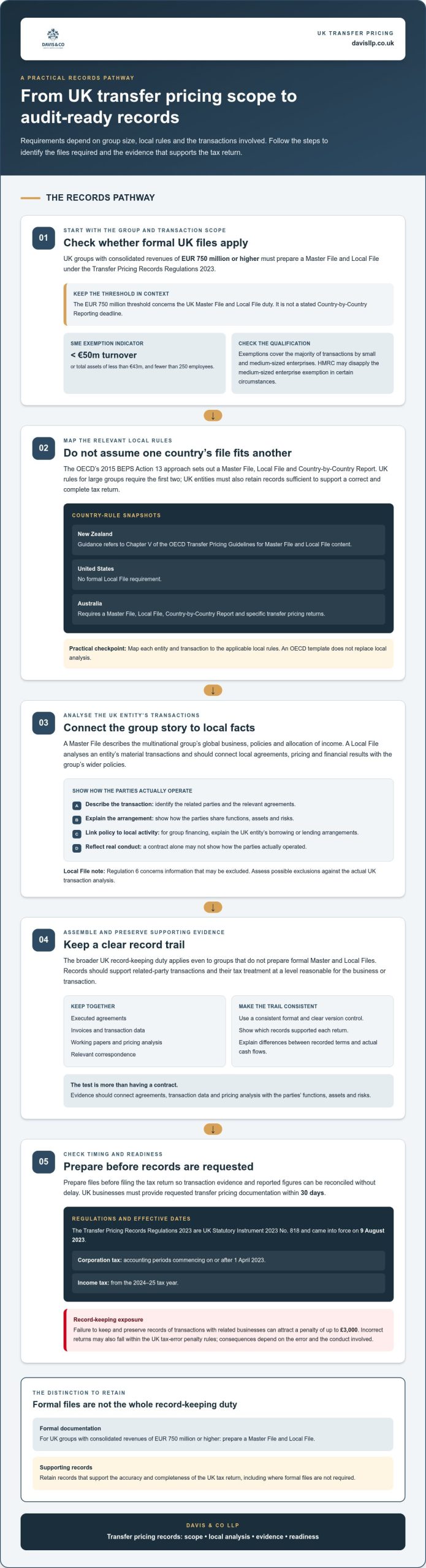
A master file describes the multinational group’s global business, policies and allocation of income, while a local file analyses an entity’s material transactions. According to the UK Government, UK groups with consolidated revenues of EUR 750 million or higher must prepare a Master File and Local File under the Transfer Pricing Records Regulations 2023. These files should follow the OECD Transfer Pricing Guidelines and demonstrate how the group’s arrangements relate to its operations.
Local Analysis of Centrally Prepared Files
A centrally prepared master file can provide group-wide context, but the local file must explain the UK entity’s own transactions. It should connect local agreements, pricing and financial results with the group’s wider policies. For example, a group financing policy needs a local explanation of the UK entity’s borrowing or lending arrangements. Regulation 6 of the Transfer Pricing Records Regulations 2023 concerns information that may be excluded from the Local File. That provision makes it important to assess exclusions against the actual UK transaction analysis.
UK Requirements and OECD Guidance
The OECD’s 2015 BEPS Action 13 approach sets out a Master File, Local File and Country-by-Country Report. UK rules for large groups require the first two, while UK entities must also retain records sufficient to support a correct and complete tax return. The OECD framework therefore provides a common structure, but UK law determines which UK entities prepare particular files and what records they preserve. A group should not treat an OECD template as a substitute for local analysis.
Country rules differ. New Zealand’s guidance refers to Chapter V of the OECD Transfer Pricing Guidelines for master file and local file content. The United States has no formal Local File requirement, while Australia requires master and local files, a Country-by-Country Report and specific transfer pricing returns. A multinational should therefore map each entity and transaction to the relevant local rules, rather than assume that a file prepared for one country meets another’s requirements.
For UK Country-by-Country Reporting, the group test involves two or more enterprises resident for tax purposes in different jurisdictions. The reporting threshold and filing deadline must be assessed under the applicable CbCR rules for the group and jurisdiction; the EUR 750 million threshold above concerns the UK Master File and Local File duty, not a stated CbCR deadline.
HMRC assesses whether records support a correct and complete tax return, at a level reasonable for the business or transaction. Evidence should connect agreements, transaction data and pricing analysis with the functions, assets and risks shared by related parties. A contract alone may not show how the parties actually operated, so the analysis should reflect their real conduct.
Obligation to keep and preserve transfer pricing records
UK rules require businesses to retain records supporting related-party transactions and their tax treatment. This duty applies even to groups that do not prepare formal master and local files.
Keeping and Providing Transfer Pricing Records
The Transfer Pricing Records Regulations 2023 set out how relevant transfer pricing records must be kept and preserved. Regulation 4 concerns that obligation, while Regulation 5 addresses specified relevant records. The regulations are UK Statutory Instrument 2023 No. 818 and came into force on 9 August 2023. For corporation tax, the measure applies to accounting periods commencing on or after 1 April 2023; for income tax, it applies from the 2024-25 tax year.
UK businesses must provide requested transfer pricing documentation within 30 days. Prepare the files before filing the tax return, so transaction evidence and reported figures can be reconciled without delay.
Documentation Consistency and Record Management
Consistent record management connects contracts, calculations and tax filings into a clear account of each controlled transaction. Keep the executed agreement, invoices, working papers, pricing analysis and relevant correspondence together. For example, if an intercompany loan’s terms differ from the recorded cash flows, retain evidence explaining the difference and how it is treated.
Use a consistent format and clear version control to show which records supported each return. Documentation should be proportionate to the business or transaction while still explaining how the parties share functions, assets and risks. Missing or inconsistent records can make it harder to support the tax treatment.
Applicable Rules and Exemptions
UK transfer pricing rules generally apply to transactions between connected businesses, although exemptions cover the majority of transactions by small and medium-sized enterprises. The SME test includes turnover of less than €50m or total assets of less than €43m, and fewer than 250 employees. HMRC may disapply the medium-sized enterprise exemption in certain circumstances, so an exemption does not remove every record-keeping consideration.
Failure to keep and preserve records of transactions with related businesses can attract a penalty of up to £3,000. Incorrect returns may also fall within the UK tax-error penalty rules in Schedule 24 to Finance Act 2007; the consequences depend on the error and the conduct involved. For a practical approach to organising financial evidence, audit and assurance support can sit alongside robust record management.
What is transfer pricing?
Transfer pricing is the pricing of transactions between connected businesses, such as a UK company and an overseas group entity. It matters because those terms affect where taxable profits arise, and the taxpayer must reflect the transaction accurately in its tax return. Article 9 of the OECD Model Tax Convention sets out the arm’s-length principle: related parties should price their dealings as independent businesses would under comparable conditions.
A controlled transaction may involve goods, services, financing, intellectual property or other dealings between related parties. Identifying dealings between related parties is an important step in considering transfer pricing requirements. The practical task is to identify the actual dealings, then compare their terms with the functions performed, assets used and risks assumed by each entity.
A common mistake is treating a signed contract as a complete account of the transaction. A service agreement, for example, may describe one arrangement while invoices, staff activity or payment records show another. Related-party loans or service charges can also be overlooked when recorded in a general ledger rather than a transfer pricing register. Before analysing the price, reconcile the contracts and accounting entries with the parties’ actual conduct.
Government proposals describe an International Controlled Transaction Schedule through which certain businesses would report cross-border related-party transaction data directly to HMRC. The proposed schedule would disclose the pricing methodology, including the profit level indicator and percentage applied under the pricing model. It also proposes separate disclosure, without aggregation, of the top five loan relationships or international related-party dealings.
The International Controlled Transactions Summary requirement is due to apply for periods starting on or after 1 January 2027. This is a UK reporting development, distinct from the OECD’s three-tier documentation framework. The proposed ICTS rules include an exemption where the aggregated value of transactions in each category is less than £1 million. Businesses should distinguish this summary reporting from the underlying analysis that demonstrates arm’s-length pricing.
Before completing a return or schedule, map each related-party arrangement to the entity involved, the agreement, the actual activity and the financial entry. This can reveal omitted transactions and mismatches between legal wording and commercial conduct. It also gives the taxpayer a clearer basis for explaining why the chosen pricing method reflects the parties’ functions, assets and risks under the arm’s-length principle.
Annual review and updating of transfer pricing documentation
Transfer pricing documentation should reflect the enterprise’s current arrangements, not simply repeat last year’s analysis. HMRC expects specified transfer pricing records to be reviewed at least annually and updated as needed. The review should compare documented terms with the parties’ actual conduct, economic conditions and reported results.
Check whether each transaction still operates as described. For each related-party arrangement, compare the agreement with invoices, payment flows, management accounts and the work performed. A service charge may need reassessment if the recipient’s activities have changed, even if the written agreement has not. Record the review date, evidence considered and reasons for retaining or revising the analysis.
Changes that may warrant an update include revised contractual terms, a new pricing method, altered functions or assets, and a shift in risks between parties. Market changes can also affect whether the original comparable companies or economic assumptions remain relevant. Explain what changed, how it affects the transaction and whether the arm’s-length outcome remains supportable.
Benchmarking needs a proportionate review too. The UK benchmarking guidance refers to paragraph 3.82 of the OECD’s 2022 Transfer Pricing Guidelines when considering how often to perform a new benchmarking study if operating conditions remain unchanged. This means the enterprise should assess whether the existing comparables and economic analysis still fit, rather than treating a new study as an automatic annual task.
Use a consistent annual review record for each material transaction. It can capture the responsible entity, transaction type, current contract, pricing method, supporting data and conclusion. If no material facts have changed, document why the existing analysis remains applicable. If circumstances have changed, identify what needs revision, such as the functional analysis, comparable set or financial calculation.
- Check the parties: confirm entities, transaction flows and responsibilities remain accurate.
- Reconcile the figures: compare the pricing analysis with current accounting records and tax return data.
- Assess economic changes: identify changes to markets, risks, functions, assets or contractual terms.
- Refresh the evidence: update the analysis where facts or operating conditions affect its conclusions.
A dated review trail shows how the enterprise reached its conclusion and which evidence informed it. It also makes later updates more focused by distinguishing stable arrangements from transactions requiring further assessment. Keeping the record with each year’s supporting documents connects the business’s actual conduct with its transfer pricing analysis.
Current UK transfer pricing documentation tiers
UK documentation duties depend on group scale, transaction type and applicable exemptions. The key distinction is between formal Master File and Local File rules and the broader duty to support a tax return. A group’s transfer pricing documentation requirements therefore depend on its size, activities and transaction profile.
For the largest groups, the UK threshold is consolidated revenue of EUR 750 million or higher. Groups meeting it must prepare a Master File and Local File under the Transfer Pricing Records Regulations 2023. These files address group-wide information and local entity transactions respectively. Groups below that threshold should still assess other country rules and their UK record-keeping duties.
Small and medium-sized enterprises are generally exempt from UK transfer pricing rules for the majority of their transactions. The SME definition includes turnover of less than €50m or total assets of less than €43m, together with fewer than 250 employees. That exemption does not mean every transaction can be ignored: the group must consider the relevant entities, counterparties and circumstances before relying on it.
Exceptions matter. The UK-to-UK exemption does not apply where a UK entity has elected under section 357A of the Corporation Tax Act 2010 for special treatment of patent profits and similar profits. It also does not apply where one or more UK entities carries on a ring-fenced trade under section 277 of that Act. The SME exemption also excludes transactions with a related enterprise in a territory lacking a UK double tax treaty with an appropriate non-discrimination clause.
Medium-sized businesses should distinguish an exemption from having no documentation exposure. HMRC may disapply the medium-sized enterprise exemption in certain circumstances and require taxable profits to be calculated under transfer pricing rules. HMRC can also request documentation from medium-sized UK businesses, even when formal file preparation is exempt. Retain records explaining material controlled transactions and the pricing applied.
For groups outside the large-group file rules, material transactions may still call for a Local File report. HMRC recommends one where controlled transactions are material. Assess the transaction’s nature, the parties’ roles and whether the records explain how reported profit was determined. The UK Government has proposed retaining the small enterprise exemption while removing the medium-sized exemption, so distinguish this proposal from the rules currently in force.
Assessing transfer pricing documentation requirements starts with mapping each UK entity to its size tier, transactions and any exemption conditions, then recording the basis for the conclusion. This helps separate formal file preparation from ongoing compliance. For related financial reporting controls, explore audit and assurance support.
Davis & Co LLP: International Tax Planning
Davis & Co LLP provides International Tax Planning for businesses reviewing cross-border tax arrangements and related-party transactions. This support can help when a group is considering how its international structure, commercial activity and tax position fit together, or how transfer pricing records relate to wider planning decisions.
Transfer pricing documentation depends on the transactions, entities and countries involved. A considered review can connect those facts with the group’s wider tax planning and identify where financial information or business arrangements need closer attention. The right focus depends on the business and its international operations.
To discuss your circumstances, contact Davis & Co LLP.
Make your next review part of wider planning
Treat transfer pricing as an ongoing business consideration, not a file prepared in isolation. Reviewing your transfer pricing documentation requirements can also raise useful questions about how cross-border arrangements support the organisation’s commercial plans, cash position and reporting.
Davis & Co LLP offers International Tax Planning, Business Growth Acceleration and Cash Flow Management. These services can connect international tax considerations with wider business priorities, giving decision-makers a more joined-up view of their arrangements.
If you’re considering how your transfer pricing position fits your plans, get in touch with Davis & Co LLP to discuss the next steps. A considered review can help you move forward with greater clarity.
Davis & Co LLP and transfer pricing documentation
Davis & Co LLP provides International Tax Planning for businesses considering transfer pricing documentation requirements. This support can connect your documentation needs with your wider tax planning.
Turn to Davis & Co LLP for support considering international tax alongside your business activities. The firm also offers Audit and Assurance, Management Accounts and Bookkeeping Services.
Frequently Asked Questions
What could the changes mean for businesses?
UK businesses may need to add transaction-level reporting to existing transfer pricing records. The International Controlled Transactions Summary requirement is due to apply for periods starting on or after 1 January 2027. The proposed schedule would report details such as the pricing methodology and profit level indicator. Businesses with cross-border related-party dealings can prepare by mapping transaction categories to the relevant entities, agreements and accounting information.
What does “contemporaneous” documentation mean?
Contemporaneous documentation is prepared as part of the relevant tax reporting process, rather than assembled only after HMRC asks questions. UK groups should prepare transfer pricing documentation before filing their tax return, so the supporting analysis reflects the facts and figures available for that return. Keep dated working papers and source records together to trace the reasoning behind a pricing decision to the information used at the time.
What does good documentation look like in practice?
Good documentation gives a coherent account of a transaction, from the parties’ agreement through to its tax treatment. For example, a management fee file might connect the service agreement, evidence of work performed, invoices, allocation method and recipient’s accounting entry. It should explain the pricing method and how the analysis fits the transaction’s commercial facts. Clear dates, consistent entity names and cross-references make the evidence easier to follow.
What does the three-tiered approach include?
The OECD BEPS Action 13 framework consists of a Master File, Local Files and a Country-by-Country Report. The Master File gives a group-level overview, while Local Files focus on local entities and their controlled transactions. Country-by-Country Reporting provides a jurisdiction-level view of a multinational group’s activity. These documents serve different purposes, so a company should distinguish the reporting framework from its separate local record-keeping duties.
Why does documentation matter beyond the filing obligation itself?
Documentation also records how a business reached commercial and tax decisions. For example, a clear analysis can help finance teams understand how a related-party charge was calculated and whether the underlying service continues. It can support consistent reporting when personnel or systems change. A documented rationale makes it easier to explain the links between transaction facts, pricing choices and reported profit.
Which UK businesses must prepare transfer pricing documentation?
UK groups with consolidated revenues of EUR 750 million or higher must prepare a Master File and Local File under the Transfer Pricing Records Regulations 2023. Other entities within the UK transfer pricing rules must keep records sufficient to support a correct and complete tax return. SMEs are generally exempt for most transactions, but exemptions have conditions and exceptions; medium-sized businesses may still be asked by HMRC for documentation.
What records must UK companies keep to support arm’s-length pricing?
Keep evidence linking the related-party transaction to its commercial terms and reported figures. Relevant records can include signed agreements, invoices, payment records, accounting entries, pricing calculations and analysis of the parties’ functions, assets and risks. For a loan, retain the agreement and records showing actual funding and repayments. The supporting material should let a reviewer understand how the price was assessed.
What are the UK master file and local file requirements?
UK groups meeting the large-group threshold must prepare a Master File and Local File in accordance with the OECD Transfer Pricing Guidelines. The Master File covers group-wide information; the Local File analyses the UK entity’s local transactions. Centrally prepared documents still need UK-relevant detail showing how the entity’s arrangements and results relate to its actual activities. HMRC also recommends a Local File report for material controlled transactions outside the specific large-group rules.