The supplier isn’t always the party that accounts for VAT. Under the UK domestic reverse charge, the customer accounts for VAT instead of the supplier charging it, when the supply is specified, the customer is registered or liable to be registered for UK VAT, and the purchase is for business purposes. The VAT reverse charge mechanism, explained in practical terms, changes who reports the tax, not whether the transaction falls within VAT rules.
It’s easy to assume that a supplier always adds VAT to an invoice and pays it to HMRC. This guide explains when reverse charge VAT applies in UK domestic and cross-border situations, what the supplier should include on the invoice, and how the customer reports the VAT on a return. It also distinguishes the reverse charge from ordinary VAT accounting, showing why the type of supply, the customer’s status and the purpose of the purchase all matter. The focus is on transactions between UK taxable persons, where an error can affect both parties’ records and returns.
Key Takeaways
- Whether the customer accounts for VAT depends on the type of supply, the customer’s VAT status and the business purpose of the purchase.
- When the domestic reverse charge applies, the supplier doesn’t charge VAT as usual; the invoice must make clear that the customer is responsible for accounting for it.
- Customers report reverse-charge VAT as output tax and may deduct it on the same return when entitled, so recovery can depend on their VAT position.
- Domestic and cross-border transactions can follow different rules, making it important to identify the supply and the parties involved before completing the VAT return.
What is reverse charge VAT?
Reverse charge VAT shifts responsibility for accounting for VAT from supplier to customer. For specified taxable supplies, section 55A requires the recipient to account for and pay the VAT, according to UK Government, legislation.gov.uk.
Customer Accounting for the VAT
The customer records the VAT due on a qualifying purchase rather than paying it to the supplier as VAT charged. The customer’s VAT status then determines whether that amount can also be reclaimed. A partially exempt buyer, or one not registered for VAT, may have reverse-charge VAT to pay without being able to recover it. The accounting treatment can therefore affect the transaction’s cost, not just the invoice wording.
Non-Resident Suppliers and Overseas Services
For services received from an overseas supplier, a UK business usually accounts for VAT itself when the service is taxable in the UK. This differs from the domestic reverse charge, which applies to specified UK supplies that meet its own conditions. For cross-border services, the supplier’s location and the place where VAT is due are central; for domestic supplies, the type of supply and the customer’s status matter. Foreign companies also need to establish whether the reverse charge applies, as a tax authority may refuse a refund or reclaim VAT if the treatment is incorrect.
Not every domestic sale qualifies. The UK domestic reverse charge does not apply to supplies to a business that is neither VAT-registered nor liable to register. Employment businesses supplying construction workers are treated as supplying staff, not construction services, so the scheme does not apply to their supply.
Construction customers may also be end users or intermediary suppliers. An end user is the final consumer; an intermediary resells or incorporates the goods or services into another supply. The customer can confirm its status in writing, helping the supplier apply the appropriate treatment.
Incorrect treatment can leave VAT recorded by the wrong party and create a risk when claiming a refund or recovering VAT. For example, a partially exempt customer may be unable to reclaim reverse-charge VAT it has to account for.
For construction services, the supplier should establish whether the customer is VAT-registered and registered under the Construction Industry Scheme (CIS). If the supplier cannot verify the customer’s credentials and VAT registration number, it should charge VAT in the normal way.
Reverse charge for goods, services and domestic transactions
The UK domestic reverse charge covers specified supplies, not every business-to-business sale. The customer must be registered, or liable to be registered, for UK VAT and buy the supply for business purposes. The measure is intended to reduce missing trader fraud and simplify some cross-border transactions. Identifying the exact goods or service is as important as confirming the customer’s status.
Specified goods include mobile phones and computer chips, which are subject to the mechanism because of their vulnerability to VAT fraud. The rules cover computer chips before they are integrated into end-user products. Smart watches with mobile phone functions are included when they aren’t paired with a mobile phone. By contrast, electric vehicle charging is excluded from the UK domestic reverse charge.
The specified domestic supplies also include:
- Wholesale gas and wholesale electricity, with the domestic reverse charge applying since 1 July 2014.
- Wholesale telecommunications services, covered since 1 February 2016.
- Renewable energy certificates, covered since 14 June 2019.
- Specified mobile phones and computer chips, covered since 1 June 2007.
For electricity supplied under a power purchase agreement or similar agreement, the specified provision applies when generation capacity by asset is 100 megawatts or less. This makes the agreement and capacity relevant when classifying the transaction, rather than simply the fact that electricity is being supplied. Goods imported into Great Britain, including from the EU, are subject to import VAT. VAT-registered businesses can account for that VAT on their return through postponed VAT accounting, a separate process from the domestic reverse charge.
For transactions involving several goods or services, classification should follow the actual supply and applicable category. Keeping clear records of invoices and transaction details supports consistent bookkeeping and VAT reporting. Bookkeeping support can help businesses maintain those records alongside their routine accounting.
Supplier invoicing and customer VAT-return reporting
Reverse-charge treatment changes how the supplier invoices and the customer records VAT. Accurate invoice details help both parties report the transaction consistently.
Reverse Charge Invoice Requirements
A reverse-charge invoice identifies the transaction as one where the customer accounts for VAT. The supplier doesn’t charge VAT in the invoice total, but should show the VAT amount the customer must account for. The invoice must include the buyer’s VAT number and the reference “reverse charge”. HMRC accepts wording such as “reverse charge: Customer to pay the VAT to HMRC”. These details distinguish the invoice from one charging VAT normally.
In the UK, both parties should use the invoice to support their accounting: the supplier records the sale without charging VAT, while the customer records the VAT due.
Records for Reverse-Charge Transactions
A clear transaction record connects the supplier’s invoice with the customer’s VAT calculation and return entry. Keep the invoice, the buyer’s VAT number, the value and nature of the supply, and the calculation used to establish the VAT due. This helps explain how the transaction was treated if the records are reviewed.
For example, the customer’s records should make it possible to trace the invoice value through to the reverse-charge output-tax entry. Keep any supporting notes explaining the supply’s classification or the customer’s business purpose, particularly where the transaction could be mistaken for an ordinary VAT-charged sale.
On a UK VAT return, the customer reports reverse-charge VAT due as output tax. A customer entitled to deduct the full amount can also deduct it on that return, resulting in no net VAT amount for the reverse-charge entry.
The supplier should retain the invoice and record the sale without treating the stated reverse-charge amount as VAT charged. The customer should reconcile the invoice against its output-tax entry and any permitted deduction. If the customer cannot deduct all the VAT, the unrecovered amount remains relevant to its VAT position.
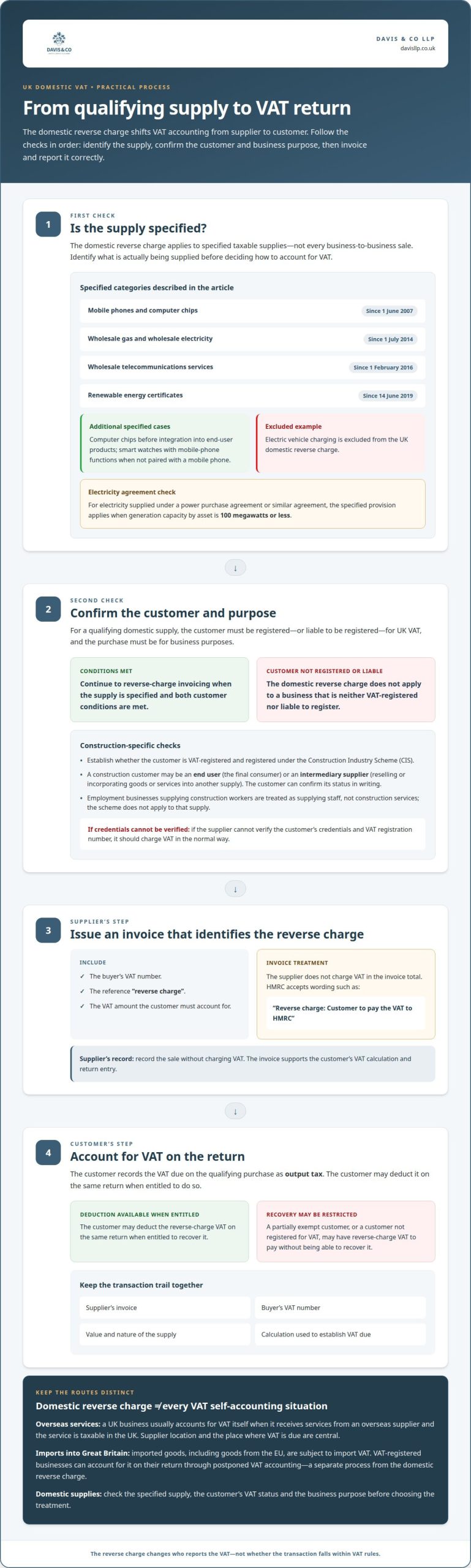
How the domestic reverse charge works between UK taxable persons
In practice, the supplier identifies whether the transaction is a specified supply and whether the customer meets the domestic reverse-charge conditions. If both conditions are met, the supplier doesn’t charge VAT, and the customer accounts for it instead.
Consider a construction service supplied to another UK business. The supplier first considers the nature of the work, then establishes whether the customer is VAT-registered or liable to register and whether the purchase is for business purposes. For construction services, the supplier should also check the customer’s Construction Industry Scheme (CIS) registration. These details help determine whether the domestic reverse charge applies, rather than assuming every business-to-business construction invoice uses it.
The customer’s role in the supply chain can also affect the construction treatment. An end user is the final consumer of the service; an intermediary supplier resells it or incorporates it into another supply. The customer can confirm its end-user or intermediary status in writing. Keeping that confirmation with the contract gives both businesses a clear basis for handling the transaction.
Next, the supplier checks the customer’s VAT credentials and registration number. If the supplier can’t verify them, it should charge VAT in the normal way. Applying the reverse charge based only on a customer’s verbal assurance could leave the supplier using the wrong treatment. The decision should follow the transaction evidence, not merely the customer’s description of its business.
Where the reverse charge applies, the supplier issues an invoice without adding VAT to the amount charged and identifies the reverse-charge treatment. The customer then records the VAT due on its return. Both businesses should keep the invoice, customer details, contract or work description, and any written end-user confirmation together, so the treatment can be traced from the supply to the return.
For recurring UK transactions, a consistent review of supply type, customer status and supporting records can help identify errors before VAT returns are filed. Arrange a review of your VAT reporting with Davis & Co LLP if you need support assessing those controls.
Davis & Co LLP: International Tax Planning
Davis & Co LLP offers International Tax Planning for businesses managing cross-border transactions, including services received from overseas suppliers. When reverse-charge treatment intersects with international activity, the supply, where VAT is due and the parties’ roles all affect the accounting. A considered review can help businesses understand these tax implications alongside their wider international arrangements.
Support can be useful when a business is expanding into overseas markets, receiving services from abroad or reviewing how cross-border transactions affect cash flow. Davis & Co LLP also offers Business Growth Acceleration and Cash Flow Management to support wider operational planning alongside tax considerations.
For tailored guidance on international tax planning, contact Davis & Co LLP.
Put clear VAT decisions into practice
With the VAT reverse charge mechanism explained, the next step is to apply that understanding consistently to business decisions. Consider how cross-border activity, transaction records and cash-flow planning fit together, rather than treating each VAT entry in isolation. This explanation of the VAT reverse charge mechanism provides a foundation for reviewing those wider implications.
Davis & Co LLP offers International Tax Planning for businesses assessing overseas activity, alongside Business Growth Acceleration and Cash Flow Management. These services can support wider commercial planning when tax treatment forms part of operational or expansion decisions. The appropriate focus depends on the business’s circumstances and the decisions it needs to make.
If you need advice on your VAT position or how it fits your business plans, contact Davis & Co LLP for VAT advice. A clear, considered approach can help you move forward with greater confidence.
How Davis & Co LLP can help with VAT
Davis & Co LLP offers VAT Compliance to help businesses address practical VAT requirements, including questions about the reverse charge mechanism. If you’re unsure how the rules apply to your transactions or how to reflect them in your VAT processes, this is a natural point to seek support.
For wider financial and business needs, Davis & Co LLP also provides Bookkeeping Services, Management Accounts, Cash Flow Management and International Tax Planning.
Frequently Asked Questions
What Topics are Covered in this Article?
This article explains who accounts for VAT under reverse-charge arrangements and how the treatment differs across transaction types. It covers specified domestic goods and services, overseas services, invoice details, VAT-return reporting and practical checks for UK business transactions. The construction discussion also considers customer status and supply-chain roles, helping readers identify which details to assess before recording a transaction.
What is the VAT reverse charge mechanism in the UK?
It’s a VAT accounting treatment that makes the customer, rather than the supplier, responsible for accounting for VAT on a qualifying supply. The supplier does not collect that VAT as part of the invoice payment. Whether the customer can deduct the amount depends on its VAT position, so a partially exempt business may face an unrecoverable cost.
Which goods and services are subject to the UK domestic VAT reverse charge?
The domestic scheme applies to defined categories, including specified mobile phones and computer chips, wholesale gas and electricity, wholesale telecommunications services, and renewable energy certificates. Computer chips are covered before integration into end-user products; certain smart watches with mobile phone functions are included when unpaired with a phone. Electric vehicle charging is excluded. A product’s broad label alone does not establish whether the specific supply qualifies.
When must a UK business apply the domestic reverse charge?
Apply it only when the supply is specified, the customer is VAT-registered or liable to register, and the purchase is for business purposes. Consider all these conditions together: a qualifying product supplied to a non-qualifying customer does not automatically receive reverse-charge treatment. For example, a sale to a business that is neither registered nor liable to register falls outside the domestic scheme.
What are the UK construction industry reverse-charge rules and exclusions?
For qualifying construction services, the customer accounts for VAT instead of the supplier charging it. The supplier should consider the customer’s VAT and Construction Industry Scheme registration, as well as whether the customer is an end user or intermediary. An end user consumes the service, while an intermediary resells or incorporates it into another supply; the customer may confirm its status in writing. Employment businesses supplying construction workers provide staff, so the construction reverse charge does not apply to that supply.
What are the penalties and risks of applying the UK VAT reverse charge incorrectly?
Incorrect treatment can leave VAT recorded by the wrong party and create refund or recovery risks. A partially exempt customer may have to pay reverse-charge VAT without being able to reclaim it, and a tax authority may refuse a refund or reclaim VAT if the treatment is wrong.